
INS-210 · Lesson 1 of 12 · 26 min
Why fittings matter for heat loss
▶ Video coming soon A video version of this lesson is on the way.
On the Friday afternoon of the Kellerton outage, with the new header insulated and the abatement crew gone, Lou Brisebois, the plant's maintenance manager, walked Marcel Ouellet and Devon through the rest of the boiler house. "You fixed the header," he said. "Now tell me what else is bare." Marcel handed Devon a clipboard with a survey sheet and a tape. In two hours they found three bare NPS 6 gate valves, four bare NPS 4 valves, fourteen bare flange pairs and two strainers with nothing on them at all, most of them left bare after repairs over the years. "A valve looks small next to a hundred feet of pipe," Marcel told Devon on the way out. "It isn't. Not to the boiler."
Straight pipe is the easy part of an insulator's job: measure, cut, close and secure. The work that takes skill, time and judgment is on the fittings: elbows, tees, reducers, valves, flanges, strainers and the other irregular shapes that break up every piping system. This course is about those fittings. It starts with why they matter: why a bare valve wastes more energy than its size suggests, why fittings are the first places insulation fails, and why fitting insulation must be built so that the equipment underneath can still be operated and maintained. INS-130 covered straight pipe and simple elbows and tees; this course builds on that work and goes on to the shapes INS-130 left for later.
A fitting has more surface than the pipe it replaces
Heat leaves a hot pipe through its outside surface. The more surface, the more heat. A fitting has much more surface than the length of pipe it takes the place of. A valve has a body that is wider than the pipe, a bonnet that rises above it, a pair of flanges at each end and a stack of bolts. A pair of flanges has a rim and two back faces, plus the bolt heads and nuts. All of that metal is at nearly the temperature of the fluid inside, and all of it loses heat to the room.
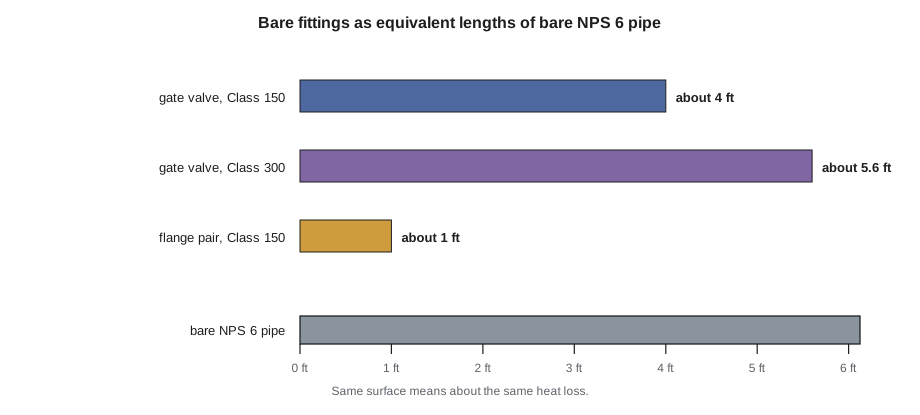
Because the surface is the thing that matters, insulators and engineers often describe a bare fitting by its equivalent length: the length of bare pipe of the same size that has the same outside surface and therefore loses about the same heat. A published example from the insulation industry puts it plainly. A bare NPS 6, Class 150 gate valve has about 7.0 ft² of exposed surface, the same as about 4 ft of bare NPS 6 pipe. A Class 300 valve of the same size, heavier and taller, has about 9.7 ft², the same as about 5.6 ft of pipe.
Worked problem
The surface of a flange pair
A pair of bolted NPS 6 Class 150 flanges has an outside diameter of 11 in, and each flange is about 1 in thick. The pipe is 6.625 in across. Ignoring the bolts and the hubs, how much bare surface do the flanges have, and how long a length of bare NPS 6 pipe has the same surface?
Show solution
- Rim: the outside edge of both flanges, π × 11 × (2 × 1) ≈ 69.1 in², or 69.1 ÷ 144 ≈ 0.48 ft².
- Back faces: two rings between the pipe and the flange edge, 2 × π ÷ 4 × (11² − 6.625²) = 2 × 0.7854 × (121 − 43.89) ≈ 121.1 in², or about 0.84 ft².
- Total: 0.48 + 0.84 ≈ 1.32 ft².
- Bare NPS 6 pipe: π × 6.625 ÷ 12 ≈ 1.73 ft² per foot.
- Equivalent length: 1.32 ÷ 1.73 ≈ 0.76 ft.
Answer: About 1.3 ft², the same as about 0.76 ft of bare pipe. The bolts, nuts and hubs add more, so a bare flange pair on NPS 6 is usually counted as about 1 ft of bare pipe. Every bare flange pair is worth insulating; a long run with a bare flange every few feet can lose a surprising share of its heat at the flanges.
How much heat a bare fitting loses
Equivalent length turns a fitting into a length of pipe, and the heat loss of bare pipe is easy to look up. A heat loss program such as 3E Plus gives it for any size, temperature and air condition. The table below gives approximate values for bare steel pipe at the temperature of the Kellerton high-pressure steam, in still indoor air at 50 °F. They are rounded and are typical of what a program gives for oxidized steel; they are good enough for a survey, not for a design.
| Pipe size | Bare loss at 366 °F, Btu/h per foot |
|---|---|
| NPS 2 | 590 |
| NPS 3 | 850 |
| NPS 4 | 1,080 |
| NPS 6 | 1,534 |
| NPS 8 | 2,000 |
For comparison, the same NPS 6 pipe with 3 in of mineral wool loses about 76 Btu/h per foot, about one twentieth of the bare loss. That ratio is the reason insulation exists. A single bare NPS 6 valve, at about 4 ft equivalent, loses about 4 × 1,534 ≈ 6,140 Btu/h, about as much as 80 ft of the same pipe insulated to the plant's standard.
Worked problem
Devon's survey
Devon's Kellerton survey found these bare items on the 150 psig steam: three NPS 6 gate valves, four NPS 4 gate valves, six NPS 6 flange pairs, eight NPS 4 flange pairs and two NPS 4 strainers. Coldstream's survey sheet uses typical equivalent lengths: NPS 6 valve 4 ft, NPS 4 valve 3 ft, NPS 6 flange pair 1 ft, NPS 4 flange pair 0.8 ft, NPS 4 strainer 2 ft. Using the table, what is the total bare heat loss?
Show solution
- NPS 6 valves: 3 × 4 × 1,534 = 18,408 Btu/h.
- NPS 4 valves: 4 × 3 × 1,080 = 12,960 Btu/h.
- NPS 6 flange pairs: 6 × 1 × 1,534 = 9,204 Btu/h.
- NPS 4 flange pairs: 8 × 0.8 × 1,080 = 6,912 Btu/h.
- NPS 4 strainers: 2 × 2 × 1,080 = 4,320 Btu/h.
- Total: 18,408 + 12,960 + 9,204 + 6,912 + 4,320 = 51,804 Btu/h, about 51,800 Btu/h.
Answer: About 51,800 Btu/h, roughly the output of a large residential furnace, pouring into the boiler house around the clock. The valves alone are more than half of it.
Worked problem
Over a year
Kellerton's steam runs about 8,400 hours a year. If removable covers cut the loss from those items by about 90 in 100, how much heat is saved in a year, and how much fuel does that represent at a boiler efficiency of 80 in 100?
Show solution
- Heat saved: 0.90 × 51,804 ≈ 46,600 Btu/h.
- Per year: 46,600 × 8,400 ≈ 391,600,000 Btu, about 392 million Btu.
- Fuel: 392 ÷ 0.80 = 490 million Btu of natural gas.
- At 100,000 Btu per therm: about 4,900 therms of gas.
Answer: About 392 million Btu of heat a year, or roughly 4,900 therms of natural gas once boiler losses are counted. Lou Brisebois read the number twice and asked for a price on removable covers for everything on the list.
The 90 in 100 figure is typical rather than exact. A well-made removable cover usually gets close to the performance of the permanent insulation on the pipe beside it, but not quite, because of seams, gaps at the stem and the flaps around the bonnet. An industry review of bare valves in steam systems found paybacks measured in months for steam and a few years for hot water; the higher the temperature and the longer the operating hours, the faster a cover pays for itself.
Why fittings are left bare
If bare fittings waste so much energy, why are so many plants full of them? Devon's survey sheet had a column for the reason, and Marcel filled it in from experience as they went:
- Maintenance: a mechanic repacked a valve, replaced a gasket or cleaned a strainer, cut or pulled off the insulation, and nobody put it back. This was the cause for most of the Kellerton items.
- Original design: some specifications, and some older plants, left valves and flanges bare on purpose, so they could be reached and watched for leaks.
- Fear of hiding leaks: operators sometimes want flanges bare so a leak shows. A removable cover with a drain hole or a leak indicator answers that concern better than bare metal.
- Damage: insulation knocked off by traffic, ladders or other trades and never repaired.
- Wrong material: insulation that could not handle the temperature or the moisture, and fell apart.
Most of these reasons come back to one problem: the insulation on a fitting must be removed for the fitting to be maintained, and permanent insulation cannot be removed and replaced without wasting it. That is why this course gives so much attention to removable covers and to building fitting insulation that comes off and goes back on. Kellerton now has a rule, written after the outage: no valve or flange job is closed until the insulation is back or a removable cover has been ordered.
Fittings are where insulation fails first
Heat loss is one reason fittings matter. The other is that fittings are where most insulation systems fail. A straight run of pipe covering with a sealed jacket has few joints. A valve has the joint where the insulation meets the pipe on each side, joints between pieces around the body and bonnet, a gap at the stem and often a removable section. Each joint is a path for heat, for water and, on cold work, for water vapor.
- On hot work, a gap at a fitting lets heat escape and makes a hot spot that can burn someone. Water that gets in through a gap at a fitting can run along the pipe under the insulation and start corrosion under insulation, CUI, which you met in INS-110 when the wet header insulation came off at Kellerton.
- On cold work, a gap at a fitting lets humid air reach a cold surface. Water condenses, then freezes on very cold lines, and the ice or water spreads along the pipe under the vapor retarder. The iced ammonia suction line at Kellerton started at a hanger, but valves and flanges are just as common a starting point.
- On all work, fittings get the most traffic: operators open valves, mechanics change gaskets, inspectors look at flanges. Insulation on a fitting must stand up to handling.
What good fitting insulation does
Good fitting insulation does the same jobs as the pipe insulation beside it and two more. It must:
- Give the same thermal performance as the pipe insulation, which usually means the same thickness, unless the specification says otherwise.
- Protect people from hot surfaces, to the same touch temperature as the pipe.
- Keep the vapor retarder continuous on cold work, with no gaps at any joint.
- Shed water outdoors and in washdown areas, with laps that face down and away from the weather.
- Leave the parts that operators and mechanics need clear: valve stems and handwheels, packing glands, strainer caps and blowdowns, test ports and gauges.
- Come off and go back on without being destroyed, where the fitting will be maintained.
The last two jobs are what make fittings different from pipe. A pipe is insulated once. A valve may be opened up a dozen times in the life of the plant, and every time someone has to take the insulation off and, ideally, put it back. Building fitting insulation with that in mind is a mark of a good insulator.
What the specification says
Most project specifications have a section on fittings. Typical requirements, which you will see in some form on most commercial and industrial jobs, include:
- Fittings, valves and flanges insulated to the same thickness as the adjoining pipe.
- Valves above a certain size, and all flanges on hot service, insulated with removable covers or removable boxes, so they can be maintained.
- On cold service, everything insulated, including valve bodies and bonnets, with the vapor retarder continuous; some specifications call for extended-stem valves so the insulation can be completed around the bonnet.
- Preformed fitting covers allowed on smaller sizes, mitered sections or fabricated covers on larger sizes.
- A list of items to leave bare, such as steam traps of certain types, unions, relief valve outlets and nameplates that must stay readable.
Read this section with care, because it changes from job to job. At Mountview, the specification called for preformed PVC covers on fittings up to NPS 2 and mitered sections with PVC covers on larger sizes, and left valves under NPS 2 on heating water uninsulated but insulated all chilled water valves. At Kellerton, the plant standard calls for removable covers on all steam valves larger than NPS 2. The same valve can be treated three different ways on three different jobs.
Note: ASTM C1129 is the standard practice for estimating the heat saved by insulating bare valves and flanges. You will not need to apply it yourself as an apprentice, but estimators and engineers use it, and its approach is the one in this lesson: work out the surface, estimate the loss, compare bare with insulated.
Common mistakes
MistakeJudging a fitting by how small it looks next to the pipe.
InsteadCount it as an equivalent length of bare pipe; a bare NPS 6 valve is worth about 4 ft of bare pipe.
MistakeLeaving a flange or valve bare because the pipe on each side is insulated.
InsteadInsulate it to the specification, with a removable cover where it will be maintained.
MistakeBuilding fitting insulation that has to be destroyed to service the fitting.
InsteadPlan for access: removable sections, covers and clear stems, glands and caps.
MistakeAssuming every job treats valves the same way.
InsteadRead the fittings section of the specification on every job.
MistakeIgnoring gaps at fittings on cold work because the gap is small.
InsteadSeal every joint; a small gap at a cold fitting can ice a whole run.
Summary and key terms
- A fitting has much more surface than the pipe it replaces, so a bare fitting loses much more heat than its size suggests.
- Equivalent length expresses a bare fitting as the length of bare pipe with the same surface: about 4 ft for a bare NPS 6 Class 150 gate valve.
- Bare heat loss can be estimated from equivalent length and a table of bare pipe losses; insulated pipe loses about one twentieth as much on high-pressure steam.
- Most bare fittings were left bare after maintenance; removable covers solve that problem.
- Fittings are where insulation fails first: gaps let out heat, let in water and, on cold work, let in vapor.
- Good fitting insulation matches the pipe insulation and also leaves operating parts clear and comes off for maintenance.
- Fitting
- Any piping component other than straight pipe, such as an elbow, tee, reducer, valve, flange or strainer.
- Equivalent length
- The length of bare pipe with the same outside surface, and about the same heat loss, as a bare fitting.
- Flange pair
- Two flanges bolted together with a gasket between them.
- Removable cover
- Fitting insulation made to be taken off and put back on for maintenance.
- Survey sheet
- A form for recording bare or damaged insulation on a system, by item, size and location.
- Corrosion under insulation (CUI)
- Corrosion of a pipe or vessel caused by water trapped under insulation.
- ASTM C1129
- The standard practice for estimating heat savings from insulating bare valves and flanges.
Practice problems
Work each problem on paper first, then reveal the answer to check.
What is an equivalent length?
Show answer
The length of bare pipe with the same surface, and about the same heat loss, as a bare fitting.
About how much bare NPS 6 pipe is a bare NPS 6 Class 150 gate valve worth?
Show answer
About 4 ft.
Using the table, what does a bare NPS 4 valve counted as 3 ft lose at 366 °F?
Show answer
3 × 1,080 = 3,240 Btu/h.
Give two reasons fittings are found bare in older plants.
Show answer
Insulation not replaced after maintenance; original design left them bare; damage; wrong material.
Name two jobs fitting insulation must do that straight pipe insulation does not.
Show answer
Leave operating parts clear and come off for maintenance without being destroyed.
Lesson quiz · 5 questions
Score 60% or more to complete this lesson.
Create a free account to save your progress, take quizzes and earn a certificate.