
INS-210 · Lesson 5 of 12 · 23 min
Valve bodies and bonnets
▶ Video coming soon A video version of this lesson is on the way.
In the Mountview penthouse, the heating water mains had NPS 4 butterfly valves with gear operators at every pump and coil connection, and the specification called for them to be insulated in place, permanently, up to the operator mounting plate. Marcel cut the first one himself while Devon watched: an oversized section of covering for the body and flanges, a hole for the valve neck, a short sleeve up the neck, two closing rings cut from board for the ends, all fitted dry before any of it was taped. "Insulate the valve," he said, tapping the gearbox, "not the part a person turns."
Valves are the fittings that people operate. They are opened, closed, throttled, repacked, tested and replaced, and each of those jobs needs a hand, a wrench or a tool on some part of the valve. Insulating a valve means covering the body and bonnet, where the heat or cold is, while leaving clear the parts that operators and mechanics need. This lesson describes the parts of common valves, what is insulated and what is left clear on hot and cold service, and how to build permanent valve insulation from pipe covering and board. Lesson 8 covers preformed covers, and the case study in lesson 12 covers removable blankets on a steam valve station.
The parts of a valve
Most valves share the same main parts, whatever their type:
- Body: the part that holds the pressure and carries the flow, with ends that are flanged, threaded, welded, soldered, grooved or pressed to the pipe.
- Bonnet: the cover on the body that carries the stem. On a gate or globe valve it rises well above the pipe; on a ball or butterfly valve it is a short neck.
- Stem: the shaft that moves the closing element, a gate, disc, ball or plug, from the outside.
- Packing and packing gland: rings of packing around the stem, squeezed by a gland and its nuts so the valve does not leak along the stem. The gland is tightened from time to time and the packing replaced.
- Operator: the handwheel, lever, chain wheel, gearbox or powered actuator that turns the stem.
- Yoke: on an outside screw and yoke (OS&Y) gate or globe valve, the frame above the bonnet that carries the threaded stem and the handwheel. The rising stem shows at a glance whether the valve is open.
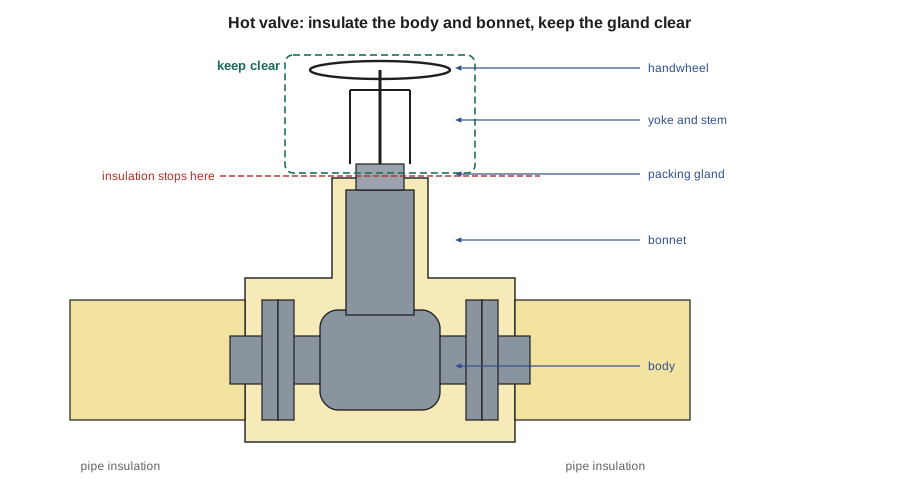
Common valve types and what to watch for
| Valve type | Shape to insulate | Leave clear |
|---|---|---|
| Gate (OS&Y or non-rising stem) | Body, flanges, tall bonnet | Packing gland, stem, yoke, handwheel |
| Globe | Bulbous body, flanges, bonnet | Packing gland, stem, handwheel |
| Ball | Compact body, short neck | Stem, lever or actuator; on cold service use an extended stem |
| Butterfly (wafer or lug) | Thin body between two pipe flanges, neck | Operator plate, gearbox or handle |
| Swing or lift check | Body and cover; no stem | Nameplate and arrow if required; cover bolts on some |
| Control valve | Body and bonnet extension only | Actuator, positioner, yoke and travel indicator |
| Safety relief valve | Inlet piping and body as specified | Bonnet, spring housing, lifting lever and the discharge |
Two kinds of valve need extra care. A control valve's actuator, positioner and the electronics on it are not made to be buried in insulation; heat trapped around them can shorten their life or change how they work. Insulate the body and as much of the bonnet as the maker allows, and leave everything above clear. A safety relief valve must open at its set pressure and discharge freely. Never insulate over its bonnet, spring housing or lifting lever, never block or restrict its discharge or its drain, and never fasten anything to its outlet pipe that could add load to the valve. If you are unsure whether a relief valve should be insulated at all, ask before you start; on many jobs the specification leaves it bare.
Hot service: where the insulation stops
On hot lines, insulate the valve body, the flanges and the bonnet up to a point just below the packing gland. Leaving the gland and stem clear has three purposes. A mechanic can tighten the gland nuts and replace the packing without removing insulation. A leak along the stem shows, instead of soaking into insulation. And the stem and operator stay cool enough to handle; a handwheel at the temperature of high-pressure steam would burn an operator's hand.
A common rule on hot valves is to stop the bonnet insulation about 1 in below the bottom of the gland, but check the specification and the space. On OS&Y gate valves, the yoke and the rising stem must also be clear so the operator can see the valve position and the stem threads do not pick up insulation fibers. Wherever insulation stops on a hot surface, finish its edge neatly with a cap or bead of cement or a metal collar, so the end of the insulation does not crumble and fall into the gland.
Cold service: insulate everything, seal everything
Cold valves are treated the other way round. Every metal surface below the dew point of the surrounding air will sweat, and on very cold lines it will frost and ice. So on chilled water, refrigeration and other cold service, the whole valve is insulated, including the bonnet, and the insulation is carried up the stem as far as possible, with the vapor retarder sealed to the stem or to a boot around it. Bare bonnets on cold valves drip, and the water runs down into the body insulation and along the pipe.
That creates a problem. If the bonnet is insulated, where does the operator go? The answer is the extended-stem valve: a ball or butterfly valve with a stem extension that puts the handle or gearbox above the outside of the insulation. Specifications for chilled water and refrigeration usually call for them, with the extension long enough to clear the full insulation thickness. If a cold valve is installed without one, tell your foreperson before you start; the choice is between a bare bonnet that will sweat and insulation that buries the handle, and neither is acceptable without the engineer's decision.
Worked problem
Is the stem extension long enough?
A ball valve on the Mountview chilled water has its stem extension ending 2 3/4 in above the top of the pipe. The pipe is NPS 2 with 1 1/2 in insulation, and the handle needs at least 1 in clear above the finished insulation to swing. Is the extension long enough?
Show solution
- The valve body is wider than the pipe, so the insulation over the body stands higher than over the pipe. Devon measures the body top 1/2 in above the pipe top.
- Top of the finished insulation over the body: 0.5 + 1.5 = 2 in above the pipe top.
- Clearance to the handle: 2.75 − 2 = 0.75 in.
- Required: 1 in.
Answer: No: the handle would have only 3/4 in. Devon reports it to Marcel, who checks the rest of the penthouse ball valves and finds three more the same. Harcourt Mechanical swaps the extensions for the next length up before the valves are insulated.
Cold valve insulation must also be built so the vapor retarder is continuous: sealed to the pipe jacket on both sides, sealed at every joint between pieces and sealed around the stem. Lesson 10 covers the methods; for now, remember that on cold service a valve is not done until every seam is closed.
Building permanent valve insulation
Permanent valve insulation is built from the same materials as the pipe: pipe covering, board and block, and on cold work, cellular glass or elastomeric. The common method is a fabricated box built from sleeves of oversize pipe covering and closing rings:
- Flange and body sleeve: a section of pipe covering whose bore is just larger than the outside of the flanges and bolts, cut to the length over the nuts plus an overlap onto the pipe insulation at each end.
- End rings: annular rings cut from board or from covering of the right thickness, fitted inside the ends of the sleeve to close the gap down to the pipe insulation.
- Bonnet or neck sleeve: a section of covering sized to the bonnet or neck, fitted through a hole cut in the top of the body sleeve and run up to the stopping point.
- Fill: loose insulation of the same type packed into any voids inside the box, so no air spaces are left around the body.
- Finish: the specified jacket, cover or cement finish over the whole box, sealed on cold work.
Worked problem
Sizing a butterfly valve box
A Mountview NPS 4 lug butterfly valve on heating water measures 6 in over the nuts, with pipe flanges 9 in across. The neck is 2 in across and its operator plate is 10 1/4 in above the pipe centerline. The pipe has 2 in glass fiber, and the box is to be 2 in thick over the flanges with a 2 in overlap onto the pipe insulation at each end. The next covering bore larger than 9 in is the NPS 10 size, about 10 3/4 in. Find the sleeve length and outside diameter, the end ring sizes and the height of neck insulation above the sleeve.
Show solution
- Sleeve length: 6 + 2 × 2 = 10 in.
- Sleeve outside diameter: 10.75 + 2 × 2 = 14.75 in.
- Pipe insulation outside diameter: 4.5 + 2 × 2 = 8.5 in.
- End rings: 10 3/4 in outside, to fit inside the sleeve bore, and 8 1/2 in inside, to close on the pipe insulation; 2 in long, the overlap length.
- Sleeve outside radius: 14.75 ÷ 2 = 7.375 in. Neck insulation height: 10.25 − 7.375 = 2.875 in, less the stopping gap below the plate.
Answer: A 10 in sleeve, 14 3/4 in outside; two end rings 10 3/4 in by 8 1/2 in; and a short NPS 2 sleeve on the neck, about 2 3/8 in tall, stopping about 1/2 in under the operator plate. Inside the sleeve, the gap between the 9 in flanges and the 10 3/4 in bore is packed with loose glass fiber.
On a gate or globe valve, the box is the same idea with a taller bonnet sleeve. Where the body is bulbous, as on a globe valve, cut the body sleeve in two halves and hollow out the inside of each half with a knife or rasp to clear the body, or build up the body with insulating cement before the sleeve goes on. Where two sizes of covering meet, at the top of the body sleeve and the bottom of the bonnet sleeve, scribe the bonnet sleeve to the curve of the body sleeve so the joint is tight, the same way a tee branch is saddled in INS-130.
Valves in awkward places
Valves are not always on a straight, horizontal pipe with room around them. Some common situations:
- Valves close to elbows or tees: plan the valve box and the fitting insulation together so their joints meet cleanly, and avoid a short sliver of pipe covering between them.
- Valves with stems pointing down or sideways: the stopping point is still below the gland, measured along the stem. On cold service, a valve with its stem pointing down is a drip point; tell your foreperson.
- Valves close together in a bank: build one long box across several valves only if the specification allows it and each valve can still be serviced; otherwise box each one separately.
- Valves against a wall or steel: the box may have to be thinner on one side. Record the clearance on the sketch and ask before reducing the thickness.
- Chain-operated valves overhead: keep the chain wheel and chain guide clear and the chain free to run.
Common mistakes
MistakeInsulating over the packing gland on a hot valve.
InsteadStop the insulation below the gland, typically about 1 in, and finish the edge neatly.
MistakeLeaving the bonnet bare on a chilled water valve.
InsteadInsulate the whole cold valve and seal the vapor retarder at the stem.
MistakeInsulating a valve without checking that the handle or lever can move.
InsteadOperate the valve, or watch it operated, before insulating.
MistakeInsulating a control valve actuator or a relief valve bonnet.
InsteadInsulate only the body and allowed bonnet area; leave actuators, springs, levers and discharges clear.
MistakeLeaving voids inside a valve box.
InsteadPack every void with loose insulation of the same type before closing the box.
Summary and key terms
- A valve has a body, bonnet, stem, packing and gland, and an operator; OS&Y valves also have a yoke and rising stem.
- On hot service, insulate the body, flanges and bonnet to just below the packing gland; leave the gland, stem, yoke and operator clear.
- On cold service, insulate the whole valve, carry the insulation up the stem and seal it; extended stems put the handle above the insulation.
- Control valve actuators and safety relief valve bonnets, springs, levers and discharges are left clear.
- A permanent valve box is built from an oversize sleeve, end rings, a bonnet or neck sleeve, packed fill and a finish.
- Check that operators can move freely and that every void is filled before the finish goes on.
- Body
- The pressure-holding part of a valve that carries the flow.
- Operator
- The handwheel, lever, chain wheel, gearbox or actuator that turns a valve stem.
- OS&Y valve
- An outside screw and yoke valve, whose threaded stem rises through a yoke above the bonnet.
- Extended-stem valve
- A valve with a stem extension that places the operator above the insulation.
- Valve box
- Permanent valve insulation built from oversize sleeves, end rings and a bonnet sleeve.
- End ring
- An annular piece that closes the end of an oversize sleeve down to the pipe insulation.
- Actuator
- A powered operator, pneumatic or electric, that moves a valve stem.
Practice problems
Work each problem on paper first, then reveal the answer to check.
Why is the packing gland left clear on a hot valve?
Show answer
So it can be tightened and repacked, leaks show and the stem and operator stay cool enough to handle.
Why is the bonnet insulated on a cold valve?
Show answer
Bare cold metal sweats or ices, and the water soaks the insulation and runs along the pipe.
A box sleeve has a 10 3/4 in bore and 2 in wall. What is its outside diameter?
Show answer
10.75 + 4 = 14.75 in.
Name two parts of a safety relief valve that must not be insulated or blocked.
Show answer
The bonnet or spring housing, the lifting lever and the discharge.
What is packed into the voids inside a valve box?
Show answer
Loose insulation of the same type as the box.
Lesson quiz · 5 questions
Score 60% or more to complete this lesson.
Create a free account to save your progress, take quizzes and earn a certificate.