
INS-210 · Lesson 4 of 12 · 25 min
Reducers and eccentric fittings
▶ Video coming soon A video version of this lesson is on the way.
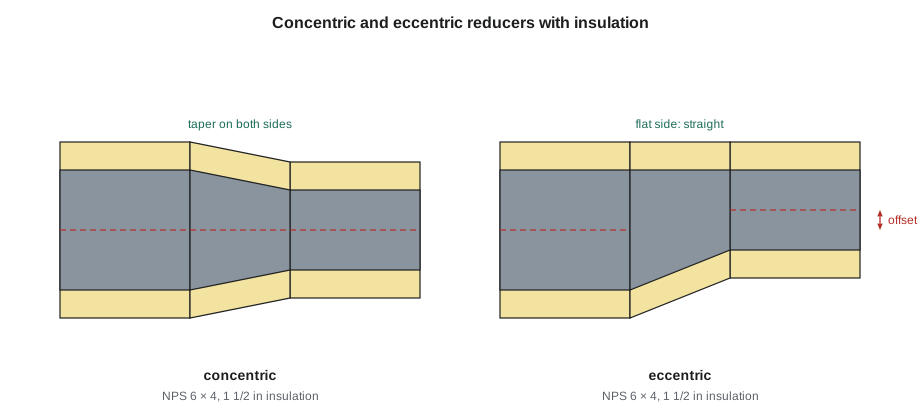
The two chilled water pumps in the Mountview penthouse each had an NPS 6 suction line that dropped to NPS 4 at the pump, through an eccentric reducer with its flat side on top. Marcel's crew had the pump connections, and Bernie lent Devon to them for an afternoon in the last week of October. Devon's first attempt was a plain cone, cut the way he had seen concentric reducers done on the heating water. It sat on the reducer like a party hat on a tilted head: tight on top, a gap you could see daylight through underneath. "It's eccentric," Marcel said. "The pipe drops on one side only. So does the insulation."
A reducer joins two pipes of different sizes. On a hot line, a badly fitted reducer is a short length of thin or missing insulation. On a cold line, like the Mountview chilled water, it is a place where humid air reaches cold metal, and the sweat that forms there will run along the pipe and soak the insulation on each side. This lesson covers the two shapes of reducer, three ways to insulate them, how to lay out a cone pattern for flexible material and how to handle the eccentric fittings that drop on one side only.
Concentric and eccentric reducers
A concentric reducer is a cone: the centerlines of the large and small pipes line up, and the wall tapers evenly all round. Concentric reducers are used where the pipe is vertical or where air or sediment in the line does not matter. An eccentric reducer has one side straight and the other side tapered, so the centerline of the small pipe is offset from the centerline of the large pipe by half the difference in their diameters. Eccentric reducers are installed with the flat side up on pump suctions, so no air pocket forms at the top of the pipe in front of the pump, and with the flat side down on lines that must drain, such as condensate on a pipe rack.
Butt-welded reducers follow ASME B16.9 dimensions; for example, an NPS 6 × 4 reducer is 5 1/2 in long, end to end. Threaded, soldered and grooved reducers are shorter. As with elbows, measure the installed fitting rather than trusting a table, because the reducer may be a different type or may have been joined to other fittings with little or no straight pipe between them.
Three ways to insulate a reducer
Insulators use three methods on reducers, chosen by size, material and specification:
- A tapered piece cut from pipe covering of the large size, with wedges removed along its length so that it closes down to the small size at the small end. This is the common method for fibrous covering on commercial and industrial pipe.
- A cone cut from flexible sheet, board or blanket to a developed pattern, like the gores in lesson 3. This is used for elastomeric sheet, flexible blanket and removable covers, and it is the pattern the shop uses for reducer jacketing in INS-220.
- A preformed reducer cover or insert, where the maker supplies one for the sizes involved, or a build-up of insulating cement over a wrapped insert (lesson 9) on small or awkward reducers.
Whichever method you use, the insulation on the reducer must be the same thickness as on the pipe, must butt tight to the pipe insulation on each side and must keep the jacket or vapor retarder continuous.
The wedge method on a concentric reducer
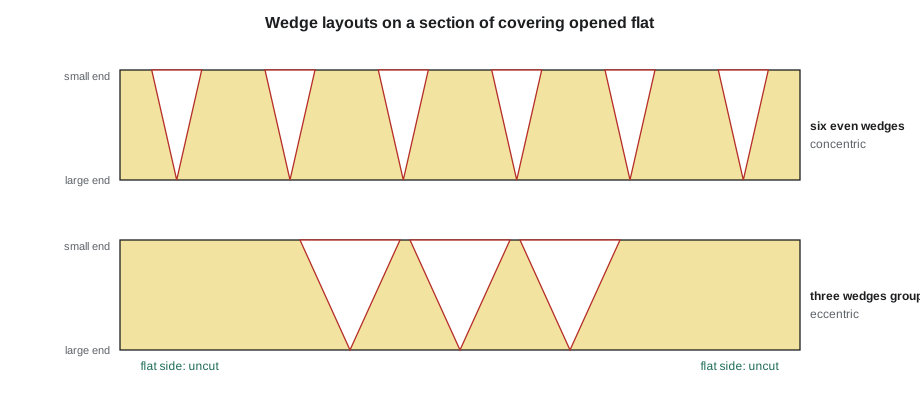
Take a section of pipe covering sized for the large pipe and cut it to the length of the reducer. At the large end, it already fits. At the small end, it is too big around by the difference in circumference between the large and small insulation. Remove that difference as a set of tapered wedges, cut lengthwise, each as wide as its share of the difference at the small end and tapering to nothing at the large end. Then close the section around the reducer: the wedges close up, the covering tapers, and the small end meets the small pipe insulation.
For pipe covering of the same thickness on both pipes, the circumference difference is the same at the bore and at the outside, because both are the difference in pipe diameter times π. That makes the arithmetic simple.
Worked problem
A wedge-cut reducer on chilled water
A concentric NPS 6 × 4 reducer on the Mountview chilled water discharge is 5 1/2 in long. Both pipes have 1 1/2 in glass fiber covering. NPS 6 is 6.625 in across and NPS 4 is 4.5 in. How much circumference must be removed at the small end, and how wide is each of six equal wedges?
Show solution
- Insulation outside diameters: 6.625 + 2 × 1.5 = 9.625 in and 4.5 + 2 × 1.5 = 7.5 in.
- Difference in circumference: π × (9.625 − 7.5) = π × 2.125 ≈ 6.68 in.
- Six wedges: 6.68 ÷ 6 ≈ 1.11 in each, about 1 1/8 in, at the small end, tapering to zero at the large end, 5 1/2 in away.
- At the bore the difference is π × (6.625 − 4.5) = π × 2.125, the same 6.68 in.
Answer: Six wedges, each about 1 1/8 in wide at the small end. Mark them evenly around the section, keeping one clear of the longitudinal seam of the jacket, cut them with a sharp knife through the full thickness, close the section and tape it. On chilled water, every wedge joint and both ends are then sealed under the vapor retarder finish.
More wedges give a smoother taper, but each one is another joint. Four to six is usual for commercial sizes; very short, steep reducers may need the covering cut into two half-cones instead, each tapered and fitted separately.
A cone pattern for flexible material
A concentric reducer covered with flexible sheet, board or a removable blanket is a frustum, a cone with its top cut off. Unrolled, a frustum is a flat ring segment, the shape of a slice of a doughnut: two arcs of different radius, joined by two straight lines that point back toward the apex of the cone. To lay it out you need three numbers: the slant length of the cone, and the two radii of the flat pattern.
Let L be the length of the reducer, and r₁ and r₂ the radii of the cone at its large and small ends. For thick flexible sheet, use the radius at the middle of the sheet, as for gores in lesson 3; for jacketing over insulation, use the outside radius of the insulation. Then:
Here s is the slant length, ρ₁ and ρ₂ are the large and small radii of the flat pattern, and the angle is the angle of the ring segment. Draw two arcs about one center, with radii ρ₁ and ρ₂, mark off the angle and draw the two straight sides toward the center. Add a lap or a glue edge to one straight side if the material needs one.
Worked problem
A cone pattern in elastomeric sheet
Using 1 1/2 in elastomeric sheet on the same NPS 6 × 4 concentric reducer, 5 1/2 in long, find the slant length, the two pattern radii and the angle of the pattern.
Show solution
- Mid-sheet radii: r₁ = 6.625 ÷ 2 + 0.75 = 4.0625 in; r₂ = 4.5 ÷ 2 + 0.75 = 3.0 in.
- d = 4.0625 − 3.0 = 1.0625 in.
- s = √(5.5² + 1.0625²) = √(30.25 + 1.129) ≈ 5.60 in.
- ρ₁ = 5.60 × 4.0625 ÷ 1.0625 ≈ 21.42 in; ρ₂ = 21.42 − 5.60 ≈ 15.82 in.
- Angle = 360 × 4.0625 ÷ 21.42 ≈ 68.3°.
Answer: Strike arcs of 21.42 in and 15.82 in from one center, mark off 68.3° and join the ends with straight lines to the center. Check: the outer arc is 2 × π × 4.0625 ≈ 25.5 in long, the mid-sheet circumference of the large pipe, as it should be.
Large-radius arcs are hard to draw with a compass. A strip of jacket material or a thin batten with a nail at one end and a marker held at the right distance works as a trammel. In the shop, Tomasz keeps a long steel rule with two sliding heads for this.
Eccentric reducers
On an eccentric reducer, the straight side needs no taper at all: the insulation runs straight across from the large pipe to the small pipe. All of the reduction happens on the other side, so the taper on that side is twice as steep as on a concentric reducer of the same sizes.
Worked problem
How steep is the eccentric side?
For the NPS 6 × 4 eccentric pump suction reducer, 5 1/2 in long, with 1 1/2 in covering, how far does the insulation drop on the tapered side, and how does the slope compare with a concentric reducer?
Show solution
- Outside diameters 9.625 in and 7.5 in; difference 2.125 in.
- Concentric: each side drops half, 1.0625 in, over 5.5 in, a slope of arctan(1.0625 ÷ 5.5) ≈ 10.9°.
- Eccentric: the tapered side drops the full 2.125 in over 5.5 in, a slope of arctan(2.125 ÷ 5.5) ≈ 21.1°.
Answer: The tapered side drops 2 1/8 in, about twice as steeply as either side of a concentric reducer. The top, with the pump suction flat side up, runs straight.
With pipe covering, the wedge method still works, but the wedges are grouped on the tapered side instead of spread evenly around. Keep the flat side whole. Cut three or four wedges centered on the side opposite the flat, with their total width at the small end equal to the circumference difference. Close the section with the uncut side along the flat of the reducer. On larger eccentric reducers, it is often easier to build the insulation in two halves: a straight half-section on the flat side and a tapered half on the dropping side, joined at the sides.
Other eccentric and offset fittings
Other fittings put the small pipe off center. A reducing tee or a reducing elbow changes size as well as direction; a swage nipple is a short forged reducer, concentric or eccentric, on small threaded and socket-weld pipe; a bushing reduces inside a fitting and leaves the outside of the fitting unchanged. Each needs the same thinking: where is the outside of the metal, where does the insulation have to go, and how does the jacket close?
- Reducing tees: insulate the run as a tee (INS-130 lesson 7), using the branch saddle for the smaller branch size.
- Reducing elbows: build the elbow at the large size and finish with a short wedge-cut reducer section at the small end, or treat it as an elbow followed by a reducer.
- Swages and bushings on small pipe: usually covered with a preformed cover or a cement build-up, since the change in size is short.
- Pipe that steps up through several reducers in a row, common at pumps and control valves: plan the whole assembly as one piece of work, so joints fall on the pipe and not at the ends of the fittings.
Cold service at reducers
On chilled water, refrigeration and other cold lines, the reducer is a common place for the vapor retarder to fail, because the jacket changes size and every wedge or pattern joint is another seam. Seal every wedge joint with the same vapor retarder tape or mastic used on the straight jacket, overlap the reducer finish onto the jacket on both sides by at least the specified amount, often 2 in, and never leave a void under the insulation at the small end where the covering meets the smaller pipe. Lesson 10 covers cold fittings in more detail.
Common mistakes
MistakeCutting a plain cone for an eccentric reducer.
InsteadFind the flat side first; leave it straight and put all the taper on the opposite side.
MistakeSpreading the wedges evenly on an eccentric reducer.
InsteadGroup the wedges opposite the flat side and leave the flat side uncut.
MistakeUsing the outside radius for a cone cut from thick flexible sheet.
InsteadUse the mid-sheet radius for thick sheet and the outside radius for jacketing.
MistakeLeaving a void at the small end of the reducer.
InsteadButt the reducer insulation tight to the small pipe insulation and fill any gap.
MistakeLeaving wedge joints unsealed on cold work.
InsteadSeal every wedge joint under the vapor retarder and overlap onto the jacket on each side.
Summary and key terms
- A concentric reducer is a cone; an eccentric reducer has one straight side and all its taper on the other.
- Eccentric reducers are installed flat side up on pump suctions and flat side down where lines must drain.
- The wedge method cuts tapered wedges from large-size covering; their total width at the small end equals π times the difference in diameters.
- A frustum pattern needs the slant length s = √(L² + d²), the pattern radii ρ₁ = s r₁ ÷ d and ρ₂ = ρ₁ − s, and the angle 360° × r₁ ÷ ρ₁.
- On eccentric fittings, group the wedges opposite the flat side; the taper is about twice as steep as on a concentric reducer.
- On cold service, seal every joint at the reducer and overlap the finish onto the jacket on both sides.
- Concentric reducer
- A reducer whose large and small ends share one centerline.
- Eccentric reducer
- A reducer with one straight side, so the small end is offset from the large end.
- Frustum
- A cone with its top cut off parallel to its base.
- Slant length
- The length of a cone or frustum measured along its sloping side.
- Wedge method
- Insulating a reducer by removing tapered wedges from a section of large-size covering.
- Swage nipple
- A short forged reducer used on small threaded or socket-weld pipe.
- Trammel
- A beam or strip with a fixed point and a marker, used to draw large arcs.
Practice problems
Work each problem on paper first, then reveal the answer to check.
Why are eccentric reducers installed flat side up on pump suctions?
Show answer
So no air pocket forms at the top of the pipe in front of the pump.
NPS 4 × 3 with 1 in covering: what total wedge width is removed at the small end? (NPS 4 = 4.5 in, NPS 3 = 3.5 in)
Show answer
π × (4.5 − 3.5) = π × 1.0 ≈ 3.14 in.
For L = 5.5 in and d = 1.0625 in, what is the slant length?
Show answer
√(5.5² + 1.0625²) ≈ 5.60 in.
Where are the wedges placed on an eccentric reducer?
Show answer
Grouped on the side opposite the flat side; the flat side is left uncut.
How much steeper is the tapered side of an eccentric reducer than either side of a concentric one of the same sizes?
Show answer
About twice as steep, because it takes the whole drop.
Lesson quiz · 5 questions
Score 60% or more to complete this lesson.
Create a free account to save your progress, take quizzes and earn a certificate.