
INS-210 · Lesson 8 of 12 · 23 min
Pre-formed fitting covers
▶ Video coming soon A video version of this lesson is on the way.
Tomasz kept a cardboard box in the shop labeled "museum," and on the Friday after the outage he tipped part of it out on the bench for the first-year apprentices: a white PVC elbow cover yellowed and cracked from sun, a PVC tee cover that had been made for 1 in insulation and forced over 2 in until it split, an aluminum elbow cover with a dent where a ladder had hit it, a molded glass fiber elbow still in its plastic, and a gray removable blanket with a stainless steel tag stitched to one corner. "Every one of these was the right product somewhere," he said. "Most of them got here because somebody put it in the wrong place."
Preformed fitting covers are fitting insulation or fitting jacketing that is made in a factory or shop, ready to install. They save time, they look neat and, used correctly, they perform as well as anything cut on site. They also have limits: of size, of thickness, of temperature, of weather and of fire rating. This lesson covers the main kinds of preformed fitting covers, how to choose the right size, how to install them so they stay sealed and where each kind should not be used.
PVC fitting covers with fibrous inserts
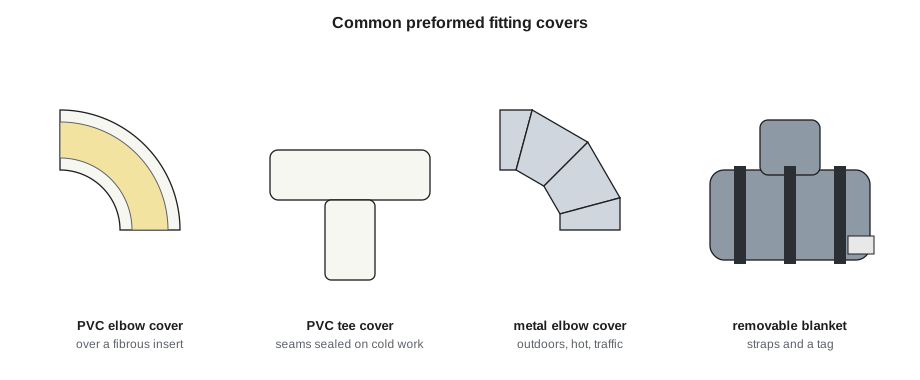
The most common preformed fitting cover on commercial work is a two-piece or one-piece molded PVC shell, used over a precut fibrous insert, usually glass fiber. The insert provides the insulation; the PVC cover provides the finish and, on cold work, part of the vapor retarder. Covers are made for 90° and 45° elbows, tees, end caps, valves and some reducers, in sizes to match pipe size and insulation thickness.
To install a PVC elbow cover:
- Check that the pipe insulation on each side is finished, with its jacket in place, and cut square at the tangent lines of the fitting.
- Wrap the insert around the fitting, filling the space between the insulation ends without voids. Use a second layer of insert where the thickness or the temperature calls for it.
- Close the cover over the insert so its ends overlap the pipe jacket on each side; many covers have a throat and heel seam that snap or lap together.
- Fasten the cover with stainless steel tacks or the maker's fasteners at the seams, or with PVC tape at the ends and seams, or both, as the specification requires.
- On cold service, seal every seam and both ends with PVC adhesive, solvent-weld cement or vapor retarder tape, so the vapor retarder is continuous from the pipe jacket, over the cover and onto the jacket beyond. Tacks alone do not seal; on cold work, any tack that pierces the cover must be sealed over.
Choosing the right size
PVC covers are sized by the pipe size and the insulation thickness they are made to fit. A cover made for NPS 2 with 1 in insulation is the wrong cover for NPS 2 with 1 1/2 in; forced over the thicker insulation, it will split at the seams or stand off the jacket so its ends do not seal. Too large a cover, on the other hand, rattles, sags and leaves voids. The cover's size is about its outside diameter: what matters is that the cover fits over the outside of the pipe insulation.
Where the exact size is not made, insulators match outside diameters instead of labels. A cover made for a larger pipe with thinner insulation may have about the same outside diameter as the size you need, and it can be used over a thicker insert, as long as the maker's charts allow it.
Worked problem
Finding a cover by outside diameter
At Mountview, the NPS 4 heating water branches have 2 in insulation, and the supplier has no PVC elbow covers listed for NPS 4 with 2 in. NPS 4 pipe is 4.5 in across and NPS 6 is 6.625 in. Would a cover listed for NPS 6 with 1 in insulation fit?
Show solution
- Outside diameter needed: 4.5 + 2 × 2 = 8.5 in.
- Outside diameter the NPS 6 × 1 in cover is made for: 6.625 + 2 × 1 = 8.625 in.
- Difference: 8.625 − 8.5 = 0.125 in, a close fit.
- But the elbow is still an NPS 4 elbow: its radius is 6 in, not the 9 in of an NPS 6 elbow.
Answer: The diameters match, but the NPS 6 cover is made for a longer bend. Some makers design their covers to be trimmed or to fit a range of radii, and their charts list which oversize covers fit which pipe sizes and thicknesses. Check the chart; if this combination is not on it, build the elbow from mitered sections and finish it with the specified jacket, as the Mountview specification allows for NPS 3 and up.
Limits of PVC covers
PVC is a plastic, and it has limits that every insulator should know:
- Temperature: the PVC cover must stay below the temperature its maker allows at the cover, often around 150 °F. The insert keeps it cool, so the limit on the pipe temperature depends on the insert thickness. For hotter pipes, the maker calls for a thicker insert or two layers. Never put a PVC cover directly on hot metal.
- Sunlight: ordinary PVC yellows and becomes brittle outdoors. Outdoor fittings get covers made for ultraviolet exposure, or metal covers.
- Fire and smoke: PVC covers for use in buildings are made to meet flame spread and smoke ratings, typically 25 and 50 on the standard tunnel test, but some areas, such as air plenums, may need covers with a specific listing. Check the specification for the area you are working in.
- Cold: PVC becomes brittle in the cold. Store cartons above the maker's minimum temperature before use, and do not try to snap covers closed in an unheated building in winter without warming them.
- Impact: PVC dents and cracks where it is hit. In mechanical rooms with traffic, or near floors and ladders, the specification may call for metal covers or a heavier PVC.
- Chemicals and washdown: in food plants and other washdown areas, covers must stand up to hot water and cleaning chemicals; Kellerton's standard calls for stainless steel jacketing in washdown areas instead.
Metal fitting covers
Metal fitting covers are used outdoors, on hot systems above what PVC allows, where there is impact or traffic and wherever the specification calls for a metal finish. Aluminum covers are made as two-piece pressed or spun elbows for common sizes and as gored sectional elbows for larger sizes; stainless steel covers are used in washdown, corrosive and food areas. The shop at Coldstream makes gored elbow covers to order on its beader and brake, as INS-220 shows. Metal covers go over insulation that is already complete; they are a finish, not insulation.
Metal covers are fastened with bands, screws or rivets as specified, with laps arranged to shed water: the upper piece over the lower, and on an elbow the seams on the side or underside, away from the weather. On hot service, a metal cover must have room to move with the pipe; on cold service, it must not puncture the vapor retarder underneath, so screws are not allowed through the vapor retarder and bands are used instead.
Molded and fabricated insulation fittings
Some fitting insulation is made in one piece to the shape of the fitting:
- Molded glass fiber or mineral wool elbows and tees, made to match pipe covering of the same size and thickness, sometimes with a factory jacket.
- Calcium silicate and perlite elbows, made in segments or as molded halves, for high-temperature systems.
- Cellular glass and polyisocyanurate fittings, fabricated in shops from block to the shape of elbows, tees and valves, used on cold and cryogenic work.
- Elastomeric preformed elbows and tees, made in the same sizes as elastomeric tubing, joined with contact adhesive.
Fabricated fittings made in a shop from block or pipe covering are built to the same standard practice as field-made ones, ASTM C450, with the dimensions of the pipe insulation from ASTM C585. When they arrive, check each one against the fitting it is for before it goes up: right pipe size, right radius, right thickness and right material.
Removable blankets
A removable blanket is a sewn insulation cover: a layer of insulation, usually glass fiber, mineral wool or a high-temperature fiber, between an inner fabric that faces the hot surface and an outer fabric that faces the room, with straps, buckles, lacing hooks or hook-and-loop fasteners to hold it on. Blankets are the usual choice for valves, strainers, flanges, expansion joints and equipment that must be opened often. ASTM C1695 is the standard specification for fabricating flexible removable and reusable blanket insulation for hot service; many specifications refer to it.
Blankets come in two main kinds. Custom blankets are patterned and sewn for each fitting from the measurements on a sketch sheet, like the ones Devon made at Kellerton in lesson 2; they fit best but take time to make. Modular or kit blankets are made in standard shapes and sizes for common fittings, and some kits allow a blanket to be assembled on site from parts. Kit blankets can be installed the same week; custom blankets typically take a few weeks from measurement to delivery.
Whatever the kind, a blanket must be tagged with the item it fits, must close completely with no gaps at the stem and the ends, must overlap the pipe insulation on each side and must be refitted correctly every time it is removed. A blanket left on the floor after a repair is the same as no insulation at all. INS-340 covers the design, patterning and sewing of blankets in detail.
Quantities and handling
Fitting covers are counted, not measured. A takeoff for fittings lists each kind of fitting by size and insulation thickness, then adds the inserts, fasteners, tape and adhesive. Covers come in cartons, and cartons are easy to damage; store them flat, dry and above the maker's minimum temperature, and open them only when needed.
Worked problem
Tape for a set of covers
In the Mountview penthouse, Marcel's crew has 24 PVC elbow covers and 10 PVC tee covers on NPS 2 chilled water with 1 1/2 in insulation. The covers are about 5 1/2 in across at their ends. Each elbow needs PVC vapor retarder tape around both ends and along about 10 in of seam; each tee needs tape around three ends and along about 16 in of seam. With 10 in 100 added for laps and waste, how much tape is needed, and how many 108 ft rolls?
Show solution
- One end: π × 5.5 ≈ 17.3 in.
- Elbow: 2 × 17.3 + 10 = 44.6 in; 24 elbows: 24 × 44.6 ≈ 1,070 in, about 89.1 ft.
- Tee: 3 × 17.3 + 16 = 67.9 in; 10 tees: 679 in, about 56.6 ft.
- Total: 89.1 + 56.6 = 145.7 ft; with 10 in 100 added: 145.7 × 1.1 ≈ 160 ft.
- Rolls: 160 ÷ 108 ≈ 1.5, so 2 rolls.
Answer: About 160 ft, so two rolls. Marcel orders three: on cold work, running out of the right tape halfway through a seal is how unsealed joints get left for the next day.
Choosing between preformed and field-made
On most jobs the specification makes the choice, but where it allows either, a few questions decide it. How many fittings of the same size and thickness are there? A run of identical elbows favors preformed covers or a shop-made batch; a scatter of odd sizes favors field-made fittings. What is the temperature? Above what PVC and its inserts allow, use metal or a fabricated fitting. Will the fitting be opened? Then use a removable cover or blanket, not a cemented or glued fitting. Is it cold? Then choose the method that gives the most reliable seal, which is often a preformed cover with fewer seams, or a fabricated cellular glass fitting with sealed joints. Is it outdoors or in a washdown area? Then the finish must stand up to weather and cleaning. And what will it look like? In a hospital mechanical room or a food plant, neat matching covers are part of what the owner is paying for.
Common mistakes
MistakeForcing a cover made for thinner insulation over thicker insulation.
InsteadUse the cover made for the actual thickness, or an oversize cover from the maker's chart.
MistakePutting a PVC cover straight onto hot metal or with too thin an insert.
InsteadUse the insert thickness or layers the maker requires for the pipe temperature.
MistakeUsing ordinary PVC covers outdoors.
InsteadUse covers made for sunlight, or metal covers.
MistakeRelying on tacks to seal a cold fitting cover.
InsteadSeal every seam and end with adhesive or vapor retarder tape, and seal over any tack.
MistakeScrewing a metal cover through a cold vapor retarder.
InsteadUse bands on cold service so the vapor retarder is not pierced.
MistakeLeaving a removable blanket off after a repair.
InsteadRefit, close and check every blanket after maintenance.
Summary and key terms
- PVC covers over fibrous inserts are the common commercial fitting finish; the insert insulates, the cover finishes and seals.
- Covers are sized to pipe size and insulation thickness; match outside diameters only as the maker's chart allows.
- PVC has limits of temperature, sunlight, fire rating, cold and impact; use thicker inserts, UV-rated or metal covers where needed.
- Metal covers are a finish over complete insulation, lapped to shed water; on cold work they are banded, not screwed.
- Molded and fabricated fittings are made to ASTM C450 with pipe insulation dimensions from ASTM C585.
- Removable blankets, custom or kit, are made to ASTM C1695 for hot service and must be tagged, closed and refitted every time.
- Fitting cover
- A preformed shell, usually PVC or metal, that fits over insulation on a fitting.
- Insert
- Precut fibrous insulation wrapped around a fitting under a PVC cover.
- Oversize cover
- A cover made for a larger pipe with thinner insulation, used where the outside diameters match.
- Removable blanket
- A sewn insulation cover with fasteners, made to be taken off and refitted.
- Kit blanket
- A blanket made in standard shapes and sizes, or assembled on site from parts.
- ASTM C1695
- The standard specification for fabricating removable and reusable blanket insulation for hot service.
- ASTM C585
- The standard practice that sets inner and outer diameters of pipe insulation.
Practice problems
Work each problem on paper first, then reveal the answer to check.
What part of a PVC fitting cover system provides the insulation?
Show answer
The fibrous insert under the cover.
NPS 3 (3.5 in) with 1 1/2 in insulation: what outside diameter must a cover fit?
Show answer
3.5 + 3 = 6.5 in.
Name three limits of PVC covers.
Show answer
Temperature, sunlight, fire rating, cold brittleness, impact, chemicals.
Why are metal covers banded rather than screwed on cold service?
Show answer
Screws would pierce the vapor retarder.
What standard covers removable blankets for hot service?
Show answer
ASTM C1695.
Lesson quiz · 5 questions
Score 60% or more to complete this lesson.
Create a free account to save your progress, take quizzes and earn a certificate.