
INS-110 · Lesson 7 of 12 · 27 min
Hot surfaces, steam and chemical hazards
▶ Video coming soon A video version of this lesson is on the way.
On a Monday in October, Devon was helping Bernie insulate the new steam line to the Mountview sterilizer room when a pipefitter opened a valve upstream to warm the line. Nobody had told the insulation crew. Within a minute the bare pipe a few inches from Devon's glove was too hot to touch, and a gasket at an untightened flange began to hiss. Bernie had both of them off the ladder before the hiss turned into a plume. Later that day, the mechanical contractor's superintendent added a rule to the site: no line would be put in service until the insulation foreperson signed off that the crew was clear.
Insulators work on the systems that are most dangerous to touch: steam lines, hot water, hot oil, process piping, boilers, turbines and exhaust ducts, and on the cold side refrigeration lines carrying ammonia or other refrigerants. They also handle adhesives, mastics, coatings and solvents that can burn, poison or sensitize. This lesson covers burns and hot surfaces, steam and pressure hazards, cold contact injuries, heat stress, the chemicals insulators use and meet, and the hazard communication systems that tell workers about them.
How hot surfaces burn
A burn depends on two things: how hot the surface is and how long the skin touches it. Skin can tolerate a warm surface for a long time, but the time needed to cause a burn drops sharply as the temperature rises. At about 120 °F, hot water takes several minutes to cause a serious burn to adult skin; at about 140 °F, it takes about five seconds; at about 158 °F, about one second. Metal surfaces burn faster than many other materials at the same temperature because metal conducts heat into the skin quickly.
Steam, hot water, heating and process lines run far above these temperatures. A low-pressure steam line at 250 °F or a hot oil line at 480 °F causes a deep burn on contact, and the reflex to pull away often makes a worker lose balance on a ladder or platform. For insulators, a burn is often the start of a fall.
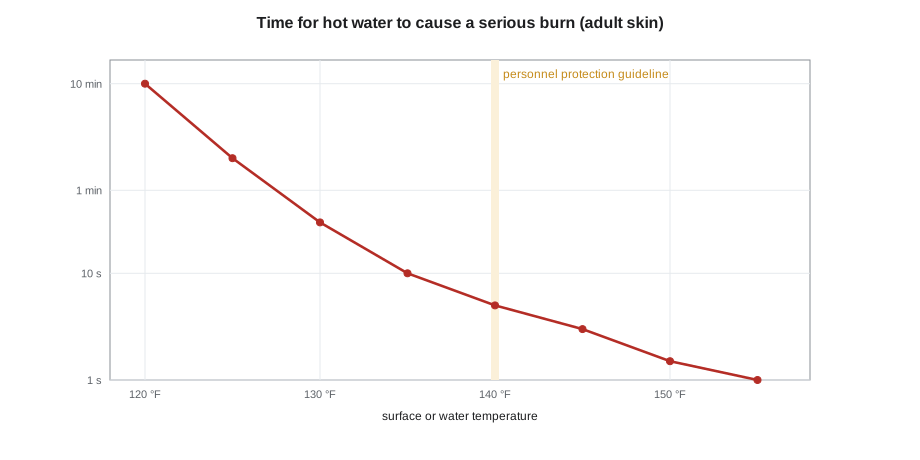
That curve is why personnel protection insulation exists. Industry guidance in ASTM C1055 suggests that surfaces people can touch should generally be kept at or below about 140 °F, a temperature at which an adult can touch a surface for about five seconds before a lasting burn, enough time to pull away. Some owners specify lower targets, such as 120 °F, for extra margin, and jacket material matters: a shiny metal jacket can be cooler to touch than a dark one at the same temperature because it gives up heat differently. The insulation design sets the thickness needed to meet the target, and INS-120 covers how. For an apprentice, the practical point is that insulation which is missing, damaged or wet may no longer protect anyone.
Working on and near hot systems
The safest way to insulate a hot system is with the system cold and isolated. On new construction, insulation is normally installed before the system is started, which is why the Mountview start-up without warning was so dangerous. On maintenance work in plants, lines are often hot and in service, and the job plan must deal with that.
- Know the temperature before you start. Ask, check the line list or permit and, where allowed, measure with a contact thermometer or infrared thermometer. Never test with a bare hand.
- Isolate where possible. If a line must be cold for the work, it is taken out of service and locked out under the plant's lockout procedure, with valves closed, locked and tagged, pressure released and drained, and the isolation verified before work begins. Every worker on the job applies a personal lock or signs onto the group lockout according to the procedure.
- When working near live hot lines, protect yourself from contact with heat-resistant gloves and sleeves, keep clear of flanges, valve packing, steam traps and vents that may leak or discharge, and plan the access so that a slip does not put a hand or face on a hot surface.
- Wait for equipment to cool. Removed insulation and bolts on a line that has just been shut down stay hot for a long time; old insulation holds heat inside.
- Coordinate start-ups. No line should be put in service until the insulation crew is clear and the foreperson agrees. If you hear or feel a line warming unexpectedly, get clear and report it.
Worked problem
Checking whether a surface is safe to touch
Before work on a heating water line at Kellerton, Devon measures surface temperatures with an infrared thermometer: 160 °F on a bare elbow, 109 °F on an old jacket with a torn seam and 84 °F on good jacket. The plant's touch limit is 140 °F. Which surfaces are hazards, and by how much does each exceed or fall below the limit?
Show solution
- Bare elbow: 160 − 140 = 20 °F over the limit. A hazard.
- Torn jacket: 109 − 140 = −31 °F, so 31 °F below the limit. Not a burn hazard on the surface, but the tear may expose hotter insulation or metal underneath.
- Good jacket: 84 − 140 = −56 °F, well below the limit.
- Infrared thermometers read shiny metal surfaces low, because shiny metal emits little infrared; bare steel and aluminum jacket may be hotter than the reading. Devon sets the emissivity on the instrument or uses a contact probe on shiny surfaces.
Answer: Only the bare elbow is over the limit, but every reading on a shiny surface needs care. The elbow gets a temporary guard and goes first on the work list.
Steam: the invisible hazard
Steam is water vapor at or above the boiling point. Saturated steam, the kind found in most heating and process systems, has a temperature fixed by its pressure: the higher the pressure, the hotter it is. A small leak of high-pressure steam is a jet of vapor at well above 212 °F. Near the leak, the steam is clear and invisible; it only turns into the white cloud people call steam a short distance away, as it cools and condenses. A worker can walk into the invisible part of a steam jet before seeing anything.
| Gauge pressure (psig) | Saturated steam temperature (°F) | Typical use |
|---|---|---|
| 0 | 212 | Atmospheric; open vents, condensate tanks |
| 15 | 250 | Low-pressure heating steam |
| 50 | 298 | Medium-pressure building and process steam |
| 100 | 338 | Process steam, sterilizers |
| 150 | 366 | Plant headers such as Kellerton's |
| 250 | 406 | High-pressure process and boiler steam |
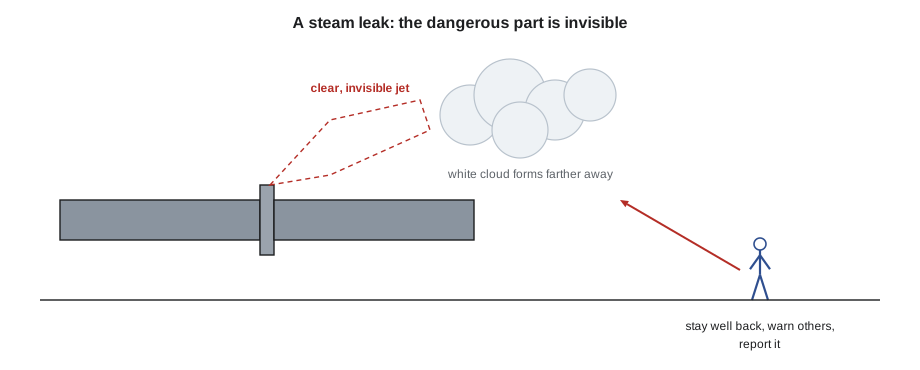
Steam and hot water also carry hazards that do not depend on temperature alone. Condensate under pressure flashes into steam when it escapes, spraying hot water and vapor. Steam traps and drip legs discharge without warning. A line full of steam that is suddenly cooled can collapse or crack, and water trapped in a steam line can be hurled along it as water hammer, which can burst fittings. Insulators are not responsible for operating these systems, but they must recognize the warning signs: hissing, rattling, banging, wet or steaming insulation, rust streaks and drips under jacketing.
If you find a steam leak: do not approach it, do not try to locate it with your hand and do not try to stop it. Move away, warn others, keep them back and report it to your foreperson and the plant operator. Some plants use a broom handle swept slowly ahead to find invisible steam jets from a distance, but that is for trained plant staff, not insulators.
Cold contact and frostbite
Cold systems injure too. Liquid and suction lines in ammonia refrigeration systems, cryogenic lines carrying liquid nitrogen or oxygen and outdoor equipment in winter can freeze skin on contact. Touching a very cold metal surface with a wet or bare hand can freeze the skin to it. Cryogenic liquids at −320 °F and below cause injuries like burns within seconds and make many ordinary materials brittle.
Protection is the same idea as for hot work: know the temperature, keep the system isolated where the work allows, wear insulated gloves and eye protection, keep skin dry and never touch frosted metal bare-handed. Frost on a pipe is a sign that the surface is below freezing and that the insulation, if any, has failed.
Heat stress
Boiler houses, steam tunnels, attics and plant areas near furnaces and ovens are hot, and insulators often work there in coveralls, gloves and respirators that trap body heat. When the body cannot get rid of heat fast enough, a worker develops heat illness. It starts with heat rash and cramps, moves to heat exhaustion, with heavy sweating, weakness, dizziness, headache and nausea, and can become heat stroke, when the body's cooling fails. Heat stroke is a medical emergency: the worker may be confused, collapse or stop sweating, and the body temperature rises to life-threatening levels.
OSHA does not yet have a final heat standard; a proposed heat injury and illness prevention rule was still in rulemaking in 2026. OSHA enforces heat hazards through its general duty clause and a national emphasis program on heat, and expects employers to provide water, rest, shade or cooling and a plan to acclimatize workers. Many plants have their own heat stress programs.
Coldstream's heat plan includes cool water within reach, rest breaks in a cool area that get longer as the heat rises, scheduling the hottest work for the coolest part of the shift, acclimatizing new workers over several days and a buddy system so co-workers watch each other for symptoms. Workers who are new, returning from time off, unwell or not used to the heat are most at risk. If someone shows signs of heat stroke, call for emergency help, move them to a cool place and cool them quickly with water and air movement while waiting.
Chemicals insulators use
Insulation work involves a surprising number of chemical products, each with its own hazards:
- Adhesives, especially solvent-based contact adhesives for elastomeric insulation, give off flammable and harmful vapors. Use them with good ventilation, away from sparks and flames, and keep the containers closed.
- Mastics and coatings for weather protection and vapor retarding may contain solvents, fibers or other ingredients; some are water-based and low-hazard, some are not.
- Sealants and caulks for joints and penetrations.
- Firestop sealants, sprays and mortars for fire separations.
- Cleaning solvents for adhesive and mastic on tools and surfaces.
- Two-part foams and foam-in-place products, some containing isocyanates, which can cause asthma after even one heavy exposure. Isocyanate products need special training, ventilation and respiratory protection.
Read the label and the safety data sheet before using any product for the first time. They tell you the hazards, the PPE, how to use and store it safely, what to do if it gets on your skin or in your eyes and how to deal with a spill.
Chemicals insulators meet
Plants contain chemicals that insulators do not use but may be exposed to: ammonia in refrigeration systems; acids and caustics in process lines and cleaning systems; fuels, solvents and flammable gases; hydrogen sulfide in refineries and wastewater plants; and many process chemicals. These are controlled by the plant's own procedures, alarms and permits. The owner must tell contractors about the hazards present, and insulators must follow the plant's rules.
At Kellerton, the main chemical hazard is ammonia. Ammonia has a strong, sharp smell that most people notice at very low concentrations, well below dangerous levels. The engine room and freezer areas have ammonia detectors and alarms, wind socks outside to show which way to move during a release and posted evacuation routes. Devon's plant orientation drilled the rule: if you smell ammonia strongly or an alarm sounds, stop work, leave by the nearest safe route, moving crosswind and upwind, go to the muster point and report. Do not go back for tools, and never investigate a leak.
Insulation removed from process lines may also be contaminated with the process fluid, such as oil, product or chemicals, which changes the PPE and disposal needed. Ask before handling it.
Hazard communication: labels, data sheets and training
In the United States, hazard communication follows OSHA's Hazard Communication Standard, 29 CFR 1910.1200, which also applies to construction. It requires chemical manufacturers to classify hazards and provide labels and safety data sheets, and employers to keep safety data sheets available, label containers and train workers. OSHA updated the standard in 2024 to align with a newer revision of the Globally Harmonized System, then extended the compliance dates in early 2026: manufacturers and importers had until May 19, 2026 to update safety data sheets for substances, and employers have until November 20, 2026 to update workplace labels, their written program and training for them.
Both systems use the same building blocks:
- Supplier labels with a product identifier, pictograms, a signal word (Danger or the less serious Warning), hazard statements, precautionary statements and supplier information.
- Workplace labels on containers that products are transferred into, such as a pail of mastic decanted from a drum. They must show the product name, safe handling information and a reference to the safety data sheet.
- Safety data sheets with 16 sections in a standard order, including hazard identification, first aid, firefighting, spill response, handling and storage, exposure controls and PPE, and physical and chemical properties.
- Pictograms in a red diamond for physical, health and environmental hazards, such as flame, skull and crossbones, corrosion, exclamation mark and health hazard.
| SDS section | What it tells an insulator |
|---|---|
| 2 Hazard identification | What the product can do to you, with pictograms and signal word |
| 4 First-aid measures | What to do for skin, eye, breathing or swallowing exposure |
| 5 Firefighting measures | Whether it burns and how to put out a fire |
| 6 Accidental release measures | How to clean up a spill safely |
| 7 Handling and storage | Ventilation, temperature limits, keeping away from heat and sparks |
| 8 Exposure controls and personal protection | Exposure limits, ventilation and the right gloves, eye protection and respirator |
| 9 Physical and chemical properties | Flash point, vapor pressure, solvent content |
| 11 Toxicological information | Short- and long-term health effects |
Worked problem
Using the flash point
A contact adhesive's safety data sheet lists a flash point of 0 °F. A water-based mastic lists none, and a solvent cleaner lists 110 °F. The boiler house at Kellerton is about 95 °F near the boilers. Which products can give off enough vapor to ignite at that temperature?
Show solution
- The flash point is the lowest temperature at which a liquid gives off enough vapor to form an ignitable mixture with air.
- Adhesive: 0 °F is far below 95 °F, so it gives off ignitable vapor at room temperature and well below. Highly flammable.
- Solvent cleaner: 110 °F is above 95 °F, so at 95 °F it is not quite at its flash point. But a container warmed on or near a hot pipe could easily pass 110 °F.
- Water-based mastic: no flash point listed, so it is not a flammable liquid in normal use.
Answer: The adhesive is a fire hazard anywhere near ignition sources and needs a hot-work check; the cleaner becomes one if it is warmed. Keep both away from hot pipes, burners and sparks, and keep lids on.
Hot work and fire
Hot work means any work that produces flames, sparks or enough heat to ignite materials: welding, cutting, brazing, soldering, grinding and torch work. Insulators rarely weld, but they grind and cut bands and metal, they work beside welders and pipefitters, and many insulation materials, facings, adhesives and coatings can burn. Fires in insulation can smolder unseen inside a jacket for hours.
Plants and most sites control hot work with a permit system. Before hot work, a competent person checks the area, removes or protects combustibles within a set distance (often about 35 ft), checks for flammable vapors, arranges a fire extinguisher and sets a fire watch. The fire watch stays during the work and for a period afterward to catch smoldering fires: at least 30 minutes under many rules, and 60 minutes under current NFPA 51B guidance and many plant permits. Insulators must not apply flammable adhesives where hot work is happening and must tell the hot-work crew about combustible insulation nearby.
Common mistakes
MistakeTesting pipe temperature with a bare hand.
InsteadAsk, check the permit and measure with a thermometer; wear heat-resistant gloves near hot lines.
MistakeWalking toward a steam cloud to find the leak.
InsteadThe jet near the leak is invisible. Stay back, warn others and report it.
MistakeAssuming a new line is cold because it is new.
InsteadLines can be started without warning; confirm with the foreperson and lockout before work.
MistakeIgnoring early signs of heat illness.
InsteadStop, cool down and drink water; treat confusion or collapse as an emergency.
MistakeLeaving adhesive containers open near hot pipes or hot work.
InsteadKeep lids on and keep flammable products away from heat, sparks and flames.
MistakeGoing back for tools during an ammonia alarm.
InsteadLeave crosswind and upwind to the muster point immediately.
Summary and key terms
- Burn risk depends on surface temperature and contact time; burn time drops sharply above about 140 °F.
- Personnel protection insulation keeps touchable surfaces at about 140 °F or lower.
- Know the temperature, isolate and lock out where possible, and coordinate start-ups so lines are not put in service while insulators are on them.
- Steam temperature rises with pressure, and the jet near a leak is invisible.
- Cold lines cause frostbite; frost on a pipe means the insulation has failed.
- Heat stress can become heat stroke; use water, rest, cooling, acclimatization and a buddy system.
- HazCom labels, safety data sheets and training tell workers how to handle hazardous chemicals safely.
- Hot work needs a permit, protection of combustibles and a fire watch afterward.
- Personnel protection
- Insulation that keeps a hot surface cool enough to touch briefly without a lasting burn.
- Saturated steam
- Steam in contact with water at the boiling temperature for its pressure.
- Lockout
- Isolating energy sources with locks and tags so equipment or lines cannot be started or opened during work.
- Heat stroke
- A life-threatening failure of the body's cooling system caused by heat.
- Safety data sheet
- A 16-section document from the supplier describing a product's hazards and safe use.
- Flash point
- The lowest temperature at which a liquid gives off enough vapor to ignite in air.
- Hot work
- Work that produces flames, sparks or heat that can ignite materials, such as welding, cutting and grinding.
- Fire watch
- A person assigned to watch for fires during and after hot work.
Practice problems
Work each problem on paper first, then reveal the answer to check.
About how long does it take hot water at 140 °F to cause a serious burn to adult skin?
Show answer
About five seconds.
What is the saturated steam temperature at about 100 psig?
Show answer
About 338 °F.
Name three signs of heat exhaustion.
Show answer
Any three of: heavy sweating, weakness, dizziness, headache, nausea, cramps.
What does the SDS section on exposure controls and personal protection tell you?
Show answer
Exposure limits, ventilation and the right gloves, eye protection and respirator.
A solvent's flash point is 100 °F and a pipe surface is 160 °F. Is a container on the pipe a hazard?
Show answer
Yes; the liquid will warm above its flash point and give off ignitable vapor.
Lesson quiz · 5 questions
Score 60% or more to complete this lesson.
Create a free account to save your progress, take quizzes and earn a certificate.