
INS-110 · Lesson 11 of 12 · 26 min
Working with other trades
▶ Video coming soon A video version of this lesson is on the way.
In the second week of October, Devon arrived at the Mountview third floor to find that the drywallers had boarded the corridor ceiling overnight, closing in 65 ft of chilled water main that Coldstream had not yet insulated. The general contractor's schedule showed insulation done on that floor by the previous Friday; Coldstream's crew had been held back because the pipefitters had not finished their pressure test. Nobody had told the drywallers. Two days and a lot of ceiling board later, the general contractor added a sign-off sheet to every ceiling area: mechanical, electrical, sprinkler and insulation all had to initial it before the ceiling could close.
Insulators never work alone. Their work comes after the pipefitters, plumbers, sheet metal workers, electricians and sprinkler fitters have installed and tested their systems, and before the drywallers, ceiling installers and painters close and finish the spaces. In plants, they work beside operators, millwrights, boilermakers, welders, scaffolders and the owner's maintenance staff. This lesson explains the sequence of work around insulation, what insulators need from other trades and what other trades need from them, and how to communicate and settle problems on a shared site.
Where insulation fits in the sequence
Insulation is one of the last mechanical activities in an area and one of the first things that must be finished before the area can be closed. That puts insulators in the middle of the schedule, often squeezed between trades that are late and trades that want to start.
- Piping and ductwork are installed, supported and connected by the pipefitters, plumbers and sheet metal workers.
- Systems are pressure tested or leak tested. Specifications usually require piping to pass its pressure test before it is insulated, because a leak hidden under insulation is hard to find and wets the insulation. Some specifications allow straight pipe to be insulated before testing with the joints left bare until the test is passed.
- Heat tracing, where needed, is installed by electricians or tracing specialists and tested before insulation goes over it.
- Insulation is installed, then inspected by the foreperson, the mechanical contractor and often the engineer or owner's representative.
- Jackets, pipe markers, valve tags and labels are completed.
- Ceilings, walls and shafts are closed, and painters finish exposed work where specified.
On a busy job, these steps overlap: one floor may be under test while the floor below is being insulated and the floor above is still being piped. The general contractor's schedule and a weekly look-ahead show where each trade will be. The insulation foreperson attends coordination meetings to make sure the crew is not booked into areas that are not ready, and to warn other trades when the crew needs an area left open.
What insulators need from other trades
Insulators can only do good work on systems that are ready for them. Before starting an area, Bernie checks the list:
- Piping and ductwork complete, supported and tested, with test records signed off.
- Hangers and supports in place, with enough clearance for the insulation thickness. Pipes too close to walls, other pipes, ducts or structure cannot be insulated properly.
- Surfaces clean and dry. Insulation should not go on wet, oily, rusty or dirty pipe; cold lines in particular must be dry when insulated, or the trapped moisture causes corrosion and ice.
- Heat tracing installed, tested and approved by the electrician, with junction boxes and controllers located so they do not interfere with the insulation.
- Gauges, thermometer wells, test ports, unions, valves that need access and equipment nameplates identified, so they can be left accessible or covered with removable insulation.
- Lockouts in place where the work requires an isolated system, and the system owner's agreement that the system will not be started while insulators are on it.
Clearance problems are the most common. A cold line that runs too close to a wall cannot get its full insulation and vapor retarder, so it will sweat. A steam line too close to another line cannot be jacketed. The time to raise clearance problems is before the insulation goes on, through the foreperson, not after.
Worked problem
Checking clearance for insulation
A NPS 3 chilled water line (3.500 in OD) must get 1 1/2 in of insulation and an aluminum jacket. It runs parallel to a wall with only 1 5/8 in between the pipe surface and the wall. How much clearance is needed, and how short is the space?
Show solution
- Needed: insulation thickness 1 1/2 in plus about 1/16 in for the jacket and laps ≈ 1 9/16 in, just to fit.
- Practical clearance to work: an insulator also needs room to fit the section, seal the laps and band the jacket, about 1 in or more beyond the finished surface.
- Total for practical work ≈ 1 9/16 + 1 = 2 9/16 in.
- Available: 1 5/8 in. Short by about 2 9/16 − 1 5/8 = 15/16 in.
Answer: The insulation might just fit, but it could not be sealed properly against the wall. Bernie reports it, and the pipefitters move the line off the wall on new hangers before Coldstream insulates it.
Hangers, supports and cold lines
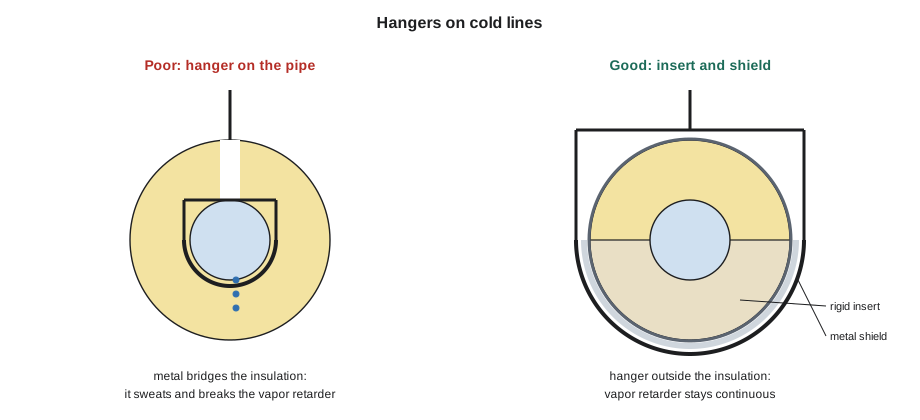
Hangers and supports are installed by the pipefitters, but they matter a great deal to insulators, especially on cold lines. If a hanger clamps directly on a chilled water pipe and the insulation is cut around it, the hanger becomes a thermal bridge: the metal conducts heat into the pipe, the hanger sweats and drips and the vapor retarder is broken. Good practice is for the hanger to go around the outside of the insulation, with an insulation insert (a rigid, high-strength block or section) at the hanger to carry the weight and a metal shield around the insert to spread the load so the insulation is not crushed.
Who supplies and installs inserts and shields varies by specification and by local custom; often the insulation contractor supplies the inserts and the pipefitter installs the hangers sized to fit over them, which means the two trades must agree on the sizes and timing before the pipe is hung. When this is not worked out early, pipe is hung directly on hangers and the insulators must later lift the pipe, insert the blocks and refit the hangers, or leave a poor detail. Coordination at the start of the job prevents that.
Worked problem
Counting hanger inserts and shields
A 160 ft straight run of NPS 3 chilled water main at Mountview hangs on clevis hangers spaced at 10 ft, with a hanger at each end. Each hanger needs one insert and one shield. How many of each should be ordered, with 2 spares?
Show solution
- Spaces between hangers = 160 ÷ 10 = 16.
- Hangers = spaces + 1 = 17.
- With 2 spares: 17 + 2 = 19 inserts and 19 shields.
Answer: 19 of each. The pipefitters need the insert size before they buy the hangers, so Raj sends them the insert dimensions the first week of the job.
Working with electricians and heat tracing
Electric heat tracing cables run along pipes under the insulation to keep them from freezing or to hold process temperatures. The electrician or tracing contractor installs and tests the cable; the insulator covers it. The two trades depend on each other:
- The insulator must know where tracing is, so the insulation is sized to fit over pipe and cable together (often the next pipe size up, or an oversized section) and so no screws, staples or pins pierce the cable.
- The electrician tests the cable's insulation resistance before the insulation goes on, and again afterward, to prove it was not damaged.
- Labels saying "electric traced" go on the outside of the jacket at regular spacing, so later workers know a live cable is underneath.
- Junction boxes, end seals and controllers pass through the insulation and jacket and must be sealed so water cannot get in.
Insulators do not connect, disconnect or repair electrical equipment, and should never work near exposed live parts. If heat tracing is energized and the work could damage it, it must be isolated and locked out by the electrician first.
Worked problem
Choosing an oversized section for traced pipe
An NPS 2 condensate line (2.375 in OD) at Kellerton has one heat tracing cable about 3/8 in thick along its bottom. A standard NPS 2 section fits 2.375 in; the next size up, NPS 2 1/2, fits 2.875 in. Will the next size up fit over the pipe and cable?
Show solution
- The pipe and cable together need about 2.375 + 0.375 = 2.750 in across in the direction of the cable.
- The NPS 2 1/2 section bore is 2.875 in, which is 2.875 − 2.750 = 0.125 in more than needed.
- So the NPS 2 1/2 section fits over the pipe and cable, with a small gap on the side away from the cable.
- The specification may allow this or call for a specific oversize; Bernie checks before ordering.
Answer: Yes, the next size up fits. Using the right section, rather than forcing a tight one over the cable, protects the cable and keeps the insulation from splitting.
Leaving access and identification
Insulation hides the systems it covers, which is good for energy and appearance but bad for anyone who later needs to read a gauge, open a union, check a nameplate or service a valve. Specifications usually say what must stay accessible. Typical items are equipment nameplates and data plates, pressure and temperature test ports, gauges and thermometers, unions and flanged joints that need removal for service, cleanouts, strainer screens, steam traps and valve operators. Larger valves, flanges and strainers on hot and cold systems often get removable, reusable insulation covers so the insulation can come off and go back on without being destroyed.
Pipe identification, with markers showing the contents and flow direction, is often applied by insulators on top of finished jacket, although painters or others may do it on some jobs. In the United States, pipe identification commonly follows ASME A13.1, and the specification sets the colors, lettering and spacing.
Inspections and protecting finished work
Before ceilings close, insulation is inspected. On commercial jobs this may be by the mechanical contractor, the engineer and sometimes a commissioning agent; in plants, by the owner's inspector. Inspectors look for the right material and thickness, complete coverage of fittings and valves, sealed vapor retarders on cold work, correct jacket laps, secure bands and clean, neat appearance. Deficiencies go on a list, and the crew fixes them before the area is accepted.
Finished insulation is easily damaged by other trades: ladders leaned against jacketed pipe, conduit strapped to insulation, other pipes run on top of it, workers standing on it to reach the ceiling. Damage to a vapor retarder on a cold line can cause condensation and ice months later. Protect finished work where possible, report damage promptly with photos and the location, and repair it properly rather than taping over a torn vapor retarder. Insulators must also respect other trades' work: do not lean ladders on sprinkler pipe, hang material from conduit or disconnect anything to make room.
Communication on a shared site
Good relations between trades make everyone's work easier. A few habits help:
- Talk through the foreperson about scope, schedule and changes. Apprentices can be friendly with other trades and should be, but instructions about the work come through the chain of command.
- Speak up immediately about safety hazards, whoever created them. Anyone may stop work they believe is unsafe.
- Be specific when reporting problems: location (floor, grid line, room number), the system, what is wrong and a photo.
- Keep to agreed areas and times, especially in shared spaces such as mechanical rooms and ceiling spaces.
- Clean up your own waste so other trades are not working in it.
- Respect permits and lockouts: never remove another worker's lock or tag, and never work under another trade's permit without being signed on.
In the United States, workers have the right to raise safety concerns, to refuse in good faith to do work that poses an imminent danger of death or serious injury when there is no time to have the hazard corrected through normal channels, and to file complaints with OSHA without retaliation. Many sites have safety committees and stop-work authority programs that give every worker the right to stop unsafe work.
| Trade | What insulators need from them | What they need from insulators |
|---|---|---|
| Pipefitters and plumbers | Tested, supported piping with clearance; hanger sizes for inserts | Insert sizes early; no damage to piping; access left at unions and test ports |
| Sheet metal workers | Sealed, tested ductwork with clearance; access doors located | Duct insulation that does not block access doors, dampers or test holes |
| Electricians and tracing contractors | Tested heat tracing; isolation of live equipment | No damage to cables; labels on traced lines; sealed penetrations |
| Sprinkler fitters | Sprinkler piping not run on top of insulated lines | No ladders or loads on sprinkler pipe |
| Drywallers and ceiling installers | Ceilings left open until insulation is accepted | Timely completion and sign-off of each area |
| Scaffolders | Safe, tagged scaffolds where needed | No alterations to scaffolds; report damage |
Common mistakes
MistakeInsulating piping before its pressure test is passed.
InsteadWait for signed test results, or leave joints bare if the specification allows.
MistakeCutting insulation around a hanger on a cold line.
InsteadUse an insulation insert and shield so the vapor retarder stays continuous.
MistakeDriving screws or staples through heat tracing.
InsteadKnow where the tracing is, use oversized sections and keep fasteners away from the cable.
MistakeInsulating over nameplates, test ports and unions.
InsteadLeave them accessible or use removable covers as the specification requires.
MistakeTaping over a torn vapor retarder damaged by another trade.
InsteadReport it with a photo and repair it properly.
MistakeTaking scope instructions directly from another trade's foreperson.
InsteadPass it through your foreperson; respond immediately only to safety concerns.
Summary and key terms
- Insulation follows installation, testing and heat tracing, and comes before ceilings and walls close.
- Insulators need tested, supported, clean and dry systems with clearance for the insulation.
- On cold lines, hangers go outside the insulation with an insert and shield; agree insert sizes with the pipefitters early.
- Heat tracing is tested before and after insulation; insulators protect cables and label traced lines.
- Leave nameplates, test ports, unions and serviceable items accessible or use removable covers.
- Inspections catch deficiencies before areas close; protect and repair finished work properly.
- Communicate through the foreperson, report problems specifically and speak up about safety.
- Pressure test
- A test of piping under pressure to prove it does not leak before it is insulated or concealed.
- Heat tracing
- Electric cable or small steam tubing along a pipe, under the insulation, that adds heat.
- Insulation insert
- A rigid, high-strength insulation block at a hanger that carries the pipe's weight.
- Hanger shield
- A curved sheet metal piece around the insulation at a hanger that spreads the load.
- Thermal bridge
- A path of high conductivity, such as a metal hanger, that lets heat bypass the insulation.
- Removable cover
- A reusable insulation blanket or box that can be taken off for service and put back.
- Look-ahead schedule
- A short-term schedule showing what each trade will do over the next few weeks.
Practice problems
Work each problem on paper first, then reveal the answer to check.
Why is piping usually pressure tested before it is insulated?
Show answer
A leak under insulation is hard to find and wets the insulation.
A 100 ft run has hangers every 8 ft including both ends, with the last space shorter. How many hangers are there?
Show answer
100 ÷ 8 = 12.5, so 13 spaces and 14 hangers.
Why should a hanger not clamp directly on a chilled water pipe under the insulation?
Show answer
It becomes a thermal bridge that sweats and breaks the vapor retarder.
Who tests heat tracing before and after insulation?
Show answer
The electrician or tracing contractor.
Name three items that should stay accessible after insulation.
Show answer
Any three of: nameplates, test ports, gauges and thermometers, unions, cleanouts, strainers, steam traps, valve operators.
Lesson quiz · 5 questions
Score 60% or more to complete this lesson.
Create a free account to save your progress, take quizzes and earn a certificate.