
INS-110 · Lesson 10 of 12 · 26 min
Job site organization and material handling
▶ Video coming soon A video version of this lesson is on the way.
The first big delivery to Mountview arrived on a flatbed at 7:00 on a Wednesday: 36 skids of pipe insulation, duct wrap, fitting covers, jacket rolls and cases of adhesive and mastic. The general contractor gave Coldstream a corner of the parking structure as a laydown area and one hour before the concrete trucks arrived. Devon, the only person on the crew with a forklift ticket, spent the morning on a borrowed telehandler while Bernie checked every skid against the packing slip and Tessa marked where each one went. By noon, everything was under cover, off the ground and labeled by floor. "Half of this trade is getting the right material to the right place, dry," Bernie said. "The other half is insulating it."
Insulation materials are bulky, light for their size, easily damaged and ruined by water. Metal jacketing is heavy, sharp and slippery. Adhesives and mastics are hazardous products with storage rules. A well-organized job site keeps all of these safe and in good condition, keeps the crew productive and keeps everyone else on site safe from the crew's work. This lesson covers receiving and storing material, moving it safely by hand and by machine, housekeeping and waste, and the daily routines that hold a job together.
Planning the work area
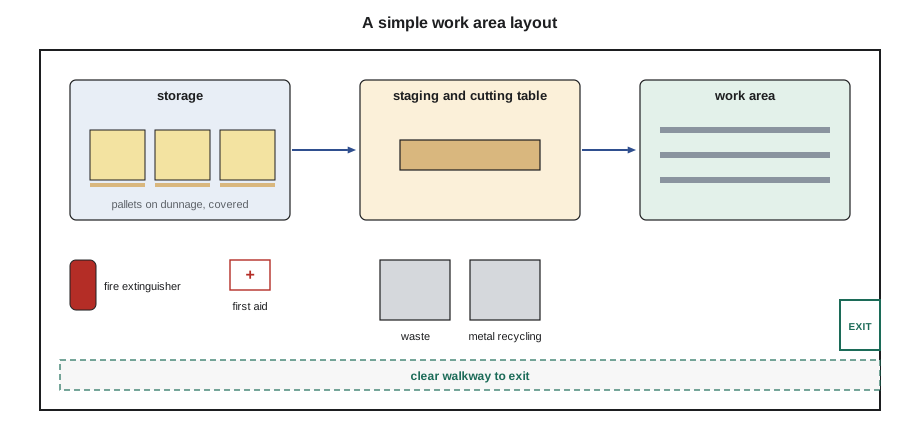
Every job begins with a plan for where things will go. On a construction site, the general contractor assigns laydown areas, storage rooms and access routes; in a plant, the owner does. The insulation foreperson then decides how to use the space: where bulk material is stored, where the crew's gang box and cutting table go, where waste is collected and how material moves from storage to the work face.
Good layouts share some features. Bulk storage is dry, secure and close to a hoist or elevator, but not in anyone's path. A cutting and staging area sits close to the work, with enough room to cut long sections safely and a clean surface so insulation is not contaminated. Waste bins are near the work so scraps go straight into them. Fire extinguishers, first aid kits and eyewash are marked and reachable. Walkways and exits stay clear. On a multi-story building, the crew stages material floor by floor, moving only what is needed for the next day or two to each floor.
Receiving material
Mistakes found at delivery are cheap to fix; mistakes found when the material is on the pipe are expensive. Receiving material well means:
- Checking each delivery against the packing slip and purchase order: product, size, thickness, quantity and pipe type (iron pipe size or copper tube size).
- Checking that products match the accepted submittals and that labels show the product name, the standard it meets and the fire ratings.
- Inspecting for damage: crushed cartons, torn jackets, wet or water-stained packaging, dented jacket rolls and cracked rigid sections.
- Noting shortages and damage on the delivery slip before signing it, and photographing damage. Once a slip is signed clean, claims are much harder.
- Checking shelf life and storage temperatures for adhesives, mastics and sealants, which can be spoiled by freezing or by age.
- Making sure safety data sheets for any new hazardous products are on site and the workers using them are trained.
Worked problem
Checking a delivery
The packing slip for a Mountview delivery lists 40 cartons of NPS 2 × 1 1/2 in sections at 12 sections per carton. Tessa counts 38 cartons, two of them crushed with 3 damaged sections each. How many usable sections arrived, and how many are short of the order?
Show solution
- Ordered: 40 × 12 = 480 sections.
- Arrived: 38 × 12 = 456 sections.
- Damaged: 2 × 3 = 6 sections.
- Usable: 456 − 6 = 450 sections.
- Short of the order: 480 − 450 = 30 sections (24 missing and 6 damaged).
Answer: 450 usable sections, 30 short. Bernie notes "2 cartons short, 6 sections damaged, photos taken" on the slip before signing, and Raj orders replacements the same day.
Storing material
Water is the enemy of insulation. Wet fibrous insulation loses most of its insulating value, may never dry out fully, can grow mold and can corrode the pipe it is on. Calcium silicate and some other rigid products are weakened by water. Factory-applied jackets stain and delaminate. Most specifications require wet insulation to be removed from site.
- Store insulation indoors where possible. Outdoors, store it off the ground on pallets or dunnage and cover it with waterproof tarps secured against wind, with the bottom open enough for air to circulate.
- Keep material off concrete floors that may get wet from cleaning, rain blowing in or leaks; use pallets even indoors.
- Protect material from damage: do not stack heavy items on cartons, and keep rigid insulation where it will not be knocked.
- Keep material clean. Dust, drywall mud, paint overspray and oil on insulation or jackets can spoil the appearance and the performance.
- Store adhesives, mastics and solvents in a ventilated area away from heat and ignition sources, in closed containers, within the temperature limits on the labels, and in a flammables cabinet where required.
- Store metal jacketing flat or on racks, with edges protected, and keep aluminum away from wet cement, lime and other alkaline materials that corrode it.
- Keep stored material stable. Stack cartons squarely and not too high, lean sheets securely and block rolls so they cannot roll.
Material storage also has to respect the building. Loads stacked on suspended floors can exceed their capacity; ask before placing heavy pallets of jacketing on upper floors. Material must never block exits, fire extinguishers, electrical panels, sprinkler valves or eyewash stations.
| Material | Main storage concern | Typical requirement |
|---|---|---|
| Fibrous pipe, duct and board insulation | Water, crushing, dirt | Indoors or covered, off the ground, not stacked under heavy items |
| Rigid insulation (calcium silicate, cellular glass, perlite) | Breakage, water | Protected from impact, dry, handled carefully |
| Elastomeric insulation | Sunlight, heat, crushing | Indoors, out of direct sun, not compressed |
| Metal jacketing | Sharp edges, corrosion, denting | Flat or racked, dry, edges protected, away from alkaline materials |
| Adhesives, mastics, solvents | Fire, freezing, shelf life | Ventilated, away from heat and ignition, within label temperature limits |
| PVC fitting covers and jacket | Heat, crushing | Out of direct sun and heat, boxed |
Manual handling
Insulators lift, carry, push and reach all day. Most cartons of insulation are light, but they are bulky, catch the wind and block the view. Jacket rolls, cases of mastic and drums of adhesive are heavy. Musculoskeletal injuries, the strains and sprains of the back, shoulders and wrists, are among the most common injuries in construction. Most are caused not by one heavy lift but by many awkward ones.
There is no single legal weight limit for lifting under OSHA. Employers must assess manual handling hazards and reduce them where they can. A widely used guide, the NIOSH lifting equation, gives a recommended maximum of about 51 lb for an ideal lift close to the body at waist height, and much less when the load is held away from the body, lifted from the floor or above the shoulders, twisted or lifted often.
- Plan the lift: check the weight, the path and where the load will go.
- Use a cart, dolly, hoist or forklift wherever possible, and get help with heavy or awkward loads.
- Keep the load close to the body, lift with the legs, keep the back straight and avoid twisting; turn with the feet.
- Carry bulky cartons so you can see where you are going, and do not carry anything up a ladder by hand.
- Break large loads into smaller ones: a full roll of jacketing can be cut into manageable pieces before carrying it.
- Watch the wind outdoors and on roofs: a sheet of jacketing or a large carton can pull a worker off balance.
Worked problem
How heavy is a jacket roll?
A roll of 0.016 in aluminum jacket is 36 in wide and 100 ft long. Aluminum weighs about 0.0975 lb per cubic inch. What does the roll weigh, and should one person carry it?
Show solution
- Volume = thickness × width × length = 0.016 in × 36 in × 1,200 in = 691.2 in³.
- Weight = 691.2 × 0.0975 ≈ 67.4 lb.
- Add the core and any moisture barrier: about 70 lb in total.
- That is above the 51 lb guide for an ideal lift, and a roll is awkward to grip.
Answer: About 70 lb. Move it with a cart or two people, and cut it into lengths near where it will be used.
Moving material by machine
Material moves around sites and plants on forklifts, telehandlers, pallet jacks, hoists, cranes and elevators. Insulators often operate forklifts and pallet jacks, and sometimes telehandlers, but only after training and authorization by the employer.
In the United States, OSHA's powered industrial truck standard, 29 CFR 1910.178, which applies on construction sites too, requires operators to be trained and evaluated on the type of truck they use, with the evaluation repeated at least every three years and after an accident, near miss or unsafe operation.
- Inspect the machine before use and report defects.
- Know the rated capacity and the load center. Long, bulky insulation loads can extend past the load center and reduce the safe capacity.
- Secure loads: light cartons blow off forks and pallets in wind, so wrap or strap them.
- Travel with the load low and tilted back, look in the direction of travel and use a spotter when the view is blocked.
- Never lift people on forks or a pallet, and never let anyone walk under a raised load.
Material lifted by crane or hoist must be rigged by a trained rigger, with tag lines to control it. Insulators often send material up to upper floors in a material hoist or through openings; nobody stands under the load, and the landing area is guarded.
Housekeeping and waste
Insulation work makes a lot of waste: offcuts, cartons, plastic wrap, jacket scraps, band tails, empty adhesive cans and used blades. Left on the floor, it causes slips and trips, blocks exits and feeds fires. Good housekeeping is continuous, not something done at the end of the week.
- Clean as you go: put scraps in bins as you cut, not in piles to clean later.
- Keep walkways, stairs, ladders and scaffold platforms clear.
- Pick up band tails, wire ends and sheet metal offcuts immediately; they cut anyone who steps on or brushes against them.
- Separate waste as the site requires: general waste, cardboard, metal for recycling, hazardous waste such as adhesive and solvent containers.
- Clean up dust with a HEPA vacuum, never by dry sweeping or blowing (Lesson 8).
- At the end of each shift, leave the work area tidy, material covered and secured, tools locked away and the area safe for the next shift and for other trades.
Some waste needs special handling. Insulation removed from old systems may contain asbestos and must be handled only by abatement workers under the asbestos rules. Insulation removed from process lines may be contaminated with oil or chemicals. Empty containers of hazardous products are disposed of according to the safety data sheet and local rules. Food plants and hospitals have their own rules for waste removal routes and times.
Worked problem
Estimating waste from offcuts
On a typical day, Devon and Tessa install 300 ft of pipe insulation with about 6 in 100 of the material lost as offcuts. Each 3 ft section on that pipe fills about 0.42 ft³ of a waste bin when cut up. If the crew's bin holds 2 yd³, how many days until it is full, counting only offcuts?
Show solution
- Length lost per day = 300 × 0.06 = 18 ft.
- Equivalent sections = 18 ÷ 3 = 6 sections.
- Waste volume per day ≈ 6 × 0.42 ≈ 2.5 ft³.
- Bin volume = 2 yd³ × 27 = 54 ft³.
- Days to fill = 54 ÷ 2.5 ≈ 21.6 days.
- Cartons and wrap take far more space than offcuts, so the real bin fills in a few days; break down cartons and recycle them.
Answer: About three weeks for the offcuts alone. Good layout of cuts keeps offcuts low; flattening cartons keeps the bin from overflowing.
Daily routines that hold a job together
A well-run crew follows the same routine every day, and the routine is part of the safety system:
- Sign in and attend the toolbox talk or safety meeting.
- Complete the job hazard analysis or pre-task plan for the day's tasks: what are the hazards, what are the controls, who is doing what.
- Check permits, scaffold tags and lift inspections.
- Stage material and tools for the day.
- Work, cleaning up as you go, and stop to reassess when conditions change.
- Record progress: what was completed, quantities installed, problems found, material needed.
- Clean up, cover material and secure the area before leaving.
Bernie's crew also does a short walk-through at the end of each day: she looks at what was installed, checks a few joints and bands, and notes anything to fix first thing in the morning. Devon thought it was fussy at first. Then he noticed that the crew almost never had to redo work at the end of a job.
| Time | Routine | Why it matters |
|---|---|---|
| Start of shift | Sign in, toolbox talk, hazard assessment, permits and tags | Everyone knows the hazards and the plan |
| Before each task | Check material against the schedule, stage tools and material | Prevents wrong material and wasted trips |
| During work | Clean as you go, watch for changes, keep walkways clear | Prevents slips, trips, cuts and fires |
| End of shift | Record progress, clean up, cover and secure material, walk-through | Protects material and catches mistakes early |
Common mistakes
MistakeSigning a delivery slip before checking the delivery.
InsteadCount, inspect and note shortages and damage on the slip before signing.
MistakeLeaving insulation on bare ground or uncovered outdoors.
InsteadStore it off the ground, covered and secured, or indoors.
MistakeCarrying a full jacket roll alone.
InsteadUse a cart or a second person, or cut it into lengths first.
MistakeLeaving band tails and sheet scraps on the floor.
InsteadPick them up immediately and put them in the metal bin.
MistakeStoring adhesive in a hot boiler room or near hot work.
InsteadStore it ventilated and cool, away from heat and ignition sources.
MistakeStacking material in front of an exit or a fire extinguisher.
InsteadKeep exits, extinguishers, panels and eyewash stations clear.
Summary and key terms
- Plan the work area: dry storage, staging near the work, waste bins, emergency equipment and clear exits.
- Check deliveries against the order and submittals, and note shortages and damage before signing.
- Keep insulation dry, off the ground, clean and protected; store hazardous products safely.
- There is no single legal lifting limit; plan lifts, use equipment and help, and keep loads close.
- Only trained and authorized workers operate forklifts and other material handling equipment.
- Clean as you go, separate waste and handle suspect or contaminated waste under the rules.
- A daily routine of hazard assessment, staging, progress recording and clean-up holds the job together.
- Laydown area
- An area assigned for storing material on a construction site.
- Dunnage
- Timbers or blocks used to keep stored material off the ground.
- Packing slip
- The list of items in a delivery, checked against what actually arrives.
- Musculoskeletal injury
- An injury to muscles, tendons, ligaments, nerves or joints, often from lifting or awkward postures.
- Load center
- The distance from the fork face to the center of gravity of the load used to rate a forklift's capacity.
- Housekeeping
- Keeping the work area clean, orderly and free of hazards.
- Toolbox talk
- A short safety meeting at the start of a shift or task.
Practice problems
Work each problem on paper first, then reveal the answer to check.
Name three things to check when a delivery arrives.
Show answer
Any three of: product, size, thickness, quantity, pipe type, labels and fire ratings, damage, shelf life, safety data sheets.
A slip lists 25 cartons of 10 sections; 24 arrive with 4 sections damaged. How many usable sections arrived?
Show answer
24 × 10 − 4 = 236.
Why should wet fiberglass insulation not be installed?
Show answer
It loses insulating value, may not dry, can grow mold and can corrode the pipe.
A jacket roll is 0.016 in × 36 in × 50 ft. About what does the aluminum weigh at 0.0975 lb/in³?
Show answer
0.016 × 36 × 600 × 0.0975 ≈ 33.7 lb.
Why should band tails be picked up immediately?
Show answer
They are sharp and cut anyone who steps on or brushes against them.
Lesson quiz · 5 questions
Score 60% or more to complete this lesson.
Create a free account to save your progress, take quizzes and earn a certificate.