
INS-110 · Lesson 5 of 12 · 26 min
Personal protective equipment
▶ Video coming soon A video version of this lesson is on the way.
Devon's first itchy night came after his first full day installing fiberglass duct wrap above a corridor ceiling at Mountview. He had worn a short-sleeved shirt under his vest because the ceiling space was warm, and by evening his forearms and neck were red and prickling. In the morning Bernie looked at his arms and shook her head. "Long sleeves, loose, buttoned at the cuffs," she said. "Gloves on. Goggles when you're working overhead. And wash your work clothes by themselves in cold water. You'll only make that mistake once."
Personal protective equipment, usually shortened to PPE, is the equipment workers wear to protect themselves from hazards that cannot be fully removed in other ways: hard hats, safety footwear, eye and face protection, hearing protection, gloves, protective clothing, high-visibility apparel, fall protection and respirators. This lesson covers the PPE insulators wear every day and the standards it must meet. Fall protection is covered in Lesson 6 and respirators in Lesson 8.
PPE is the last line of defense
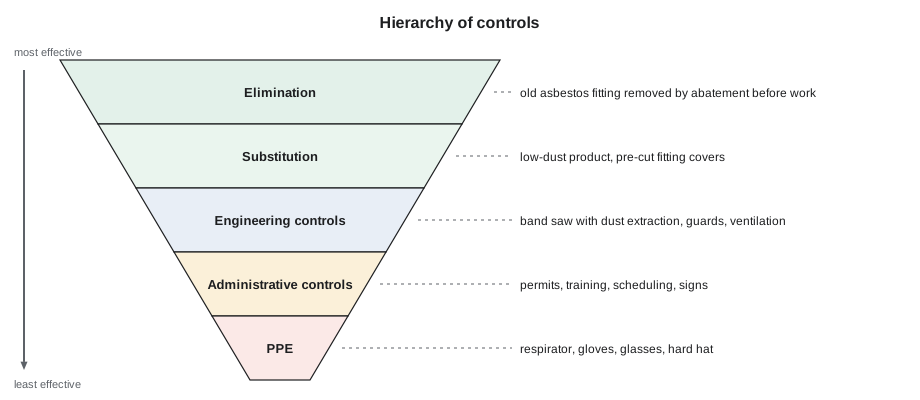
Safety professionals rank ways of controlling a hazard from most to least effective. The order is usually shown as a hierarchy: eliminate the hazard, substitute something less hazardous, use engineering controls such as guards and ventilation, use administrative controls such as procedures, training and scheduling, and finally use PPE. PPE comes last because it only works when it is chosen correctly, fits, is worn the whole time and is in good condition. If any one of those fails, the worker is exposed.
That does not make PPE unimportant. On a construction site or in a plant, many hazards cannot be eliminated: things fall, edges are sharp, surfaces are hot and noise is everywhere. PPE is what stands between the hazard and the worker when everything else has been done. The point of the hierarchy is that PPE should never be the only control when a better one is available.
Who provides PPE and who must wear it
Under OSHA's construction standards in 29 CFR 1926 Subpart E, the employer must make sure that workers use the protective equipment needed for the hazards of the job, and in most cases must pay for it. The main exceptions are ordinary safety-toe footwear and prescription safety eyewear that workers may wear off the job, which the employer does not have to pay for, though many do. The standards cover head protection, hearing protection, eye and face protection and other PPE. Workers must wear what is required and must report damaged equipment.
On top of the law, sites and plants set their own minimum PPE. At Mountview the minimum is a hard hat, safety boots, safety glasses, gloves, a high-visibility vest and long pants. At Kellerton it adds long sleeves, flame-resistant clothing in the boiler house, hearing protection in posted areas, hairnets in production areas and a chin strap on the hard hat when working from a boom lift. The stricter rule always applies.
| PPE | US standard | When insulators use it |
|---|---|---|
| Hard hat | ANSI/ISEA Z89.1 | Always on site |
| Safety footwear | ASTM F2413 | Always on site |
| Eye and face protection | ANSI/ISEA Z87.1 | Always on site; goggles and face shields for specific tasks |
| Hearing protection | Rated under EPA labeling rules; ANSI S3.19 or S12.6 testing | In noisy areas and with loud tools |
| High-visibility apparel | ANSI/ISEA 107 | Where vehicles or mobile equipment operate |
| Cut-resistant gloves | Cut levels under ANSI/ISEA 105 (A1 to A9) or EN 388 | Handling insulation, knives and sheet metal |
| Flame-resistant clothing | NFPA 2112 for flash fire; NFPA 70E for arc flash | Where plants require it for flash fire or arc hazards |
Head protection
Hard hats protect against falling objects, bumps against overhead pipes and ducts and, depending on class, electrical contact. Insulators bump their heads constantly, working under pipe racks, in ceiling spaces and around hangers and supports, so a hard hat that fits well and stays on matters.
Hard hats are classified by type and by electrical class. Type 1 hats protect against blows to the top of the head; Type 2 hats also protect against blows to the sides, front and back. Electrical classes describe whether the shell insulates against electricity: Class E hats are tested to a high voltage, Class G to a lower voltage and Class C give no electrical protection. Most sites accept Type 1, Class E hats; some plants require Type 2 hats or hats with chin straps for work at height, where a hat that falls off is both a lost hat and a falling object.
Care is simple but often ignored. Inspect the shell and suspension every day. Replace the hat after any significant impact, even if no damage is visible, and follow the manufacturer's service life, which for many hats is about five years for the shell and one year for the suspension. Keep hard hats out of direct sun on the truck dashboard, because heat and ultraviolet light weaken the plastic. Do not drill holes, paint the shell or put stickers on it except where the manufacturer allows, and never wear a ball cap underneath it unless the hat is designed for that.
Safety footwear
Insulators carry heavy rolls, cases and sheet metal, climb ladders and walk on scaffold planks, gratings and pipe racks. Safety boots protect against crushing, punctures from nails and screws on the floor and slips. They also support the ankles on uneven surfaces.
In the United States, protective footwear is made to ASTM F2413, and the label inside the boot lists its ratings: impact and compression protection for the toe, metatarsal protection, electrical hazard resistance, static dissipation and puncture resistance. OSHA requires protective footwear where there is a danger of foot injuries from falling or rolling objects or objects piercing the sole.
Choose boots with slip-resistant soles, good ankle support and laces or fasteners that will not catch on ladder rungs. On cold work in freezers and outdoors in winter, insulated boots prevent cold injury. On hot work, soles must handle hot surfaces. Replace boots when the sole is worn smooth, the toe cap is exposed or damaged, or the upper is split.
Eye and face protection
Eye injuries in insulation work come from flying chips when cutting rigid insulation and metal, fibers and dust falling from overhead work, splashes of adhesive, mastic and solvents, metal slivers from snips and drills and sparks from grinding. The basic protection is impact-rated safety glasses with side protection, worn at all times on site.
- Safety goggles seal around the eyes and are better than glasses for overhead fibrous insulation, dusty demolition and chemical splashes. Indirect-vent goggles let air in but keep splashes out.
- Face shields protect the whole face from flying particles, grinding and splashes. They are always worn over safety glasses or goggles, never instead of them.
- Tinted lenses suit outdoor work in bright sun but not dim mechanical rooms.
- Anti-fog coatings help in humid plant areas and when wearing a respirator.
If fibers or dust get into the eyes, do not rub them. Rinse with clean water or eyewash for several minutes and report it. Every site should have an eyewash station or bottles within reach of the work, and plants with chemicals have plumbed eyewash stations. Know where the nearest one is before starting work.
Hearing protection
Noise damages the tiny hair cells in the inner ear. The damage builds slowly and painlessly over years and cannot be reversed. Plants are noisy, with boilers, fans, compressors, pumps and steam leaks, and insulators' own tools add to it. The rule of thumb is that if you must raise your voice to be heard by someone an arm's length away, the noise is probably above 85 dBA and hearing protection is needed.
Decibels are logarithmic. Every increase of 3 dB doubles the sound energy, so a noise of 91 dBA has twice the energy of 88 dBA and four times that of 85 dBA. That is why the allowed exposure time drops so quickly as noise rises.
OSHA's construction noise rule, 29 CFR 1926.52, sets a limit of 90 dBA for 8 hours with a 5 dB exchange rate, and requires feasible controls and hearing protection above it. Shops and plants under the general industry rule, 29 CFR 1910.95, must also run a hearing conservation program when workers are exposed to an 8-hour average of 85 dBA or more, with hearing tests and training. Many plants apply the 85 dBA level to everyone on site, including contractors.
- Foam earplugs are cheap, comfortable and effective if rolled down tightly and inserted deep, with the ear pulled up and back. Badly inserted plugs give little protection.
- Pre-molded and banded plugs are reusable and quick to put in and take out.
- Earmuffs are easy to fit correctly but can be hot, and safety glasses or hair under the seals reduce their protection.
- Double protection, plugs and muffs together, is used in very loud areas.
Every hearing protector has a noise reduction rating on the package. Real-world protection is usually much less than the label, because people do not fit protectors as well as the testing lab does. A common practice is to subtract 7 from the rating and then halve it to estimate the real protection of a protector against noise measured in dBA. The best protector is the one that fits and that you will actually wear the whole time.
Worked problem
Is the hearing protection good enough?
Devon will work for 4 hours near the Kellerton boiler feed pumps, where the noise is 97 dBA. He has foam earplugs rated NRR 32. Estimate his protected exposure, and compare it with OSHA's limit, which allows 4 hours at 95 dBA.
Show solution
- Estimated real protection = (NRR − 7) ÷ 2 = (32 − 7) ÷ 2 = 12.5 dB.
- Protected exposure ≈ 97 − 12.5 = 84.5 dBA.
- At 84.5 dBA, the allowed time is far more than 8 hours under OSHA's rule, so 4 hours is within the limit.
- Without protection, 97 dBA is above 95 dBA, where only 4 hours are allowed; at 97 dBA the allowed time is about 3 hours, so 4 hours would be over the limit.
Answer: With well-fitted plugs, Devon's estimated exposure is about 84.5 dBA, within the limit. If the plugs are badly inserted, the real protection can drop to almost nothing, so fitting matters more than the rating.
Hand and arm protection
Insulators' hands meet knives, sheet metal edges, band tails, wire ends, fibers, adhesives, solvents, hot surfaces and frozen pipes. No single glove handles all of these, so most insulators carry two or three kinds.
- Cut-resistant gloves, rated A3 to A5 or higher under ANSI/ISEA 105, for knives and sheet metal. Many insulators wear a cut-resistant glove on the hand that holds the material and a lighter glove on the knife hand.
- Coated knit gloves with nitrile or polyurethane palms for grip and general handling of insulation.
- Chemical-resistant gloves, chosen from the safety data sheet, for adhesives, mastics, coatings and solvents. Nitrile suits many products, but some solvents go straight through it; the safety data sheet says which glove material to use.
- Heat-resistant gloves for handling hot pipe and equipment. These protect against brief contact, not against holding hot metal.
- Insulated gloves for freezers, cold rooms and outdoor winter work.
Gloves can create hazards too. Loose gloves can be caught in drills, grinders and band saws, and some shop machines must be run bare-handed or with tight-fitting gloves only. Follow the tool rules. Replace gloves when they are cut, worn through or soaked with chemicals; a glove soaked in solvent holds the solvent against the skin.
Protective clothing
Fibrous insulation irritates the skin. The fibers do not cause an allergy; they are simply sharp and stiff enough to prickle and scratch. The irritation is temporary but uncomfortable. The protection is clothing that covers the skin and keeps fibers out:
- Loose-fitting long-sleeved shirts and long pants, buttoned at the cuffs and collar, or disposable coveralls for heavy overhead work.
- Gloves, and a head covering or hood when working overhead.
- After work, wash exposed skin with cool water and mild soap; hot water opens the pores and lets fibers in. Do not rub or scratch.
- Wash work clothes separately from other laundry and rinse the machine afterward, or use disposable coveralls.
Some plants require flame-resistant (FR) clothing wherever there is a risk of flash fire or electrical arc flash. FR clothing does not catch fire and continue burning, and it insulates the skin for a short time from the heat of a flash. It works only if the outer layer is FR and nothing meltable is worn against the skin: synthetic shirts and underwear can melt into a burn. At Kellerton, FR coveralls are required in the boiler house because of the natural gas burners.
High-visibility vests, shirts or jackets are required wherever vehicles, forklifts or mobile equipment operate. Plants and large sites usually require them everywhere outdoors and in warehouse areas. The class of garment depends on the traffic speed and the lighting.
PPE for hot and cold conditions
Insulators work in some of the hottest and coldest places in a building or plant: boiler houses and steam tunnels in summer, freezers and outdoor pipe racks in winter. PPE can make heat worse by trapping body heat, and cold can make PPE harder to use.
In heat, choose the lightest PPE that still protects, use breathable coveralls, take cool-down breaks, drink water often and watch co-workers for signs of heat illness: heavy sweating, cramps, dizziness, headache, nausea and confusion. Confusion or stopping sweating is an emergency. Lesson 7 covers heat stress in more detail.
In cold, dress in layers, keep hands and feet dry and warm, wear a hard hat liner, and take warm-up breaks. In blast freezers and cold storage at Kellerton, which run at about −22 °F, workers wear insulated coveralls, insulated boots and gloves and work in limited periods with warm-up time between them. Cold makes fingers clumsy, which makes knife and snip work more dangerous.
Inspecting, fitting and storing PPE
PPE only protects if it is in good condition and fits. Inspect it before each use, replace damaged items, clean it regularly and store it where it stays clean and out of sun and heat. Report damaged or missing PPE immediately; do not work without it.
| Item | Daily check | Replace when |
|---|---|---|
| Hard hat | Shell cracks, dents, chalky surface; suspension straps and clips | After an impact, or at the end of its service life |
| Safety glasses and goggles | Scratches, cracks, loose side shields, strap condition | Lenses scratched enough to blur vision, or frame damaged |
| Safety boots | Sole wear, exposed or damaged toe cap, split uppers | Sole worn smooth, toe cap damaged, or after a heavy crush |
| Gloves | Cuts, holes, worn palms, chemical soaking | Cut, worn through or contaminated |
| Hearing protection | Clean, soft, undamaged plugs or seals | Foam plugs after each use; muff seals when hard or cracked |
| FR clothing | Holes, contamination with oil or flammable liquids | Damaged or contaminated; follow the laundering instructions |
Worked problem
Ordering PPE for a crew
Bernie's Kellerton crew is six people for a 5-day outage. Each person uses 4 pairs of foam earplugs a day, 1 pair of cut-resistant gloves every 2 days and 2 disposable coveralls a day for the dusty work in the boiler house, which is planned for 3 of the 5 days. How many of each should she order, with a 20 in 100 allowance for loss and damage?
Show solution
- Earplugs: 6 people × 4 pairs × 5 days = 120 pairs; with the allowance, 120 × 1.2 = 144 pairs.
- Gloves: 6 people × (5 days ÷ 2) = 6 × 2.5 = 15 pairs; with the allowance, 15 × 1.2 = 18 pairs.
- Coveralls: 6 people × 2 a day × 3 days = 36; with the allowance, 36 × 1.2 = 43.2, so 44.
Answer: About 144 pairs of earplugs, 18 pairs of gloves and 44 coveralls. Running out of PPE halfway through a shift is not a reason to work without it; it is a reason to stop.
Common mistakes
MistakeWearing short sleeves around fibrous insulation.
InsteadWear loose long sleeves buttoned at the cuffs, gloves and goggles for overhead work.
MistakeWashing fibers off with hot water and scrubbing.
InsteadRinse with cool water and mild soap; do not rub.
MistakeUsing a face shield without safety glasses.
InsteadAlways wear safety glasses or goggles under a face shield.
MistakeSquashing foam earplugs in without rolling them.
InsteadRoll plugs tightly, pull the ear up and back and insert deeply, then hold until they expand.
MistakeWearing synthetic clothing under FR coveralls.
InsteadWear cotton or FR layers underneath; synthetics can melt onto the skin.
MistakeKeeping a hard hat after it took a hard hit because it looks fine.
InsteadReplace it; damage to the shell or suspension may not be visible.
Summary and key terms
- PPE is the last line of defense in the hierarchy of controls; better controls come first.
- Employers must provide and require the PPE the law and the site require; workers must wear it.
- Hard hats are classified by type and electrical class; replace them after impacts and at the end of their service life.
- Safety footwear must meet ASTM F2413 and suit the job's hazards.
- Safety glasses are worn at all times; goggles and face shields add protection for specific tasks.
- Noise damage is permanent; fit hearing protection correctly and expect less protection than the label.
- Choose gloves for the hazard: cut, chemical, heat or cold; and wear clothing that keeps fibers off the skin.
- PPE
- Personal protective equipment worn to protect a worker from hazards that other controls cannot fully remove.
- Hierarchy of controls
- The ranking of hazard controls: elimination, substitution, engineering, administrative and PPE.
- Class E hard hat
- A hard hat tested to protect against contact with high-voltage electrical conductors.
- dBA
- A measure of sound level weighted to match the way the human ear hears.
- Exchange rate
- The number of decibels by which noise must rise to halve the allowed exposure time.
- Noise reduction rating
- The laboratory-measured noise reduction of a hearing protector, shown on the package.
- Flame-resistant clothing
- Clothing that does not keep burning after a brief flash fire or arc flash.
Practice problems
Work each problem on paper first, then reveal the answer to check.
List the hierarchy of controls from most to least effective.
Show answer
Elimination, substitution, engineering controls, administrative controls, PPE.
Which standard covers safety footwear in the US?
Show answer
ASTM F2413.
Earplugs are rated NRR 29. Estimate the real protection in dBA.
Show answer
(29 − 7) ÷ 2 = 11 dB.
What should you do if fibers get in your eye?
Show answer
Do not rub; rinse with clean water or eyewash for several minutes and report it.
Why are synthetic shirts not worn under FR coveralls?
Show answer
They can melt onto the skin in a flash fire.
Lesson quiz · 5 questions
Score 60% or more to complete this lesson.
Create a free account to save your progress, take quizzes and earn a certificate.