
INS-110 · Lesson 6 of 12 · 27 min
Working at heights and on scaffolds
▶ Video coming soon A video version of this lesson is on the way.
The chilled water mains at Mountview ran along the third-floor corridor at about 15 ft above the slab, just under the structure. For the first week, Devon worked from an aluminum platform ladder. Then the crew moved into the two-story lobby, where the pipes were 26 ft up, and Bernie booked a scissor lift. Before she let Devon on it, she checked his fall protection training card, walked him around the machine with the operator's manual and made him do the pre-use inspection himself. "Falls kill more construction workers than anything else," she said. "Every height job gets planned. No exceptions."
Falls from height are the leading cause of death and serious injury in construction in both Canada and the United States. Insulators spend much of their working lives above the floor: on ladders, scaffolds, elevating work platforms, pipe racks, tank roofs and mezzanines. This lesson covers the legal triggers for fall protection, the main ways to prevent and arrest falls, and the safe use of ladders, scaffolds and elevating work platforms. It is not a substitute for the formal fall protection training every worker must complete before working at height.
When fall protection is required
In the United States, OSHA's construction fall protection rule, 29 CFR 1926 Subpart M, requires fall protection where a worker on a walking or working surface with an unprotected side or edge could fall 6 ft or more to a lower level. Scaffolds have their own rule in Subpart L, with fall protection required at 10 ft. Fall protection is also required at any height above dangerous equipment. Employers must train each worker who may be exposed to fall hazards to recognize them and use the protection correctly, and must certify that training in writing.
Those are minimums. Many plants and large sites set lower triggers, such as fall protection at any height above 6 ft or on any open-sided platform, and Kellerton requires a harness and lanyard in every boom lift. The stricter rule always applies.
Plan first: preventing a fall
Fall protection is chosen in order of preference, following the same logic as the hierarchy of controls in Lesson 5. The best plan removes the fall hazard; the last resort is a system that stops a fall after it starts.
- Eliminate the height. Can the work be done from the floor? Pipe insulation for a high run can sometimes be prefabricated and jacketed at floor level and lifted into place, and fitting covers are made in the shop.
- Use guardrails and other passive protection. Guardrails on scaffolds, platforms and floor edges protect everyone without anyone needing to clip on. Covers over floor openings must be secured and marked.
- Use travel restraint. A harness and lanyard attached so the worker cannot reach the edge prevents a fall from happening.
- Use fall arrest. A full-body harness, connector and anchor stop a fall after it starts. Fall arrest is necessary in many situations, but the worker still falls, can be injured by the arrest or by swinging into structure and must be rescued quickly.
OSHA requires prompt rescue of a worker whose fall has been arrested, which in practice means a written rescue plan before anyone works in fall arrest. Coldstream writes a fall protection plan for each job, listing the hazards, the systems, the anchors and the rescue method.
Rescue planning matters because a worker hanging in a harness is in danger even if uninjured. Hanging still with the legs below the body lets blood pool in the legs, and within minutes some people faint; this is called suspension intolerance or suspension trauma. The rescue plan must get the worker down quickly, by lowering a lift platform, using a rescue kit or with help from the site's rescue team, not by waiting for an ambulance to bring a ladder.
Fall arrest equipment
A personal fall arrest system has three parts, sometimes called the ABCs: an anchor, a body harness and a connector.
- Anchor: a point strong enough to hold the arrest forces, such as a structural beam, an engineered anchor or a manufacturer's anchor on a lift. OSHA requires anchors used for fall arrest to support at least 5,000 lb per worker, or to be designed by a qualified person with a safety factor of at least two. Pipes, conduit, cable trays, ducts and hangers are not anchors.
- Body harness: a full-body harness, made to ANSI/ASSP Z359.11, with the back D-ring between the shoulder blades for fall arrest. Body belts are not allowed for fall arrest.
- Connector: a lanyard with an energy absorber, or a self-retracting lifeline, joining the harness to the anchor. The energy absorber tears open during a fall to limit the force on the body.
Inspect the equipment before every use: webbing for cuts, burns, fraying, chemical damage and paint; stitching; hardware for cracks, rust and distortion; snap hooks and carabiners for working gates and locks; energy absorber packs for signs of deployment. Hot surfaces, sparks and sharp jacketing edges are real hazards for harness webbing and lanyards in insulation work. Equipment that has arrested a fall must be removed from service.
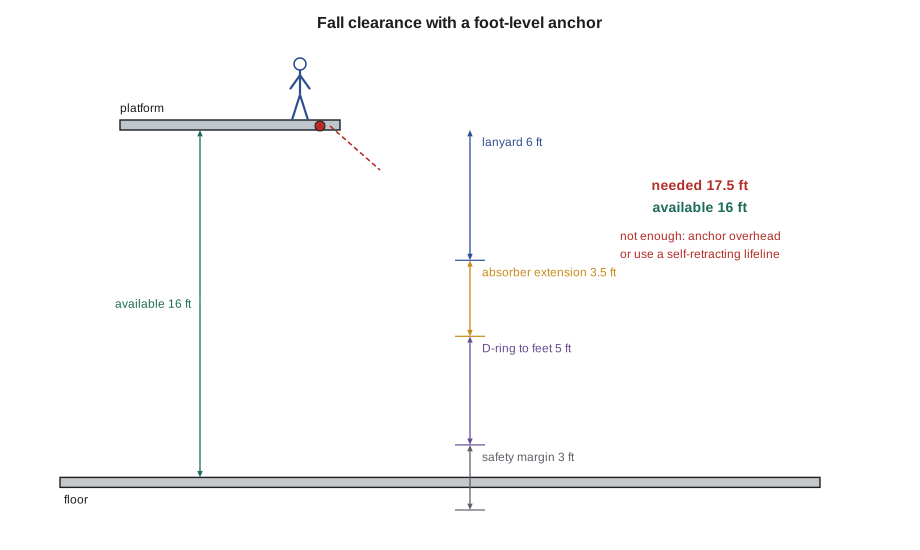
Fall arrest needs room. A worker who falls drops the length of the lanyard, then the energy absorber stretches out, the harness stretches and the D-ring shifts. If the floor or a lower pipe is closer than that total distance, the worker hits it before the fall is stopped. That distance is called the clearance, and it must be checked before using a lanyard.
Worked problem
Checking fall clearance
Devon is working from a fixed platform 16 ft above the boiler house floor, clipped to a beam at his feet level with a 6 ft energy-absorbing lanyard. The absorber can extend up to 3.5 ft. His back D-ring is about 5 ft above his feet, and Coldstream adds a 3 ft safety margin. Is there enough clearance?
Show solution
- Free fall with the anchor at foot level: the D-ring starts 5 ft above the anchor and ends 6 ft below it, so the free fall is 5 + 6 = 11 ft.
- Required clearance below the platform = lanyard length + absorber extension + D-ring height + safety margin = 6 + 3.5 + 5 + 3 = 17.5 ft.
- Available clearance = 16 ft.
- 17.5 ft is more than 16 ft, so he could hit the floor.
- Also, the free fall of 11 ft is more than the 6 ft limit OSHA sets for most personal fall arrest systems.
Answer: Not enough clearance. Bernie moves the anchor to an overhead beam, which cuts the free fall to about 1 ft, and switches to a self-retracting lifeline. Better still, the platform has its guardrail repaired so fall arrest is not needed at all.
Ladders
Ladders are the most common way insulators reach their work, and the most misused. Ladders are for access and for short, light work, not for long tasks that need two hands and heavy material. If a job needs both hands for more than a moment, needs heavy material carried up or keeps a worker on the ladder for a long time, use a platform ladder, a scaffold or a lift instead.
- Inspect the ladder before use: rails, rungs or steps, feet, locks and labels. Remove damaged ladders from service and tag them.
- Choose the right ladder: the duty rating must cover the worker plus tools and material; non-conductive fiberglass rails are used where electrical hazards exist.
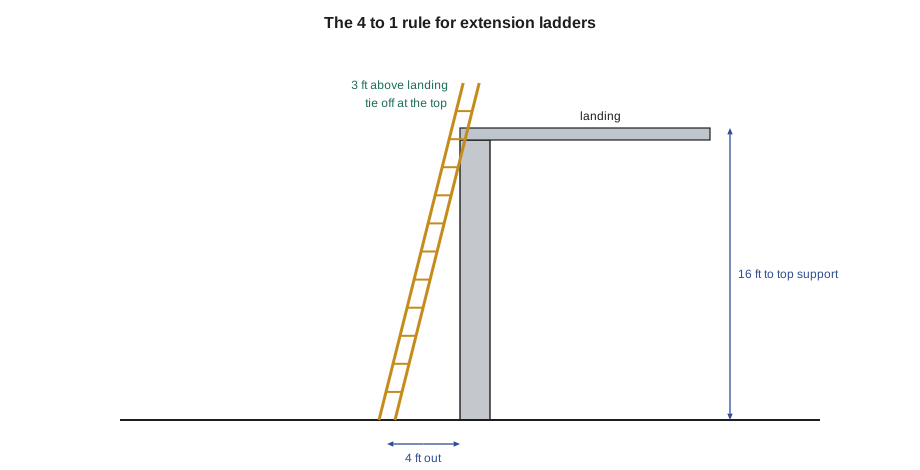
- Set extension ladders at an angle of about 4 to 1: one unit out from the wall for every four units of height to the top support point. Extend the ladder at least 3 ft above the landing if it is used to reach a platform or roof, and tie it off at the top.
- Set stepladders fully open with the spreaders locked, on firm, level ground. Do not stand on the top cap or the step below it, and do not use a folded stepladder as a leaning ladder.
- Face the ladder, keep three points of contact (two hands and a foot or two feet and a hand) when climbing, and do not carry material in your hands; raise it with a rope.
- Keep your belt buckle between the rails; overreaching tips ladders. Climb down and move the ladder instead.
Worked problem
Setting up an extension ladder
Devon needs to reach a mezzanine landing 12 ft above the floor. How far out should the foot of the ladder be, and how long must the ladder be to extend 3 ft above the landing?
Show solution
- Distance out = height ÷ 4 = 12 ÷ 4 = 3 ft.
- Length to the landing, by the Pythagorean theorem: √(12² + 3²) = √(144 + 9) = √153 ≈ 12.4 ft.
- Add the extension above the landing, measured along the ladder: 12.4 + 3 = 15.4 ft.
- Extension ladders overlap their sections, so the working length is less than the nominal size. Choose a ladder whose maximum working length is at least 15.4 ft; a 20 ft extension ladder is typical.
Answer: Set the foot 3 ft out and use a ladder with a working length of at least 15.4 ft.
Scaffolds
Scaffolds give insulators a stable, guarded platform for long work at height, such as jacketing a vessel or insulating a bank of pipes. Insulators usually use scaffolds built and inspected by others: on industrial sites, specialist scaffold crews erect, modify and dismantle scaffolds, and other trades may not alter them. On smaller jobs, insulators may set up rolling frame scaffolds themselves, after training.
OSHA's scaffold rule, 29 CFR 1926 Subpart L, requires each scaffold to support its own weight and at least four times the maximum intended load, and to be erected, moved, dismantled or altered only under the supervision of a competent person. A competent person must inspect the scaffold for visible defects before each work shift and after any event that could affect it.
Most sites use a tag system to show the status of a scaffold. The colors vary, but a common system is:
- Green tag: the scaffold has been inspected and is safe for use as built.
- Yellow tag: the scaffold may be used only with special precautions written on the tag, such as fall protection because a guardrail is missing for access to the work.
- Red tag: do not use. The scaffold is incomplete, being modified or unsafe.
Before climbing onto a scaffold, check the tag and the date, and look for the obvious: complete platforms with no gaps, guardrails and toe boards on all open sides, base plates or casters locked on firm ground, bracing in place and a safe access ladder or stair. Never climb the frames unless they are designed as a ladder, never remove guardrails or planks to make the work easier and never overload the platform with insulation cases and jacket rolls. If something is wrong, get off, tell the foreperson and leave the scaffold for the scaffold crew to fix.
| Check | What to look for |
|---|---|
| Tag | Green, current date, signed; special conditions read and followed on a yellow tag |
| Base | Base plates and mud sills on firm ground, or casters locked on a rolling scaffold |
| Platform | Fully planked or decked, no gaps, planks secured and not cracked |
| Guardrails | Top rail, midrail and toe board on every open side |
| Bracing and ties | All braces in place; tall scaffolds tied to the structure as designed |
| Access | A built-in ladder, attached ladder or stair; no climbing cross-braces |
| Load | Material on the platform kept within the rated load; nothing stacked on guardrails |
| Surroundings | Clear of overhead power lines, hot pipes and moving equipment |
Elevating work platforms
Scissor lifts and boom lifts, often called aerial work platforms or mobile elevating work platforms, are common on commercial and industrial jobs. They are fast and flexible but can tip over, be driven into holes, crush operators against overhead structure and catapult workers from the basket. Operators must be trained and familiar with the specific model.
- Training: OSHA requires operators of aerial lifts to be trained, and the ANSI/SAIA A92 standards set out the design, use and training requirements for these machines.
- Inspect before each shift: controls, emergency lowering, guardrails, gate, tires, outriggers where fitted, alarms, leaks and the manual in its holder.
- Check the work area: floor strength, slopes, holes, drains, overhead obstructions, power lines and pedestrian traffic.
- Stay inside the guardrails with both feet on the platform floor. Never climb or sit on the rails or stand on boxes to gain height.
- In boom lifts, wear a full-body harness and a short lanyard attached to the manufacturer's anchor in the basket, as the manufacturer and the site require. Most scissor lifts rely on their guardrails, but follow the manufacturer's manual and site rules.
- Watch for crushing hazards: driving or raising a basket toward overhead pipe can trap the operator against the controls. Many lifts now have secondary guarding that stops the machine if the operator is pushed against the controls.
- Never exceed the platform's rated capacity, which includes people, tools and material. A few cases of jacketing and a crew of two add up fast.
Worked problem
Checking a scissor lift load
A scissor lift is rated for 750 lb. Devon weighs 180 lb and Tessa 140 lb. They want to bring up four cases of fiberglass pipe insulation at 30 lb each, a box of fittings at 20 lb, tools at 40 lb and a 55 lb roll of aluminum jacket. Is the load within the rating?
Show solution
- People: 180 + 140 = 320 lb.
- Insulation: 4 × 30 = 120 lb.
- Other: 20 + 40 + 55 = 115 lb.
- Total = 320 + 120 + 115 = 555 lb.
- Margin = 750 − 555 = 195 lb.
Answer: 555 lb, within the 750 lb rating. The rating may be lower when the platform extension deck is extended or outdoors in wind, so check the plate on the machine.
Other height hazards in insulation work
Insulators meet some height hazards that other trades rarely do. Pipe racks and tank roofs often have no guardrails, and the insulation itself is not a walking surface: insulated pipe looks solid but will crush, roll or slide under a foot, and metal jacketing is slippery, especially when wet, frosted or oily. Never walk on insulated pipe or use it as a step. Cold lines can be covered in frost or ice, and hot lines can burn a hand reaching for support. Openings left in grating for pipes may be bigger than they look. Falling objects are a hazard too: insulation scraps, jacket offcuts and tools must be kept from falling on people below, with toe boards, debris netting, tool tethers and barricades under the work.
Weather and fatigue raise every height hazard. Wind catches sheets of jacketing like sails; rain and frost make surfaces slippery; long shutdown shifts make people careless. Bernie stops height work outdoors when gusts make sheet handling unsafe, and she reminds the crew that the plan for getting down is part of the plan for going up.
Common mistakes
MistakeUsing a pipe, duct or hanger as an anchor.
InsteadAnchor only to structure, engineered anchors or the manufacturer's anchor on a lift.
MistakeClipping a lanyard at foot level without checking clearance.
InsteadCalculate the clearance; anchor overhead or use a self-retracting lifeline where it is short.
MistakeWorking from a ladder with heavy material and both hands busy.
InsteadUse a platform ladder, scaffold or lift for two-handed or long work.
MistakeClimbing a red-tagged scaffold to finish one piece.
InsteadNever use a red-tagged scaffold. Tell the foreperson and wait for the scaffold crew.
MistakeStanding on the guardrails of a scissor lift to reach higher.
InsteadKeep both feet on the platform floor; reposition or use a taller machine.
MistakeWalking on insulated pipe.
InsteadInsulated pipe and jacketing are not walking surfaces; use proper platforms.
Summary and key terms
- OSHA requires fall protection at 6 ft in construction and 10 ft on scaffolds, with certified training.
- Choose fall protection in order: eliminate the height, guardrails, travel restraint, then fall arrest.
- Fall arrest needs a strong anchor, a full-body harness, a connector and a rescue plan.
- Calculate fall clearance before using a lanyard; a low anchor may not stop a fall in time.
- Set extension ladders at 4 to 1, extend them above the landing and keep three points of contact.
- Check scaffold tags and conditions daily; never alter or overload a scaffold.
- Elevating work platform operators must be trained, inspect the machine, respect its capacity and avoid crushing hazards.
- Fall arrest
- A system that stops a fall after it starts, using an anchor, harness and connector.
- Travel restraint
- A system that keeps a worker from reaching an edge where a fall could happen.
- Clearance
- The vertical distance needed below a worker for a fall arrest system to stop a fall safely.
- Energy absorber
- Part of a lanyard that tears open in a fall to limit the force on the body.
- Self-retracting lifeline
- A connector that reels out and locks quickly in a fall, limiting the free fall.
- Suspension intolerance
- Fainting or worse caused by hanging motionless in a harness; also called suspension trauma.
- Scaffold tag
- A tag on a scaffold showing whether it is safe to use, safe with conditions or not to be used.
Practice problems
Work each problem on paper first, then reveal the answer to check.
At what height does OSHA's construction rule generally require fall protection?
Show answer
6 ft, or 10 ft on scaffolds, and at any height over dangerous equipment.
A ladder must reach a support point 16 ft up. How far out should its foot be?
Show answer
16 ÷ 4 = 4 ft.
Name the three parts of a personal fall arrest system.
Show answer
Anchor, body harness and connector.
What does a yellow scaffold tag usually mean?
Show answer
Use only with the special precautions written on the tag.
Two workers at 175 lb and 155 lb plus 130 lb of material are on a lift rated 500 lb. What is the margin?
Show answer
500 − 460 = 40 lb.
Lesson quiz · 5 questions
Score 60% or more to complete this lesson.
Create a free account to save your progress, take quizzes and earn a certificate.