
INS-110 · Lesson 1 of 12 · 28 min
The heat and frost insulator trade
▶ Video coming soon A video version of this lesson is on the way.
Devon Marsh's first morning with Coldstream Insulation began at 6:30 on Tuesday, September 8, 2026, in the gravel lot behind the south-side shop. He had spent three years in a warehouse, driving a forklift and stacking pallets, and he had applied for the apprenticeship after a cousin told him that insulators "work indoors most of the year, make good money and never dig a ditch." He was not sure what else the job involved.
His foreperson, Bernie Valois, handed him a hard hat with a fresh Coldstream sticker, a pair of cut-resistant gloves and a roll of aluminum tape, and pointed at the truck. "We're on the Mountview Hospital addition for the next six weeks," she said. "Chilled water, heating water, domestic water and a little steam. By Friday you'll know more about pipe than the pipefitters think you should. Get in."
On the drive Devon asked the question every new apprentice asks: "So what do insulators actually do?" Bernie laughed. "We keep heat where it belongs," she said. "Hot stays hot, cold stays cold, and nobody gets burned or dripped on. That's the whole trade in one sentence. The rest is details, and the details take four years."
This lesson explains what the heat and frost insulator trade is, why buildings and plants need it, how an apprentice becomes a certified journeyworker and what the work feels like day to day. Every later lesson in this course builds on it: the tools, the protective equipment, the hazards and the paperwork all exist because of the work described here.
What heat and frost insulators do
Heat and frost insulators install, repair and maintain insulation on mechanical systems: piping, ductwork, tanks, vessels, boilers, chillers, heat exchangers, turbines, process equipment and the valves, flanges and fittings that join them. The insulation goes on systems that are hotter or colder than the air around them. A steam line, a domestic hot water line, a chilled water line, a refrigeration suction line, a liquefied gas tank and a kitchen exhaust duct all need it, for different reasons.
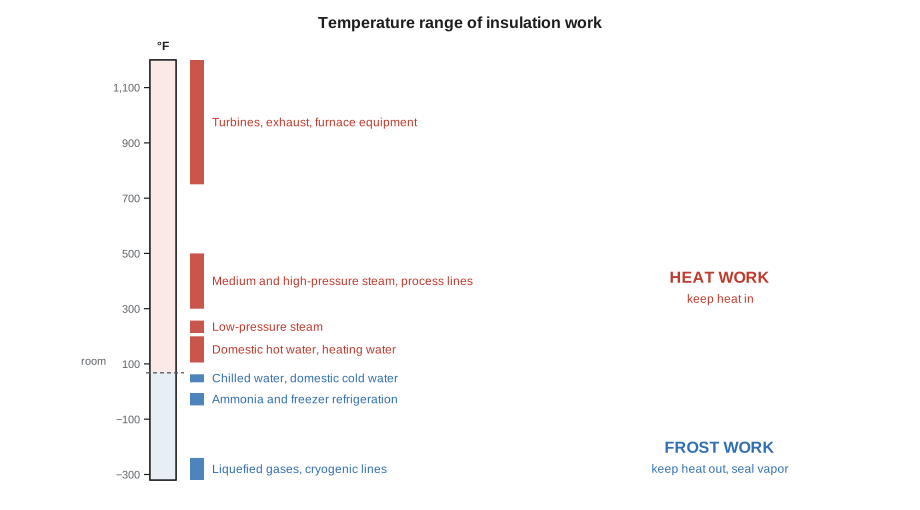
The trade's name says it plainly. On the heat side, insulators keep heat in pipes and equipment that run hot, sometimes several hundred degrees above room temperature. On the frost side, they keep heat out of systems that run cold, from chilled water at about 43 °F down to refrigeration and cryogenic lines far below freezing. Cold work is often harder than hot work, because a cold system also has to be sealed against water vapor, as you will see below.
Insulators do much more than wrap pipe. A typical journeyworker can measure and lay out insulation for any pipe size, cut and fit covers for elbows, tees, valves and flanges, apply vapor retarders and sealants, fabricate and install metal and plastic jacketing, install insulation on ducts and equipment, apply firestopping where pipes pass through fire separations, install removable insulation covers, apply acoustic insulation to reduce noise and work safely around existing hazardous materials such as old asbestos insulation. Many insulators also spray-apply coatings and mastics, and some specialize in refractory linings or cryogenic systems.
Why systems are insulated
Every insulation job has a reason, and the reason decides what material goes on, how thick it is and how carefully it is sealed. Specifications usually say why a system is insulated, and good insulators read that before they cut anything. The main reasons are these.
- Energy conservation. A bare hot pipe loses heat to the room all day and night, and a bare cold pipe gains it. Energy codes set minimum insulation thicknesses for heating and cooling piping and ductwork because the losses add up to real money and real emissions over a building's life.
- Process control. In a plant, a fluid often has to arrive at a certain temperature. Chocolate, asphalt, sulfur, heavy oils and many chemicals become thick or solid if they cool, and some products spoil if they warm. Insulation, sometimes with electric or steam heat tracing under it, keeps the process within its range.
- Personnel protection. A steam pipe at 366 °F can cause a serious burn in a fraction of a second. Insulation that keeps the outside surface cool enough to touch protects workers who walk past, lean on or grab the pipe. Lesson 7 covers burn hazards and the surface temperatures that are considered safe.
- Condensation control. Cold pipes and ducts sweat when warm, humid air touches them, just as a cold drink sweats in summer. The water drips on ceilings, equipment and product, rusts the pipe and grows mold. On cold systems, insulation and a sealed vapor retarder keep the surface above the dew point and keep moisture out.
- Freeze protection. Water and sewer lines in unheated spaces, outdoor process lines and fire protection piping can freeze and burst. Insulation slows the loss of heat, and heat tracing replaces what is lost.
- Noise control. Insulation and heavy barrier jackets reduce the noise from ducts, valves, pumps and pipes carrying high-velocity flow. Hospitals, schools, theaters and offices often specify acoustic insulation.
- Fire protection. Some insulation and firestopping products help keep fire and smoke from spreading through openings for pipes and ducts, or protect steel and equipment from fire for a rated time.
One system can need several of these at once. The chilled water lines at Mountview Hospital are insulated to save energy, prevent condensation on the ceilings of patient rooms and keep the water cold enough for the air handlers to do their job. The steam lines to the sterilizer room are insulated to save energy and to keep workers from being burned.
Worked problem
How much heat a bare pipe wastes
Bernie tells Devon that a bare NPS 2 steam pipe at 366 °F loses about 780 Btu/h for every foot of length in a 68 °F room, and that insulation cuts that by about 90 in 100. A 100 ft run is left bare. How much heat does it waste in a year if the steam runs 8,000 hours, and how much would insulation save?
Show solution
- Heat loss from the bare run = 780 Btu/h per ft × 100 ft = 78,000 Btu/h.
- Energy in a year = 78,000 Btu/h × 8,000 h = 624,000,000 Btu, or 6,240 therms (1 therm = 100,000 Btu).
- With insulation, about 10 in 100 of that is still lost: 6,240 × 0.10 = 624 therms.
- Saving = 6,240 − 624 = 5,616 therms a year.
- That is about the heat used by several average houses in a year, from one uninsulated run of pipe.
Answer: About 5,616 therms a year is wasted that insulation would save. That is why owners and energy codes care so much about a few feet of bare pipe.
The numbers in that example are typical, not exact; INS-120 shows how heat loss is actually calculated. The point is that small gaps matter. A missing fitting cover, a valve left bare after a repair or a run of pipe nobody got around to insulating can waste more energy than the rest of the system combined.
Hot work and cold work are different
Hot and cold insulation look similar from a distance, but they behave very differently, and mixing up the rules is one of the most common apprentice mistakes.
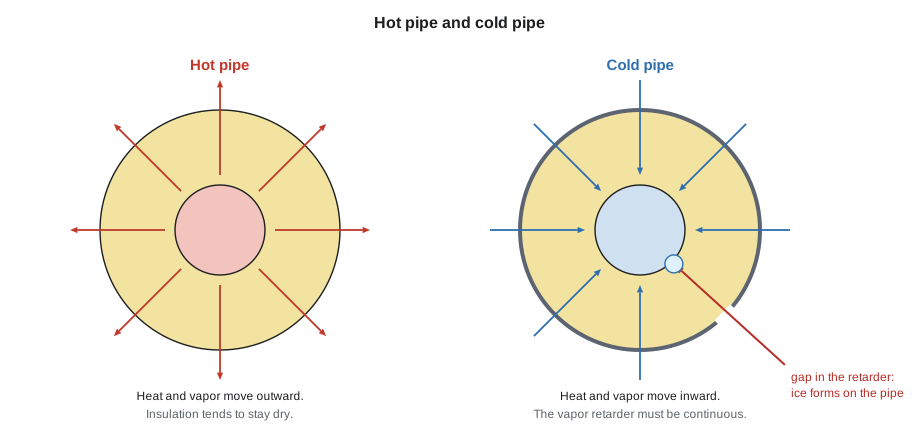
On a hot system, heat flows outward and so does any moisture: the warm pipe drives water vapor out of the insulation. Small gaps waste energy, but the insulation usually stays dry. Hot insulation must handle the temperature without melting, burning or breaking down, and it must allow for the pipe growing longer as it heats up.
On a cold system, heat flows inward, and water vapor is driven inward too, toward the cold pipe. If the vapor gets through, it condenses inside the insulation and, below freezing, turns to ice. Wet insulation insulates poorly, so the pipe gets colder and pulls in even more moisture. Within months a small leak can turn into a dripping, ice-covered pipe with rusted steel underneath. That is why cold work needs a continuous vapor retarder with every seam, joint and penetration sealed. Bernie puts it simply: "On hot pipe, a gap costs money. On cold pipe, a gap destroys the job."
| Hot systems | Cold systems | |
|---|---|---|
| Direction of heat flow | Outward from the pipe | Inward toward the pipe |
| Direction of water vapor | Outward; insulation tends to dry | Inward; insulation tends to get wet |
| Main reason for sealing | Weather protection and appearance | Stop vapor and condensation |
| Typical failure | Heat loss, burns, damaged jacket | Sweating, ice, wet insulation, corrosion |
| What matters most | Temperature limit, expansion, thickness | Continuous vapor retarder, sealed joints |
How the trade is organized
In the United States, there is no national license for insulators. Most heat and frost insulators learn the trade in a registered apprenticeship that lasts four or five years and combines paid on-the-job training with related classroom instruction every year. In Ohio, apprenticeships are registered through ApprenticeOhio, the state apprenticeship agency. Many programs are run jointly by insulation contractors and the union, the International Association of Heat and Frost Insulators and Allied Workers; open-shop contractors run registered programs too. Ohio does not license insulators as a separate trade, but the City of Columbus and building owners require the mechanical work to meet the building code and the job specifications, and plants often require proof of safety training before a worker may enter.
Devon is registered as a first-year apprentice. He will work under the direction of Bernie and other journeyworkers, attend related classroom instruction in the coming year and log his hours as he goes. Coldstream's training plan follows the work processes listed in its registered program, which cover everything a journeyworker must be able to do, from reading specifications to insulating equipment and handling hazardous materials.
| Stage | What the apprentice does | Who checks the work |
|---|---|---|
| First level or year | Straight pipe, simple fittings, material handling, safety basics, helping on jacketing | Foreperson inspects every piece |
| Middle levels | Valves, flanges, ducts, vessels, cold systems with vapor retarders, metal jacketing layout | Foreperson spot-checks, apprentice self-checks |
| Final level | Complex equipment, high-temperature and cryogenic systems, estimating, leading a small crew | Apprentice checks own and others' work |
| Journeyworker | Works independently, trains apprentices, reads and questions specifications | Quality inspector and owner's representative |
Who insulators work for
Most insulators work for insulation contractors like Coldstream. The insulation contractor is usually a subcontractor to the mechanical contractor, who installs the piping and ductwork, and the mechanical contractor works for the general contractor or the building owner. In a plant, the insulation contractor may work directly for the owner's maintenance department during a shutdown or under a long-term maintenance contract.
This chain matters because instructions and payments come down it, and questions go back up it. If Devon finds a problem with the piping, he tells Bernie, Bernie tells Coldstream's project manager, Raj Sandhu, and Raj raises it with the mechanical contractor. Apprentices do not take instructions about the scope of work from other trades or from the owner's staff directly, though they always follow site safety directions from anyone in charge.
Some insulators work for building owners and plants directly, as maintenance staff. Others work for manufacturers and distributors as technical representatives, for engineering firms as inspectors and estimators or for energy auditors measuring heat loss. Experienced insulators move into foreperson, superintendent, estimator, project manager and safety coordinator roles. Coldstream's owner, Walt Lowery, started as an apprentice in 1983 and still does the big industrial estimates himself.
What a working day looks like
Insulation work is steady, physical and detailed. On a typical day Devon arrives early, signs in at the site office and attends a short toolbox talk or safety meeting. The crew reviews the hazards for the day on a field-level hazard assessment, checks scaffold tags and permits, and stages material. Then the work begins: measuring pipe, cutting sections, fitting them, sealing joints, banding or taping, fabricating fitting covers and jacketing. Before leaving, the crew cleans up, covers material against weather and dust and notes what was completed so the foreperson can report progress.
The work is mostly indoors, in mechanical rooms, ceiling spaces, service tunnels, boiler houses and plant process areas. It can be hot, cramped, dusty and noisy. Insulators spend a lot of time on ladders, scaffolds and elevating work platforms, reaching overhead and working in awkward positions. They work around live systems that may be hot, cold or under pressure, and around other trades running their own work at the same time. It is also skilled, satisfying work: a long run of neatly jacketed pipe, with every seam lapped the right way and every band evenly spaced, is something an insulator can be proud of for decades.
Good insulators share a few habits. They measure carefully and cut once. They keep their knives sharp and their work areas clean. They think about water: which way it will run, where vapor will try to get in and how the jacket laps will shed it. They protect their own health, because the trade's history includes a terrible toll from asbestos, as Lesson 8 explains. And they take pride in appearance, because on finished work the insulator's craftsmanship is the only part of the mechanical system most people ever see.
Worked problem
Measuring a day's production
On Thursday of his second week, Devon and Tessa Moreau insulate straight chilled water pipe with preformed sections that come in 3 ft lengths. Between them they install 64 sections on NPS 2 pipe and 38 sections on NPS 4 pipe. How many feet of pipe did they insulate, and how does that compare with Raj's estimate of 280 ft for the day?
Show solution
- Total sections = 64 + 38 = 102.
- Length = 102 × 3 ft = 306 ft.
- Compared with the estimate: 306 − 280 = 26 ft more than planned.
- As a share of the estimate: 306 ÷ 280 ≈ 1.09, so about 109 in 100 of the planned length.
Answer: About 306 ft, roughly 26 ft ahead of the estimate. Bernie still checks the joints before she counts it as done: fast work that leaks vapor has to be redone.
Skills an insulator needs
The trade uses more mathematics and reading than most new apprentices expect. Insulators work with diameters, circumferences, areas and volumes every day; they convert between pipe sizes and actual outside diameters; they lay out patterns for elbows and tees using geometry; and they estimate quantities of insulation, jacketing, bands and sealant. TRD-102 and later INS courses cover these calculations step by step.
Reading is just as important. Insulators read specifications, drawings, insulation schedules, safety data sheets, manufacturers' instructions, permits and plant procedures. A misread line on a schedule can put the wrong material on a whole system, and a skipped line on a permit can put someone in danger.
Physical skill comes with practice: a clean straight cut through a section of mineral wool, a tight butt joint, a smooth bead of mastic, a neatly formed metal jacket seam. So does judgment: knowing when a pipe is too hot to work on, when a scaffold looks wrong or when old insulation looks like it might contain asbestos. Lessons 3 to 8 build the safety side of that judgment; INS-130 and later courses build the craft side.
| Skill area | Examples on the job | Where it is taught |
|---|---|---|
| Mathematics | Circumference of insulated pipe, jacket layout, material quantities, unit conversions | TRD-102, INS-130, INS-210 |
| Reading and documents | Specifications, schedules, drawings, safety data sheets, permits | Lesson 9, TRD-103 |
| Materials knowledge | Choosing and handling fibrous, cellular and granular insulation, jackets and mastics | INS-120 |
| Hand and power tool skill | Knives, saws, snips, crimpers, banding tools, drills, band saws | Lessons 3 and 4 |
| Safety | PPE, heights, hot surfaces, chemicals, dust and respiratory protection | Lessons 5 to 8, TRD-101 |
| Communication | Toolbox talks, coordination with other trades, reporting problems | Lessons 10 and 11 |
A short history, and why it matters
Pipe and boiler insulation became a trade in the late 1800s, when steam heating and steam power spread through factories, ships and large buildings. Early insulators applied magnesia, cork, hair felt and, increasingly, asbestos, which was cheap, did not burn and handled high temperatures well. Through most of the twentieth century, insulators mixed, cut, sawed and applied asbestos products every day, often without any respiratory protection.
The result was a public-health disaster. Insulators suffered some of the highest rates of asbestosis, lung cancer and mesothelioma of any workers, and many died decades after the exposure. Studies of insulators in the 1960s helped prove the link between asbestos and disease and led to the bans and strict controls in place today. Bernie's uncle, an insulator, died of mesothelioma in 2011. She does not tell the story often, but every apprentice on her crew hears it once.
Modern insulation products do not contain asbestos, but old asbestos insulation is still present in many plants, hospitals, schools and ships built before the 1980s. Insulators are among the workers most likely to find it, because they work on exactly the systems where it was used. That is why this course spends a full lesson on dust, fibers and respiratory protection, and why Coldstream treats any unknown old insulation as hazardous until it is proven otherwise.
Common mistakes
MistakeThinking insulation is only about saving energy.
InsteadRead why each system is insulated: energy, process control, burn protection, condensation, freeze protection, noise or fire. The reason decides the material and the details.
MistakeTreating cold work like hot work.
InsteadOn cold systems, vapor drives inward. Seal every joint and penetration so the vapor retarder is continuous, or the insulation will get wet and fail.
MistakeLeaving fittings and valves bare because they are awkward.
InsteadFittings and valves lose or gain a lot of heat for their size. Insulate them to the same standard as the straight pipe unless the specification says otherwise.
MistakeTaking scope instructions from other trades or the owner directly.
InsteadPass questions up the chain through the foreperson, while always following site safety directions.
MistakeAssuming old insulation is harmless.
InsteadTreat unknown old insulation as possibly containing asbestos. Stop, do not disturb it and report it.
Summary and key terms
- Heat and frost insulators install and maintain insulation on piping, ducts and equipment that run hotter or colder than their surroundings.
- Systems are insulated for energy, process control, personnel protection, condensation control, freeze protection, noise and fire.
- On hot systems heat and vapor move outward; on cold systems both move inward, so a continuous vapor retarder is essential.
- In the US the trade is learned in a four- to five-year registered apprenticeship, registered in Ohio through ApprenticeOhio.
- Insulation contractors usually work for mechanical contractors; questions and instructions travel through the chain of command.
- The trade needs mathematics, reading, materials knowledge, tool skill, safety judgment and pride in appearance.
- The trade's history with asbestos is why insulators treat unknown old insulation as hazardous.
- Heat and frost insulator
- A tradesperson who installs, repairs and maintains insulation on hot and cold mechanical systems.
- Personnel protection
- Insulation installed mainly to keep surfaces cool enough that people are not burned.
- Vapor retarder
- A layer that slows the movement of water vapor into insulation; essential on cold systems.
- Dew point
- The temperature at which moist air starts to condense water onto a surface.
- Heat tracing
- Electric cables or small steam lines run along a pipe under the insulation to add heat.
- Red Seal
- The interprovincial standard of excellence that lets a certified tradesperson work anywhere in Canada.
- Registered apprenticeship
- A formal training program, registered with a government agency, combining paid work and classroom instruction.
- Mechanical contractor
- The contractor who installs piping, ductwork and mechanical equipment, and usually hires the insulation contractor.
Practice problems
Work each problem on paper first, then reveal the answer to check.
Name four reasons a system might be insulated.
Show answer
Any four of: energy conservation, process control, personnel protection, condensation control, freeze protection, noise control and fire protection.
Why does a gap in the insulation on a chilled water line cause more trouble than a gap on a steam line?
Show answer
On the cold line, vapor drives inward, condenses in the insulation and wets it, which spreads the failure; on the hot line, the gap mainly wastes heat.
A bare pipe loses 500 Btu/h per foot. What does a 40 ft run lose in 1,000 hours?
Show answer
500 × 40 = 20,000 Btu/h; 20,000 × 1,000 = 20,000,000 Btu, or 200 therms.
How long is a typical US heat and frost insulator apprenticeship?
Show answer
Four to five years of paid work plus related classroom instruction each year.
Who should an apprentice tell about a problem with the piping?
Show answer
The foreperson, who passes it up through the project manager to the mechanical contractor.
Lesson quiz · 5 questions
Score 60% or more to complete this lesson.
Create a free account to save your progress, take quizzes and earn a certificate.