
HSE-342 · Lesson 7 of 12 · 26 min
Racking and storage
Backroom storage holds the store's buffer of stock: overstock that does not fit on the shelves, cases waiting to be worked, seasonal goods and supplies. Storage feels static, but it is one of the places where a single failure can cause the most harm. An overloaded beam can drop a pallet, a damaged upright can let a whole bay collapse, and a case stacked loosely on a top shelf can fall on someone's head. This lesson covers pallet racking, shelving and stacking: how racking works, what load signs mean, how to load it, how to spot and report damage and how to store cases on shelves and floors so they stay put. Lesson 8 covers storage up high, mezzanines and falling objects.
How selective pallet racking works
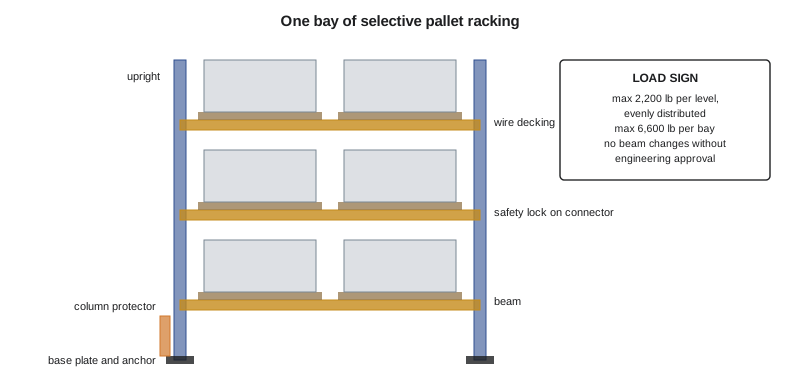
The most common racking in stores and warehouses is selective pallet racking, which lets any pallet be reached without moving others. It is built from a few parts:
- Upright frames: pairs of vertical columns, called uprights, joined by diagonal and horizontal bracing. They carry all the weight down to the floor.
- Beams: horizontal members that hook into the uprights at each level and carry the pallets. A pair of beams, front and back, forms one level of a bay.
- Beam connectors and safety locks: the connectors hook into slots in the uprights; a safety lock or clip on each connector stops the beam lifting out if it is bumped from below.
- Base plates and anchors: plates at the foot of each upright, bolted to the floor so the frame cannot be knocked off its feet.
- Decking and supports: wire mesh decks or pallet supports that sit across the beams, so cases or pallets that do not fit perfectly cannot fall through.
- Row spacers and wall ties: connectors that tie back-to-back rows together or tie a row to the building.
A rack works as a system. The beams can only carry their rated load if the uprights are straight and undamaged, the connectors and locks are in place, the frames are anchored and the load sits evenly on the beams. Change any one of those, and the capacity changes.
Load signs and capacity
Every run of racking should have a load sign, also called a load plaque, posted where workers can see it. The sign gives the maximum load per beam level, usually as a uniformly distributed load across the pair of beams, and often the maximum total load per bay. Both limits apply. A bay with three levels each rated at 2,200 lb (1,000 kg) and a bay limit of 6,600 lb (3,000 kg) can take three full levels, but if the bay limit were only 5,500 lb (2,500 kg), loading all three levels to their maximum would overload the uprights even though no single level is overloaded.
The rated capacity depends on the beam heights. Moving a beam up to make room for taller pallets increases the unsupported length of the upright below it and usually lowers the bay's capacity. Removing a beam level altogether can lower it a lot. Any change to beam heights, the number of levels or the decking should be checked against the manufacturer's data or by an engineer, and the load sign updated. A rack with no sign should be treated as having an unknown capacity until one is obtained.
In the United States, the Rack Manufacturers Institute's standard ANSI MH16.1 covers the design, testing and use of steel storage racks, including load signs. OSHA 1910.176 requires that stored materials not create a hazard and that stacks be secured against sliding or collapse, and OSHA has cited employers for overloaded and damaged racking under that rule and the General Duty Clause. Racking in many stores was installed years ago by a previous tenant, and the original load data is often lost. In that case, a rack supplier or engineer can identify the components and set a safe capacity.
Loading racking properly
- Know the weight of what you are putting up. A pallet of bottled water or canned goods can weigh 2,000 lb (900 kg) or more; a pallet of paper towels much less.
- Put heavy pallets on the lowest levels and light ones higher up.
- Center the pallet on the beams, front to back and side to side, with a small, even overhang at front and back. A pallet pushed too far back can fall off the rear beam.
- Use pallets in good condition. Broken boards and missing blocks can collapse on the beams.
- Do not let cases hang over the edge of the pallet into the flue spaces between back-to-back rows or past the front beam.
- Use decking where loads are hand-stocked onto the beams or where pallets do not fit squarely.
- Never climb racking to reach stock or to place it. Use the right lift equipment or a proper platform (Lesson 8).
Northfield's racking has load signs on the ends of each row, but the second row was reconfigured two years ago to fit taller seasonal pallets, and nobody checked whether the sign still applied. Marco asked the racking supplier to visit. The supplier found that raising the bottom beam had cut the bay capacity in that row and issued a new sign.
Checking a bay against its sign
The program below checks the planned load of each bay in Northfield's second row against the level and bay limits from the new sign. Weights are invented but typical.
# Check planned pallet loads against rack level and bay limits (invented weights).
level_limit = 1000        # kg per beam level, uniformly distributed (from the load sign)
bay_limit = 2500          # kg per bay (from the load sign after the beam change)
bays = {   # bay: [level 1 (bottom), level 2, level 3] pallet weights in kg; two pallets per level
    "Bay 1": [[480, 470], [210, 190], [150, 160]],
    "Bay 2": [[520, 540], [430, 410], [120, 130]],
    "Bay 3": [[450, 460], [300, 280], [350, 320]],
    "Bay 4": [[480, 470], [450, 460], [340, 330]],
}
for bay, levels in bays.items():
    problems = []
    for i, pallets in enumerate(levels, start=1):
        w = sum(pallets)
        if w > level_limit:
            problems.append(f"level {i} {w} kg > {level_limit}")
    total = sum(sum(p) for p in levels)
    if total > bay_limit:
        problems.append(f"bay total {total} kg > {bay_limit}")
    if levels[2] and sum(levels[2]) > sum(levels[0]):
        problems.append("top level heavier than bottom")
print(f"{bay}: total {total} kg -> " + ("OK" if not problems else "; ".join(problems)))Bay 1: total 1660 kg -> OK Bay 2: total 2150 kg -> level 1 1060 kg > 1000 Bay 3: total 2160 kg -> OK Bay 4: total 2530 kg -> bay total 2530 kg > 2500
Bays 1 and 3 are within both limits, although Bay 3 has a fairly heavy top level that would be better swapped lower. Bay 2 has an overloaded bottom level. Bay 4 has no single level over its limit but exceeds the bay limit, the trap described above. Both overloaded bays are unloaded until the pallets are redistributed. The quick check takes minutes once the weights are known, and Northfield now writes the approximate weight on each overstock pallet's label when it is put away.
Rack damage
Most rack failures start with damage that was visible for weeks or months before the collapse. The usual cause is impact from pallet jacks, stackers or forklifts, especially at the foot of the uprights at the ends of aisles and at bay entrances. Things to look for:
- Uprights that are dented, bent, twisted, creased or out of plumb, especially near the floor.
- Bracing that is bent, torn or missing.
- Beams that are bent, sagging noticeably under load or have damaged connectors.
- Missing safety locks or clips on beam connectors.
- Base plates damaged, anchors missing or loose, or frames shifted on the floor.
- Cracked welds, rust or corrosion, and decking that is bent or missing.
Rack standards and rack suppliers commonly use a three-level traffic-light system to classify damage. Green damage is within the tolerance the standard or manufacturer allows and needs only to be recorded and watched. Amber damage is beyond tolerance but not immediately dangerous; the bay should be unloaded or not loaded further, and repaired within a few weeks. Red damage is serious; the bay is unloaded at once, isolated so nobody uses it, and repaired or replaced before use. The exact tolerances, such as how much bend in an upright is acceptable over a given length, come from the manufacturer or the standard and should be used by whoever carries out the inspections.
Inspections are usually done at three levels: workers report any damage they see or cause, immediately; a trained person in the store walks the racking on a regular schedule, such as weekly or monthly, with a checklist; and a qualified rack inspector or engineer inspects at least once a year. Damage caused by an impact must be reported, not hidden. A culture where workers fear blame for reporting a rack strike is a culture where racks collapse.
The program below triages Northfield's last walk-through log. The measurement limits in it are illustrative only, chosen for teaching; a real inspection uses the manufacturer's or the standard's tolerances.
# Rack inspection triage (illustrative limits only; use the manufacturer's tolerances in practice).
amber_bend, red_bend = 3, 6            # mm of bend in an upright over a 1 m straight edge (illustrative)
findings = [   # location, item, measured bend mm (None if not a bend), other defect
    ("Row 1 Bay 1 front left upright", "upright", 2, None),
    ("Row 1 Bay 4 front right upright", "upright", 7, None),
    ("Row 2 Bay 2 rear left upright", "upright", 4, None),
    ("Row 2 Bay 3 beam level 2", "beam", None, "safety lock missing"),
    ("Row 2 Bay 1 base plate", "base", None, "anchor missing"),
    ("Row 1 Bay 2 bracing", "bracing", None, "diagonal brace torn"),
]
def grade(bend, defect):
    if defect in ("diagonal brace torn",):
        return "RED"
    if defect in ("anchor missing", "safety lock missing"):
        return "AMBER"
    if bend is None:
        return "GREEN"
    return "RED" if bend >= red_bend else "AMBER" if bend >= amber_bend else "GREEN"
actions = {"RED": "unload now, isolate, repair before use", "AMBER": "do not load further, repair within weeks",
           "GREEN": "record and monitor"}
for loc, item, bend, defect in findings:
    g = grade(bend, defect)
    what = f"{bend} mm bend" if bend is not None else defect
print(f"{g:5} {loc}: {what} -> {actions[g]}")GREEN Row 1 Bay 1 front left upright: 2 mm bend -> record and monitor RED Row 1 Bay 4 front right upright: 7 mm bend -> unload now, isolate, repair before use AMBER Row 2 Bay 2 rear left upright: 4 mm bend -> do not load further, repair within weeks AMBER Row 2 Bay 3 beam level 2: safety lock missing -> do not load further, repair within weeks AMBER Row 2 Bay 1 base plate: anchor missing -> do not load further, repair within weeks RED Row 1 Bay 2 bracing: diagonal brace torn -> unload now, isolate, repair before use
Two red findings, a badly bent upright at the end of Row 1 and a torn brace, mean those bays are unloaded and taped off today. A missing safety lock is a two-minute fix that should happen immediately; Northfield keeps a box of spare locks for exactly this. The missing anchor needs the supplier. Northfield also added column protectors to the end uprights of each row, where the worst strike happened. Protectors do not make an upright stronger, but they take the first hit.
Shelving and floor stacking
Much backroom storage is not pallet racking but steel shelving, gondola shelving moved from the sales floor, and cases stacked on the floor or on pallets. The same principles apply. Heavy items go on the lower shelves. Shelving units over about head height should be anchored to the wall or to each other so they cannot tip. Shelves should not be overloaded or bowed, and boxes should not overhang the shelf edge. Cases stacked on the floor should be stable: square, interlocked or banded where needed, no taller than the store's stack-height limit, with crushed or wet cases taken down. Bags of salt, soil and pet food should be stacked in a pattern that interlocks and not too high, because bags slump and slide. Lesson 8 covers storage near the ceiling and on top of coolers.
For supervisors: weights, signs and reporting
Three habits keep racking safe. First, make sure everyone knows roughly what their pallets weigh, by putting weights on labels or keeping a list of heavy items. Second, keep load signs up to date and visible, and never allow a rack to be changed without checking the sign. Third, make reporting a rack strike quick and blame-free; praise the worker who reports it, because the alternative is a hidden dent that grows into a collapse. Walk the racking with your checklist on the schedule, and treat a red finding as a stop-work: unload, isolate and call for repair.
Worked problem
A dent at the end of the aisle
During the overnight shift, Hana notices a fresh dent in the front upright at the end of Row 1, about knee height. The bay above holds two pallets of canned goods on each of its three levels. Nobody has reported hitting it. What should she do?
Show solution
- Stop loading or unloading that bay and keep people out of the aisle below it.
- Look closely or measure if she is trained to: a fresh, deep dent at the foot of an end upright is likely red damage.
- Unload the bay from the top down, using the powered jack and a second worker, without bumping the upright again. If unloading looks risky, isolate the area and wait for the supervisor.
- Tape off the bay and tag it out of use. Report it to Marco and log it with photos.
- Ask the crew, without blame, who might have hit it, so the cause can be fixed: a tight turn, speed, a missing column protector.
Answer: Treat it as likely red damage: stop, clear the area, unload carefully or isolate it, tag it out, report it and find the cause without blame.
Common mistakes
MistakeLoading a rack with no load sign because it looks strong.
InsteadTreat it as unknown capacity until the supplier or an engineer sets a safe load.
MistakeRaising a beam level to fit taller pallets without checking the sign.
InsteadHave any reconfiguration checked and the load sign updated.
MistakeChecking only the beam level limit.
InsteadCheck both the level limit and the bay limit.
MistakeHiding a rack strike to avoid blame.
InsteadReport every strike at once so the damage can be assessed.
MistakeStacking heavy pallets on the top level because there was space.
InsteadPut heavy loads low and light loads high.
Summary and key terms
- Selective pallet racking is a system of uprights, beams, connectors, locks, base plates, anchors and decking.
- Load signs give level and bay limits, and both apply; changing beam heights changes capacity.
- ANSI MH16.1 covers storage racks; OSHA 1910.176 requires stored materials to be secured and not create hazards.
- Load heavy pallets low, center them on the beams and use pallets in good condition.
- Most collapses start with visible damage from impacts; inspect regularly and report every strike.
- Green, amber and red damage levels guide whether to monitor, stop loading or unload and isolate.
- Shelving should be anchored and not overloaded, and floor stacks kept stable and within height limits.
- Selective pallet racking
- Racking that allows any pallet to be reached without moving others.
- Upright
- A vertical column of a rack frame.
- Beam
- A horizontal member that carries pallets between uprights.
- Load sign
- A sign on a rack giving its maximum loads per level and per bay.
- Safety lock
- A clip or pin that stops a beam lifting out of its upright.
- Column protector
- A guard fitted around the foot of an upright to absorb impacts.
Practice problems
Work each problem on paper first, then reveal the answer to check.
Name five parts of a selective pallet rack.
Show answer
Any five of: uprights, bracing, beams, beam connectors, safety locks, base plates, anchors, decking, row spacers.
What two limits does a load sign usually give?
Show answer
The maximum load per beam level and the maximum load per bay.
Why can raising a beam lower the bay capacity?
Show answer
It increases the unsupported length of the upright below it.
In the load check, why is Bay 4 overloaded?
Show answer
No single level exceeds its limit, but the total exceeds the bay limit.
What causes most rack damage?
Show answer
Impacts from pallet jacks, stackers and forklifts, especially at the foot of uprights.
What should happen to a bay with red damage?
Show answer
Unload it at once, isolate it and repair or replace the damaged part before use.
Name the three levels of rack inspection.
Show answer
Immediate reporting by workers, regular checks by a trained person, and at least yearly inspection by a qualified inspector.
What does a column protector do and not do?
Show answer
It absorbs the first impact, but it does not make the upright stronger.
Lesson quiz · 5 questions
Score 60% or more to complete this lesson.
Create a free account to save your progress, take quizzes and earn a certificate.