
HSE-342 · Lesson 12 of 12 · 26 min
Capstone: a backroom safety inspection and improvement plan
This capstone brings the course together. Marco Delgado and Priya Nair have been asked by their district manager to inspect Northfield's backroom from end to end, rank what they find, and present a one-year improvement plan with costs, owners and measures. The plan has to fit a store budget, cannot stop freight from moving, and must show how the store will know whether it worked. You will follow their inspection, see how the findings are scored and prioritized, look at one larger decision, the dock vehicle restraint, in detail, and see the final plan.
The same approach works in any store backroom, large or small. It is the hierarchy of controls and the risk assessment method from HSE-103, applied to the hazards in Lessons 1 to 11.
Step 1: plan the inspection
A good inspection is planned, not improvised. Marco and Priya decide to inspect over two days so they see both the morning truck and the overnight crew. They invite Tomás from receiving, Hana from the overnight crew and a member of the joint health and safety committee or safety committee, because the people who do the work see hazards that managers walk past. They take the checklists from this course: the dock readiness check from Lesson 3, the rack inspection from Lesson 7, the sprinkler clearance check from Lesson 8, the lockout record review from Lesson 10 and the housekeeping score from Lesson 11, plus the compliance self-check from Lesson 2. They also pull three years of injury and near-miss reports and the operator training records.
Step 2: walk the freight path
They follow the freight path from Lesson 1: from the dock, through breakdown and storage, to the sales floor doors, and back to the baler and compactor. They watch real work rather than asking people to demonstrate, talk with workers as they go and take photos of what they find. At each stage they ask the questions from the lessons. Is the trailer restrained? Where does lifting happen from the floor or above the shoulders? Which loads go on manual jacks that should go on powered ones? Are racks loaded within their signs and free of damage? Is anything stored on the cooler or in the sprinkler zone? Does the baler interlock work, and does the crew lock out? Are exits, extinguishers and panels clear?
Step 3: record and rate the findings
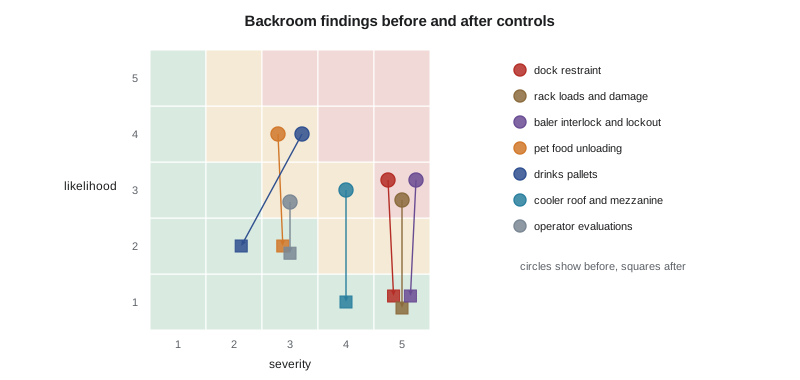
Each finding is written down with where it is, what was seen, who is exposed and how often. Then it is rated on the five-by-five risk matrix used throughout the safety courses: likelihood from 1 (rare) to 5 (almost certain) and severity from 1 (first aid) to 5 (fatal or permanent disability). Likelihood is judged for the way things are done now, with existing controls. The score is likelihood multiplied by severity; scores of 15 or more are high, 8 to 14 medium and below 8 low. Ratings are judgments, and the value of doing them as a group is that the judgments are discussed and challenged.
| Finding | Lesson | Likelihood | Severity | Score |
|---|---|---|---|---|
| Chocks not used on every delivery; no restraint or driver light | 3 | 3 | 5 | 15 |
| Pet food truck floor-loaded and unloaded by hand by two people | 4 | 4 | 3 | 12 |
| Full drinks pallets moved on manual jacks over threshold and slope | 5 | 4 | 3 | 12 |
| Two powered jack operators overdue for re-evaluation | 6 | 3 | 3 | 9 |
| Rack row 2 reconfigured without new sign; bays overloaded | 7 | 3 | 5 | 15 |
| Red damage on two rack bays; missing locks and anchor | 7 | 3 | 5 | 15 |
| Stock on cooler roof; chain at mezzanine loading point | 8 | 3 | 4 | 12 |
| Three locations within sprinkler clearance | 8 | 2 | 5 | 10 |
| Baler interlock found bypassed; lockout steps skipped at night | 9, 10 | 3 | 5 | 15 |
| Cardboard piles, exit and extinguisher blocked at busy times | 11 | 3 | 4 | 12 |
| Pool chemicals stored near acids and aerosols | 11 | 2 | 4 | 8 |
Five findings score 15, the high band, and every one of them could kill: trailer creep, an overloaded rack, a damaged rack, the bypassed baler interlock and the skipped lockout. Several medium findings are about strains, which are the most common injuries even though each one is less severe. A good plan deals with both: the rare but deadly hazards first, and the frequent injuries close behind.
Step 4: choose controls with the hierarchy
For each finding, the team asks which controls would bring the risk down the most, starting at the top of the hierarchy, and estimates the new likelihood and severity with those controls in place, the cost and who will own the action. Some controls are almost free, such as a new load sign, a box of rack locks or moving the pool chemicals. Others cost real money, such as a vehicle restraint or a pallet safety gate. The program below ranks the actions by how much risk each removes for each thousand dollars spent, while always putting any action that closes a high-risk finding into the first quarter. The costs are illustrative.
# Rank improvement actions by risk removed per $1,000, with high risks first (illustrative costs).
actions = [   # action, (L, S) before, (L, S) after, cost in dollars
    ("Dock vehicle restraint and driver light", (3, 5), (1, 5), 9500),
    ("Chocks on chain, four-point check card (interim)", (3, 5), (2, 5), 150),
    ("Ask supplier for pallets; conveyor and lift table for pet food", (4, 3), (2, 3), 2800),
    ("Powered jack for all full drinks pallets; fix threshold", (4, 3), (2, 2), 600),
    ("Re-evaluate overdue operators; monthly records check", (3, 3), (2, 3), 300),
    ("New load sign row 2; redistribute pallets; weights on labels", (3, 5), (1, 5), 400),
    ("Repair red bays; locks and anchor; column protectors", (3, 5), (1, 5), 3200),
    ("Clear cooler roof; pallet safety gate at mezzanine", (3, 4), (1, 4), 2400),
    ("Lower stock and mark sprinkler line on walls", (2, 5), (1, 5), 100),
    ("Restore interlock; lockout station; retrain; key control", (3, 5), (1, 5), 900),
    ("Cardboard carts; marked staging; holiday freight plan", (3, 4), (1, 4), 1200),
    ("Separate shelf and spill kits for pool chemicals", (2, 4), (1, 4), 350),
]
rows = []
for name, (l0, s0), (l1, s1), cost in actions:
    before, after = l0 * s0, l1 * s1
    removed = before - after
    per_k = removed / (cost / 1000)
    rows.append((before >= 15, per_k, name, before, after, cost))
rows.sort(key=lambda r: (not r[0], -r[1]))
for high, per_k, name, before, after, cost in rows:
    tag = "HIGH" if high else "    "
    print(f"{tag} {before:2d}->{after:2d}  ${cost:>6,}  {per_k:6.1f}/k  {name}")
print(f"Total cost: ${sum(r[5] for r in rows):,}")HIGH 15->10 $ 150 33.3/k Chocks on chain, four-point check card (interim)
HIGH 15-> 5 $ 400 25.0/k New load sign row 2; redistribute pallets; weights on labels
HIGH 15-> 5 $ 900 11.1/k Restore interlock; lockout station; retrain; key control
HIGH 15-> 5 $ 3,200 3.1/k Repair red bays; locks and anchor; column protectors
HIGH 15-> 5 $ 9,500 1.1/k Dock vehicle restraint and driver light
10-> 5 $ 100 50.0/k Lower stock and mark sprinkler line on walls
12-> 4 $ 600 13.3/k Powered jack for all full drinks pallets; fix threshold
8-> 4 $ 350 11.4/k Separate shelf and spill kits for pool chemicals
9-> 6 $ 300 10.0/k Re-evaluate overdue operators; monthly records check
12-> 4 $ 1,200 6.7/k Cardboard carts; marked staging; holiday freight plan
12-> 4 $ 2,400 3.3/k Clear cooler roof; pallet safety gate at mezzanine
12-> 6 $ 2,800 2.1/k Ask supplier for pallets; conveyor and lift table for pet food
Total cost: $21,900The ranking puts the high-risk items first and, within them, the cheapest big wins: putting the chocks on a chain with a check card, fixing the rack load sign and pallet weights, and restoring the baler interlock with a lockout station and key control. The red rack damage and the dock restraint cost more but close high-risk findings, so they stay in the first quarter. Among the medium items, marking the sprinkler line and lowering stock costs almost nothing, and putting full drinks pallets on the powered jack and fixing the threshold removes a lot of strain risk for very little money. The full plan costs about $22,000 for the year, most of it in the dock restraint, the rack repairs, the mezzanine gate and the pet food changes.
Step 5: the dock restraint decision
The vehicle restraint is the single biggest cost in the plan, so the district manager wants evidence. Lesson 3 introduced the dock readiness check. Marco had the receiving crew complete it for every delivery for two weeks and used the results to see how often critical controls were missing. The program below summarizes the two weeks.
# Two weeks of dock readiness checks: how often were critical controls missing? (synthetic data)
import random
random.seed(3)
days = 14
deliveries, missing = 0, 0
late_total, late_missing = 0, 0
for day in range(days):
    for slot in ("06:00", "09:30", "13:15"):
        if slot == "09:30" and day % 2:      # dropped trailer only on alternate days
            continue
        deliveries += 1
        late = slot == "13:15" and random.random() < 0.5
        p_miss = 0.35 if late else 0.08
        miss = random.random() < p_miss
        missing += miss
        if late:
            late_total += 1
            late_missing += miss
print(f"Deliveries checked: {deliveries}")
print(f"Missing a critical control: {missing} ({100 * missing / deliveries:.0f}%)")
print(f"Late deliveries: {late_total}, of which missing a control: {late_missing} ({100 * late_missing / max(late_total, 1):.0f}%)")
per_year = missing / days * 365
print(f"At this rate, about {per_year:.0f} deliveries a year start without a critical control")Deliveries checked: 35 Missing a critical control: 4 (11%) Late deliveries: 4, of which missing a control: 2 (50%) At this rate, about 104 deliveries a year start without a critical control
Over two weeks, about one delivery in nine started with a critical control missing, and half of the late deliveries did. Projected over a year, that is around a hundred deliveries where a trailer could creep or leave with someone inside. Chocks on a chain and a check card will help, but they still depend on someone remembering under pressure, which is exactly when the misses happen. A vehicle restraint with lights works whether or not anyone is rushed, and its lights give the driver an unambiguous signal. The district manager approves it for the first quarter, with the interim chock routine starting immediately.
Step 6: write the plan
The plan fits on two pages. Each action has an owner, a deadline, a cost and a measure of success. Actions are grouped by quarter, with the immediate fixes done in the first week. Northfield's plan, simplified, looks like this:
| When | Actions | Owner |
|---|---|---|
| First week | Mark sprinkler line and lower stock; chocks on chain and check card; restore baler interlock, lockout station, key control; move pool chemicals; clear cooler roof; unload red rack bays | Marco, Tomás, Hana |
| Quarter 1 | Vehicle restraint and light; rack repairs, locks, anchor, column protectors; new row 2 load sign; re-evaluate overdue operators | Priya (budget), Marco, rack supplier |
| Quarter 2 | Pet food: supplier pallets or conveyor and lift table; powered jack rule for drinks; threshold repair; pallet safety gate at mezzanine | Tomás, Marco |
| Quarter 3 | Holiday freight plan with distribution center; cardboard carts and marked staging; retrain all baler and jack operators | Priya, Hana |
| Quarter 4 | Review results; annual rack inspection by qualified inspector; update plan for next year with the safety committee | Priya, Marco, committee |
Step 7: decide how to measure success
A plan without measures cannot show whether it worked. Lagging indicators, such as the number of backroom injuries and the injury rate per 200,000 hours, matter but move slowly in a single store, where a handful of injuries can make a year look good or bad by chance. Leading indicators measure whether the controls are actually in place and are more useful month to month:
- Percentage of deliveries with all critical dock controls in place (target 100%).
- Weekly housekeeping score and number of critical failures (target 85% or more, no critical failures left unfixed).
- Rack inspections completed on schedule and open red or amber findings (target none open past their deadline).
- Operators with current evaluations (target 100%).
- Lockout records reviewed and correct; interlock tests logged daily.
- Near misses reported per month, which should go up at first as reporting improves.
- Worker feedback from a short survey or crew huddle on whether the backroom is easier and safer to work in.
Marco puts these on a single page that the store reviews monthly with the committee and sends to the district manager each quarter. After a year, the plan is reviewed and updated: what worked, what did not, what changed in the store and what should come next.
Applying this to your own store
You do not need Northfield's numbers to do this. Any backroom inspection follows the same steps: plan it with the people who do the work, walk the freight path, record and rate what you see, choose controls from the top of the hierarchy, rank actions by risk and cost while putting the highest risks first, write a short plan with owners and deadlines, and measure whether the controls are in place. The law in every province and state expects an employer to find and control hazards in this way, and the plan becomes the evidence that it did.
For supervisors: carry the plan into every shift
A plan written in an office changes nothing until it shows up on the floor. Talk about one item from the plan at each crew huddle. Check the leading indicators you own, such as the dock card, the interlock log and the housekeeping score, during your shift walk. Tell the crew when an action is finished and what difference it makes. Ask what is still hard or risky, and feed that back into the plan. The backroom crew are the people the plan is for, and they are usually the first to see whether it is working.
Worked problem
Presenting the plan
Priya has ten minutes with the district manager to present the plan and ask for the budget. The district manager asks why the store should spend $9,500 on a dock restraint when there has never been a dock injury. How should Priya answer?
Show solution
- Start with the hazard: trailer creep and early departure can kill, and severity stays at 5 whatever the history.
- Show the evidence: two weeks of checks found about one delivery in nine starting without a critical control, including half of the late deliveries, which projects to around a hundred a year.
- Show the near miss: the trailer that moved away from the dock while Omar was working.
- Explain why chocks alone are not enough: they depend on memory under time pressure; the restraint works regardless and gives the driver a clear signal.
- Show the interim control: chocks on a chain and a check card started this week, so risk is already falling while the restraint is ordered.
Answer: Priya argues from severity, evidence from the dock checks, the near miss and the limits of chocks, and shows that interim controls are already in place.
Common mistakes
MistakeInspecting the backroom alone, on a quiet afternoon.
InsteadInspect with workers and committee members, during real work, including busy and overnight shifts.
MistakeFixing the cheapest items first regardless of risk.
InsteadPut high-risk items first, then rank by risk removed per dollar.
MistakeWaiting for the expensive fix before doing anything.
InsteadPut interim controls in place immediately while longer-term fixes are arranged.
MistakeMeasuring success only by injury counts.
InsteadUse leading indicators that show whether controls are in place, plus injury rates over time.
MistakeWriting the plan and filing it.
InsteadReview it monthly, talk about it at huddles and update it each year.
Summary and key terms
- Plan the inspection with the people who do the work, across busy and overnight shifts, using the course checklists.
- Walk the freight path and record each finding with location, exposure and frequency.
- Rate findings by likelihood and severity; high scores go first.
- Choose controls from the top of the hierarchy and rank actions by risk removed per dollar within risk bands.
- Use evidence, such as two weeks of dock checks, to justify larger investments, with interim controls in the meantime.
- Write a short plan with owners, deadlines, costs and measures, grouped by quarter.
- Track leading indicators monthly and review the plan yearly with the committee.
- Risk matrix
- A grid that rates hazards by likelihood and severity to give a risk score.
- Interim control
- A temporary control used until a permanent fix is in place.
- Leading indicator
- A measure of whether safety controls and activities are in place, used to predict performance.
- Lagging indicator
- A measure of harm that has already happened, such as injuries.
- Owner
- The person responsible for completing an action in a plan.
- Freight path
- The route freight takes from the truck to the shelf, and waste back to the baler.
Practice problems
Work each problem on paper first, then reveal the answer to check.
Who should take part in a backroom inspection?
Show answer
Managers plus workers from receiving and the overnight crew and a safety committee member.
How is a finding's risk score calculated?
Show answer
Likelihood (1 to 5) multiplied by severity (1 to 5).
Which five Northfield findings scored in the high band?
Show answer
Dock restraint and chocks, overloaded row 2 racks, red rack damage, the bypassed baler interlock and the skipped lockout.
Why are high-risk actions placed first even if they cost more?
Show answer
They prevent the hazards most likely to kill or seriously injure.
What did two weeks of dock checks show?
Show answer
About one delivery in nine started without a critical control, including half of the late deliveries.
Why are chocks alone not enough at Northfield's dock?
Show answer
They rely on memory under time pressure; a restraint works regardless and signals the driver.
Name three leading indicators for the backroom plan.
Show answer
Any three of: dock controls in place, housekeeping score, rack inspections on time, operator evaluations current, lockout records, near misses reported, worker feedback.
Why might near-miss reports go up after the plan starts?
Show answer
Reporting improves as workers see that reports lead to action.
Lesson quiz · 5 questions
Score 60% or more to complete this lesson.
Create a free account to save your progress, take quizzes and earn a certificate.