
HSE-342 · Lesson 6 of 12 · 25 min
Powered pallet jacks and forklifts in stores
A powered pallet jack takes the pushing out of moving heavy pallets. One worker can move a metric ton of drinks across the backroom with a twist of the throttle, and a store that has one or two for its heavy loads will see far fewer strains than one that moves everything by hand. But a powered jack is a vehicle. It weighs several hundred kilograms on its own, it moves loads that weigh much more, and it can crush a foot, pin a worker against a rack or run into a customer. In most jurisdictions the law treats it like a forklift: operators must be trained, evaluated and authorized before they use it.
HSE-218 covers forklifts and powered mobile equipment in depth: types and classes of lift trucks, stability, inspection, safe operation, pedestrians, fueling and charging, docks and supervision. This lesson covers what a store needs to know about the powered equipment it is most likely to have: walkie and rider pallet jacks, walkie stackers, and the forklifts some larger stores use.
Types of powered equipment in stores
- Walkie pallet jack: the operator walks beside or behind the jack and controls it with a handle that carries the throttle, horn and lift buttons. Most grocery stores use these. The jack lifts the pallet only a few centimeters.
- Rider pallet jack: like a walkie but with a platform the operator stands on, for longer distances. Common in distribution centers and some large stores.
- Walkie stacker: a walk-behind truck with a mast that can lift pallets onto racking. It combines the foot hazards of a pallet jack with the stability and overhead hazards of a forklift.
- Counterbalance forklift: a sit-down or stand-up truck with forks at the front and a counterweight at the back, used in home improvement stores, garden centers and warehouse clubs to put pallets onto high racking, sometimes while the store is open.
Northfield has two walkie pallet jacks with lead-acid batteries and one newer walkie with a lithium-ion battery. It does not have a stacker or forklift; pallets go onto the upper rack levels when the distribution center delivers, using a rented stacker once a season, or are broken down and hand-stocked onto the lower levels. Lesson 7 returns to this.
How powered pallet jacks hurt people
Most injuries with powered pallet jacks fall into a few patterns:
- Feet run over or crushed under the jack's drive wheel or load wheels, often when the operator walks too close or steps off a rider platform with the jack still moving.
- Workers pinned between the jack and a rack, wall, doorway or another jack, especially when the operator walks backward pulling the jack toward a fixed object. Walkie jacks have a reversing button on the end of the handle, sometimes called the belly button, which reverses the jack if it presses against the operator's body. It works only if it is kept in working order and the operator does not reach around it.
- Collisions with pedestrians, coworkers and customers, especially at blind corners, doorways and aisle ends.
- Loads falling from the forks on slopes, during sharp turns or when unstable pallets are moved too fast.
- Hands caught between the handle and a fixed object when turning in a tight space.
Operating a walkie pallet jack safely
- Check the jack before each shift: horn, brakes, belly button, throttle return, steering, wheels, forks, battery charge and connector, and any leaks or damage. Report and tag out any fault.
- Walk beside or ahead of the jack with the handle to the side, not directly in front of it walking backward, and keep feet clear of the wheels.
- Use the slow or turtle mode in the backroom and always on the sales floor.
- Travel with the load low, at walking pace, and slow down for corners, doorways, ramps and wet floors. Sound the horn at blind corners and doors.
- Go up and down ramps with the load uphill of you, never with the load running downhill ahead of you.
- Never ride on a walkie jack, never let anyone ride on the load, and never use a jack to push another load.
- Park with the forks lowered, the power off and the key removed or the code locked, out of aisles and exits.
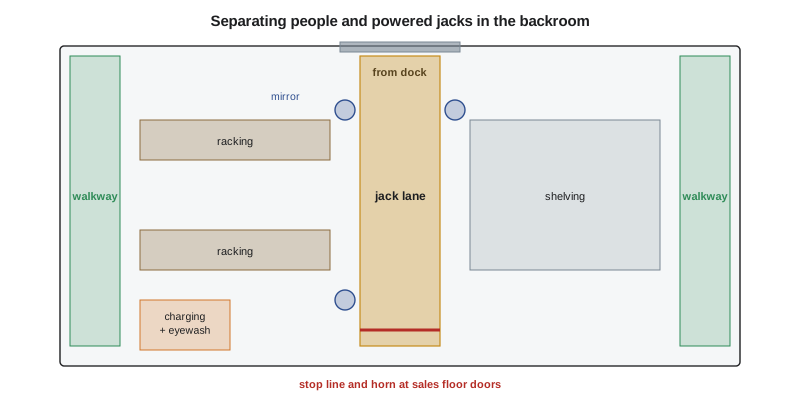
People and powered equipment in the same space
In a backroom, the people most at risk from a powered jack are usually not the operator but everyone else: coworkers breaking down pallets, vendors with hand trucks, contractors and, on the sales floor, customers. Separating people and vehicles is the most effective control. Northfield painted a yellow lane down the middle of the backroom from the dock to the sales floor doors and green walkways along the walls, put convex mirrors at two blind corners and at the doors, and made a rule that powered jacks stop at the doors and sound the horn before entering the sales floor. During store hours, powered jacks go onto the sales floor only for drinks and heavy stock in wide aisles, at turtle speed, with the aisle cleared or a second worker spotting.
Stores that use forklifts while open need much more: closing the aisle with barriers or chains, a spotter who keeps customers out of the work zone and away from the racking, working only at quiet times where possible, and never lifting loads over people. Several serious injuries and deaths in North American big-box stores have involved stock falling from high racking onto customers while it was being moved. Lesson 8 covers falling objects.
Training, evaluation and authorization
OSHA's powered industrial truck standard, 1910.178, and Washington's WAC 296-863 cover motorized pallet jacks as well as forklifts. Operators must complete training that combines formal instruction, practical training and an evaluation of their performance in the workplace, and the employer must certify that this has been done. Each operator's performance must be evaluated at least once every three years, and refresher training is required after an accident or near miss, after unsafe operation, when the operator is assigned a different type of truck or when workplace conditions change. Federal child labor rules bar workers under 18 from operating forklifts and similar powered hoisting equipment. Northfield applies the same rules to its walkie jacks and keeps a record of each operator's training and evaluation dates.
The program below checks Northfield's operator records and lists who is due for re-evaluation. A three-year cycle is used, with re-evaluation also required after an incident. The records are invented.
# Powered pallet jack operator records: who is due for re-evaluation (invented records).
from datetime import date, timedelta
today = date(2026, 11, 2)
cycle = timedelta(days=3 * 365)
operators = [   # name, age, last evaluation, incident since evaluation
    ("Tomás", 38, date(2025, 3, 14), False),
    ("Omar", 24, date(2023, 10, 30), False),
    ("Hana", 31, date(2023, 6, 2), False),
    ("Lee", 45, date(2024, 8, 19), True),
    ("Rosa", 52, date(2026, 1, 9), False),
    ("Jess", 17, None, False),
]
for name, age, last, incident in operators:
    if age < 18:
        print(f"{name}: not eligible (under 18)")
        continue
    if last is None:
        print(f"{name}: never evaluated - may not operate")
        continue
    due = last + cycle
    if incident:
        status = "re-evaluate now (incident since last evaluation)"
    elif due <= today:
        status = f"overdue since {due.isoformat()}"
    elif (due - today).days <= 90:
        status = f"due {due.isoformat()} (within 90 days)"
    else:
        status = f"current until {due.isoformat()}"
print(f"{name}: {status}")Tomás: current until 2028-03-13 Omar: overdue since 2026-10-29 Hana: overdue since 2026-06-01 Lee: re-evaluate now (incident since last evaluation) Rosa: current until 2029-01-08 Jess: not eligible (under 18)
Two operators have lapsed: Hana, who leads the overnight crew, and Omar, whose evaluation ran out only a few days ago. That matches the gap found in Lesson 2's self-check. Lee needs a re-evaluation because he was pinned against a rack upright last month, the incident in the example below. Jess is not eligible because she is under 18, whatever her experience. A list like this, kept up to date and checked monthly, is enough for most stores.
Charging the batteries
Electric pallet jacks run on batteries that need daily charging, and the charging area has its own hazards. HSE-322 covers battery hazards in depth; the basics for a store are these.
- Lead-acid batteries give off hydrogen while charging, especially near the end of the charge. Hydrogen is flammable from about 4% in air. Charge in a well-ventilated area away from sparks, flames and smoking, and never in a closed cupboard.
- Lead-acid batteries contain sulfuric acid. Wear eye protection and gloves when topping up water, and have an eyewash station or bottle nearby.
- Lithium-ion batteries do not give off hydrogen in normal use but can overheat and catch fire if damaged, overcharged or charged with the wrong charger. Use only the manufacturer's charger, do not charge a damaged battery, and keep the charging area clear of cardboard and other combustibles.
- Unplug the charger before disconnecting the battery, to avoid sparks at the connector.
The program below gives a rough idea of how much hydrogen a lead-acid jack battery can release during the finishing stage of a charge and what that would mean in a small closed room. The charging current and time are illustrative; real figures come from the charger and battery manufacturers, and the aim of the calculation is only to show why ventilation matters.
# Rough hydrogen release from charging one lead-acid pallet jack battery (illustrative).
cells = 12                 # a 24 V battery has 12 cells of about 2 V
finish_current = 10        # A during the gassing stage (illustrative)
hours = 3                  # length of the gassing stage (illustrative)
litres_per_ah_cell = 0.42  # about 0.42 L of hydrogen per ampere-hour per cell (Faraday's law, at 0 degrees C)
h2_litres = cells * finish_current * hours * litres_per_ah_cell
room_m3 = 3 * 3 * 2.5      # a small closed storeroom
pct = 100 * (h2_litres / 1000) / room_m3
print(f"Hydrogen released: about {h2_litres:.0f} L")
print(f"In a sealed {room_m3:.1f} m3 room: {pct:.2f}% hydrogen (flammable from about 4%)")
for batteries in (2, 3):
    print(f"{batteries} batteries in the same sealed room: {batteries * pct:.2f}%")
print("With even modest ventilation the hydrogen is carried away; never charge in a closed cupboard.")Hydrogen released: about 151 L In a sealed 22.5 m3 room: 0.67% hydrogen (flammable from about 4%) 2 batteries in the same sealed room: 1.34% 3 batteries in the same sealed room: 2.02% With even modest ventilation the hydrogen is carried away; never charge in a closed cupboard.
One battery in a sealed small room would reach about 0.7% hydrogen, and three batteries charging together about 2%, half of the lower flammable limit and well above the 1% that ventilation standards commonly aim to stay below. Real storerooms are not perfectly sealed and the gas does not mix evenly; hydrogen rises and can collect at the ceiling. That is why Northfield moved its charging area out of a small closed storeroom into an open corner of the backroom under an exhaust fan, with a sign banning smoking and open flames and an eyewash bottle on the wall.
For supervisors: keep the jacks for the people trained to use them
The most common powered jack problem in stores is not a mechanical fault but an untrained person using one because it was there. Keep the key or code with authorized operators and the supervisor. Make sure a powered jack is free and charged when heavy loads arrive, so nobody is tempted to move them by hand or borrow the jack without training. Watch for the habits that lead to injuries: walking backward in front of the jack, riding a walkie, using fast mode in the backroom, taping over or bypassing the belly button. Correct them on the spot, and re-evaluate an operator after any incident or near miss.
Worked problem
A pinch at the rack
Lee is reversing a walkie pallet jack into a rack bay, walking backward with the handle in front of him. He glances over his shoulder, misjudges the distance and is pressed against a rack upright. The belly button stops the jack, but his hip is bruised and the upright is dented. What went wrong, and what should happen next?
Show solution
- Lee was walking backward toward a fixed object, the classic pinch position.
- The belly button worked, which prevented a worse injury. Check that it still works and that nobody has tampered with it.
- Inspect the dented upright before anyone loads that bay (Lesson 7).
- Coach Lee to approach bays with the jack ahead of him or at an angle with the handle to the side, and to slow to turtle speed near racks.
- Record the incident and re-evaluate Lee before he operates again.
Answer: Lee was in the pinch position walking backward toward a rack. Check the belly button and the upright, coach the approach, record the incident and re-evaluate him.
Common mistakes
MistakeLetting anyone who has watched others use the powered jack.
InsteadAllow only workers who have been trained, evaluated and authorized.
MistakeWalking backward toward a rack or wall with the jack in front of you.
InsteadWalk beside the jack with the handle to the side, and slow down near fixed objects.
MistakeTaping over the reversing button because it stops the jack too often.
InsteadKeep it working; if it triggers often, the operating position needs to change.
MistakeCharging lead-acid batteries in a closed cupboard.
InsteadCharge in a ventilated area away from sparks and flames, with eye protection and an eyewash nearby.
MistakeDriving a powered jack onto a busy sales floor at full speed.
InsteadUse turtle mode, stop and sound the horn at the doors, and clear the aisle or use a spotter.
Summary and key terms
- Stores use walkie and rider pallet jacks, walkie stackers and sometimes forklifts.
- Main injuries: crushed feet, pinning against racks and walls, collisions with people and falling loads.
- Check the jack before use, walk beside it, use slow mode, keep feet clear and never ride a walkie.
- Separate people and powered equipment with lanes, walkways, mirrors and stop points.
- 1910.178 and WAC 296-863 require training, evaluation at least every three years and employer certification.
- Charge lead-acid batteries with ventilation, away from sparks; use only the right charger for lithium-ion.
- Keep powered jacks for authorized operators and make sure one is available when heavy loads arrive.
- Walkie pallet jack
- A powered pallet jack controlled by an operator walking beside or behind it.
- Walkie stacker
- A walk-behind powered truck with a mast that lifts pallets onto racking.
- Belly button
- The reversing switch on the end of a walkie handle that reverses the jack if it presses against the operator.
- Turtle mode
- A low-speed setting on a powered jack for tight spaces and areas with people.
- Operator evaluation
- A practical check by a qualified person that an operator can use the equipment safely in the workplace.
- Gassing
- The release of hydrogen and oxygen from a lead-acid battery near the end of charging.
Practice problems
Work each problem on paper first, then reveal the answer to check.
Name three types of powered equipment found in stores.
Show answer
Any three of: walkie pallet jack, rider pallet jack, walkie stacker, counterbalance forklift.
What is the classic pinch position with a walkie jack?
Show answer
Walking backward toward a fixed object with the jack in front of you.
What does the belly button do?
Show answer
It reverses the jack if the end of the handle presses against the operator.
Name three things to check before using a powered jack.
Show answer
Any three of: horn, brakes, belly button, throttle, steering, wheels, forks, battery and connector, leaks.
How should a powered jack go up and down a ramp?
Show answer
With the load uphill of the operator, never running downhill ahead.
What three parts must OSHA operator training include?
Show answer
Formal instruction, practical training and an evaluation in the workplace.
When must an operator be re-evaluated besides the regular cycle?
Show answer
After an incident or near miss, unsafe operation, a change of truck type or a change in workplace conditions.
Why does lead-acid battery charging need ventilation?
Show answer
Batteries release hydrogen while charging, which is flammable from about 4% in air.
Lesson quiz · 5 questions
Score 60% or more to complete this lesson.
Create a free account to save your progress, take quizzes and earn a certificate.