
HSE-342 · Lesson 3 of 12 · 26 min
Receiving: docks, trailers and deliveries
Receiving is where the store meets the trucking world. A tractor-trailer weighing many metric tons backs up to a raised dock, a dock leveler bridges the gap, and workers and pallet jacks cross back and forth between the store and the trailer while the driver waits, checks paperwork or tries to get to the next stop. At smaller stores, a box truck backs into a lane or parking lot and freight comes off a lift gate onto the pavement. Most of the time this goes smoothly. When it goes wrong, it can go very wrong: a trailer that moves away from the dock while a worker is inside, a pallet jack that drops into the gap, a worker who falls off the dock edge, or a pedestrian struck by a reversing truck.
HSE-218 Lesson 12 covers loading docks in detail for distribution centers and warehouses that use forklifts all day. This lesson covers what a store receiving crew needs to know, with manual and powered pallet jacks, a single dock and a mix of trucks and vendors.
Parts of a store dock
A typical store dock has a raised platform at about the height of a trailer floor, an overhead door, dock bumpers to stop the trailer hitting the building, a dock seal or shelter around the door, and a way to bridge the gap between the dock and the trailer. The bridge is either a dock leveler, which is a hinged steel ramp built into the dock that is raised and lowered by springs or hydraulics and has a lip that rests on the trailer floor, or a portable dock plate or dock board laid across the gap. Many docks also have lights that shine into the trailer, a light system to tell the driver when to stay put and when it is safe to leave, and a vehicle restraint that hooks the trailer's rear impact guard.
Northfield's dock has a mechanical leveler, bumpers, a seal, a dock light and a pair of wheel chocks on a chain. It does not yet have a powered vehicle restraint or a driver signal light. Direct-delivery vendors use the ground-level door beside the dock with hand trucks.
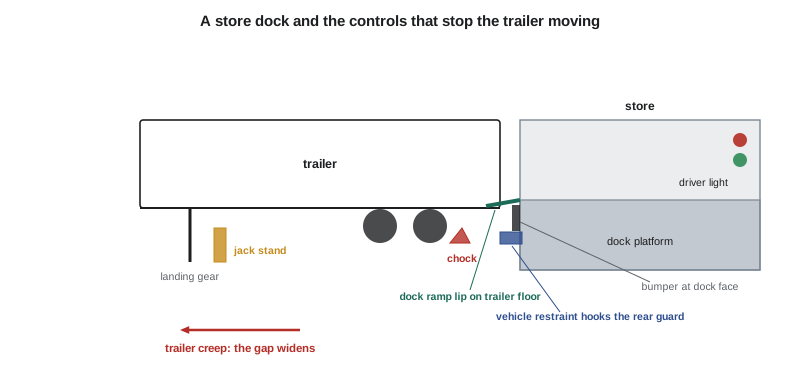
Trailer creep and early departure
Two of the most dangerous dock events are the trailer moving while people are working in it. Trailer creep is gradual movement away from the dock caused by the repeated push and pull of pallet jacks or forklifts braking and turning on the trailer floor, especially if the tractor's brakes are not set or the trailer has been dropped without its tractor. The gap between the dock and the trailer slowly widens until the leveler lip slips off the trailer and a pallet jack or worker falls through. Early departure is worse: the driver pulls away, thinking loading is finished or misunderstanding a signal, while a worker or pallet jack is still in the trailer or on the leveler.
The controls are simple and well proven:
- Restrain the trailer every time. A vehicle restraint that hooks the rear impact guard is the best option, because it holds the trailer even if the driver tries to leave, and many models have lights that show the driver and the dock crew whether the trailer is locked. Where there is no restraint, wheel chocks on both sides of the rear wheels, placed by the store, are the minimum.
- Control the keys or use a signal system. Many stores and carriers use a rule that the driver hands the keys to the receiver or stays in a set place until the receiver says it is safe. A red and green light at the door and in the driver's mirror tells everyone the status.
- Support dropped trailers. A trailer left without its tractor stands on its landing gear at the front. The weight of a pallet jack and load moving to the front of the trailer can make old or poorly set landing gear collapse or tip the trailer. Place a trailer jack stand under the front of any dropped trailer before anyone enters.
- Check before you enter. Look at the gap, the lip and the chocks or restraint each time you go in and out, not just at the start.
Dock levelers, dock plates and gaps
A dock leveler should rest with its lip fully on the trailer floor, at a slope the pallet jack can manage. Very high or very low trailers make the slope too steep; a steep slope is hard work with a manual jack and can make a powered jack lose traction or tip its load. A lip that rests on the very edge of the trailer floor can slip off. Damaged lips, broken hinges or springs and missing toe guards on the sides of the leveler are reasons to tag it out of service. Never stand on the leveler while it is moving, and keep feet clear of the gap at the sides.
Portable dock plates and dock boards must be strong enough for the heaviest combined load of jack, freight and operator, and they must be secured so they cannot slide. Each should be marked with its capacity. Aluminum plates are light enough to move by hand but have lower capacities than steel boards. A plate that bends, rocks or has a raised edge should be replaced. Northfield found that its spare dock plate had no capacity marking and a lip that caught pallet jack wheels; it was replaced.
Falls from the dock
A store dock is usually 4 ft (about 1.2 m) high. A fall from that height onto pavement can cause serious head and back injuries. Falls happen when a worker steps backward off an open dock door with no trailer present, when a pallet jack rolls off the edge, or when a worker jumps down to the ground instead of using the stairs. Keep the overhead door closed when no trailer is at the dock, or use a barrier, chain or dock gate across the opening. Paint the dock edge in a high-visibility color. Provide stairs or a ladder from the dock to the ground and require their use. In winter, keep the dock clear of snow and ice, and keep the apron where trucks stand salted or sanded.
Inside the trailer
Before entering a trailer, check that it is restrained, that the lip is properly placed and that the trailer is lit. Look at the floor for holes, soft spots and broken boards, which can trap a pallet jack wheel or a foot. Look at the load: has it shifted in transit, are any pallets leaning or broken, is anything stacked loosely near the doors that could fall when they are opened? Open swing doors from the side, not standing in front of them. Trailers in summer can be very hot inside; plan work and breaks accordingly, and see HSE-243 for heat stress.
Deliveries without a dock
Many smaller stores, and the vendor door at larger ones, receive freight without a dock. A box truck backs into a lane, lot or loading zone, and freight comes down a lift gate or is carried off by hand truck. The hazards change:
- Reversing vehicles: drivers have large blind spots behind a truck. Pedestrians, customers, children and store workers can be struck. Use a trained spotter who stays in the driver's view, mark a loading area with cones or paint, and keep store workers out of the reversing path.
- Lift gates: a lift gate can crush feet and fingers and can drop a load if it is overloaded or tilted. Only the driver or a trained person operates it, nobody rides it with a load that could shift, and loads are kept within its rated capacity.
- Hand trucks on slopes and curbs: a fully loaded hand truck going down a ramp or off a curb can run away. Keep loads below chest height so the operator can see over them, and go down slopes with the load behind you.
- Store hours: deliveries during opening hours bring trucks and pallets into contact with customers. Schedule them for quiet times or keep a clear barrier between the delivery area and customers.
Talking with drivers
Many dock incidents come down to two people assuming different things. The driver thinks unloading is done because the dock crew walked away; the crew thinks the driver knows they are still working. A short routine for every delivery removes the guesswork: greet the driver, confirm how the trailer will be restrained, confirm the key or light rule, agree who opens and closes the trailer doors, and say clearly when it is safe to leave. Northfield's driver rules sheet, introduced in Lesson 2, sets this out.
For supervisors: make the dock routine automatic
The best dock routines are the ones nobody has to think about. Keep the chocks on a chain right at the dock door so they cannot wander off. Put a checklist on the dock door with the four checks: restraint, lip, light, floor. Make the last check before releasing the truck a walk into the trailer to confirm nobody and nothing is left. Ask drivers to stay in the driver's lounge or another set place while unloading is under way. Report any leveler, plate or restraint problem the same day. When a worker skips a step, ask why: often the chocks were missing, the light was broken or the truck was late and the crew was rushed.
Scoring dock readiness
A simple checklist turns the controls above into a score for each delivery. It does not replace judgment, but it helps a crew notice when one or two controls are missing and helps a supervisor see patterns over a week. The program below scores three deliveries at Northfield on one morning. The weights are illustrative; a store would set its own, and any delivery missing a critical control should not start until it is fixed, whatever its score.
# Dock readiness check for each delivery (illustrative weights; critical items must all be met).
checks = {   # item: (weight, critical)
    "trailer restrained (chocks or restraint)": (5, True),
    "jack stand under dropped trailer": (5, True),
    "leveller lip fully on trailer floor": (4, True),
    "keys held or driver signal in use": (4, True),
    "trailer floor inspected": (2, False),
    "trailer interior lit": (2, False),
    "dock edge clear and marked": (1, False),
    "load inspected for shifting before entry": (2, False),
}
deliveries = {
    "06:00 DC truck (tractor attached)": {"trailer restrained (chocks or restraint)": True,
        "jack stand under dropped trailer": None, "leveller lip fully on trailer floor": True,
        "keys held or driver signal in use": True, "trailer floor inspected": True, "trailer interior lit": True,
        "dock edge clear and marked": True, "load inspected for shifting before entry": True},
    "09:30 dropped trailer, seasonal stock": {"trailer restrained (chocks or restraint)": True,
        "jack stand under dropped trailer": False, "leveller lip fully on trailer floor": True,
        "keys held or driver signal in use": None, "trailer floor inspected": False, "trailer interior lit": True,
        "dock edge clear and marked": True, "load inspected for shifting before entry": True},
    "13:15 DC truck (rushed, late)": {"trailer restrained (chocks or restraint)": False,
        "jack stand under dropped trailer": None, "leveller lip fully on trailer floor": True,
        "keys held or driver signal in use": False, "trailer floor inspected": False, "trailer interior lit": True,
        "dock edge clear and marked": False, "load inspected for shifting before entry": True},
}
for name, res in deliveries.items():
    applicable = {k: v for k, v in res.items() if v is not None}
    possible = sum(checks[k][0] for k in applicable)
    got = sum(checks[k][0] for k, v in applicable.items() if v)
    missing_critical = [k for k, v in applicable.items() if not v and checks[k][1]]
    status = "STOP: " + "; ".join(missing_critical) if missing_critical else "ready"
print(f"{name}: {got}/{possible} ({100 * got / possible:.0f}%) -> {status}")06:00 DC truck (tractor attached): 20/20 (100%) -> ready 09:30 dropped trailer, seasonal stock: 14/21 (67%) -> STOP: jack stand under dropped trailer 13:15 DC truck (rushed, late): 8/20 (40%) -> STOP: trailer restrained (chocks or restraint); keys held or driver signal in use
The early truck scores full marks. The dropped trailer has its chocks in place but no jack stand, and that alone stops the job even though two-thirds of the points are there, which is exactly why a single percentage is not enough. The late afternoon truck is the worst, missing both the restraint and the key rule. It is no accident that the rushed delivery is the one where controls slipped. Lesson 12 uses a week of these checks to decide whether Northfield should install a powered vehicle restraint and a driver signal light.
Worked problem
A trailer that moved
During a busy afternoon, Omar drives a powered pallet jack in and out of a trailer six times. On the seventh trip he notices the leveler lip is resting on only the last few centimeters of the trailer floor and there is a widening gap at the side. The truck's tractor is attached and the driver is in the cab. No chocks were placed. What should Omar do, and what should change?
Show solution
- Stop. Do not drive back into the trailer or onto the leveler.
- Tell the driver not to move and ask them to set the brakes. Tell Tomás.
- Once the driver has confirmed the brakes are set, place the chocks, reset the leveler with the lip fully on the trailer floor, and check the trailer floor at the edge for damage.
- Record it as a near miss. Ask why the chocks were not placed: were they missing, was the crew rushed, did nobody own the step?
- Longer term, consider a vehicle restraint with lights and make the restraint check part of every entry, not only the first.
Answer: Omar stops, has the driver set the brakes, chocks the trailer and resets the leveler before continuing, and the event is reported as a near miss so the cause can be fixed.
Common mistakes
MistakeRelying on the driver to set the brakes and stay put.
InsteadRestrain the trailer every time with a vehicle restraint or chocks placed by the store.
MistakeEntering a dropped trailer without a jack stand.
InsteadPut a jack stand under the front of any trailer standing on its landing gear.
MistakeLeaving the overhead door open with no trailer at the dock.
InsteadClose the door or put a barrier across the opening, and mark the dock edge.
MistakeJumping down from the dock to the ground.
InsteadUse the stairs or ladder provided.
MistakeStanding behind a reversing truck to guide it.
InsteadSpot from the side, in the driver's mirror view, and keep others out of the reversing path.
Summary and key terms
- A store dock includes bumpers, a seal, a leveler or plate, lights and ideally a vehicle restraint and signal system.
- Trailer creep and early departure can drop a worker or pallet jack into the gap; restrain the trailer every time.
- Dropped trailers need a jack stand under the front before anyone enters.
- The leveler lip must rest fully on the trailer floor at a manageable slope; dock plates must be rated and secured.
- Prevent falls from the dock with closed doors or barriers, marked edges and stairs.
- Without a dock, control reversing trucks with spotters and marked areas, and use lift gates and hand trucks safely.
- A short routine with every driver removes confusion about when it is safe to leave.
- Dock leveler
- A hinged steel ramp built into a dock that bridges the gap to the trailer floor.
- Dock plate
- A portable plate laid across the gap between a dock and a trailer.
- Trailer creep
- Gradual movement of a trailer away from the dock caused by equipment moving in and out.
- Early departure
- A truck pulling away from the dock while people or equipment are still in the trailer or on the leveler.
- Vehicle restraint
- A device on the dock that hooks the trailer's rear impact guard to hold it in place.
- Jack stand
- A support placed under the front of a dropped trailer to stop it tipping or its landing gear collapsing.
Practice problems
Work each problem on paper first, then reveal the answer to check.
What causes trailer creep?
Show answer
The repeated push and pull of equipment moving in and out of the trailer, especially if brakes are not set or the trailer is dropped.
What is the minimum control where there is no vehicle restraint?
Show answer
Wheel chocks on the rear wheels, placed by the store, every time.
Why does a dropped trailer need a jack stand?
Show answer
The weight of a jack and load at the front can collapse the landing gear or tip the trailer.
Name two signs that a dock leveler should be taken out of service.
Show answer
Any two of: damaged lip, broken hinges or springs, missing toe guards, a lip that does not rest fully on the trailer.
How should a worker get from the dock to the ground?
Show answer
By the stairs or ladder, never by jumping.
Where should a spotter stand when guiding a reversing truck?
Show answer
To the side, where the driver can see them in the mirror, never behind the truck.
In the scoring program, why does the dropped trailer stop despite a high score?
Show answer
It is missing a critical control, the jack stand, and any missing critical control stops the job.
What four checks should be made on every entry into a trailer?
Show answer
Restraint, lip, light and floor.
Lesson quiz · 5 questions
Score 60% or more to complete this lesson.
Create a free account to save your progress, take quizzes and earn a certificate.