
HSE-342 · Lesson 1 of 12 · 27 min
The retail backroom and its hazards
Customers see the shelves, the checkouts and the displays. Behind the swinging doors at the back of the store is a different workplace. Trucks back up to the building, pallets of freight come off them, workers break down loads with pallet jacks and carts, stock goes up onto racks and shelving, cardboard is crushed in a baler, garbage goes into a compactor, and online orders are picked and staged for pickup. Much of this work happens early in the morning, late at night or on weekends, often with a small crew and often in a hurry to get product onto the floor before the store opens.
This is the third and last course in the retail sites track. HSE-340 covered the hazards of the sales floor: stocking shelves, step stools, box cutters, coolers, spills and crowds. HSE-341 covered robbery and aggressive customers. This course follows the freight from the truck to the shelf and the waste from the shelf to the baler, and covers the hazards along the way: docks and deliveries, unloading, manual and powered pallet jacks, racking and storage up high, balers and compactors, lockout and housekeeping.
Some topics in this course are taught in depth in other courses, and this course points to them rather than repeating them. HSE-107 covers manual handling and ergonomics, including the NIOSH lifting equation and pushing and pulling. HSE-218 covers forklifts and other powered mobile equipment in detail, including loading docks in large warehouses. HSE-210 covers lockout and the control of hazardous energy in every kind of workplace. HSE-212 covers falls and fall protection, HSE-104 covers personal protective equipment, and HSE-322 covers battery charging and lithium-ion hazards. This course applies those lessons to the scale and pace of a store backroom.
We continue to follow Northfield Market in Spokane, Washington, the grocery and general merchandise store from HSE-340 and HSE-341. Store manager Priya Nair and safety lead Marco Delgado appear again, along with stocker Omar, front-end supervisor Sam and part-time workers Jess, who is 17, and Kai, who is 15. Two new people join the story. Tomás Reyes is the receiving lead, who runs the dock on day shift. Hana Kim leads the overnight stocking crew of five to seven people.
What happens in a backroom
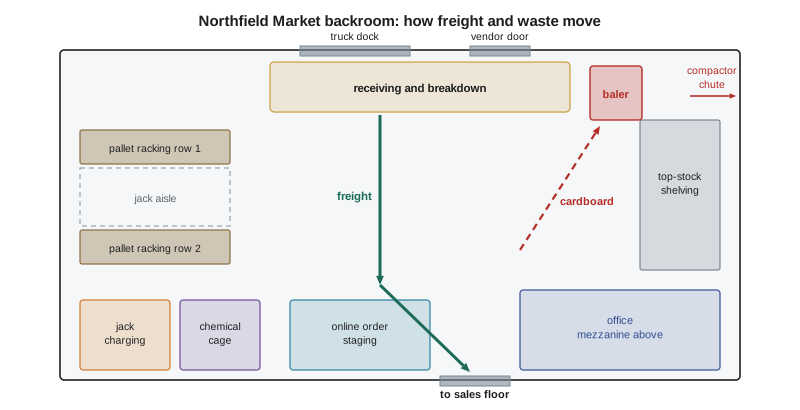
Every store's backroom is different, but most handle the same flows of goods and waste. Understanding the flows makes the hazards easier to see, because most injuries happen where something is being moved, lifted, stored or crushed.
- Receiving: trucks from the company's distribution center arrive on a schedule, usually with full pallets or roll cages. Vendors who deliver directly to the store, such as bread, snack, soft drink and dairy suppliers, arrive through the day with hand trucks or small loads.
- Breakdown and staging: pallets are broken down by department and moved to the sales floor on pallet jacks, carts and U-boats, or held in the backroom as overstock.
- Storage: overstock and seasonal goods go onto pallet racking, top-stock shelving, a mezzanine or, too often, any flat surface that is free.
- Waste and recycling: cardboard from opened cases goes to the baler; plastic wrap, garbage and damaged goods go to bins and the compactor; returns go back on the truck.
- Online orders: in many stores a growing share of goods is picked for online and curbside orders, staged in totes and carried to cars.
Northfield's backroom
Northfield's backroom is about the size of a large house. At the back wall is one truck dock with a dock leveler and an overhead door, and beside it a ground-level door used by direct-delivery vendors. Along one side are two rows of selective pallet racking with three beam levels, the top level 16 ft (about 4.9 m) above the floor. Between them is a wide aisle for pallet jacks. Steel top-stock shelving lines the other walls. A vertical cardboard baler stands near the dock door, and a self-contained garbage compactor sits outside, fed through a chute in the wall. Above the backroom office is a mezzanine used for seasonal stock, reached by a staircase. A charging area for the store's three powered pallet jacks is in one corner, and a fenced cage holds cleaning chemicals, aerosols and pool supplies. Near the front of the backroom, a small area with shelving and a cooler is used to stage online orders.
How backroom workers get hurt
The injuries in a backroom are mostly the same few kinds, repeated. Overexertion from lifting, pushing, pulling and carrying is the largest group in retail and wholesale work, followed by slips, trips and falls, and contact with objects and equipment, which includes being struck by falling stock, caught between a pallet jack and a wall, cut by strapping or run over by a pallet jack wheel. Less often but much more seriously, workers are crushed in balers and compactors, struck by forklifts or trucks, or injured in falls from racking, mezzanines or dock edges.
National injury statistics show the pattern. In Canada and the United States, retail trade and warehousing have some of the highest numbers of lost-time injuries of any sector, mostly because so many people work in them and because so much of the work is manual handling. Within a store, the backroom usually produces a larger share of serious injuries than its share of workers would suggest, because that is where the heavy loads, the equipment and the heights are concentrated.
| Hazard | Typical backroom examples | Where in this course |
|---|---|---|
| Manual handling and overexertion | Unloading floor-loaded cases, lifting heavy cases onto top-stock shelving, pushing loaded pallet jacks | Lessons 4 and 5 (and HSE-107) |
| Vehicles and docks | Trailer creep, gaps at the dock edge, delivery trucks reversing, falls off the dock | Lesson 3 (and HSE-218) |
| Powered pallet jacks and forklifts | Crushed feet, pinned against racking, collisions with pedestrians | Lesson 6 (and HSE-218) |
| Storage and falling objects | Overloaded or damaged racking, stock falling from height, unstable stacks | Lessons 7 and 8 |
| Falls from height | Climbing racking, mezzanine edges, standing on pallets or the top of a cooler | Lesson 8 (and HSE-212) |
| Balers and compactors | Reaching into the chamber, clearing jams, bale ejection, chutes | Lessons 9 and 10 (and HSE-210) |
| Housekeeping and fire | Blocked exits, cardboard piles, cords and wrap on the floor, chemicals stored badly | Lesson 11 |
| Cuts | Strapping, stretch wrap, box cutters, broken glass | Lesson 4 (and HSE-340 Lesson 6) |
Why the backroom is harder to manage than the sales floor
Several features of backroom work make hazards easier to overlook. The first is pace. Freight has to be on the shelves before the store opens or before the evening rush, and a late truck squeezes the whole schedule. Workers under time pressure lift more than they should, skip the pallet jack in favor of carrying, leave cardboard on the floor for later and reach into the baler instead of shutting it off. Good backroom safety is mostly about making the safe way also the fast way.
The second is space. Many backrooms were sized for a store that sold fewer goods and handled no online orders. As volumes grow, freight spills into aisles, in front of exits and on top of anything flat. The third is crew structure. Overnight and early-morning crews are often small, may not include a supervisor, and often include young or new workers. Help and first aid are further away. HSE-352 covers working alone and late-night safety in detail; this course points to it where the backroom raises those issues.
The fourth is that the backroom is shared with people who do not work for the store. Truck drivers, vendors stocking their own products, contractors servicing the baler or the refrigeration and cleaning crews all pass through. Each has their own employer and their own idea of how things are done. Lesson 2 explains who is responsible for what.
Northfield's backroom injuries
When Marco Delgado reviewed three years of Northfield's injury reports, the backroom stood out. About 35 of Northfield's 90 workers spend most of their time in receiving, stocking or online order picking, yet that group accounted for more than half of the store's recordable injuries. Most were strains from lifting and pushing. Others were feet run over by pallet jacks, a hand caught between a pallet jack handle and a rack upright, a cut from steel strapping, and a fall from a pallet that a worker had stood on to reach top stock. There were also several near misses that were never written down as incidents, including a trailer that moved away from the dock while a worker was inside it and a stocker who reached into the baler chamber to straighten a box while the gate was open.
The program below takes a synthetic three-year injury list, groups it by type and works out what share of injuries came from each part of the store compared with the share of hours worked there. The numbers are invented for the course, but the pattern is typical of grocery and general merchandise stores.
# Share of injuries by area versus share of hours worked (synthetic three-year data).
hours = {"sales floor and checkouts": 300000, "backroom and receiving": 150000, "online orders": 66000}
injuries = [
    ("backroom and receiving", "lifting strain"), ("backroom and receiving", "lifting strain"),
    ("backroom and receiving", "pushing strain"), ("backroom and receiving", "foot run over by pallet jack"),
    ("backroom and receiving", "hand caught against rack"), ("backroom and receiving", "cut from strapping"),
    ("backroom and receiving", "fall from pallet"), ("backroom and receiving", "lifting strain"),
    ("online orders", "lifting strain"), ("online orders", "slip in cooler"),
    ("sales floor and checkouts", "box cutter cut"), ("sales floor and checkouts", "slip on spill"),
    ("sales floor and checkouts", "cashier tendinitis"), ("sales floor and checkouts", "lifting strain"),
    ("sales floor and checkouts", "struck by cart"),
]
total_h = sum(hours.values())
total_i = len(injuries)
print(f"{'area':28}{'hours %':>9}{'injuries %':>12}{'rate per 200,000 h':>20}")
for area, h in hours.items():
    n = sum(1 for a, _ in injuries if a == area)
    print(f"{area:28}{100 * h / total_h:9.0f}{100 * n / total_i:12.0f}{200000 * n / h:20.2f}")
kinds = {}
for _, k in injuries:
    kinds[k] = kinds.get(k, 0) + 1
print("Most common:", ", ".join(f"{k} ({v})" for k, v in sorted(kinds.items(), key=lambda x: -x[1])[:3]))area hours % injuries % rate per 200,000 h sales floor and checkouts 58 33 3.33 backroom and receiving 29 53 10.67 online orders 13 13 6.06 Most common: lifting strain (5), pushing strain (1), foot run over by pallet jack (1)
The backroom and receiving area has about 29% of the hours but more than half of the injuries, and its rate per 200,000 hours is roughly three times the sales floor's. Online order picking also runs above the sales floor. Lifting strains are the most common single type. That tells Marco where to start: manual handling and pallet jack use in receiving and stocking. The rate per 200,000 hours is the same one used in HSE-340 and is roughly the number of injuries per 100 full-time workers per year.
The hierarchy of controls in the backroom
The same hierarchy of controls used throughout the safety courses applies here. Eliminating a hazard or substituting something less dangerous comes first, then engineering controls, then administrative controls such as procedures, training and schedules, and personal protective equipment last. In a backroom, that often looks like this:
- Elimination and substitution: ask the distribution center to deliver on pallets rather than floor-loaded; buy cases in smaller sizes; replace a vertical baler with a horizontal one that does not need hand feeding; stop storing stock on top of the walk-in cooler.
- Engineering: vehicle restraints at the dock, powered pallet jacks for heavy loads, rack column protectors and anchoring, baler interlocks, mezzanine guardrails and gates, good lighting.
- Administrative: delivery schedules that spread trucks through the day, rules for who may use the baler and pallet jacks, a lockout procedure, inspection checklists, a clear-aisle rule.
- PPE: safety footwear, cut-resistant gloves for strapping and cases, high-visibility vests on the dock where trucks move, eye protection when cutting strapping.
Look at how much of the list is engineering and organization rather than PPE. Safety boots help when a pallet jack rolls onto a foot, but a store that schedules trucks so the crew is not rushed, keeps aisles clear and buys powered jacks for heavy loads will have fewer feet in the way in the first place.
For supervisors: walk the freight path
One of the most useful things a supervisor can do is follow a single pallet from the truck to the shelf and the cardboard from the shelf to the baler, watching how each step is done. Where does the worker have to lift from the floor, reach high or twist? Where does the pallet jack have to squeeze past something? Where is the cardboard left while it waits for the baler? Where does a worker have to wait, and what do they do while waiting? The walk takes about half an hour and usually shows two or three easy fixes, such as moving a staging area, clearing an aisle or changing the order in which departments are worked.
Worked problem
Following a pallet through the backroom
Marco follows a mixed pallet of canned goods and paper products from the 6 a.m. truck. Tomás unloads it with a manual pallet jack across the dock plate, which has a lip that catches the wheels. It waits in the breakdown area for 40 minutes because the aisle to the floor is blocked by a pallet of seasonal stock. Omar then breaks it down by hand, lifting cases of cans from the bottom layer at floor level onto a U-boat, and leaves the empty cases on the floor beside the baler, which already has a pile next to it. What does Marco see, and what should change?
Show solution
- Dock: the lip on the dock plate makes the manual jack hard to start and could tip a load. Check the plate and the leveler (Lesson 3).
- Aisle: seasonal stock is blocking the main aisle. Give it a place on the racking or the mezzanine so the aisle stays clear (Lessons 7 and 11).
- Lifting: cases are lifted from floor level. A pallet positioner, a lift table or simply working the top layers first and raising the pallet on a powered jack reduces bending (Lesson 4).
- Cardboard: empty cases on the floor create a trip and fire hazard. Bale as you go or use a cardboard cart (Lessons 9 and 11).
Answer: Four problems in one short path: a dock plate lip, a blocked aisle, floor-level lifting and loose cardboard. Each has a simple fix, and together they also save time.
Common mistakes
MistakeTreating the backroom as an extension of the sales floor with the same hazards.
InsteadRecognize the backroom hazards: docks, vehicles, heavy freight, powered equipment, height and balers.
MistakeCounting only injuries that cause lost time.
InsteadRecord near misses too, such as a trailer moving or someone reaching into the baler; they show where serious injuries will come from.
MistakeRelying on PPE as the main control.
InsteadUse the hierarchy: eliminate, substitute and engineer first, then procedures and training, with PPE as the last layer.
MistakeLetting time pressure decide how freight is handled.
InsteadPlan deliveries and crews so the safe way is also the fast way.
MistakeAssuming drivers, vendors and contractors know the store rules.
InsteadTell them the rules for the dock, the backroom and the baler, and supervise them (Lesson 2).
Summary and key terms
- The backroom handles freight from truck to shelf and waste from shelf to baler, often under time pressure and with small crews.
- Most backroom injuries are overexertion, slips and trips, and contact with objects and equipment; the most serious involve balers, vehicles, forklifts and falls.
- Backroom areas often have a higher injury rate per hour than the sales floor.
- Pace, space, crew structure and shared workspaces make backroom hazards easy to overlook.
- The hierarchy of controls applies: eliminate and engineer first, PPE last.
- Following a pallet and a load of cardboard through the backroom is a quick way to find hazards.
- Backroom
- The non-public part of a store used for receiving, storage, breakdown, waste handling and order picking.
- Receiving
- Accepting deliveries from trucks and vendors, checking them and moving them into the store.
- Overstock
- Stock held in the backroom because there is no room for it on the sales floor.
- Direct-delivery vendor
- A supplier who delivers to the store and often stocks its own products, rather than shipping through the distribution center.
- Breakdown
- Splitting mixed pallets into loads for each department or aisle.
- Near miss
- An event that could have caused injury or damage but did not.
Practice problems
Work each problem on paper first, then reveal the answer to check.
Name the five main flows of goods and waste in a store backroom.
Show answer
Receiving, breakdown and staging, storage, waste and recycling, and online order picking.
What are the three largest groups of backroom injuries?
Show answer
Overexertion, slips, trips and falls, and contact with objects and equipment.
Name three backroom hazards that are less common but can kill.
Show answer
Any three of: balers and compactors, forklifts, trucks at the dock, falls from racking or mezzanines.
Why does time pressure matter so much in the backroom?
Show answer
Workers under pressure lift too much, skip equipment, leave cardboard on the floor and take shortcuts at the baler.
Give one example each of an engineering control and an administrative control for the backroom.
Show answer
For example, a vehicle restraint at the dock (engineering) and a delivery schedule that spreads trucks out (administrative).
In the Northfield analysis, why is the injury rate a better measure than the number of injuries?
Show answer
It allows for how many hours are worked in each area, so areas of different size can be compared.
What is a near miss, and why record it?
Show answer
An event that could have hurt someone but did not; it shows where serious injuries are likely.
What does a supervisor learn by following a pallet through the backroom?
Show answer
Where workers lift from the floor or reach high, where equipment is blocked, where waste piles up and where time is lost.
Lesson quiz · 5 questions
Score 60% or more to complete this lesson.
Create a free account to save your progress, take quizzes and earn a certificate.