
HSE-342 · Lesson 4 of 12 · 25 min
Unloading freight safely
Once the trailer is safely restrained, the real work begins: getting freight off the truck and into the store. Unloading is where most backroom strains happen. A single distribution center truck can carry a thousand or more cases, some of them heavy, awkward or fragile, and a receiving crew of two or three may move them all in a couple of hours. This lesson covers the two main kinds of load, how to set up the work so most lifting happens in the comfortable zone between knees and shoulders, conveyors, strapping and wrap, unstable loads and how to plan the crew so the pace is sustainable.
HSE-107 covers manual handling in depth, including the NIOSH lifting equation, risk assessment tools, lifting technique and team lifts. HSE-340 Lesson 3 applied it to stocking shelves. This lesson applies the same ideas to unloading and does not repeat the theory.
Palletized and floor-loaded freight
Freight arrives in one of two main ways. Palletized freight is stacked and wrapped on pallets, which are moved off the trailer with a pallet jack and broken down in the backroom. Floor-loaded freight is stacked case by case directly on the trailer floor, floor to ceiling, and every case has to be handled by hand or slid onto a conveyor. Floor-loading lets a carrier fit more on a truck, which is why some suppliers and parcel carriers use it, but it means much more lifting for the store, often at the worst heights: the bottom layer is at the floor and the top layer is above the head.
Most of Northfield's distribution center freight is palletized, but two suppliers floor-load: a paper products supplier and a pet food supplier. The pet food truck is the one the crew dreads. Bags of dry dog food weigh up to 40 lb (about 18 kg), and the bottom rows sit on the trailer floor. When Marco asked the crew where they hurt after a long receiving shift, the pet food truck came up again and again.
The comfortable zone
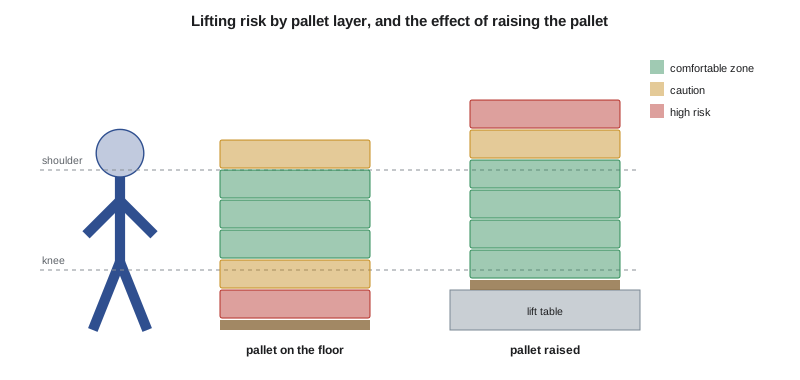
Lifting is easiest on the body when the load is close to the body and between about knee and shoulder height, sometimes called the power zone. Lifting from the floor, reaching above the shoulders, twisting and reaching out are what turn a manageable case into a strain. The most effective controls change the work so most lifts are in the comfortable zone:
- Raise the work. Put the pallet being broken down on a pallet positioner, a lift table or a powered jack raised a little, so the bottom layers come up toward the comfortable zone. Some stores use spring-loaded pallet carousels that rise as layers are removed.
- Lower the top. Work the top layers onto a cart at chest height rather than lifting them down to the floor, and use a step platform rather than reaching above the head.
- Slide, do not lift. Pull a case across onto a cart or conveyor at the same height rather than lifting it up and down.
- Keep it close. Step in toward the load and turn the feet rather than twisting the back.
- Split heavy items. Two people lift cases over the store's team-lift weight, and bags of salt, litter and pet food are handled with a hand truck or conveyor where possible.
Conveyors
Roller and skate-wheel conveyors let cases be pushed rather than carried from the trailer into the store, and extendable conveyors reach deep into a floor-loaded trailer so workers only lift a case once onto the belt. They remove a large share of carrying, but they bring their own hazards.
- Pinch points: fingers and clothing can be caught where rollers meet the frame, at transfers between sections and where a belt runs onto a pulley. Powered conveyors must have guards at these points.
- Emergency stops: powered conveyors need stop buttons or pull cords along their length, within easy reach, and everyone working near the conveyor needs to know where they are.
- Climbing and crossing: never climb on, sit on or step over a conveyor. Use a crossover or walk around.
- Jams: clear jams on a powered conveyor only after stopping it and, if hands go near moving parts, locking it out (Lesson 10).
- Ends and gaps: a case running off the end of a gravity conveyor can drop onto feet. Use end stops and keep the receiving end staffed.
- Loose clothing, long hair and jewelry: keep them away from rollers and belts.
Strapping, wrap and cutting
Pallets arrive held together with stretch wrap, plastic strapping and sometimes steel strapping. Steel strapping is under tension and can spring back violently when cut, cutting faces and hands. Cut it with proper strapping cutters, not a box cutter or knife, stand to the side of the strap, hold the strap near the cut, and wear safety glasses and cut-resistant gloves. Plastic strapping is less dangerous but can still flick. Stretch wrap is best cut with a safety cutter or a wrap-cutting tool that keeps the blade away from the hand and the product. Gather cut strapping and wrap at once; loops on the floor are a trip hazard and can catch pallet jack wheels. HSE-340 Lesson 6 covers box cutters and glove cut levels.
Unstable loads, damaged pallets and broken glass
Loads shift in transit. Before breaking down a pallet, walk around it. A pallet that is leaning, has a crushed corner or broken bottom boards, or has cases hanging over the edge can collapse when the wrap is cut. Cut wrap from the top down on the side away from you, and be ready to step back. Heavy cases stacked on top of light ones may have crushed them. Broken glass, leaking liquids and burst bags of powder are common; handle them with gloves, use a dustpan and broom or a spill kit, not bare hands, and check the safety data sheet for any leaking chemical product. Broken pallets should be taken out of use and stacked for return or disposal, not reused for storage.
Heavy and awkward items
Every store has a few items that cause a large share of strains: cases of bottled water, bags of salt, cat litter and pet food, cases of canned goods, large appliances, patio furniture and garden products in spring, and bulk paper products that are light but bulky. Northfield keeps a short list of these items in the receiving area, with how each should be handled: by two people, with a hand truck, with a powered jack, or only by workers over 18. It also asked its distribution center to put the heaviest items on the bottom of mixed pallets but never on the floor-level layer of a floor-loaded truck, and to label cases over 50 lb (23 kg) with their weight.
Planning the crew and the pace
The speed of unloading is set by the number of cases, the crew, the equipment and the time available. When a truck is late or the crew is short, the same number of cases has to be moved by fewer people in less time, and lifting rates go up. Sustained high lifting rates are one of the clearest risk factors for back injury. Planning the crew in advance, and knowing when to call for help or delay part of the work, protects workers.
The program below estimates how long the pet food truck will take with different crews and works out each worker's lifting rate. It uses an illustrative planning limit on lifts per worker per hour for loads of this weight; the right limit for a store comes from an ergonomic assessment of its own work, and HSE-107 explains how to do one.
# Unloading plan for a floor-loaded pet food truck (illustrative rates and limits).
cases = 1150                  # bags and cases on the truck
heavy_share = 0.45            # share over 15 kg, handled more slowly
rate_light = 220              # light cases per worker per hour with a conveyor (illustrative)
rate_heavy = 120              # heavy bags per worker per hour with a conveyor (illustrative)
limit_heavy_per_hour = 100    # illustrative planning limit for heavy lifts per worker per hour
heavy = round(cases * heavy_share)
light = cases - heavy
for crew in (2, 3, 4):
    # time is set by the work split evenly across the crew
    hours = (light / rate_light + heavy / rate_heavy) / crew
    heavy_per_worker_hour = heavy / crew / hours
    flag = "over limit" if heavy_per_worker_hour > limit_heavy_per_hour else "within limit"
    print(f"crew {crew}: {hours:4.1f} h, {heavy_per_worker_hour:5.0f} heavy lifts per worker per hour ({flag})")
# same truck with only 1.5 hours available and 2 people
crew, hours = 2, 1.5
need_rate = heavy / crew / hours
print(f"rushed: 2 people in 1.5 h means {need_rate:.0f} heavy lifts per worker per hour")crew 2: 3.6 h, 72 heavy lifts per worker per hour (within limit) crew 3: 2.4 h, 72 heavy lifts per worker per hour (within limit) crew 4: 1.8 h, 72 heavy lifts per worker per hour (within limit) rushed: 2 people in 1.5 h means 173 heavy lifts per worker per hour
The numbers show something that surprises many supervisors: adding people shortens the job but does not change each person's lifting rate, because the work is split evenly and the time shrinks in proportion. With these assumptions, every crew size runs at about 72 heavy lifts per worker per hour, inside the illustrative limit. The danger is the last line. If the truck arrives late and the same two people have to finish in an hour and a half, the rate jumps to about 173 heavy lifts per hour, far over the limit. The control is not only crew size; it is protecting the time. If the truck is late, the plan should be to bring in a third person, delay stocking part of the load, or ask for help from the floor, not to have two people lift twice as fast.
Rotation and breaks
Rotating workers between unloading, breakdown, stocking and lighter tasks spreads the load across different muscle groups and gives time to recover. Short breaks during a long unload help more than one long break at the end. Hydration matters, especially in a hot trailer in summer or a cold one in winter. Warm-up stretching before a shift is popular, but the evidence that it prevents strains on its own is weak; it is no substitute for reducing the loads and the pace.
For supervisors: three questions before every truck
Before each truck, ask three questions. What is on it, and is any of it floor-loaded or unusually heavy? Who is on the crew, and are any of them new, young or coming back from an injury? How much time is there, and what will happen if the truck is late? The answers tell you whether to set up the conveyor, bring the lift table to the breakdown area, call in a third person or plan to leave some stocking until later. Writing the answers on the receiving board takes two minutes and gives the crew a shared plan.
Worked problem
Rethinking the pet food truck
The pet food truck arrives every Tuesday at 7 a.m. with about 1,150 floor-loaded bags and cases. Two workers unload it by hand, carrying each bag 33 ft (about 10 m) from the trailer to a pallet in the backroom. Three strains have been reported from this task in a year. What should Northfield change?
Show solution
- Eliminate or substitute: ask the supplier whether it can deliver on pallets. If not, ask for the heaviest bags to be loaded above floor level.
- Engineering: use the extendable conveyor from the trailer to the backroom so bags are lifted once, not carried. Put the receiving pallet on a lift table so bags are placed at waist height.
- Administrative: plan a crew of three, rotate the person in the trailer every 30 minutes, and protect the time by not scheduling another truck until the unload is done.
- Review: after a month, ask the crew how it feels and check the injury and discomfort reports.
Answer: Ask for pallets or better load order, use the conveyor and a lift table, plan a crew of three with rotation, and protect the unloading time.
Common mistakes
MistakeLifting the bottom layer of a pallet from the floor all day.
InsteadRaise the pallet on a lift table, positioner or powered jack so lifts are closer to waist height.
MistakeCutting steel strapping with a box cutter while standing in front of it.
InsteadUse strapping cutters, stand to the side, hold the strap and wear eye protection and gloves.
MistakeStepping over a running conveyor to save time.
InsteadWalk around it or use a crossover, and stop it before reaching in.
MistakeCutting the wrap off a leaning pallet from the low side.
InsteadWalk around it first, cut from the top on the side away from you and be ready to step back.
MistakeAsking two people to work twice as fast when the truck is late.
InsteadAdd people, delay some stocking or ask for help, so the lifting rate stays sustainable.
Summary and key terms
- Floor-loaded freight means far more lifting, often at the worst heights, than palletized freight.
- Keep most lifts between knee and shoulder height by raising pallets, sliding loads and working top layers onto carts.
- Conveyors cut carrying but need guards, emergency stops and lockout for jams.
- Cut steel strapping with proper cutters from the side, wearing eye protection and gloves.
- Check pallets for leaning, damage and shifted loads before cutting the wrap.
- Keep a list of heavy and awkward items with how each should be handled.
- Plan the crew and protect the time; a late truck should not double the lifting rate.
- Floor-loaded
- Freight stacked case by case on a trailer floor rather than on pallets.
- Palletized
- Freight stacked and wrapped on pallets so it can be moved as a unit.
- Comfortable zone
- The height range between about knee and shoulder, close to the body, where lifting is least stressful.
- Lift table
- A table that raises a load or pallet to a comfortable working height.
- Extendable conveyor
- A conveyor that extends into a trailer so cases are lifted once onto it.
- Strapping cutter
- A tool designed to cut strapping safely while holding the cut end.
Practice problems
Work each problem on paper first, then reveal the answer to check.
Why is floor-loaded freight harder on workers than palletized freight?
Show answer
Every case is handled by hand, and the bottom and top layers are at floor level and above the head.
Name three ways to keep lifts in the comfortable zone.
Show answer
Any three of: raise the pallet, work top layers onto a cart at chest height, slide rather than lift, keep the load close, use two people or equipment for heavy items.
What two safeguards should every powered conveyor have?
Show answer
Guards at pinch points and emergency stops within reach along its length.
How should steel strapping be cut?
Show answer
With strapping cutters, standing to the side, holding the strap, wearing eye protection and cut-resistant gloves.
What should you do before cutting the wrap off a pallet?
Show answer
Walk around it and check for leaning, damage or shifted cases.
In the unloading plan, why does a bigger crew not change each worker's lifting rate?
Show answer
The work is split evenly and the time shrinks in proportion, so each person lifts at the same rate.
What happens to the lifting rate if two people must unload the truck in 1.5 hours?
Show answer
It roughly doubles, to about 173 heavy lifts per worker per hour, well over the illustrative limit.
Name the three questions a supervisor should ask before every truck.
Show answer
What is on it, who is on the crew, and how much time is there.
Lesson quiz · 5 questions
Score 60% or more to complete this lesson.
Create a free account to save your progress, take quizzes and earn a certificate.