
HSE-340 · Lesson 9 of 12 · 25 min
Customer areas: spills, slips and trips
Slips, trips and falls are the second most common cause of injury to retail workers, and they are the most common cause of injury to customers in stores. A grocery store floor collects water from misted produce, melted ice from the seafood counter, drips from freezer cases, broken jars, spilled drinks, tracked-in rain and snow, and the residue of floor cleaning. Add pallets, cords, curled mats and product left in the aisle, and the sales floor offers plenty of ways to fall. HSE-106 covers slips, trips and falls in general, including floor surfaces, footwear, stairs and housekeeping programs. This lesson applies those ideas to the customer areas of a store, with a focus on how spills are found and cleaned up quickly.
Why spills matter so much in stores
A spill in a factory is mostly a risk to the workers there. A spill in a store is a risk to everyone who walks through the aisle, including older customers, children and people distracted by their phones or shopping lists. A fall that a young worker would shrug off can break an older customer's hip. Customer falls are also one of the largest sources of liability claims against retailers.
In the United States, state premises liability law generally requires stores to keep their floors reasonably safe for customers, and many slip-and-fall cases turn on whether the store knew, or should have known, about a spill in time to clean it up. A documented floor walk program and prompt spill response are therefore both a safety control and the store's main evidence that it took reasonable care. Workers' compensation covers employees who fall, while customer falls are handled as liability claims.
Where spills come from
| Source | Where | Prevention |
|---|---|---|
| Produce misting and wet produce | Produce department | Adjust misters, drip trays, absorbent mats, frequent checks |
| Melting ice | Seafood counter, floral, ice merchandisers | Drip trays and drains, mats, check during ice changes |
| Condensation and defrost water | In front of freezer and cooler cases | Maintenance of cases and door heaters, report drips |
| Broken containers | Grocery, beverages, cleaning products | Stable stacking, careful stocking, damaged-goods checks |
| Customer spills | Coffee areas, samples, sample stations | Lids, trays, bins and cleaning supplies nearby |
| Tracked-in water and snow | Entrances, vestibules, first aisles | Long entrance mats, umbrella bags, extra checks in bad weather |
| Floor cleaning | All areas, especially during scrubbing | Clean in sections, signs, dry before reopening, off-peak cleaning |
| Grease and food | Deli, bakery, prepared foods | Degreasing cleaners, mats, slip-resistant footwear |
Finding spills: floor walks
Many spills are reported by customers or found by workers passing by, but a store cannot rely on luck. The core of a spill program is a scheduled floor walk: an assigned person walks every aisle at set intervals, looking for spills, debris, trip hazards and damaged product, and records the time and what was found. Many stores use a phone app or scan points at the end of each aisle; others use a paper sweep log. The interval depends on how busy the store is and how spill-prone each area is: entrances and produce may need checking every 15 or 30 minutes at busy times and in bad weather, while quiet aisles may need checking once an hour.
Floor walks work only if they are done properly. A walk that consists of initialling the log at the end of the aisle without looking down the aisle is worse than useless, because it creates a false record. Supervisors should check walks are real, adjust intervals when spills are found often, and make sure the person on floor walks is not also expected to cover a checkout or the deli.
Every worker is a floor walker
Scheduled walks are a backstop, not the whole program. Northfield's rule is that any worker who sees a spill owns it until it is cleaned up or handed off to someone who will clean it. That means stopping, guarding the spill and getting it cleaned, not walking past and hoping someone else will deal with it. Workers on the floor should also listen for customers reporting spills and act at once.
Responding to a spill
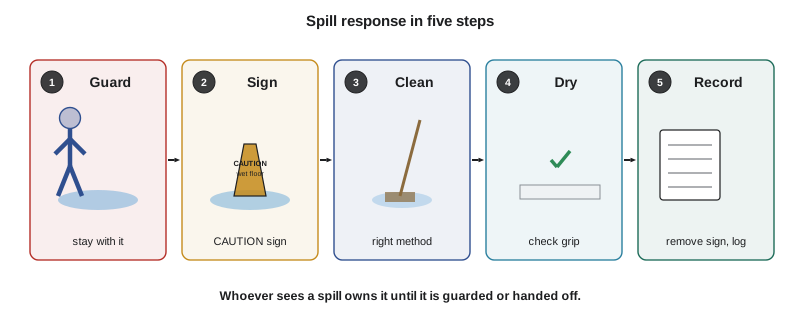
- Guard: stay with the spill or block it with a cart or sign so nobody walks into it. If you need supplies, ask a coworker or customer to stand by, or call for help on the radio or phone.
- Sign: put out a CAUTION wet floor sign, or several for a large spill, so people approaching from any direction can see it.
- Clean: use the right method. Water and most food spills can be mopped or wiped; oils need an absorbent product first; broken glass needs gloves and a broom and dustpan (Lesson 6); chemical spills from damaged cleaning products need the safety data sheet and the right gloves and absorbent (HSE-102, HSE-251).
- Dry: dry the area with a clean mop or towels and check it is not still slippery. A floor that looks clean can still be slippery if a film of oil or cleaner remains.
- Record: remove the sign once the floor is dry (signs left out for hours are ignored) and note the time and location in the log.
Northfield keeps spill stations with signs, absorbent, towels, gloves, a dustpan and a broken-glass container at the front end, in produce, at the deli and in the backroom, so no spill is more than a short walk from supplies.
How often to walk: a simple model
The longer a spill sits before it is found, the more people walk past it. If spills happen at random times and are found only on floor walks, a spill sits on average for about half the time between walks. The program below estimates how many spills happen in Northfield's produce department each busy day and how many minutes of spill exposure there are with different walk intervals. The spill rate is invented for illustration.
# Spills in a busy department and exposure time under different floor-walk intervals.
import math

spills_per_hour = 0.6          # average spills in produce at busy times (invented)
busy_hours = 8
expected = spills_per_hour * busy_hours

def p_at_least_one(rate_per_hour, hours=1.0):
    return 1 - math.exp(-rate_per_hour * hours)

print(f"Expected spills per busy day: {expected:.1f}")
print(f"Chance of at least one spill in any hour: {p_at_least_one(spills_per_hour):.0%}")
print()
for interval in (60, 30, 15):
    avg_wait = interval / 2                 # minutes a spill sits before a walk finds it
    exposure = expected * avg_wait          # spill-minutes per day
    print(f"Walk every {interval:>2} min: average spill sits {avg_wait:>4.1f} min, "
f"{exposure:5.0f} spill-minutes per day")Expected spills per busy day: 4.8 Chance of at least one spill in any hour: 45% Walk every 60 min: average spill sits 30.0 min, 144 spill-minutes per day Walk every 30 min: average spill sits 15.0 min, 72 spill-minutes per day Walk every 15 min: average spill sits 7.5 min, 36 spill-minutes per day
Moving from hourly to 15-minute walks in produce cuts the time an average spill sits from 30 minutes to under 8 minutes, and total spill exposure by three-quarters. In reality, many spills are found sooner because workers and customers report them, which is why the habit of every worker owning the spills they see matters so much. The model also shows why the walk interval should change with conditions: on a rainy Saturday, spills happen more often at the entrance and the interval there should shrink.
Entrances, mats and weather
Entrances are where outdoor water, snow and slush meet a smooth indoor floor. Good entrance matting is one of the most effective slip controls a store can buy, because it removes water from shoes before people reach the sales floor. Mats need to be long enough for several steps on them, typically several meters, with bevelled edges that lie flat. Curled or bunched mats become trip hazards and must be replaced, as Northfield learned in Lesson 2. In wet weather, add extra mats, umbrella bags or stands and more frequent checks of the first few meters of floor.
Outside, parking lots and walkways need snow clearing and ice control before the store opens and during storms, often by contractors. The store should know who is responsible for clearing which areas, when they will come, and how to call them back. Workers collecting carts in winter need warm clothing and slip-resistant footwear or ice cleats, and should report icy patches. Cart corrals should be placed so carts do not roll across driving lanes.
Trip hazards
- Pallets and stocking carts left in aisles: keep them close to the shelf, mark them with a cone or sign if they must stay, and remove them before peak hours.
- Product and packaging on the floor: pick up fallen items and cardboard right away.
- Cords: avoid cords across walkways; use cord covers where unavoidable and route power for displays from the ceiling or floor boxes.
- Mats: replace curled, torn or bunched mats.
- Display bases and wings: keep them out of the walkway and visible, with contrasting edges.
- Floor damage: report cracked tiles, holes and lifted transitions between floor types.
Floor cleaning
Cleaning can create the very hazard it is meant to remove. Scrubbing or mopping while customers are in the store leaves wet floors behind, so clean in sections with signs, dry before reopening an area and do heavy cleaning outside busy times. Use the correct dilution of floor cleaner, since too much can leave a slippery film. Auto-scrubbers should be operated only by trained workers. Fuel-powered floor buffers and burnishers can produce carbon monoxide; they need good ventilation and maintenance, and workers who feel headache, dizziness or nausea while using them should stop and get fresh air.
Footwear
Slip-resistant footwear with a soft, patterned sole greatly reduces slips on wet and greasy floors. Many retailers require it for food areas and recommend it everywhere, and some provide a subsidy or a supplier program. Shoes should be replaced when the tread wears smooth. HSE-106 explains how slip resistance is tested and labeled.
Measuring floor slipperiness
Some stores and their insurers measure floor slipperiness with a device called a tribometer, which estimates the friction between the floor and a test sole. Results are usually reported as a coefficient of friction, where higher numbers mean less slippery. Different devices and standards give different numbers, so results should only be compared using the same method. The program below checks readings from Northfield's floor survey against an illustrative action level of 0.42 for level wet floors; the action level is used here only as an example.
# Check wet floor friction readings against an illustrative action level.
action = 0.42   # illustrative action level for level floors when wet
readings = {"entrance tile": [0.45, 0.39, 0.41], "produce vinyl": [0.38, 0.36, 0.40],
            "grocery aisle": [0.52, 0.55, 0.50], "deli quarry tile": [0.48, 0.46, 0.44]}
for area, vals in readings.items():
    avg = sum(vals) / len(vals)
    low = min(vals)
    status = "ok" if low >= action else "below action level - review cleaning, mats, surface"
print(f"{area:<17} avg {avg:.2f} lowest {low:.2f} {status}")entrance tile avg 0.42 lowest 0.39 below action level - review cleaning, mats, surface produce vinyl avg 0.38 lowest 0.36 below action level - review cleaning, mats, surface grocery aisle avg 0.52 lowest 0.50 ok deli quarry tile avg 0.46 lowest 0.44 ok
The survey flags the entrance and the produce floor. That matches where Northfield's spills and its slip injury happened. Possible fixes include changing the floor cleaner or dilution, adding absorbent mats in produce, extending the entrance matting and, in the longer term, replacing the produce floor with a more slip-resistant surface.
For supervisors: running a spill program
Set floor walk intervals by area and time of day, and shorten them in bad weather. Assign a named person to each walk who is not tied to another post. Check that walks are real and logs accurate. Keep spill stations stocked. Track where spills and slips happen and fix the sources, such as misters, leaking cases or bad stacking. Make sure every worker knows that they own any spill they see until it is guarded.
Worked problem
A slip in produce
Northfield's lost-time slip last year happened at 5:40 p.m. on a rainy weekday. A stocker slipped on water near the lettuce misters and broke her wrist. The floor walk log shows produce was last walked at 4:50 p.m. and the next walk was due at 5:50 p.m. What should change?
Show solution
- The source: the lettuce misters were set to run often and the drip tray was cracked, so water reached the floor.
- The walk interval: hourly walks in produce at the busiest time of day, on a rainy day, left any spill sitting for up to an hour.
- The floor: the survey shows the produce vinyl is the most slippery floor in the store when wet.
- Fixes: repair the drip tray and adjust the misters, add absorbent mats in front of the misted cases, walk produce every 15 minutes from 4 to 7 p.m. and in wet weather, and plan to resurface the floor.
- Footwear: check that produce staff have slip-resistant shoes with good tread.
Answer: Fixing the water source, adding mats, shortening the walk interval at busy and wet times and improving the floor surface address the causes; the stocker's carelessness was not the main issue.
Common mistakes
MistakeWalking past a spill and assuming someone else will clean it.
InsteadGuard it and get it cleaned; whoever sees a spill owns it until it is handed off.
MistakeInitialling the sweep log without walking the aisle.
InsteadWalk every aisle, look properly and record what was found.
MistakeLeaving the wet floor sign out for hours after the floor is dry.
InsteadRemove signs once the floor is dry so they keep their meaning.
MistakeMopping an oil spill with water.
InsteadUse absorbent first, then clean and dry the floor.
MistakeKeeping the same walk interval on a rainy Saturday as on a quiet Tuesday.
InsteadShorten intervals at busy times and in bad weather, especially at entrances and in produce.
Summary and key terms
- Slips, trips and falls injure many retail workers and are the main cause of customer injuries in stores.
- Premises liability law expects stores to keep floors reasonably safe and to find and clean spills in reasonable time.
- Scheduled, documented floor walks find spills; every worker who sees a spill owns it until it is guarded.
- Spill response follows five steps: guard, sign, clean, dry and record.
- Shorter walk intervals cut the time spills sit; intervals should shrink at busy times and in bad weather.
- Entrance mats, snow and ice control, and removing trip hazards prevent many falls.
- Cleaning should be done in sections with signs; slip-resistant footwear and floor surveys help find and fix slippery areas.
- Floor walk
- A scheduled walk through the store to look for and deal with spills and hazards.
- Sweep log
- A record of floor walks showing the time, the area and what was found.
- Spill station
- A stocked point with signs, absorbent, towels, gloves and tools for cleaning spills.
- Occupiers' liability
- The legal duty of those who control premises to keep visitors reasonably safe.
- Premises liability
- In the United States, the legal responsibility of property owners and occupiers for injuries on their property.
- Tribometer
- A device that measures the friction between a floor and a test sole.
- Coefficient of friction
- A number describing how much grip a surface gives; higher values are less slippery.
Practice problems
Work each problem on paper first, then reveal the answer to check.
Name four sources of spills in a grocery store.
Show answer
Any four of: produce misting, melting ice, condensation, broken containers, customer spills, tracked-in water, floor cleaning, grease.
What are the five steps of spill response?
Show answer
Guard, sign, clean, dry and record.
Why must a floor walk actually cover every aisle?
Show answer
A walk without looking creates a false record and misses spills.
If walks happen every 40 minutes, about how long does an unreported spill sit on average?
Show answer
About 20 minutes, half the interval.
How should an oil spill be cleaned?
Show answer
Apply absorbent first, then clean and dry the floor.
Why remove the wet floor sign once the floor is dry?
Show answer
Signs left out for hours are ignored, so they lose their meaning.
Give three ways to control slips at entrances in winter.
Show answer
Any three of: long entrance mats, extra mats, umbrella bags, frequent checks, snow clearing and ice control outside.
What hazard can fuel-powered floor buffers create?
Show answer
Carbon monoxide, which causes headache, dizziness and nausea.
Lesson quiz · 5 questions
Score 60% or more to complete this lesson.
Create a free account to save your progress, take quizzes and earn a certificate.