
HSE-340 · Lesson 6 of 12 · 24 min
Box cutters, knives and sharp objects
Opening boxes is one of the most frequent tasks in retail, and the box cutter is one of the most common causes of retail injuries. A stocker may open dozens or hundreds of cases a shift, often quickly, often holding the box with one hand and cutting with the other. When the blade slips, it usually goes into the free hand, the forearm or the thigh. Most cuts are minor, but deep cuts to the hand can damage tendons and nerves and take months to heal. This lesson covers the tools, the techniques and the gloves that prevent cuts, and how to deal with broken glass and discarded needles safely. Knives and slicers in the deli are covered in Lesson 8.
How box cutter cuts happen
Investigations of retail cuts show the same few patterns again and again.
- Cutting toward the body or toward the hand holding the box, so a slip carries the blade into the worker.
- Using too much force on a deep cut through several layers of cardboard or tough strapping, so the blade jumps when it breaks through.
- Cutting on an unstable surface, such as a box held against the thigh or balanced on a cart edge.
- Leaving the blade exposed when the knife is put down, carried in a pocket or passed to someone.
- Using a dull blade that needs more force, or a knife as a pry bar or screwdriver until the blade snaps.
- Changing blades by hand and leaving old blades loose in a pocket, a garbage bag or the cardboard bin.
Every one of these can be prevented by the right tool and a few simple habits.
Choosing the right tool
| Type of cutter | How it works | Strengths and limits |
|---|---|---|
| Fixed-blade utility knife | Blade is always exposed | Highest cut risk; should not be used for routine case opening |
| Manually retractable knife | Blade slides in and out with a thumb slider | Safer than fixed, but only if the user remembers to retract it |
| Self-retracting (spring-back) knife | Blade retracts as soon as it leaves the material or the slider is released | Good for most case opening; reduces cuts from exposed blades |
| Concealed-blade or hook cutter | Blade is recessed in a guard, so only material can reach it | Very low cut risk; ideal for shrink wrap, strapping and thin cardboard |
| Ceramic-blade cutter | Ceramic blade stays sharp longer and is less likely to cut deeply | Fewer blade changes; often combined with self-retracting designs |
| Scissors and strap cutters | Purpose-built for bands and plastic strapping | Safer than knives for strapping, which can spring back when cut |
Northfield replaced all fixed-blade and manual knives with self-retracting cutters after the cluster of produce cuts described in Lesson 1, and provides hook cutters for shrink wrap and strap cutters for banding. Workers are issued a cutter and a belt holster on their first day, and blades are changed by department leads using a blade bank, a small container that holds used blades safely.
Safe cutting technique
- Place the box on a stable surface at about waist height, such as a cart or a table, not on your lap or against your leg.
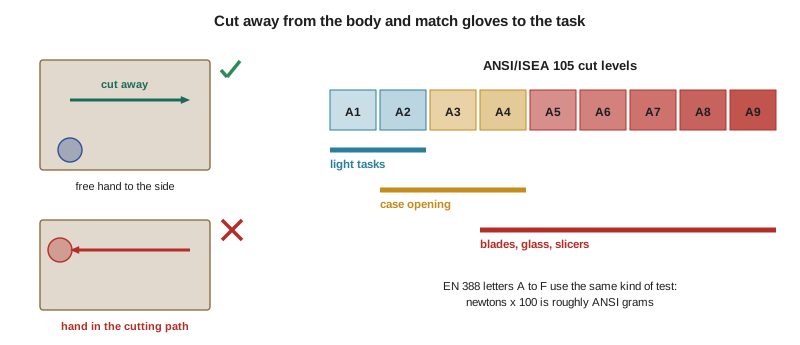
- Keep your free hand out of the cutting path: hold the box well to the side, or behind the blade, never in front of it.
- Cut away from your body and away from your free hand.
- Use short, shallow strokes. Cut only through the tape or the top layer of cardboard, so you do not damage the product or send the blade through the box into your leg.
- Let the self-retracting blade do its job. Do not tape or wedge the slider to keep the blade out.
- Retract the blade or put the cutter in its holster every time you put it down or walk away.
- Never use a knife as a pry bar, screwdriver or scraper.
Packaging that needs less cutting
The safest cut is the one you do not make. Many suppliers now ship products in shelf-ready packaging with perforated tear-off fronts, tear strips or handles, so the case can be opened by hand and placed directly on the shelf. Stores can ask suppliers for these designs, especially for high-volume products, and can track which products lead to the most cuts. Shrink-wrapped trays can often be opened with a hook cutter rather than a knife. Clamshell packaging, on the other hand, is notoriously hard to open and should be handled with scissors or a dedicated opener, never with a knife pushed toward the hand.
Cut-resistant gloves
Cut-resistant gloves are the last line of defense. They reduce the severity of a cut but do not make a worker cut-proof, and a sharp blade with enough force will still get through. Gloves are rated by testing how much force a blade needs to cut through the material.
- In North America, ANSI/ISEA 105 rates cut resistance on a scale from A1 to A9, based on the grams of force needed to cut through the glove in a standard test.
- In Europe and in many gloves sold in Canada, EN 388 uses a letter from A to F for the same kind of test, along with numbers for abrasion, tear and puncture.
- As a rough guide, the ANSI grams and the EN newtons are about a factor of 100 apart, so an EN level B glove (5 to 10 N) is comparable to ANSI A2 (500 to 999 g).
Higher is not always better. Very cut-resistant gloves can be thick, hot and clumsy, which leads people to take them off. Match the glove to the task: a light, dexterous glove for routine case opening, a higher level for changing blades, handling broken glass or cleaning slicers. Gloves should fit well, and torn or worn gloves should be replaced. Cut-resistant gloves must not be worn where they could be caught by rotating parts, such as in a baler or near powered equipment, unless the equipment instructions allow it.
The program below matches tasks at Northfield to a minimum glove level and checks the gloves the store currently stocks.
# Match store tasks to a minimum cut-resistance level and check stocked gloves.
# ANSI/ISEA 105 levels A1-A9; EN 388 letters A-F (roughly grams/100 = newtons).
ansi_g = {"A1": 200, "A2": 500, "A3": 1000, "A4": 1500, "A5": 2200, "A6": 3000}
en_n = {"A": 2, "B": 5, "C": 10, "D": 15, "E": 22, "F": 30}

tasks = {"open cases with safety cutter": "A2",
         "cut shrink wrap and strapping": "A2",
         "change cutter blades": "A4",
         "pick up broken glass jars": "A4",
         "clean deli slicer blade": "A5"}
stocked = {"thin knit glove (EN B)": en_n["B"] * 100,
           "general glove (ANSI A3)": ansi_g["A3"],
           "heavy glove (EN D)": en_n["D"] * 100,
           "slicer glove (ANSI A6)": ansi_g["A6"]}

for task, level in tasks.items():
    need = ansi_g[level]
    ok = [g for g, grams in stocked.items() if grams >= need]
    best = min(ok, key=lambda g: stocked[g]) if ok else "none stocked"
print(f"{task:<32} needs {level} ({need} g) -> {best}")open cases with safety cutter needs A2 (500 g) -> thin knit glove (EN B) cut shrink wrap and strapping needs A2 (500 g) -> thin knit glove (EN B) change cutter blades needs A4 (1500 g) -> heavy glove (EN D) pick up broken glass jars needs A4 (1500 g) -> heavy glove (EN D) clean deli slicer blade needs A5 (2200 g) -> slicer glove (ANSI A6)
The output shows that the store's thin knit glove covers routine case opening, the general glove is a step up, and the heavy EN D glove covers blade changes and broken glass. Slicer cleaning needs the A6 slicer glove, which is kept in the deli. The simplest rule for workers is to wear the glove the task card names; the simplest rule for supervisors is to stock one glove for each band rather than one glove for everything.
Broken glass
Broken jars and bottles are common in grocery stores, and they create two hazards: cuts from the glass and slips from the spilled contents. Never pick up broken glass with bare hands. Block off the area, wear cut-resistant gloves, use a broom and dustpan or a scoop, and put the glass in a puncture-resistant container or a sturdy box labeled broken glass, not loose in a garbage bag where it can cut the next person. Wipe up the liquid as described in Lesson 9 and check for small fragments that may have traveled under shelves.
Needles and other sharps
Store workers sometimes find used needles in washrooms, parking lots, returned items, fitting rooms or garbage. A needle-stick injury can expose a worker to bloodborne infections, so needles must never be picked up by hand or recapped. Northfield keeps a sharps kit at the customer service desk with tongs or a pick-up tool, puncture-proof gloves and a rigid sharps container. Workers who find a needle should keep others away and get a trained person with the kit. Anyone who is stuck by a needle should wash the area with soap and water, report it right away and seek medical advice the same day. HSE-245 covers infection prevention and bloodborne pathogens.
First aid for cuts
For a minor cut, wash your hands if possible, apply pressure with a clean dressing until the bleeding stops, clean the cut and cover it. For a deep or gaping cut, a cut that will not stop bleeding, a cut on the palm with numbness or loss of movement in a finger, or a puncture from a dirty object, get medical care. Report every cut so it goes in the first-aid record; the pattern of cuts tells the store which tools and tasks to fix. HSE-110 covers first aid.
For supervisors: a cut prevention program
Replace fixed-blade knives with self-retracting or concealed-blade cutters, and issue holsters. Set up blade banks and assign blade changes to trained people. Stock gloves for each task band and make them easy to get. Ask suppliers for shelf-ready packaging on high-volume products. Watch new workers open their first few cases and coach technique on the spot. Review the first-aid log monthly for cut clusters by department or product. Keep a sharps kit and broken glass container where everyone knows to find them.
Worked problem
Strapping that springs
A stocker cuts the plastic strapping on a stack of bagged soil in the garden center with a utility knife. The strapping is under tension and springs back, and the knife slips toward her other hand. She is not hurt, but reports a near miss. What should change?
Show solution
- The tool was wrong: plastic strapping should be cut with a strap cutter or safety cutter designed for banding, not a knife.
- The method was wrong: stand to the side of the strap, hold the strap on the side away from the cut if possible, and expect it to spring.
- Eye protection is useful when cutting tensioned strapping, because the ends can whip toward the face.
- Northfield adds strap cutters and safety glasses to the garden center opening kit and updates the task card.
- The near miss report is thanked and shared at the next huddle so other departments check how they cut strapping.
Answer: Provide strap cutters and eye protection for tensioned strapping, teach the correct stance, and treat the near miss as a free lesson rather than a reason to blame.
Common mistakes
MistakeHolding the box against your thigh and cutting toward yourself.
InsteadCut on a stable surface at waist height, away from your body and free hand.
MistakeTaping the slider so the blade stays out.
InsteadLet self-retracting cutters retract; that is how they prevent cuts.
MistakeDropping used blades loose in the garbage or cardboard bin.
InsteadPut used blades in a blade bank or sharps container.
MistakePicking up broken glass or a needle with bare hands.
InsteadUse gloves, a broom and dustpan or tongs, and a puncture-resistant container.
MistakeWearing the thickest cut glove for every task.
InsteadMatch the glove level to the task so workers keep their gloves on.
Summary and key terms
- Box cutter cuts are among the most common retail injuries and mostly come from cutting toward the body or free hand, using force, unstable surfaces and exposed blades.
- Self-retracting and concealed-blade cutters, strap cutters and holsters greatly reduce cuts.
- Cut on a stable surface at waist height, away from the body and free hand, with short shallow strokes.
- Shelf-ready packaging removes many cuts entirely.
- Cut-resistant gloves are rated by ANSI/ISEA 105 (A1 to A9) or EN 388 (A to F) and should be matched to the task.
- Broken glass and needles must never be handled with bare hands; use gloves, tools and puncture-resistant containers.
- Report every cut and review the first-aid log for clusters.
- Self-retracting cutter
- A knife whose blade springs back into the handle as soon as it leaves the material or the slider is released.
- Concealed-blade cutter
- A cutter with the blade recessed in a guard so fingers cannot reach it.
- Blade bank
- A small, closed container for safely storing used blades.
- Shelf-ready packaging
- Cases designed to be opened by hand and placed directly on the shelf.
- ANSI/ISEA 105
- The North American standard that rates glove cut resistance from A1 to A9.
- EN 388
- The European standard for protective gloves against mechanical risks, which rates cut resistance from A to F.
- Sharps container
- A rigid, puncture-resistant container for needles and other sharp objects.
Practice problems
Work each problem on paper first, then reveal the answer to check.
Name three common causes of box cutter cuts.
Show answer
Any three of: cutting toward the body or free hand, using too much force, unstable surfaces, exposed blades, dull blades, misusing the knife, loose old blades.
Why are self-retracting cutters safer than manual retractable ones?
Show answer
The blade retracts automatically, so it cannot be left exposed by mistake.
What is the correct cutting direction?
Show answer
Away from your body and away from your free hand.
What tool should be used to cut tensioned plastic strapping?
Show answer
A strap cutter or a safety cutter designed for banding, with eye protection.
Roughly which ANSI level matches an EN 388 level C glove?
Show answer
About ANSI A3, since 10 to 15 N corresponds to about 1,000 to 1,500 g.
Why not wear the most cut-resistant glove for every task?
Show answer
Very resistant gloves can be thick and clumsy, so workers take them off; match the glove to the task.
What should a worker do after finding a needle in a washroom?
Show answer
Keep others away, not touch it, and get a trained person with the sharps kit.
Give two signs that a cut needs medical care.
Show answer
Any two of: deep or gaping, will not stop bleeding, numbness or loss of finger movement, puncture from a dirty object.
Lesson quiz · 5 questions
Score 60% or more to complete this lesson.
Create a free account to save your progress, take quizzes and earn a certificate.