
HSE-340 · Lesson 4 of 12 · 23 min
Checkouts, cashiers and repetitive work
A checkout looks like light work. Nothing a cashier lifts is very heavy, and the job is done standing in one place. But a busy grocery cashier may scan and bag well over a thousand items in a shift, reaching, grasping, lifting, twisting and turning with the same arm hundreds of times an hour. Over weeks and months, that repetition can injure the tendons, nerves and muscles of the hands, wrists, shoulders and neck. Add long hours standing on a hard floor, cold drafts from the doors and the occasional heavy case of water, and the checkout becomes one of the main sources of musculoskeletal injuries in a store. This lesson covers how checkouts injure people and how layout, equipment and work organization prevent it.
How repetitive work injures the body
HSE-107 explains musculoskeletal disorders in detail. They develop when tissues are loaded repeatedly without enough time to recover. The main risk factors are repetition, force, awkward postures such as bent wrists or raised arms, holding the same posture for a long time, contact pressure from hard edges, and cold. Early signs include aching, stiffness, tingling, numbness or weakness, often worse at the end of a shift or at night. Common checkout injuries include tendinitis in the wrist and forearm, carpal tunnel syndrome, shoulder strains from reaching across the counter, and neck and low back pain from twisting and standing.
These injuries are easiest to treat and fix when they are caught early. A cashier who notices tingling in the fingers after shifts should report it, not wait until it keeps them awake at night. Northfield's cashier with wrist tendinitis last year had noticed soreness for several weeks before she said anything, by which time she needed several weeks on restricted duties.
The checkout workstation
Most checkout injuries are set up by the design of the workstation. Good checkout design follows a few simple ideas.
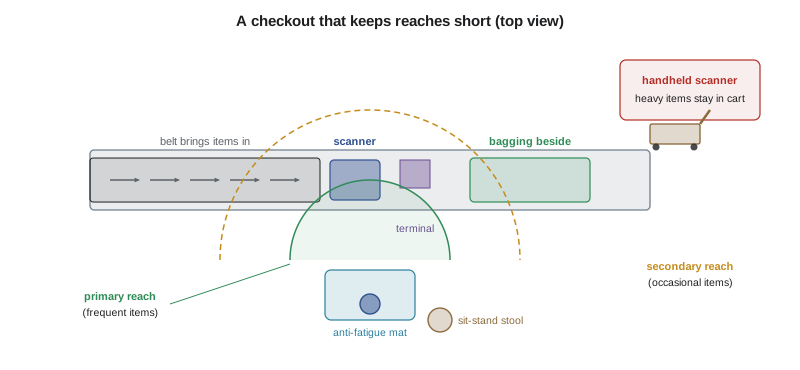
- Keep frequent reaches short. The scanner, the bagging area and the payment terminal should be within easy reach, so the cashier does not have to stretch across the counter or lean forward.
- Keep work at about elbow height. Counters that are too high force the shoulders up; counters that are too low force the back to bend. Adjustable platforms or counters help people of different heights.
- Let products slide rather than lift. A powered belt brings items to the cashier, and the scanner is placed so items can be slid across it rather than lifted.
- Avoid twisting. The bagging area should be in front of or beside the cashier, not behind, and the cashier should be able to turn with their feet rather than their back.
- Leave heavy items in the cart. A handheld scanner lets the cashier scan cases of water, bags of pet food and other heavy items without lifting them onto the counter.
Standing all shift
Standing for long periods on a hard floor causes tired legs, sore feet and low back pain, and over time it is linked with circulation problems in the legs. Standing still is harder on the body than walking, because the muscles are not pumping blood back toward the heart. Good controls include anti-fatigue mats with bevelled edges that do not curl, supportive footwear, a footrest or rail that lets the cashier shift weight, and the option to sit or lean.
Many cashiers in Europe work seated, and seated or sit-stand checkouts are becoming more common in North America. In California, the state's wage orders require suitable seating when the nature of the work reasonably permits it, and the California Supreme Court's 2016 decision in Kilby v. CVS Pharmacy said courts should look at the tasks done at a particular location rather than the whole job, which led many retailers there to provide seats at checkouts. Washington has no equivalent general seating rule, but a sit-stand stool at each checkout is a low-cost control that many cashiers value.
Handling heavy and awkward items
Most items a cashier handles are light, but a few are not: cases of water, large bags of dog food, cat litter, flats of soft drinks, watermelons and bags of soil in the spring. Lifting these from a cart onto the belt and then into a bag or back into the cart, with a twist, is exactly the kind of lift that injures backs and shoulders. Northfield's checkout procedure says heavy items stay in the cart and are scanned with the handheld scanner. Customers are asked to leave them in the cart, and a sign at the start of the belt explains why.
Bag weight is another issue. Heavy bags are hard on the cashier who lifts them into the cart and on the customer who carries them. Spreading heavy items across several bags, double-bagging when needed and not overfilling reusable bags all help.
Self-checkouts
Self-checkouts move scanning work to customers but create new tasks for the attendant: walking between stations, bending to fix errors, reaching into bagging areas, checking ID for age-restricted items and dealing with frustrated customers. Attendants may stand for long periods with little chance to sit. Store layouts should give attendants a podium or stool, clear walkways between stations and a way to call for help. Conflicts with customers over theft checks, age verification or machine errors are a common source of aggression; HSE-341 covers how to handle them safely.
Cold, drafts and the work environment
Checkouts are often near the doors, so cashiers can be exposed to cold drafts every time the doors open in winter. Cold makes hands less nimble and increases the risk of strains. Air curtains, vestibules, heaters at the checkout, and allowing warm layers or fingerless gloves all help. Lighting should allow the cashier to read screens and labels without glare, and the constant beeping of scanners can be turned down where store systems allow it.
Rotation, breaks and pace
Even a well-designed checkout involves a lot of repetition, so work organization matters. Rotating cashiers between the checkout and other tasks, such as front-end tidying, stocking light items, customer service or helping at self-checkout, gives the hands and shoulders a rest. Short breaks spread through the shift are better for recovery than one long break. Scan-rate targets, if used, should be set at a pace people can sustain without rushing, and should not count against cashiers for leaving heavy items in the cart or helping customers.
The program below estimates how much a cashier handles in a four-hour block at the checkout, with and without the handheld-scanner rule for heavy items.
# Rough estimate of the load handled by a cashier in a 4-hour block (US units).
items_per_min = 18          # average scanning pace on a busy shift
minutes = 4 * 60 * 0.75     # 75% of the block spent scanning
avg_lb = 1.3                # typical item weight
heavy_share = 0.03          # share of items that are heavy (cases, bags)
heavy_lb = 24.0             # typical heavy item weight

items = items_per_min * minutes
light = items * (1 - heavy_share)
heavy = items * heavy_share
lifted_all = light * avg_lb + heavy * heavy_lb
lifted_rule = light * avg_lb          # heavy items stay in the cart
print(f"Items scanned:            {items:,.0f}")
print(f"Heavy items:              {heavy:,.0f}")
print(f"Weight handled, no rule:  {lifted_all:,.0f} lb")
print(f"Weight handled, rule:    {lifted_rule:,.0f} lb")
print(f"Reduction: {1 - lifted_rule / lifted_all:.0%}")Items scanned: 3,240 Heavy items: 97 Weight handled, no rule: 6,418 lb Weight handled, rule: 4,086 lb Reduction: 36%
Even though only 3 percent of the items are heavy, they make up over a third of the weight handled. Leaving them in the cart removes about 2,300 lb of lifting from each four-hour block, and it removes the most awkward lifts. The numbers are rough, but the lesson is robust: a simple rule about heavy items does more for a cashier's back than any amount of advice about posture.
Customer service desks, returns and lottery counters
Not all front-end work is at the checkout. Customer service desks handle returns, which can mean lifting bulky or heavy items over a counter and carrying them to a return cart. Counters should have a low section or a gate so heavy returns can be passed through rather than lifted over, and a cart should be kept beside the desk. Lottery, tobacco and pharmacy counters often involve reaching up to locked cabinets or down to low drawers many times an hour, so the most frequently used stock should be kept between waist and shoulder height. Front-end workers also handle cash, which links checkout work to robbery risk; cash limits, drop safes and robbery procedures are covered in HSE-341.
What cashiers can do
Cashiers cannot redesign their checkout, but they can do a lot within it. Adjust the platform or stool if one is provided. Stand close to the counter and slide items rather than lifting them. Turn with your feet. Use the handheld scanner for heavy items and ask customers to leave them in the cart. Keep wrists straight and avoid pinching heavy items between thumb and fingers. Shift your weight, use the footrest and stretch between customers. Wear supportive shoes. Report early symptoms such as tingling, numbness or aching that lasts after the shift.
For supervisors: checking a checkout
Watch a cashier work for ten minutes at a busy time. Count how often they reach beyond the edge of the counter, twist to bag, lift heavy items or lean forward. Ask whether the mat curls, the stool is used, the handheld scanner works and the bagging area is in the right place. Small changes, such as moving the payment terminal closer or replacing a curled mat, can be made the same day. Check rotation schedules and make sure breaks are actually taken during busy periods.
Worked problem
Fixing lane 4
Several cashiers say lane 4 leaves them with sore right shoulders. Marco watches the lane and sees that the payment terminal is mounted on a pole at the far end of the counter, the bagging well is slightly behind the cashier, and the handheld scanner cable is too short to reach into a cart. What should be changed?
Show solution
- Move the payment terminal to a swivel mount near the scanner so cashiers do not reach across the counter to help customers.
- Turn or relocate the bagging well so it is in front of or beside the cashier, removing the twist on every bag.
- Replace the handheld scanner with a cordless one, or fit a longer coiled cable, so heavy items can be scanned in the cart.
- Add a sit-stand stool and replace the old mat, which has curled at one corner.
- Ask the cashiers to try the lane for two weeks and report whether the shoulder pain has eased.
Answer: Moving the terminal and bagging area into easy reach, making the handheld scanner usable and adding a stool and a new mat removes the main causes of the shoulder strain.
Common mistakes
MistakeTreating checkout work as light work that cannot cause injury.
InsteadRecognize that repetition, reaching, twisting and standing cause many cashier injuries.
MistakeLifting heavy items onto the belt and back into the cart.
InsteadLeave heavy items in the cart and scan them with a handheld scanner.
MistakeWaiting until pain is severe before reporting it.
InsteadReport early signs such as tingling, numbness or aching that lasts after the shift.
MistakePutting the bagging area behind the cashier.
InsteadPlace bagging in front of or beside the cashier so they do not twist.
MistakeKeeping a cashier on the same lane for the whole shift without breaks.
InsteadRotate between checkout and other tasks and spread short breaks through the shift.
Summary and key terms
- Checkout work involves high repetition, reaching, twisting and long standing, which can cause tendinitis, carpal tunnel syndrome and shoulder, neck and back pain.
- Good checkout design keeps frequent reaches short, work at elbow height, items sliding and bagging in front of the cashier.
- Heavy items should stay in the cart and be scanned with a handheld scanner.
- Anti-fatigue mats, supportive footwear, footrests and sit-stand stools reduce the effects of standing.
- California requires suitable seating where the work reasonably permits it; other states vary.
- Rotation, short breaks and sustainable pace targets reduce repetitive strain.
- Early reporting of symptoms lets injuries be treated and workstations fixed before serious harm.
- Musculoskeletal disorder
- An injury or disorder of the muscles, tendons, nerves, joints or discs, often caused by repeated strain.
- Tendinitis
- Inflammation of a tendon, often in the wrist, forearm or shoulder, linked to repetitive motion.
- Carpal tunnel syndrome
- Pressure on the median nerve at the wrist, causing numbness, tingling and weakness in the hand.
- Reach zone
- The area a worker can reach comfortably without stretching or leaning.
- Anti-fatigue mat
- A cushioned mat that reduces the strain of standing on hard floors.
- Handheld scanner
- A scanner that can be moved to an item, so heavy items can be scanned in the cart.
- Job rotation
- Moving workers between tasks that use different muscles to allow recovery.
Practice problems
Work each problem on paper first, then reveal the answer to check.
Name four risk factors for repetitive strain at a checkout.
Show answer
Any four of: repetition, force, awkward postures, static postures, contact pressure and cold.
Where should the bagging area be relative to the cashier?
Show answer
In front of or beside the cashier, not behind.
What is the simplest rule for heavy items at the checkout?
Show answer
Leave them in the cart and scan them with a handheld scanner.
Why is standing still harder on the body than walking?
Show answer
The leg muscles are not pumping blood back toward the heart, so legs and feet tire and back pain increases.
Give three controls for long standing.
Show answer
Any three of: anti-fatigue mats, supportive footwear, a footrest or rail, a sit-stand stool, rotation and breaks.
In the example, what share of the weight handled came from heavy items?
Show answer
Over a third, even though they were only 3 percent of the items.
Name two new tasks that self-checkouts create for attendants.
Show answer
Any two of: walking between stations, bending to fix errors, reaching into bagging areas, checking ID and handling frustrated customers.
What early signs of repetitive strain should a cashier report?
Show answer
Aching, stiffness, tingling, numbness or weakness, especially if it lasts after the shift or wakes them at night.
Lesson quiz · 5 questions
Score 60% or more to complete this lesson.
Create a free account to save your progress, take quizzes and earn a certificate.