
HSE-340 · Lesson 7 of 12 · 25 min
Coolers, freezers and cold work
Every grocery store has rooms that are kept cold all year. Walk-in coolers hold dairy, produce, meat and deli products at 34 to 39 °F (about 1 to 4 °C), and walk-in freezers hold frozen food at 0 to −10 °F (about −18 to −23 °C) or colder. Stockers and receivers go in and out of these rooms many times a shift, sometimes for long periods while stocking or rotating product. The cold itself is a hazard, and the rooms bring others: ice on the floor, poor visibility, heavy frozen cases, doors that must open from the inside, and refrigerant leaks. This lesson covers how to work safely in and around cold rooms. HSE-243 explains cold stress and cold injuries in depth.
How cold affects workers
The body loses heat quickly in cold air, and faster when air is moving, as it is near the evaporator fans that cool a walk-in. The first effects are on the hands and feet: fingers become numb and clumsy, grip weakens and the risk of dropping a case or cutting a hand rises. Handling frozen product with bare or thin-gloved hands can cause frostnip or frostbite of the fingers through direct contact, even when the rest of the body feels fine. Over longer periods, shivering, fatigue and poor judgment can set in, and in extreme cases the core body temperature can fall toward hypothermia, which is rare in store freezers but possible if someone is trapped or works far too long without warming up.
Cold also makes other hazards worse. Muscles are stiffer and more easily strained, so lifting heavy frozen cases in a freezer is riskier than lifting the same case at room temperature. Workers may rush to get out of the cold, skipping carts or stacking product carelessly.
Cold room hazards
| Hazard | Where it shows up | Controls |
|---|---|---|
| Cold stress and cold injuries | Long stocking or rotation sessions, especially in freezers | Insulated clothing, time limits, warm-up breaks, rotation |
| Contact cold on hands | Handling frozen cases and metal shelving | Insulated gloves, ideally with cut resistance and good grip |
| Slips on ice and frost | Door thresholds, under evaporators, where condensation freezes | Defrost maintenance, mats, prompt clean-up, slip-resistant boots |
| Entrapment | Door closes while someone is inside | Inside safety release, lighting, alarm button, check-in system |
| Poor visibility | Fogged glasses, dim lights, steam at the door | Good lighting, clear aisles, strip curtains kept in repair |
| Heavy and awkward lifts | Frozen cases, meat boxes, ice | Carts, waist-height shelving, team lifts |
| Refrigerant leaks | Coils, piping and mechanical rooms | Leak detectors and alarms, evacuation, trained technicians only |
Getting out: the inside release
Every walk-in cooler and freezer door must open from the inside, even if it is locked from the outside. Walk-in doors are usually fitted with an inside safety release, a large knob or plunger that pushes the latch open from inside. It must be clearly marked, free of ice, easy to find in the dark and tested regularly. Many walk-ins also have a light inside that the worker can see from the door, an alarm button or buzzer, and heated door frames that keep the door from freezing shut. Doors must never be padlocked or blocked while anyone could be inside.
Entrapment incidents in walk-in coolers and freezers have happened when inside releases were broken, frozen, removed or hidden behind stacked product, or when a worker was locked in at closing time. The fixes are simple and cheap compared with the consequences: test the release weekly, keep product clear of the door, have the closing supervisor check the walk-ins before locking up, and tell someone when you go in for a long session.
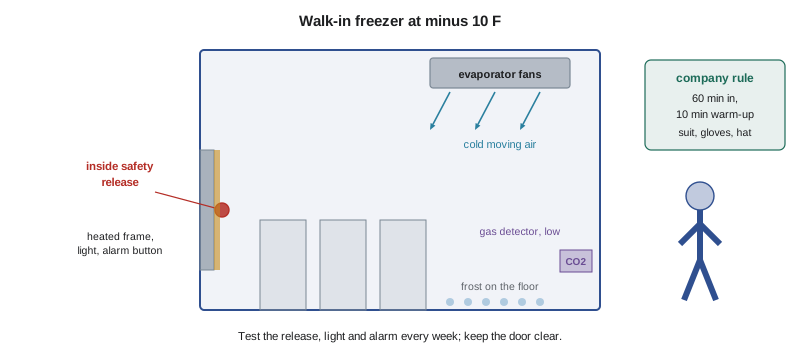
Northfield tests the inside release, the light and the alarm button on all three walk-ins every Monday and records the result. The program below reads the last two months of the test log and flags any problems.
# Weekly tests of walk-in safety features at an invented store.
from datetime import date

log = [
    # date, room, release opens, alarm works, light works
    (date(2026, 2, 2), "dairy cooler", True, True, True),
    (date(2026, 2, 2), "produce cooler", True, True, True),
    (date(2026, 2, 2), "freezer", True, True, True),
    (date(2026, 2, 9), "dairy cooler", True, True, True),
    (date(2026, 2, 9), "freezer", False, True, True),     # release iced up
    (date(2026, 2, 16), "dairy cooler", True, True, False),
    (date(2026, 2, 16), "produce cooler", True, True, True),
    (date(2026, 2, 16), "freezer", True, True, True),
    (date(2026, 3, 2), "dairy cooler", True, True, True),
    (date(2026, 3, 2), "produce cooler", True, False, True),
    (date(2026, 3, 2), "freezer", True, True, True),
    (date(2026, 3, 23), "dairy cooler", True, True, True),
    (date(2026, 3, 23), "freezer", True, True, True),
]
today = date(2026, 3, 30)
rooms = {r for _, r, *_ in log}
for room in sorted(rooms):
    tests = [t for t in log if t[1] == room]
    last = max(t[0] for t in tests)
    fails = [(t[0], n) for t in tests for n, ok in
             zip(("release", "alarm", "light"), t[2:]) if not ok]
    gap = (today - last).days
    note = "OVERDUE" if gap > 7 else "ok"
    print(f"{room:<15} tests {len(tests)}  last {last}  ({gap} days, {note})")
    for d, part in fails:
print(f" failed: {part} on {d}")dairy cooler tests 5 last 2026-03-23 (7 days, ok)
failed: light on 2026-02-16
freezer tests 5 last 2026-03-23 (7 days, ok)
failed: release on 2026-02-09
produce cooler tests 3 last 2026-03-02 (28 days, OVERDUE)
failed: alarm on 2026-03-02The log shows the freezer release failed once in February because it had iced up, and the dairy cooler light and produce cooler alarm each failed once; Marco checks that each was fixed. More worrying is that the produce cooler has not been tested for four weeks, and nobody tested any room on 9 or 16 March. Missed tests are a warning sign that a routine is slipping, and Marco assigns a named person and a backup for every Monday.
Dressing for the cold
Clothing is the main protection for most cold room work. Workers who go into coolers briefly may only need a fleece or jacket, but anyone stocking a freezer for more than a few minutes needs proper freezer gear.
- Insulated jacket or freezer suit, worn in layers so it can be opened when moving between temperatures.
- Insulated gloves with good grip; for handling cases with sharp edges or using a cutter, gloves with both insulation and cut resistance, or a thin cut-resistant liner under an insulated glove.
- A hat or hood, since a lot of heat is lost from the head and neck.
- Insulated, slip-resistant boots or overshoes for freezer floors.
- A spare pair of dry gloves, because damp gloves lose much of their insulation.
The store should provide freezer suits and gloves in a range of sizes, kept clean and dry near the freezer door, so that workers are not tempted to go in wearing only a hoodie as in the refusal example in Lesson 2.
Time limits and warm-up breaks
Even with good clothing, long periods in a freezer lead to cold hands, fatigue and mistakes. Published work and warm-up schedules, such as the one adopted by the ACGIH from a Saskatchewan guideline, set maximum work periods and the number of warm-up breaks based on the air temperature and wind speed. Many retailers set their own simpler rule for freezers, for example limiting continuous sessions and requiring a short warm-up break in a heated area between them. HSE-243 covers the published schedules.
Air moving past the evaporator fans makes a freezer feel colder than its thermostat reading. The program below uses the National Weather Service wind chill formula to estimate how cold the freezer feels near the fans, then applies Northfield's company rule. The rule's session lengths are invented for this course and are not taken from any regulation.
# Wind chill near the evaporator fans and an invented company session rule (US units).
def wind_chill_f(t_f, v_mph):
    if v_mph < 3:
        return t_f                    # formula not used in near-still air
    v = v_mph ** 0.16
    return 35.74 + 0.6215 * t_f - 35.75 * v + 0.4275 * t_f * v

def session_minutes(wc):
    # Company rule (invented for this course): continuous session, then 10 min warm-up.
    if wc > 14: return 120
    if wc > -13: return 60
    if wc > -31: return 40
    return 20

for room, t, v in [("cooler", 36, 4), ("freezer, still corner", -10, 0),
                   ("freezer, near fans", -10, 5), ("blast freezer", -22, 9)]:
    wc = wind_chill_f(t, v)
print(f"{room:<22} air {t:>4} F feels {wc:6.1f} F session {session_minutes(wc)} min")cooler air 36 F feels 32.7 F session 120 min freezer, still corner air -10 F feels -10.0 F session 60 min freezer, near fans air -10 F feels -22.3 F session 40 min blast freezer air -22 F feels -42.1 F session 20 min
Near the fans, the freezer feels about 12 degrees Fahrenheit colder than in a still corner, enough to move it into a shorter session under the company rule. The exact numbers matter less than the habit: decide how long people stay in the freezer before they go in, give them a timer or a check-in, and make sure a warm room and a hot drink are available for warm-up breaks.
Refrigerant leaks
Store refrigeration systems use refrigerants that can be hazardous if they leak. Older systems use synthetic refrigerants (HFCs), which displace oxygen in an enclosed space if enough leaks out. Many newer supermarkets use carbon dioxide (CO2) systems because of its low climate impact; CO2 is heavier than air, has no smell and becomes harmful at high concentrations, so a leak into a closed walk-in can build up near the floor. Some larger systems and warehouses use ammonia, which is toxic and has a strong smell. Stores with these systems should have leak detectors with alarms in walk-ins and machine rooms, and workers should know what the alarm sounds like.
If a refrigerant alarm sounds or you notice a hissing sound, an unusual smell, a sudden fog or feel dizzy or short of breath in a cold room, leave immediately, close the door behind you, tell your supervisor and do not go back in. Only trained refrigeration technicians should enter to investigate. Refrigeration machine rooms are off-limits to store staff.
Dry ice
Some stores sell dry ice or receive products packed in it. Dry ice is solid CO2 at −109 °F (about −78 °C). It can cause severe frostbite on contact, so handle it only with insulated gloves or tongs. As it warms it turns directly into CO2 gas, which can build up in a closed car, cooler or small room. Store it in a well-ventilated area in an insulated container that is not airtight, never in a sealed container that could burst, and tell customers how to transport it with a window open.
Open freezers and coolers on the sales floor
Reach-in and open coffin freezers on the sales floor create their own hazards. Stocking a coffin freezer means repeated bending into a cold case, so use carts at the same height and stock in short sessions. Condensation and frost can drip onto the floor in front of cases, so check for water during floor walks. Glass doors that fog or ice up should be reported to maintenance.
For supervisors: cold room checklist
Test inside releases, lights and alarms weekly and record the results. Keep freezer suits, gloves and boots in good condition and in all sizes. Set time limits and warm-up breaks for freezer work and plan stocking so nobody stays in too long. Make sure someone knows when a worker is in a walk-in for a long session, especially on night shifts, and check all walk-ins before locking up. Keep refrigerant alarms working and make sure everyone knows what to do if one sounds.
Worked problem
Planning a freezer reset
Northfield is resetting the walk-in freezer: every case must be moved, the shelves cleaned and the product put back. The job will take about four hours of freezer work for two people. How should it be planned?
Show solution
- Split the work into sessions that follow the company rule, for example 40 minutes near the fans and 60 minutes elsewhere, each followed by a 10-minute warm-up in the staff room.
- Use four workers in rotating pairs, so two are in the freezer while two warm up or move product outside.
- Issue freezer suits, insulated cut-resistant gloves, hats and boots, and keep spare dry gloves at the door.
- Move product on carts and keep the heaviest cases at waist height when restocking.
- Test the inside release and alarm before starting, keep the door path clear, and have the lead check that everyone is out at each changeover.
Answer: Rotating pairs, timed sessions with warm-up breaks, proper cold gear and carts let the reset be done safely without anyone staying in the freezer for hours.
Common mistakes
MistakeStocking the freezer in a hoodie and thin gloves for a long session.
InsteadWear a freezer suit, insulated gloves, a hat and boots, and follow time limits.
MistakeStacking product in front of the inside release.
InsteadKeep the door and release clear and test the release weekly.
MistakeLocking up without checking the walk-ins.
InsteadHave the closing supervisor check every walk-in before locking up.
MistakeGoing back into a cold room to find the source of a hissing sound.
InsteadLeave, close the door, alert your supervisor and let a refrigeration technician investigate.
MistakeKeeping dry ice in a sealed container.
InsteadUse an insulated, non-airtight container in a ventilated area.
Summary and key terms
- Walk-in coolers run at about 34 to 39 °F and freezers at about 0 to −10 °F or colder.
- Cold numbs the hands, weakens grip, stiffens muscles and can cause frostbite through contact with frozen product.
- Every walk-in must open from the inside; test the release, light and alarm weekly and keep the door clear.
- Freezer work needs insulated clothing, gloves, hats and boots, time limits and warm-up breaks.
- Air from evaporator fans makes freezers feel colder; wind chill can push a session into a shorter limit.
- Refrigerant leaks, including CO2, can be dangerous in closed rooms; leave immediately if an alarm sounds.
- Dry ice causes frostbite and releases CO2; handle it with gloves and store it in ventilated, non-airtight containers.
- Walk-in cooler
- A refrigerated room large enough to walk into, kept just above freezing.
- Walk-in freezer
- A refrigerated room kept below freezing for frozen food storage.
- Inside safety release
- A device on the inside of a walk-in door that lets a person open it even if it is latched or locked from outside.
- Evaporator
- The cooling coil and fans inside a cold room that remove heat and move cold air.
- Wind chill
- An estimate of how cold the air feels on exposed skin when air movement is taken into account.
- Work and warm-up schedule
- A plan that limits time in the cold and sets warm-up breaks based on temperature and air movement.
- Dry ice
- Solid carbon dioxide, which is extremely cold and turns into CO2 gas as it warms.
Practice problems
Work each problem on paper first, then reveal the answer to check.
Name four hazards of walk-in freezers.
Show answer
Any four of: cold stress, contact cold on hands, slips on ice, entrapment, poor visibility, heavy frozen lifts, refrigerant leaks.
How often does Northfield test walk-in releases, lights and alarms?
Show answer
Every week, on Mondays, with the results recorded.
Why can handling frozen cases cause frostbite even when the body feels warm?
Show answer
Direct contact with frozen product draws heat out of the fingers quickly.
Why does a freezer feel colder near the evaporator fans?
Show answer
Moving air removes heat from the skin faster, increasing the wind chill.
What should you do if a refrigerant alarm sounds in a walk-in?
Show answer
Leave immediately, close the door, tell your supervisor and do not go back in.
Why is CO2 refrigerant a particular concern in a closed walk-in?
Show answer
It is heavier than air, has no smell and can build up near the floor to harmful levels.
How should dry ice be stored?
Show answer
In an insulated, non-airtight container in a well-ventilated area.
What should the closing supervisor check before locking up?
Show answer
That nobody is inside any walk-in cooler or freezer.
Lesson quiz · 5 questions
Score 60% or more to complete this lesson.
Create a free account to save your progress, take quizzes and earn a certificate.