
HSE-340 · Lesson 12 of 12 · 26 min
Capstone: new-worker orientation and a store safety walk
This final lesson brings the course together at Northfield Market. It does two things that every store needs to do well. The first is orienting new workers: giving each new hire, on their first shift, the knowledge they need to stay safe, and then supporting them through the first weeks when injuries are most likely. The second is the store safety walk: a regular, structured look at the whole store that finds hazards before they cause harm and turns them into fixes with owners and dates. Both draw on everything in Lessons 1 to 11.
Why the first weeks matter
Lesson 1 showed that new workers, especially young ones, are injured more often than experienced workers, and that a large share of retail workers are new at any given time. In Northfield's records, three of last year's five serious injuries happened to workers in their first six months. New workers do not yet know where the hazards are, may not want to slow others down by asking, and may copy shortcuts they see experienced workers take. A good orientation, followed by close supervision and check-ins, changes that.
Northfield's orientation checklist
Northfield's orientation is built to meet Washington's requirement that the accident prevention program include a safety orientation for new workers, and to cover the hazards in this course. It is delivered on the first shift by the worker's supervisor, takes about an hour, includes a walk-through of the store, and is signed by both the worker and the supervisor.
| Topic | What the new worker learns or is shown | Lesson |
|---|---|---|
| People and rights | Supervisor's name, the safety committee members, the right to a safe workplace and to report concerns without retaliation | 2 |
| Reporting | How to report hazards, injuries and near misses, and that reporting is expected and safe | 2 |
| Lifting and carts | Where heavy items are stored, cart use, the 50 lb team-lift rule, asking for help | 3 |
| Checkout work | Workstation set-up, heavy items stay in the cart, rotation and breaks, reporting early symptoms | 4 |
| Climbing | Where step stools are, three points of contact, never climbing shelves or carts | 5 |
| Cutting | Issue of a safety cutter and holster, cutting technique, gloves, broken glass and needles | 6 |
| Cold rooms | Inside releases, freezer clothing, time limits, refrigerant alarms | 7 |
| Food areas and age rules | Which equipment the worker may and may not use under federal and state rules for minors | 8 |
| Spills | Owning spills, the five steps, spill station locations | 9 |
| Displays and carts | Stacking limits, cart collection rules, reporting door faults | 10 |
| Emergencies | Exits, alarm sounds, assembly point, first aid trained staff and AED, their role in an evacuation | 11 |
| Violence and working alone | Introduction to robbery and aggression procedures and check-in rules | HSE-341, HSE-352 |
The checklist is a starting point, not the whole of training. Department-specific training follows: a deli worker is trained and authorized on each machine before using it, a stocker is shown the night crew's routines, and a cashier practices at a training lane. Training is recorded so the store knows who is authorized for what.
Making orientation stick
People forget much of what they hear on a busy first day. Northfield uses four habits to make orientation stick.
- Show, do not just tell: walk the store and point to the step stools, spill stations, exits and inside releases rather than describing them.
- Buddy up: pair each new worker with an experienced worker for the first two weeks, chosen for good habits rather than speed.
- Check back: the supervisor checks in at the end of the first shift, after the first week and after the first month, asking what the worker has noticed and whether anything feels unsafe.
- Keep it short and repeat: short team huddles at the start of shifts revisit one topic at a time, such as cutters one week and spills the next.
Young workers
Young workers need the same orientation plus attention to the rules that apply only to them: hours limits during the school year, equipment they may not use, and rules about working alone or late at night. Lesson 8 covered the age rules for food equipment. Supervisors should schedule young workers with these rules in mind and make sure there is always an adult supervisor on shift with them. HSE-352 covers working alone and late-night safety.
The store safety walk
Northfield's joint committee or safety committee members and managers walk the whole store every month using a fixed route and checklist, and department leads do a shorter walk of their own areas every week. The walk is not a white-glove inspection for tidiness. It is a search for the hazards covered in this course, done while the store is operating so the walkers see real conditions.
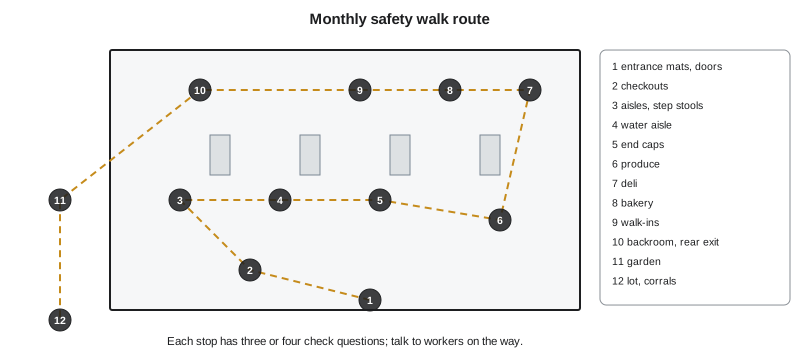
At each stop the walkers ask three or four questions taken from the lessons. At the entrance: are mats flat and long enough, do automatic doors work properly, is the floor dry? At the checkouts: are mats flat, are handheld scanners working, are heavy items being left in carts? In the aisles: is there a step stool within reach, is top-stock light and stable, is anyone climbing? In produce: are misters dripping, is the floor dry, are spill stations stocked? At the walk-ins: does the inside release work, are freezer suits available, is the door clear? In the backroom: are exits clear and fire equipment visible? Walkers also talk to workers along the way, because workers know about hazards that a walker passing through will miss.
Turning findings into fixes
A safety walk is only useful if its findings are fixed. Each finding is given a risk rating based on how badly someone could be hurt and how likely that is, an owner and a due date. Anything that could cause serious harm soon, such as a blocked exit or a broken freezer release, is made safe before the walkers move on. The program below ranks the findings from one of Northfield's walks.
# Rank safety walk findings by risk (severity x likelihood, each 1 to 4).
findings = [
    ("rear exit partly blocked by carts", 4, 3),
    ("entrance mat curled at one edge", 2, 3),
    ("no step stool in aisles 11-12", 3, 3),
    ("deli slicer cleaning card missing", 4, 2),
    ("freezer suit size small only", 2, 2),
    ("end cap of juice stacked over limit", 3, 3),
    ("cart pusher battery not charging", 2, 2),
    ("price rail sign hanging loose", 1, 2),
]
def due(score):
    if score >= 12: return "make safe now"
    if score >= 8:  return "within 48 hours"
    if score >= 4:  return "within 2 weeks"
    return "next month"

ranked = sorted(findings, key=lambda f: f[1] * f[2], reverse=True)
for what, sev, like in ranked:
    s = sev * like
print(f"{s:>2} {what:<38} {due(s)}")12 rear exit partly blocked by carts make safe now 9 no step stool in aisles 11-12 within 48 hours 9 end cap of juice stacked over limit within 48 hours 8 deli slicer cleaning card missing within 48 hours 6 entrance mat curled at one edge within 2 weeks 4 freezer suit size small only within 2 weeks 4 cart pusher battery not charging within 2 weeks 2 price rail sign hanging loose next month
The blocked rear exit scores highest and is cleared on the spot. The missing step stools, the high juice stack and the missing slicer cleaning card are next and are fixed within two days. The curled mat, the freezer suit sizes and the cart pusher go on the two-week list, and the loose sign is a low priority. The committee reviews the list at its next meeting and checks that every item was closed. Over several months, the walk records also show patterns: if the same finding appears at every walk, such as carts blocking the rear exit, the store needs a permanent change, such as marking a no-parking zone and adding cart storage elsewhere.
Making sure every area is walked
Weekly department walks only help if they happen in every area, including on nights and weekends when many injuries occur. Northfield rotates walkers so each area is checked by someone from outside the department at least once a month, which brings fresh eyes. The program below checks a four-week walk schedule for gaps.
# Check that every area gets a weekly walk and an outside walker each month.
areas = ["front end", "grocery", "produce", "deli", "bakery", "walk-ins", "backroom", "garden"]
home = {"Marco": "front end", "Ana": "deli", "Sam": "backroom", "Lee": "produce", "Rosa": "grocery"}
schedule = {  # week: list of (walker, area)
    1: [("Marco", "front end"), ("Ana", "deli"), ("Sam", "backroom"), ("Lee", "produce"),
        ("Rosa", "grocery"), ("Marco", "walk-ins"), ("Ana", "bakery")],
    2: [("Marco", "grocery"), ("Ana", "deli"), ("Sam", "walk-ins"), ("Lee", "produce"),
        ("Rosa", "front end"), ("Sam", "backroom"), ("Ana", "bakery"), ("Lee", "garden")],
    3: [("Marco", "front end"), ("Ana", "deli"), ("Sam", "backroom"), ("Lee", "produce"),
        ("Rosa", "grocery"), ("Rosa", "bakery"), ("Marco", "walk-ins")],
    4: [("Marco", "backroom"), ("Ana", "deli"), ("Sam", "grocery"), ("Lee", "produce"),
        ("Rosa", "front end"), ("Ana", "bakery"), ("Sam", "walk-ins"), ("Marco", "garden")],
}
for area in areas:
    weeks = [w for w, walks in schedule.items() if any(a == area for _, a in walks)]
    outside = any(a == area and home.get(n) != area for walks in schedule.values() for n, a in walks)
    missing = sorted(set(schedule) - set(weeks))
    note = f"missing weeks {missing}" if missing else "every week"
print(f"{area:<10} {note:<22} outside walker: {'yes' if outside else 'NO'}")front end every week outside walker: yes grocery every week outside walker: yes produce every week outside walker: NO deli every week outside walker: NO bakery every week outside walker: yes walk-ins every week outside walker: yes backroom every week outside walker: yes garden missing weeks [1, 3] outside walker: yes
The schedule covers most areas every week, but the garden center is walked only twice in the month, and it is the area with the newest workers in spring. Two areas never get an outside walker: the deli, which is always walked by its own lead, and produce, which is always walked by the produce lead. Marco adds a weekly garden center walk for the season and swaps walkers so the deli and produce get fresh eyes at least once a month.
Working conditions that affect safety
Many of the hazards in this course get worse when people are tired, rushed or short-staffed. The holiday season brings longer hours, more customers, more deliveries and more temporary workers. Night stocking crews work against deadlines. The garden center gets hot in summer. Supervisors can reduce these pressures by scheduling enough people for peak times, protecting breaks, rotating heavy and repetitive tasks, limiting long stretches of overtime and watching new and temporary workers closely. Violence and harassment from customers also affect safety and wellbeing; HSE-341 and HSE-108 cover them, and HSE-109 covers psychological health and safety.
Return to work after an injury
When a worker is injured, getting them back to suitable work as soon as it is medically safe helps their recovery and keeps them connected to their team. Retail offers many options for modified duties: a cashier recovering from wrist tendinitis can work as a greeter, at customer service with limited scanning, or doing price checks; a stocker with a back strain can face shelves, check dates or train new workers without lifting. The worker, the supervisor and the health care provider agree on what is suitable, and the plan is reviewed as the worker recovers. Modified duties should never be used as a punishment or to discourage reporting.
For supervisors: your first month as a safety leader
In your first week, walk your department with the checklist and fix the easy things. In your second week, sit down with each of your people and ask what worries them. In your third week, review the first-aid log and hazard reports for patterns. In your fourth week, check that every new worker in your area has a signed orientation and knows the exits, the step stools, the spill stations and the rules for their equipment. Then keep doing it.
Worked problem
Putting it together: a new worker's first month
Kai, aged 15, starts at Northfield in May as a bagger and garden center helper. Plan his first month so that he is safe, legal and learns good habits.
Show solution
- Before the first shift: confirm Kai's age, Washington's minor work endorsement and parent and school authorization requirements and the federal and state limits on his hours and tasks, and schedule him only when an adult supervisor is on shift.
- First shift: complete the orientation checklist with a store walk, issue a safety cutter and holster, show the step stools and spill stations, and pair Kai with an experienced buddy in the garden center.
- First week: keep Kai away from the slicers, mixers, fryers, ovens, baler, compactor and ladders, which federal rules bar for 14- and 15-year-olds; teach cart collection with the 10-cart limit, a high-visibility vest, water breaks and sunscreen on hot days.
- Check-backs: the supervisor asks Kai at the end of the first shift, the first week and the first month what he has noticed and whether anything feels unsafe, and records the conversation.
- First month: include Kai in shift huddles and in a weekly walk of the garden center, and recheck his schedule against school-year hours limits.
Answer: A legal schedule, a first-shift orientation with a store walk, a buddy, clear limits on equipment, and check-backs at one shift, one week and one month give Kai the best chance of a safe start.
Common mistakes
MistakeHanding a new worker a binder of policies and putting them straight on the floor.
InsteadWalk the store, show the equipment and exits, pair them with a buddy and check back.
MistakeChoosing the fastest worker as a buddy.
InsteadChoose a buddy with good safety habits who will model the right way to work.
MistakeDoing safety walks only on weekday mornings.
InsteadWalk at different times, including nights and weekends, and while the store is busy.
MistakeWriting down walk findings without owners or due dates.
InsteadRate each finding, assign an owner and a date, and check it was closed.
MistakeFixing the same recurring finding again and again.
InsteadLook for a permanent change when a finding keeps coming back.
Summary and key terms
- New workers are injured most often in their first weeks, so orientation and early supervision matter most.
- A documented first-shift orientation covers rights, reporting, the main hazards, rules for minors and emergencies, as Washington's accident prevention program requires.
- Orientation sticks when it is shown rather than told, backed by a buddy, check-backs and short repeated huddles.
- A regular safety walk on a fixed route finds hazards while the store is operating and includes talking to workers.
- Findings need risk ratings, owners and due dates; serious hazards are made safe on the spot and recurring ones need permanent fixes.
- Walk schedules should cover every area, every shift and bring outside eyes to each department.
- Staffing, breaks, rotation and return-to-work plans support safety alongside physical controls.
- Orientation checklist
- A list of the topics every new worker must be shown and taught, signed by worker and supervisor.
- Buddy system
- Pairing a new worker with an experienced worker who models safe habits.
- Check-back
- A planned follow-up conversation with a new worker after their first shift, week and month.
- Safety walk
- A structured walk through a workplace to find hazards and talk with workers.
- Risk rating
- A score combining how badly someone could be hurt and how likely it is, used to set priorities.
- Modified duties
- Temporary changes to a job so an injured worker can return to suitable work safely.
- Shift huddle
- A short team meeting at the start of a shift, often used to revisit one safety topic.
Practice problems
Work each problem on paper first, then reveal the answer to check.
Why do new workers need extra attention in their first weeks?
Show answer
They are injured more often because they do not yet know the hazards, may not ask and may copy shortcuts.
Name five topics on Northfield's orientation checklist.
Show answer
Any five of: rights and people, reporting, lifting and carts, checkout work, climbing, cutting, cold rooms, food areas and age rules, spills, displays and carts, emergencies, violence and working alone.
What are the four habits that make orientation stick?
Show answer
Show rather than tell, buddy up, check back and keep it short and repeat.
When does Northfield check back with new workers?
Show answer
At the end of the first shift, after the first week and after the first month.
A finding scores severity 4 and likelihood 3. What does the walk program say?
Show answer
A score of 12 means make safe now.
What should happen when the same finding appears at every walk?
Show answer
The store needs a permanent change rather than repeated quick fixes.
Why rotate safety walkers between departments?
Show answer
Outside walkers bring fresh eyes and notice hazards that people who work there every day stop seeing.
Give two modified duties for a stocker with a back strain.
Show answer
Any two of: facing shelves, checking dates, price checks, training new workers, work that avoids lifting.
Lesson quiz · 5 questions
Score 60% or more to complete this lesson.
Create a free account to save your progress, take quizzes and earn a certificate.