
HSE-340 · Lesson 2 of 12 · 23 min
Rights, roles and reporting in a store
Safety in a store depends on everyone knowing what they can expect and what is expected of them. A new cashier needs to know that she can ask for help with a heavy item, report a broken step stool and refuse a task she believes is dangerous, without getting in trouble. A department supervisor needs to know that he is responsible for the safety of the people he directs. The store manager needs to know which committees, records and reports the law requires. This lesson gives a short, practical version of those rights and roles for retail workers. HSE-101 and HSE-405 cover worker rights and joint committees in more depth.
Three basic rights
Federal law and Washington's state plan give workers similar protections. Northfield follows the Washington Industrial Safety and Health Act and the rules enforced by the Division of Occupational Safety and Health (DOSH) of the Department of Labor and Industries, which must be at least as effective as federal OSHA.
- The right to a safe workplace and to know about hazards: employers must keep the workplace free of recognized serious hazards, train workers in a language they understand and tell them about the chemicals they use (HSE-102 covers the Hazard Communication standard).
- The right to speak up and participate: workers can report hazards, raise concerns, take part in the safety committee, request an inspection and see injury records, and they are protected from retaliation for doing so.
- A limited right to refuse: a worker may refuse a task that presents an imminent danger of death or serious injury when there is no time to get the hazard fixed through normal channels and the employer has refused to fix it. In practice, a store should treat any good-faith refusal as a reason to stop and look.
Refusing unsafe work in a store
Refusals in retail are rare, but they happen. A stocker may be asked to climb a rack to reach overstock, a new worker may be told to clean a meat slicer without training, or someone may be asked to stock the freezer for a whole shift without a freezer suit. A refusal is a signal that something has gone wrong in planning or training, and a good supervisor treats it that way.
In Washington, as under federal OSHA, the safest approach is for the worker to tell the supervisor right away what the danger is and ask for it to be fixed, to stay at the workplace unless told to leave, and to contact DOSH if the employer will not act. Workers who refuse in good faith in the narrow circumstances the law protects, or who report hazards, injuries or concerns, are protected from retaliation such as firing, demotion, reduced hours or threats. Complaints of retaliation have short filing deadlines, so workers who believe they have been punished for raising a safety concern should act quickly.
Who does what
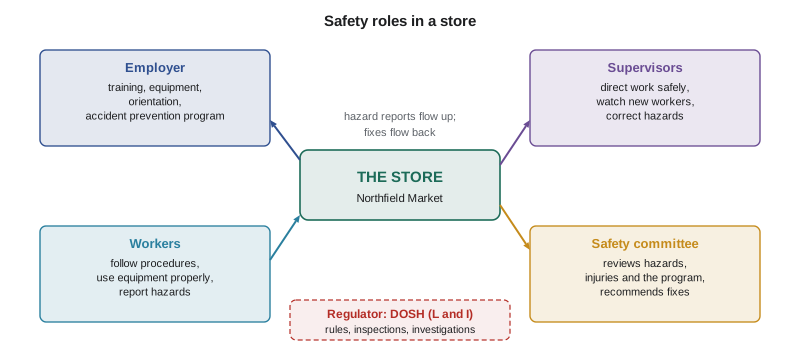
Safety law spreads responsibility across everyone in the store. The table below shows the main duties in plain terms.
| Role | Main duties in a store |
|---|---|
| Employer (the company and store manager) | Provide a safe store, a written accident prevention program, training, equipment such as step stools and safety knives, first aid, and orientation for new workers |
| Supervisor (department lead, shift manager) | Know the hazards of the work they direct, train and watch new workers, correct unsafe conditions, investigate incidents |
| Worker | Follow safe work procedures, use equipment and PPE properly, report hazards and injuries |
| Safety committee or safety meetings | Review hazards, injuries and the safety program, and recommend improvements |
| DOSH (Labor and Industries) | Set and enforce rules, inspect, investigate serious incidents; L&I also runs workers' compensation |
Washington requires most employers with 11 or more employees to have a safety committee with employee-elected and employer-selected members, and smaller employers or those with workers spread across different shifts to hold regular safety meetings instead. Washington also requires every employer to have a written accident prevention program tailored to its hazards. Federal OSHA does not require committees, so stores in other states may not have one unless the state or the company requires it.
Orientation for new and young workers
Federal OSHA standards require training on specific hazards, such as hazardous chemicals, but do not set one orientation checklist. Washington's accident prevention program must include a safety orientation for new workers that covers how to report injuries and hazards, first aid, emergency procedures, the hazards of the job and how to use required PPE, with records kept. Many retail chains also follow their own detailed checklists. Lesson 12 builds an orientation checklist for Northfield.
Reporting hazards
The single most useful thing a retail worker can do for safety is report hazards early. A wobbly step stool, a freezer door that sticks, a loose mat, a leaking cooler, a blocked exit, a frayed cord behind a display: each is easy to fix today and may hurt someone next week. Workers often do not report because they assume someone else already did, because they think nothing will happen, or because they worry about looking like complainers. Supervisors overcome all three by thanking people for reports, fixing things quickly and telling the reporter what was done.
Northfield uses a simple system. Any worker can tell their supervisor, write the hazard on a paper form at the staff room or scan a code with the store app. Each report gets a priority. High-priority hazards, such as a blocked exit, a broken freezer release or a spill that cannot be cleaned right away, are fixed or made safe immediately. Medium-priority hazards are fixed within a week, and low-priority items within a month. The joint committee reviews the open list at every meeting.
The program below takes Northfield's hazard reports from one month and works out how long each took to close and which are overdue.
# Hazard reports at an invented store: days to close and overdue items.
from datetime import date

limit = {"high": 1, "medium": 7, "low": 30}   # target days to fix
today = date(2026, 3, 31)
reports = [
    ("step stool wobbles, aisle 7", "medium", date(2026, 3, 2), date(2026, 3, 5)),
    ("freezer door slow to open from inside", "high", date(2026, 3, 4), date(2026, 3, 4)),
    ("entrance mat curled at edge", "medium", date(2026, 3, 9), date(2026, 3, 20)),
    ("boxes blocking rear exit", "high", date(2026, 3, 12), date(2026, 3, 12)),
    ("light out in dairy cooler", "low", date(2026, 3, 15), None),
    ("cord across bakery floor", "medium", date(2026, 3, 18), None),
    ("cart corral rail loose", "low", date(2026, 3, 25), None),
]
for what, pri, opened, closed in reports:
    end = closed or today
    days = (end - opened).days
    status = "closed" if closed else "open"
    late = days > limit[pri]
    flag = "  << overdue" if late else ""
    print(f"{what:<40} {pri:<7} {status:<7} {days:>3} days{flag}")
open_n = sum(1 for r in reports if r[3] is None)
print(f"Open reports: {open_n} of {len(reports)}")step stool wobbles, aisle 7 medium closed 3 days freezer door slow to open from inside high closed 0 days entrance mat curled at edge medium closed 11 days << overdue boxes blocking rear exit high closed 0 days light out in dairy cooler low open 16 days cord across bakery floor medium open 13 days << overdue cart corral rail loose low open 6 days Open reports: 3 of 7
Two items stand out. The curled entrance mat took eleven days to fix against a target of seven, and the cord across the bakery floor has been open for thirteen days. Both are trip hazards that could hurt a worker or a customer, so Marco moves them to the top of the list and asks why they stalled. The answer for the mat was waiting for a replacement from the supplier; the store could have taped or removed the old mat in the meantime. Making a hazard safe while waiting for a permanent fix is an important habit.
Reporting injuries and incidents
Every injury, however small, should be reported to the supervisor right away and written in the first-aid record. Near misses, such as a heavy box falling from a shelf without hitting anyone, should also be reported, because they show where the next injury may come from.
In Washington, workers should report injuries to their employer right away and can file a workers' compensation claim with L&I or, at self-insured employers, through the employer. Employers that must keep injury records record work-related injuries that meet OSHA's recording criteria on the OSHA 300 log. Many retail industries, including grocery stores, must keep the log; some lower-hazard retail industries are partially exempt. Deaths, inpatient hospitalizations, amputations and loss of an eye must be reported to DOSH within short deadlines measured in hours, and the scene of a serious incident must be preserved except to help the injured.
For supervisors: when a worker reports an injury
Make sure the worker gets first aid or medical care first. Then record what happened while details are fresh, look at the scene, make it safe and ask what would have prevented the injury. Avoid asking who was to blame; ask what in the task, tools, layout or schedule made the injury possible. Thank the worker for reporting. Never discourage reporting, for example by tying bonuses to having no reported injuries, because that hides problems until they become serious.
Worked problem
A refusal at the freezer
At 9 p.m. on a busy Saturday, the night lead asks Jess, a 17-year-old new stocker, to restock the walk-in freezer for the rest of her shift, about three hours. Jess has only a hoodie and says she is not comfortable working that long in the freezer. What should happen?
Show solution
- Jess tells the night lead why she is concerned: no freezer clothing and a long time in the cold.
- The night lead stops and investigates rather than insisting. Northfield's procedure calls for a freezer suit, gloves and a warm-up break every hour in the freezer (Lesson 7).
- He finds a freezer suit in the right size, splits the task into shorter sessions with warm-up breaks, and pairs Jess with an experienced stocker for the first session.
- Jess agrees the task is now safe. If the concern had not been resolved, it would go to the store manager and the safety committee, and Jess could contact DOSH.
- He records the concern and the fix, and raises the missing suits at the next safety committee meeting so they are always available.
Answer: The lead should treat the concern as a signal that the job was not set up safely, fix it, and record what was done. Jess must not be punished for raising it.
Common mistakes
MistakeTelling a new worker who raises a concern to just get on with it.
InsteadStop, listen and investigate; a refusal or concern usually means the job was not planned or equipped properly.
MistakeLeaving a hazard unreported because someone else has probably reported it.
InsteadReport it anyway; duplicate reports cost nothing, missed ones can cost an injury.
MistakeLeaving a reported hazard in place until the permanent fix arrives.
InsteadMake it safe right away with a barrier, tape, sign or by removing the item, then fix it properly.
MistakeRewarding departments for having no reported injuries.
InsteadReward reporting and fixing hazards; incentives tied to zero reports hide problems.
MistakeSkipping orientation for part-time or seasonal workers.
InsteadGive every new worker a documented orientation before they start, whatever their schedule.
Summary and key terms
- Workers have the right to a safe workplace, to information and training, to report hazards and participate, and a limited right to refuse imminent danger, with protection from retaliation.
- Employers provide a safe store, an accident prevention program, training, equipment and orientation; supervisors direct work safely; workers follow procedures and report hazards; the safety committee reviews and recommends.
- In Washington, most employers with 11 or more employees need a safety committee, and smaller ones hold safety meetings.
- New and young workers need a documented orientation before they start work.
- Hazard reports should be prioritized, made safe right away and closed quickly, with the reporter told what was done.
- Every injury and near miss should be reported; serious injuries must be reported to the regulator quickly and the scene preserved.
- Right to refuse
- A worker's legal right to refuse work they reasonably believe is dangerous, following the procedure set by law.
- Joint health and safety committee
- A committee of worker and employer members that inspects, hears concerns and recommends improvements.
- Safety committee
- In Washington and some other places, a required committee of employee and employer members that reviews hazards, injuries and the safety program.
- Orientation
- Training given to a new worker before they start work, covering hazards, procedures, rights and emergencies.
- Hazard report
- A record that a worker has seen something that could cause harm, with a priority and a date to fix it.
- Retaliation
- Punishing a worker for raising a safety concern, reporting an injury or using a safety right; it is prohibited.
- Supervisor
- A person who directs the work of others and is responsible for their safety while they do it.
Practice problems
Work each problem on paper first, then reveal the answer to check.
Name three things US workers have the right to.
Show answer
Any three of: a safe workplace, information and training on hazards, reporting hazards and participating, seeing injury records, requesting an inspection, protection from retaliation.
At what size does a Washington employer usually need a safety committee?
Show answer
Eleven or more employees; smaller employers hold safety meetings.
What written program must every Washington employer have?
Show answer
An accident prevention program tailored to its hazards.
When does the limited federal right to refuse apply?
Show answer
When a task presents an imminent danger of death or serious injury, there is no time to fix it through normal channels and the employer has refused to fix it.
What should happen to a hazard while waiting for a permanent fix?
Show answer
It should be made safe right away, for example with a barrier, tape, a sign or by removing the item.
Why is tying bonuses to zero reported injuries a bad idea?
Show answer
It discourages reporting and hides problems until they become serious.
What should a supervisor ask after an injury, instead of who was to blame?
Show answer
What in the task, tools, layout or schedule made the injury possible.
Which serious injuries must be reported to DOSH within hours?
Show answer
Deaths, inpatient hospitalizations, amputations and loss of an eye.
Lesson quiz · 5 questions
Score 60% or more to complete this lesson.
Create a free account to save your progress, take quizzes and earn a certificate.