
HSE-340 · Lesson 8 of 12 · 23 min
Food areas: deli, bakery and slicers
The deli and bakery are the most industrial parts of a grocery store. They have power-driven slicers with razor-sharp circular blades, commercial mixers that can trap an arm, ovens and fryers that cause serious burns, knives used for hours at a time, flour dust, strong cleaning chemicals and floors that are often wet or greasy. They are also staffed by many young and new workers, including students working weekends. This lesson covers the main hazards of food preparation areas and the rules, including age rules, that control them. Food safety, which protects customers, overlaps with worker safety in places such as handwashing and cleaning, but the focus here is on protecting the people doing the work.
Meat and cheese slicers
Commercial slicers cause some of the most serious injuries in grocery stores: deep cuts and fingertip amputations, usually to the hand that is feeding product, adjusting the guard or cleaning the blade. The blade keeps spinning for a moment after the slicer is switched off, and it stays sharp enough to cut deeply when it is stopped. Most slicer injuries happen during cleaning, when the guard is off and the worker's hands are close to the edge.
- Use the slicer only after training and authorization, and only with all guards in place.
- Use the product pusher or carriage handle; never push product toward the blade with your hand, and never slice items so small that your hand gets close to the blade.
- Keep your eyes on the blade while it is running and do not talk on the phone or turn away.
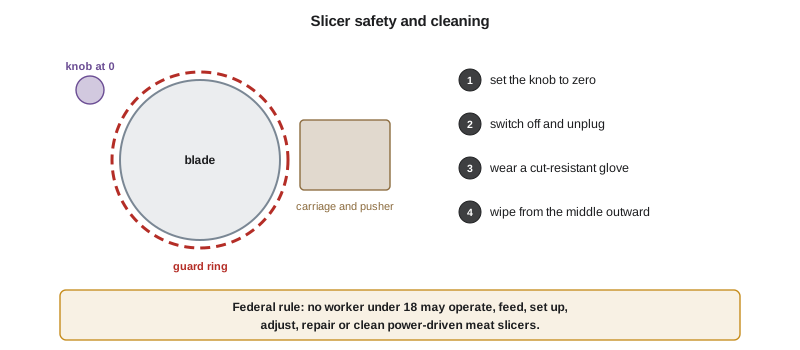
- When finished, turn the thickness knob to zero so the blade edge is covered, switch off and unplug the slicer before cleaning or adjusting it.
- Clean the blade wearing a cut-resistant glove, wiping from the center outward, away from the edge. Never reach across the blade.
- Report any damaged guard, loose knob or electrical fault and tag the slicer out of service.
Age rules for food equipment
Federal child labor rules under the Fair Labor Standards Act set hazardous occupations orders that apply to all workers under 18. One order prohibits minors from operating, feeding, setting up, adjusting, repairing or cleaning power-driven meat slicers and other meat-processing machines, and another covers power-driven bakery machines such as mixers and dough sheeters. Fourteen- and fifteen-year-olds face further limits: they may do some cooking under strict conditions but not baking, and they may not use ladders, work in freezers and meat coolers for long periods, or operate most power-driven equipment. Their hours are also limited during the school year. Washington's own rules for minors are at least as strict and require employers to hold a minor work endorsement. Violations carry penalties, and enforcement in grocery stores is common, so check the current federal and state rules before assigning young workers.
The age rules exist because young workers are more likely to be hurt on this equipment, often because they are new, eager to please and not yet aware of how quickly a blade can cut. Following them is not optional, and it is easy to break them by accident on a busy day, for example by asking a 16-year-old to wipe down the slicer at closing. Clear labels on equipment and a staffing plan that keeps an adult on every closing shift help prevent that.
The program below checks a deli and bakery schedule against age rules.
# Check a deli/bakery schedule against federal hazardous occupations rules (simplified).
rule = {  # task: minimum age (federal rules; state rules may be stricter)
    "operate slicer": 18, "clean slicer": 18, "operate mixer": 18,
    "fryer": 16, "oven": 16, "wrap and label": 14, "serve counter": 14,
}
staff = {"Ana": 34, "Jess": 17, "Kai": 15, "Omar": 19}
shift = [("Jess", "clean slicer"), ("Kai", "serve counter"), ("Kai", "fryer"),
         ("Omar", "operate mixer"), ("Ana", "operate slicer"), ("Jess", "oven")]
for name, task in shift:
    ok = staff[name] >= rule[task]
print(f"{name:<5} ({staff[name]}) {task:<15} {'ok' if ok else 'NOT ALLOWED - reassign'}")Jess (17) clean slicer NOT ALLOWED - reassign Kai (15) serve counter ok Kai (15) fryer NOT ALLOWED - reassign Omar (19) operate mixer ok Ana (34) operate slicer ok Jess (17) oven ok
Two assignments break the rule: Jess, at 17, has been scheduled to clean the slicer, and Kai, at 15, to work the fryer. The fix is to swap tasks with Omar and Ana before the shift starts. A simple check like this, done by the scheduler, catches the mistakes that happen when a store is short-staffed. The program simplifies the rules; the full federal and Washington rules have more detail and some exceptions.
Knives
Deli and meat counters use knives for hours at a time, and most knife cuts in food areas come from a few habits. Keep knives sharp, since a dull knife needs more force and slips more easily. Cut on a stable board that does not slide; a damp cloth under the board helps. Cut away from your body and keep the fingers of the guiding hand curled. Carry knives point down at your side and say behind or sharp when passing others. Never try to catch a falling knife. Do not leave knives in a sink full of soapy water where someone could reach in and grab the blade; wash them separately and put them away. A cut-resistant glove on the guiding hand, or a mesh glove for meat cutting, adds protection.
Mixers, sheeters and other bakery machines
Commercial mixers, dough sheeters, dividers and slicers can catch hands, hair, sleeves and jewelry and pull them in. Mixers should have bowl guards that stop the machine when opened, and workers must never reach into a running mixer to scrape the bowl or add ingredients. Before cleaning, clearing a jam or changing attachments, the machine must be switched off and unplugged or locked out. HSE-215 covers machine guarding and HSE-210 covers lockout. Long hair should be tied back, sleeves kept close and jewelry removed.
Ovens, fryers and burns
Burns are the most common bakery injury. Rack ovens, deck ovens and proofers hold trays and racks at high temperatures, and steam released when an oven door opens can scald the face and arms. Fryers hold oil at 350 to 375 °F (about 175 to 190 °C), and hot oil causes deep burns.
- Use dry, heat-resistant oven mitts that cover the forearm; wet mitts conduct heat and steam.
- Open oven doors slowly and stand to the side to let steam escape.
- Announce hot trays and racks, and leave hot pans with a warning such as a sprinkle of flour on the handle or a hot sign.
- Keep fryer oil at the correct level, lower food gently and keep water and ice away from hot oil.
- Let oil cool before filtering or changing it, and use the fryer's built-in filter system or a proper oil caddy, never an open bucket carried across the floor.
- Know where the fire extinguisher and the hood suppression pull station are. Fryer fires need a Class K extinguisher; never use water on a grease fire. HSE-105 covers fire safety.
Flour dust and baker's asthma
Breathing flour dust over months and years can cause baker's asthma, one of the most common causes of occupational asthma, as well as eye, nose and skin irritation. Dust is released when flour is tipped, scooped, sifted and thrown onto benches, and when mixers start. Simple controls reduce exposure: add flour gently, start mixers at low speed, use lids on mixers, scoop rather than pour from height, avoid throwing flour on benches and clean with a vacuum or damp cloth rather than a dry brush or compressed air. Workers who develop wheezing, a runny nose or skin rashes that improve on days off should report it, because early action can stop the condition getting worse.
Cleaning chemicals
Food areas use strong chemicals: degreasers, oven cleaners, sanitizers and floor cleaners. Oven cleaners and some degreasers are corrosive and can burn skin and eyes, and mixing chlorine-based products with acids or ammonia releases toxic gases. Read the label and safety data sheet (HSE-102), wear the gloves and eye protection they call for, use the dilution system provided rather than mixing by eye, never mix products and know where the eyewash station is.
Floors in food areas
Deli and bakery floors are often wet, greasy or dusted with flour, which is slippery. Slip-resistant footwear is especially important here. Clean spills at once, use degreasing floor cleaners on the schedule set by the store, keep floor drains clear and mats clean, and report areas that stay slippery after cleaning. Lesson 9 covers slips in more depth.
For supervisors: food area checklist
Check that slicer and mixer guards are present and working at the start of each shift. Train and authorize every worker on each machine before they use it, and keep a record. Post the age rules on the equipment and check schedules against them. Make sure cut-resistant gloves, oven mitts and eye protection are available and in good condition. Watch the flour handling practices of the bakery team. Check fryer oil handling and fire equipment. Keep floors clean and dry and footwear rules enforced.
Worked problem
A slicer cut at closing
At closing time, a deli worker wiped down the slicer blade while the thickness knob was still open and the slicer was plugged in, and cut two fingers on the blade edge. She had been shown the cleaning steps once on her first day, two months earlier. What should the investigation look at?
Show solution
- The immediate cause: cleaning with the knob open and the slicer plugged in, so the blade edge was exposed and could have been started.
- Training: one demonstration two months ago was not enough. Slicer cleaning should be practiced under supervision until the worker can do it correctly every time, and checked again later.
- Time pressure: closing tasks were rushed because the deli was short-staffed that night.
- Equipment: a laminated cleaning card on the slicer and cut-resistant gloves kept next to it make the right steps easier to follow.
- Age and authorization: check that the worker was old enough and authorized under the age rules for slicer cleaning.
Answer: The fix combines supervised practice and re-checks for slicer cleaning, a cleaning card and gloves at the slicer, enough staff at closing and a check that only authorized adults clean slicers.
Common mistakes
MistakeCleaning a slicer with the knob open and the plug in.
InsteadSet the knob to zero, switch off and unplug, then clean with a cut-resistant glove from the center outward.
MistakeAsking a 16-year-old to wipe down the slicer at closing.
InsteadFollow the age rules: in the United States no one under 18 may clean power-driven meat slicers, and many Canadian employers set the same rule.
MistakeReaching into a running mixer to scrape the bowl.
InsteadStop the mixer and wait for it to stop before reaching in; never bypass the bowl guard.
MistakeUsing a wet oven mitt to pull out a hot tray.
InsteadUse dry, heat-resistant mitts that cover the forearm.
MistakeSweeping flour with a dry brush or blowing it off with compressed air.
InsteadClean flour with a vacuum or damp cloth to keep dust out of the air.
Summary and key terms
- Deli and bakery areas have slicers, mixers, ovens, fryers, knives, flour dust, chemicals and slippery floors.
- Most slicer injuries happen during cleaning; set the knob to zero, unplug and clean with a cut-resistant glove from the center outward.
- Federal rules bar under-18s from operating or cleaning power-driven meat slicers and bakery machines, and limit 14- and 15-year-olds further.
- Keep knives sharp, cut away from the body, carry them point down and never leave them in a sink of soapy water.
- Mixers and sheeters need guards and lockout before cleaning or clearing jams.
- Prevent burns with dry mitts, care with steam and safe fryer oil handling; use Class K extinguishers for grease fires.
- Flour dust can cause baker's asthma; handle flour gently and clean without raising dust.
- Slicer guard
- A fixed ring around the blade edge of a slicer that protects hands while it runs.
- Thickness knob
- The control that sets slice thickness; turned to zero, it covers the blade edge.
- Hazardous occupations order
- A US federal rule listing jobs that workers under 18 may not do.
- Baker's asthma
- Occupational asthma caused by breathing flour and other bakery dusts.
- Class K extinguisher
- A fire extinguisher designed for cooking oil and grease fires.
- Mesh glove
- A glove made of interlocking metal rings worn on the guiding hand for meat cutting.
- Lockout
- Isolating a machine from its energy source and securing it so it cannot start during maintenance or cleaning.
Practice problems
Work each problem on paper first, then reveal the answer to check.
When do most slicer injuries happen?
Show answer
During cleaning, when the guard is off and hands are close to the blade.
List the four slicer cleaning steps.
Show answer
Set the thickness knob to zero, switch off and unplug, put on a cut-resistant glove, wipe from the center outward.
What does the federal meat slicer hazardous occupations order prohibit?
Show answer
Workers under 18 operating, feeding, setting up, adjusting, repairing or cleaning power-driven meat slicers.
Why should knives never be left in a sink of soapy water?
Show answer
Someone could reach in and grab the blade without seeing it.
What should happen before clearing a jam in a dough sheeter?
Show answer
Switch it off and unplug or lock it out so it cannot start.
Why open an oven door slowly and stand to the side?
Show answer
To let steam escape without scalding the face and arms.
Name three ways to reduce flour dust.
Show answer
Any three of: add flour gently, start mixers slowly, use mixer lids, scoop rather than pour from height, avoid throwing flour, clean with a vacuum or damp cloth.
What kind of extinguisher is used on a fryer fire?
Show answer
A Class K extinguisher; never water.
Lesson quiz · 5 questions
Score 60% or more to complete this lesson.
Create a free account to save your progress, take quizzes and earn a certificate.