
HSE-333 · Lesson 2 of 12 · 26 min
Law and standards for permits and isolation in oil and gas
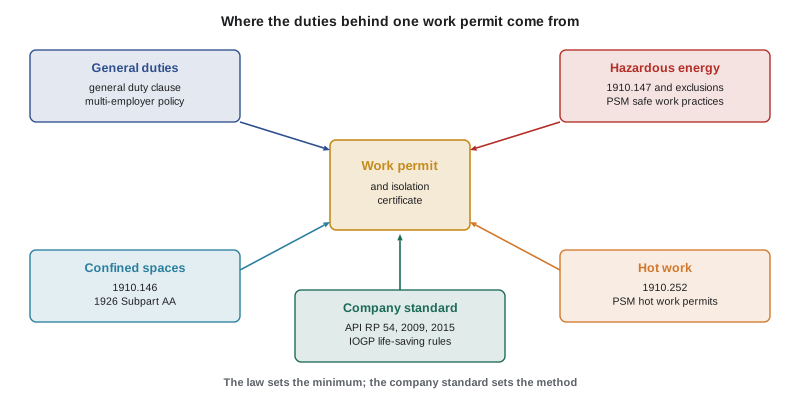
HSE-221 explained how permit duties are spread across general duties, hazard-specific rules, fire codes and consensus standards, and HSE-330 and HSE-332 mapped the regulators that oversee oil and gas sites and pipelines. This lesson narrows the focus to one question: which rules govern how work is authorized and how equipment is isolated on an oil and gas site in the United States, and where do company standards and industry guidance have to fill the gaps? The answer matters because a permit or isolation procedure that does not meet the legal minimum exposes workers and the company, and one that meets only the legal minimum may still not be safe enough for sour, high-pressure service.
General duties and who holds them
The Occupational Safety and Health Act's general duty clause requires every employer to keep its workplace free of recognized hazards likely to cause death or serious physical harm, and OSHA uses it where no specific standard applies, which is common in oil and gas extraction. On sites with several employers, OSHA's multi-employer citation policy can hold creating, exposing, correcting and controlling employers responsible for the same hazard. The operator that controls a battery or plant is usually the controlling employer for site-wide hazards, and a permit system is one of the main ways it shows reasonable care over the contractors working there. Some states run their own OSHA-approved plans; North Dakota is under federal OSHA.
Rules for hazardous energy
Lockout rules are where most isolation requirements sit. OSHA's control of hazardous energy standard, 29 CFR 1910.147, requires energy control procedures, training and periodic inspections for servicing and maintenance in general industry. It has exclusions that matter in oil and gas: it does not cover oil and gas well drilling and servicing, and it does not cover hot tap operations on pressurized pipelines when continuity of service is essential, shutdown is impractical and documented procedures and special equipment protect employees. For drilling and servicing rigs, OSHA relies on the general duty clause, and industry follows API RP 54, Occupational Safety and Health for Oil and Gas Well Drilling and Servicing Operations, which includes lockout. Where a process falls under process safety management, 1910.119 also requires safe work practices for lockout and tagout, confined space entry, opening process equipment or piping, and control over entry into the facility by maintenance and contractor personnel.
Rules for confined spaces
Tanks, vessels, separators, treaters, well cellars and pits are confined spaces on many oil and gas sites. OSHA's permit-required confined spaces standard, 1910.146, requires a written program, a permit for each entry into a permit-required space, atmospheric testing, isolation, attendants and rescue arrangements. Construction work in confined spaces falls under 1926 Subpart AA, adopted in 2015, which adds coordination duties among employers. API Standard 2015 and API RP 2016 set out industry practice for safe entry into and cleaning of petroleum storage tanks.
Rules for hot work
Hot work on oil and gas sites is governed by OSHA's welding, cutting and brazing standard, 1910.252, whose fire prevention section requires that hot work be moved away from hazards or the hazards be removed or guarded, and sets out fire watch and authorization requirements. Where a process is covered by process safety management, 1910.119 requires a hot work permit for hot work on or near the covered process, documenting the fire prevention and protection measures in place before the work begins. NFPA 51B covers fire prevention during hot work, and API RP 2009 sets out industry practice for safe welding, cutting and hot work in the petroleum and petrochemical industries.
Process safety, change control and offshore systems
OSHA's process safety management standard, 1910.119, covers processes with listed highly hazardous chemicals or large quantities of flammable liquids or gases. It excludes oil or gas well drilling or servicing operations and normally unoccupied remote facilities, so many wells and small batteries fall outside it while gas plants and larger compressor stations often fall inside. EPA's Risk Management Program rule overlaps for some plants. Offshore, the Bureau of Safety and Environmental Enforcement requires a Safety and Environmental Management System (SEMS) under 30 CFR 250 Subpart S, including safe work practices, hazard analysis, management of change, stop work authority and a clear ultimate work authority, built on API RP 75.
Industry guidance that fills the gaps
Laws set the minimum; most of the detail of oil and gas permit and isolation practice comes from company standards built on industry guidance. Four sources come up again and again.
- API RP 54 for drilling and servicing, API RP 2009 for hot work, API Standard 2015 and RP 2016 for tank entry and cleaning, API RP 75 for offshore safety management and API RP 76 for contractor safety management give detailed practice for specific activities.
- The IOGP Life-Saving Rules, used internationally and by many US operators, cover nine activities: bypassing safety controls, confined space, driving, energy isolation, hot work, line of fire, safe mechanical lifting, work authorization and working at height.
- The UK Health and Safety Executive's guidance on permit-to-work systems (HSG250) and on safe isolation of plant and equipment (HSG253) is the reference most often quoted for good practice, including risk-based selection of isolation methods.
- Contractor prequalification and orientation programs such as SafeLandUSA, covered in HSE-330, set common expectations for contract workers arriving at a site.
| Activity | Main legal rules (US) | Industry guidance often adopted |
|---|---|---|
| Energy isolation and lockout | 1910.147 (excludes well drilling and servicing and some hot taps); general duty clause | API RP 54, HSG253, IOGP rules |
| Opening process equipment | 1910.119 safe work practices where PSM applies; general duty clause | Company line-break standards |
| Confined space entry | 1910.146; 1926 Subpart AA for construction | API Std 2015 and RP 2016 |
| Hot work | 1910.252; 1910.119 hot work permits where PSM applies | API RP 2009, NFPA 51B |
| Drilling and servicing | General duty clause; parts of 1910 | API RP 54 |
| Management of change and overrides | 1910.119 where PSM applies; SEMS offshore | API RP 75, company standards |
Using a duty map
Because the rules are scattered, many operators keep a simple duty map that lists, for each kind of permitted work, the legal rules that apply in each jurisdiction where they operate and the company standard that meets them. The program below builds a short duty map for four jobs planned at the Kettle Creek compressor station. It is a teaching sketch, not a legal opinion: the rule names are summaries and must be checked against the current text.
# A small duty map for jobs at a compressor station (teaching summary, US).
RULES = {
    "isolation": ["29 CFR 1910.147", "PSM safe work practices if covered"],
    "line break": ["PSM safe work practices if covered", "company line-break standard"],
    "entry": ["29 CFR 1910.146", "API Std 2015 if a tank"],
    "hot work": ["29 CFR 1910.252", "PSM hot work permit if covered", "API RP 2009"],
    "lift": ["29 CFR 1910.180 (crawler, truck cranes)", "company critical lift standard"],
}
jobs = {
    "replace compressor suction valve": ["isolation", "line break"],
    "inspect inlet scrubber internally": ["isolation", "line break", "entry"],
    "weld new support on cooler skid": ["hot work"],
    "lift cylinder head with picker": ["isolation", "lift"],
}
for job, needs in jobs.items():
    rules = sorted({r for n in needs for r in RULES[n]})
    print(f"{job}:")
    for r in rules:
        print(f"   - {r}")
print("Controlling employer coordinates all four jobs on one site.")replace compressor suction valve: - 29 CFR 1910.147 - PSM safe work practices if covered - company line-break standard inspect inlet scrubber internally: - 29 CFR 1910.146 - 29 CFR 1910.147 - API Std 2015 if a tank - PSM safe work practices if covered - company line-break standard weld new support on cooler skid: - 29 CFR 1910.252 - API RP 2009 - PSM hot work permit if covered lift cylinder head with picker: - 29 CFR 1910.147 - 29 CFR 1910.180 (crawler, truck cranes) - PSM safe work practices if covered - company critical lift standard Controlling employer coordinates all four jobs on one site.
Even this small map shows why a single permit often answers to several rules at once. The internal inspection of the inlet scrubber needs isolation, a line break and a confined space entry, each with its own legal source, and the permit package has to satisfy all of them together. A duty map also shows the site's managers which rules to watch for amendments.
Inspection and enforcement
OSHA compliance officers can inspect permit records, ask how isolations were verified and issue citations under specific standards or the general duty clause, and serious incidents lead to investigations. PHMSA inspects pipeline operators for compliance with 49 CFR 192 and 195, including operator qualification for covered tasks, and BSEE audits SEMS offshore. Inspectors rarely accept that a form exists as proof that the system works; they ask to see permits from real jobs, compare them with what happened in the field and talk to the workers who held them.
Where the law is silent
Some of the most important oil and gas isolation decisions are not spelled out in any regulation. No rule says exactly when a sour gas line needs a spectacle blind rather than double block and bleed, how long a depressured section must be watched for pressure creep, or how a lease operator should hand over isolations to a contractor at an unstaffed battery. These are set by company standards, which should be written down, based on recognized guidance, consistent across sites and enforced for contractors and employees alike. When a regulator or court asks whether the company took every reasonable precaution, the company standard and evidence that it was followed are what it will rely on.
Worked problem
Mapping duties for a compressor overhaul at Kettle Creek
Larchwood plans a two-week overhaul of one compressor at Kettle Creek, with a mechanical contractor, an electrical contractor and a crane company on site while the other compressor keeps running. Which duties should the overhaul plan show?
Show solution
- General duties: each employer protects its own workers; Larchwood, as controlling employer, coordinates all employers' work so it is safe together.
- Hazardous energy: isolate the compressor from process gas, fuel gas, starting air, electrical supplies and stored energy under 1910.147 and, if the station is a covered process, PSM safe work practices.
- Line breaking and entry: open the suction scrubber and cylinders under the company line-break standard, and treat any vessel entry as a permit-required confined space entry under 1910.146.
- Hot work and lifting: control any welding under 1910.252, with a PSM hot work permit if covered, and plan the cylinder lifts under the crane and rigging rules.
- Simultaneous operations: show how the running compressor's hazards are kept away from the overhaul crew.
Answer: The overhaul plan should list each legal source next to the company procedure that meets it, so that every employer on site can see which permits and isolations apply and why.
Common mistakes
MistakeAssuming 1910.147 covers every oil and gas isolation.
InsteadRemember its exclusions for well drilling and servicing and for some hot taps, and fill the gap with API RP 54 and the general duty clause.
MistakeTreating industry guidance as optional decoration.
InsteadUse recognized guidance as the basis of the company standard; it is what regulators and courts compare practice against.
MistakeHolding contractors to a lower standard than employees.
InsteadApply the same permit and isolation rules to everyone on site, as Pasadena showed.
MistakeKeeping a duty map that is never updated.
InsteadReview the map when rules or standards are revised and when the company starts work in a new jurisdiction.
MistakeShowing an inspector the blank form as evidence of compliance.
InsteadShow completed permits from real jobs and evidence that the field matched the paperwork.
Summary and key terms
- The general duty clause and the multi-employer citation policy make the operator responsible for coordinating permits on multi-employer sites.
- Isolation duties come from 1910.147, which excludes well drilling and servicing and some hot taps, from PSM safe work practices where PSM applies, and from API RP 54 on rigs.
- Confined space entry falls under 1910.146 and 1926 Subpart AA, with API tank entry standards for petroleum tanks.
- Hot work falls under 1910.252 and PSM hot work permits, with API RP 2009 and NFPA 51B widely used.
- Industry guidance such as life-saving rules, HSG250 and HSG253 fills the gaps that the law leaves.
- A duty map links each permitted activity to its legal sources and the company procedure that meets them.
- Where the law is silent, written, consistently enforced company standards are what show reasonable care.
- Prime contractor
- The party responsible for coordinating health and safety on a multi-employer work site, in Alberta usually the licensee or operator of an oil and gas site.
- Controlling employer
- Under OSHA policy, the employer with general authority over a worksite, including the power to correct hazards.
- General duty clause
- The OSH Act provision requiring employers to keep workplaces free of recognized serious hazards.
- CSA Z460
- The Canadian standard on control of hazardous energy by lockout and other methods.
- API RP 54
- The industry recommended practice for occupational safety on oil and gas well drilling and servicing operations.
- API RP 2009
- The industry recommended practice for safe welding, cutting and hot work in the petroleum and petrochemical industries.
- Life-saving rules
- A short set of mandatory rules for the activities most likely to kill, used across the industry.
- Duty map
- A table linking each permitted activity to the legal rules and company procedures that apply to it.
Practice problems
Work each problem on paper first, then reveal the answer to check.
Which OSHA policy can make several employers responsible for one hazard?
Show answer
The multi-employer citation policy.
Which oil and gas activity is excluded from 1910.147?
Show answer
Oil and gas well drilling and servicing.
Under what conditions are hot taps excluded from 1910.147?
Show answer
When continuity of service is essential, shutdown is impractical and documented procedures and special equipment protect employees.
Which safe work practices does PSM require?
Show answer
Practices for lockout and tagout, confined space entry, opening process equipment or piping, and control of entry by maintenance and contractor personnel.
Name two facility types excluded from PSM.
Show answer
Oil or gas well drilling or servicing operations and normally unoccupied remote facilities.
Which standard covers confined space work in construction?
Show answer
1926 Subpart AA.
What does BSEE require offshore operators to maintain?
Show answer
A Safety and Environmental Management System under 30 CFR 250 Subpart S.
In the program, which job needed rules for isolation, line breaking and confined space entry?
Show answer
The internal inspection of the inlet scrubber.
Why are company standards important where the law is silent?
Show answer
They set the method for decisions the law does not specify and are the evidence of reasonable care.
What do inspectors usually ask to see instead of a blank permit form?
Show answer
Completed permits from real jobs and evidence that field conditions matched them.
Lesson quiz · 5 questions
Score 60% or more to complete this lesson.
Create a free account to save your progress, take quizzes and earn a certificate.