
HSE-333 · Lesson 11 of 12 · 28 min
Handover, suspension, revalidation and closing permits
A permit is safest at the moment it is issued, when the issuer and receiver have just walked the job together. Every hour after that, conditions can change, people go home and new people arrive. HSE-221 covered handover, suspension, revalidation and close-out in general, including structured handover tools and the story of a forgotten blind. This lesson looks at how these steps work on oil and gas sites, where crews work long rotations at remote sites, emergencies can suspend every permit on a pad in seconds, wells and equipment change hands between contractors and operations, and returning equipment to hydrocarbon service is itself a hazardous operation.
Shifts, rotations and unstaffed nights
Oil and gas crews often work 12-hour shifts on rotations such as two weeks on and one week off, living in camps or driving long distances. Drilling and completions run day and night, while many production sites are staffed only by day and monitored remotely at night. This creates three kinds of handover that permit systems must handle:
- shift-to-shift handover within a 24-hour operation, such as night tour to day tour on a rig or between plant shift supervisors;
- rotation handover, when a whole crew, including issuers and supervisors, leaves for a week and is replaced by people who were not there when the job started;
- overnight suspension at a day-staffed site, when work stops at the end of the day, the site is left unstaffed with isolations in place, and work resumes next morning.
Rotation handovers are especially risky because the incoming crew may not know the history of a long job: why a temporary isolation was set the way it was, which valve was found passing, or which contractor still has a lock on the box. Good practice is a written handover for every open permit and isolation, a face-to-face handover where possible and a walk-around of the jobs, not just a conversation in the office.
What a handover must cover
Whatever the type of handover, the incoming issuer or supervisor needs the same core information for each open permit: the scope and status of the work, the isolations in place and any that are temporary or deviate from the standard, active overrides and their compensating measures, the last gas test and when the next is due, any SIMOPS restrictions, anything abnormal about the plant, and what the crew plans to do next. The program below checks a set of handover records against a list of required items and reports gaps.
# Check permit handover records for missing items (invented records).
REQUIRED = ["status", "isolations", "overrides", "last gas test", "next gas test due",
            "simops limits", "abnormal conditions", "next step"]
handovers = {
    "PTW-3317 scrubber line opening": {
        "status": "blinds in, internals inspection 60 percent done",
        "isolations": "IC-118, group box 4, seven points",
        "overrides": "LSHH-210 inhibited, operator watching local gauge",
        "last gas test": "17:40 clear",
        "next gas test due": "before restart 07:00",
        "simops limits": "no lifts over scrubber",
        "abnormal conditions": "V3 passes slightly; bleed left open",
        "next step": "finish inspection, then box up",
    },
    "PTW-3322 cooler support weld": {
        "status": "welding complete, fire watch finished 18:30",
        "isolations": "none",
        "last gas test": "16:10 clear",
        "next step": "paint tomorrow under cold work",
    },
    "PTW-3325 fuel gas filter change": {
        "status": "filter out, new element not yet fitted",
        "isolations": "IC-121, two valves locked",
        "overrides": "none",
        "next step": "fit element, leak test",
    },
}
for permit, rec in handovers.items():
    missing = [item for item in REQUIRED if item not in rec]
    flag = "complete" if not missing else "missing: " + ", ".join(missing)
print(f"{permit:<36} {flag}")PTW-3317 scrubber line opening complete PTW-3322 cooler support weld missing: overrides, next gas test due, simops limits, abnormal conditions PTW-3325 fuel gas filter change missing: last gas test, next gas test due, simops limits, abnormal conditions
The scrubber permit is fully handed over, and it records something the incoming shift must know: valve V3 is passing slightly and its bleed has been left open. The weld permit is missing items about overrides, the next gas test, SIMOPS limits and abnormal conditions; some may genuinely be none, but the handover should say so rather than leave a blank. The filter change permit is the most worrying: equipment is open with the filter element out, and the handover says nothing about gas tests, SIMOPS limits or plant conditions. An incoming issuer reading these records would know which jobs to visit first.
Suspension
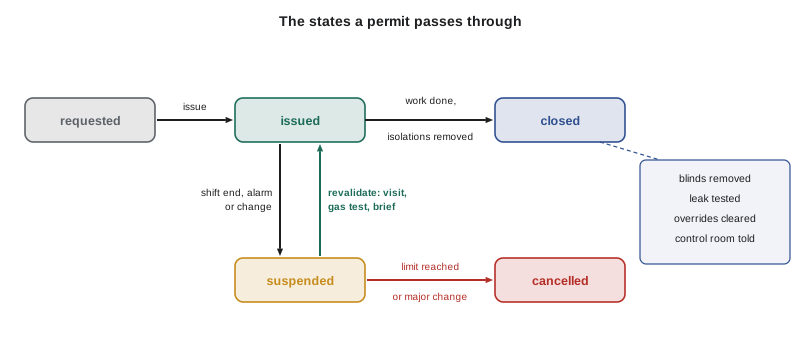
A permit is suspended when work stops but the job is not finished: at the end of a shift, during a break, when conditions change, or in an emergency. Suspension means the crew leaves the worksite, the equipment is left in a safe state, and nobody restarts the work until the permit is revalidated. On oil and gas sites, common reasons to suspend include:
- any gas alarm, H2S alarm, fire alarm or emergency shutdown in the area or on the site;
- a process upset, start-up or shutdown that could affect the work;
- weather: lightning within a set distance, high winds for lifts and work at height, extreme cold;
- a well control event, frac stop or other emergency on the pad;
- a change in the work scope or the discovery of something unexpected, such as a valve that will not hold;
- loss of the safety watch, fire watch or communication.
When an emergency alarm sounds, every permit in the affected area is suspended at once. Crews make their work safe if they can do so in seconds, such as shutting off a torch or closing a valve they opened, and go to the muster point. After the emergency, no permit is simply resumed. Each one is revalidated: the issuer checks that the equipment and isolations are as they were left, a new gas test is taken, and the crew is briefed again. Emergencies often change conditions, for example a release can leave gas in low areas or an emergency shutdown can move valves that were part of the plant around the job.
Revalidation
Revalidation renews a suspended permit or extends it into a new shift. It is not a signature in the office. The issuer, or the incoming issuer after a handover, visits the job, checks the isolations against the certificate, witnesses or reviews a fresh gas test, confirms that SIMOPS conditions have not changed, and briefs the crew, who may be different people from the day before. Many companies limit how many times a permit can be revalidated before it must be canceled and reissued from scratch, and require a full reissue after any emergency or significant change.
Tracking permit states
Electronic permit systems and many paper registers track each permit through a set of states and only allow certain moves between them. The program below models a simple version of that logic: a permit can be issued, suspended, revalidated and closed, and the program refuses moves that break the rules, such as revalidating without a gas test or closing while isolations or overrides remain.
# A simple permit register that enforces allowed state changes (teaching model).
ALLOWED = {
    "requested": {"issued"},
    "issued": {"suspended", "closed"},
    "suspended": {"issued", "cancelled"},      # back to issued only by revalidation
}

class Permit:
    def __init__(self, number):
        self.number, self.state, self.revalidations = number, "requested", 0
        self.isolations_on, self.overrides_on = True, True

    def move(self, new, gas_test_ok=False):
        if new not in ALLOWED.get(self.state, set()):
            return f"refused: {self.state} -> {new} not allowed"
        if new == "issued" and not gas_test_ok:
            return "refused: no valid gas test"
        if new == "issued" and self.state == "suspended":
            if self.revalidations >= 3:
                return "refused: revalidation limit reached, cancel and reissue"
            self.revalidations += 1
        if new == "closed" and (self.isolations_on or self.overrides_on):
            return "refused: isolations or overrides still in place"
        self.state = new
        return f"ok: now {new}"

p = Permit("PTW-3317")
steps = [("issued", True), ("suspended", False), ("issued", False), ("issued", True),
         ("closed", False)]
for new, gas in steps:
    print(f"{p.number} {p.state:>10} -> {new:<9} {p.move(new, gas)}")
p.isolations_on = p.overrides_on = False           # handed back, isolations removed
print(f"{p.number} {p.state:>10} -> closed {p.move('closed')}")PTW-3317 requested -> issued ok: now issued PTW-3317 issued -> suspended ok: now suspended PTW-3317 suspended -> issued refused: no valid gas test PTW-3317 suspended -> issued ok: now issued PTW-3317 issued -> closed refused: isolations or overrides still in place PTW-3317 issued -> closed ok: now closed
The register refuses to revalidate the suspended permit until a valid gas test is recorded, and refuses to close it while isolations and the level switch override are still in place. Once the job is handed back and the isolations and override are removed, the permit can close. A paper system can enforce the same rules only through the discipline of the people using it, which is why audits check exactly these transitions.
Handover between contractors and operations
On wells and new facilities, a major handover happens when a drilling or completions contractor finishes and the well or equipment passes to production operations. The well handover should include the well's status, the barriers in place and their test records, wellhead and valve positions and pressures, any open issues, and the documents the production operator needs. New facilities pass from construction to commissioning to operations with similar handover packages. Many companies use a formal handover certificate signed by both parties, and until it is signed the receiving party does not treat the equipment as its own. Ambiguity about who controls a well or a piece of equipment during these transitions has contributed to serious incidents, so the bridging document and the SIMOPS plan should say exactly when control changes.
Handing back and de-isolation
When the work is finished, the receiver hands the job back to the issuer, confirming that the crew has left, tools and materials have been removed, guards and covers are refitted, and the equipment is ready for de-isolation. De-isolation is the reverse of isolation but needs as much care, because it reintroduces energy and hydrocarbons into equipment that has just been worked on. A typical sequence on an oil and gas site is:
- confirm every permit and personal lock linked to the isolation certificate is closed or removed;
- remove blinds in the planned order, checking each against the blind list, and fit the correct gaskets;
- close vents and drains that were opened for the job, and return small-bore valves to their normal positions;
- purge air out of the equipment with nitrogen until the oxygen content is low enough that hydrocarbons can be introduced without forming a flammable mixture inside;
- leak test the joints that were broken, first with nitrogen at a moderate pressure using leak detection fluid or a gas detector, then at operating pressure as hydrocarbons are introduced;
- remove overrides, test the safety devices back into service, and clear the control room inhibits;
- return the equipment to service under the operating procedure, with a pre-startup safety review for new or modified equipment, as HSE-311 describes.
Closing the permit
A permit is closed only when the work is complete, the equipment has been handed back and de-isolated or left in a recorded safe state, every linked certificate is closed, and the control room has been told. If the equipment will stay isolated, for example waiting for parts, the isolation is transferred to a long-term isolation record before the work permit closes, so that the isolation does not become an orphan with no permit behind it. Closed permits, isolation certificates, gas test records and override certificates should be kept for the period the company standard sets, both as legal records and as material for audits and learning, as Lesson 12 describes.
Worked problem
Restarting after an H2S alarm at Spruce Ridge
At 10:20 an H2S alarm sounds at the Spruce Ridge sulfur plant. Four permits are active in the area: a line opening on a sour water drain, insulation work on the reaction furnace, scaffolding near the condensers and an instrument calibration. All crews muster. By 11:05 operations find a small leak at a sour water pump seal, isolate the pump and declare the area clear. What must happen before work resumes?
Show solution
- All four permits were suspended when the alarm sounded; none resumes automatically.
- The issuer checks the line opening first: are its isolations as left, did the emergency response move any valves, is the drain still open and depressured?
- Fresh gas tests are taken at each worksite, at low points and at drains, because H2S may have collected after the release.
- The issuer reviews whether the leak and the pump isolation change any SIMOPS conditions, for example whether the sour water system is now running on its spare pump near one of the jobs.
- Each crew is briefed again, the permits are revalidated and recorded, and the incident is reported so that the seal leak is investigated.
Answer: Every permit must be revalidated with a site visit, fresh gas tests, a check of isolations and SIMOPS, and a new briefing, because the emergency may have changed conditions at each job.
Common mistakes
MistakeHanding over open permits in a quick conversation in the office.
InsteadUse a written handover for every open permit and isolation, face to face and with a walk-around where possible.
MistakeResuming work straight after the all-clear.
InsteadRevalidate every suspended permit with a site visit, fresh gas test and new briefing.
MistakeRevalidating a permit by signature without visiting the job.
InsteadVisit, check isolations, witness a gas test and brief the crew.
MistakeIntroducing hydrocarbons into equipment that still contains air.
InsteadPurge air out with nitrogen and leak test before returning to hydrocarbon service.
MistakeClosing a work permit while equipment stays isolated with no record.
InsteadTransfer the isolation to a long-term isolation record before the permit closes.
Summary and key terms
- Oil and gas permit systems must handle shift, rotation and overnight handovers, with rotation handovers the riskiest.
- A handover covers status, isolations, overrides, gas tests, SIMOPS limits, abnormal conditions and next steps for every open permit.
- Permits are suspended for alarms, upsets, weather, well events, scope changes and loss of the watch, and every permit stops when an emergency alarm sounds.
- Revalidation needs a site visit, isolation check, fresh gas test, SIMOPS check and new briefing, with limits on repeated revalidation.
- Permit registers enforce allowed state changes, such as no closure while isolations or overrides remain.
- Wells and new facilities pass between contractors and operations through formal handover certificates.
- De-isolation removes blinds by list, purges air, leak tests, clears overrides and returns equipment to service before the permit closes.
- Rotation handover
- The handover when a whole crew leaves for its days off and a new crew takes over.
- Suspension
- Stopping permitted work and leaving the job in a safe state until revalidation.
- Revalidation
- Renewing a suspended permit after a site check, fresh gas test and briefing.
- Handover certificate
- A signed record transferring control of a well or equipment from one party to another.
- De-isolation
- Removing isolations in a planned sequence to return equipment to service.
- Leak test
- A test of broken joints with nitrogen or the process fluid before or during return to service.
- Hand back
- The receiver returning a finished job to the issuer.
- Orphan isolation
- An isolation left in place with no permit or record behind it.
Practice problems
Work each problem on paper first, then reveal the answer to check.
Name the three kinds of handover oil and gas permit systems must handle.
Show answer
Shift-to-shift, rotation and overnight suspension at day-staffed sites.
Why are rotation handovers especially risky?
Show answer
The incoming crew may not know the history of a long job, such as temporary isolations, passing valves or remaining locks.
In the handover program, which permit was most worrying and why?
Show answer
The fuel gas filter change: equipment was open and the record said nothing about gas tests, SIMOPS limits or plant conditions.
Name four reasons to suspend a permit on an oil and gas site.
Show answer
Any four of: gas or fire alarm, emergency shutdown, upset or start-up, lightning or high wind, well event or frac stop, scope change, loss of the watch or communication.
What happens to permits after an emergency all-clear?
Show answer
Each is revalidated with a site visit, fresh gas test, isolation and SIMOPS check and new briefing.
In the register program, why was the first revalidation refused?
Show answer
There was no valid gas test.
Why did the register refuse to close the permit at first?
Show answer
Isolations and an override were still in place.
What does a well handover package include?
Show answer
Well status, barriers and test records, wellhead and valve positions and pressures, open issues and documents.
Why is air purged out of equipment before hydrocarbons are introduced?
Show answer
To avoid forming a flammable mixture inside the equipment.
What must happen to an isolation that stays in place after the work permit closes?
Show answer
It must be transferred to a long-term isolation record.
Lesson quiz · 5 questions
Score 60% or more to complete this lesson.
Create a free account to save your progress, take quizzes and earn a certificate.