
HSE-333 · Lesson 10 of 12 · 26 min
Simultaneous operations on pads, plants and pipelines
Simultaneous operations, usually shortened to SIMOPS, happen whenever two or more activities in the same area could affect each other: a crane lift over a pipe rack while a line is opened below, hot work upwind of a tank being gauged, or a frac fleet pumping next to producing wells. HSE-221 explained the general tools for managing SIMOPS: conflict matrices, coordination meetings, permit boards and distance rules. This lesson applies them to the situations that make SIMOPS a daily reality in oil and gas: multi-well pads where drilling, completions and production share one lease, plants where construction ties into live equipment, and pipelines where crews work far from the control room that can change the line's pressure.
Why oil and gas sites are full of SIMOPS
Modern oil and gas development puts many activities close together. A pad in the Montney or the Bakken may have producing wells, a rig drilling new wells a few meters away, a frac fleet completing other wells, flowback equipment, a battery, trucks hauling water and sand, and construction crews building facilities, all within a few hundred meters. Each activity is run by a different contractor with its own procedures. Gas plants and compressor stations run turnarounds and expansions while the rest of the facility keeps producing. Pipelines are worked on while connected to live systems. In all of these, the hazards of one activity become the hazards of the others.
Typical oil and gas SIMOPS
| Situation | How one activity endangers another | Typical controls |
|---|---|---|
| Rig move or drilling beside producing wells | Dropped loads or rig equipment striking live wellheads; gas from wells reaching rig ignition sources | Shut in and secure offset wells, wellhead protection frames, lift plans, gas detection |
| Fracturing beside producing or recently completed wells | Pressure communication from frac to offset wells, called a frac hit, overpressuring their wellheads or flowlines | Shut in and monitor offset wells, confirm wellhead ratings, communication plan between frac and production |
| Wireline or coiled tubing on one well, production on the next | Well control event or release affecting the producing well and its crew | Exclusion zones, shut-in criteria, shared alarms and muster |
| Construction tie-ins into a live battery or plant | Hot work, excavation and lifts close to live equipment; tie-in break into a live system | Isolation to the tie-in point, hot work controls, scheduling around operations |
| Turnaround of one plant train while the other runs | Releases or upsets from the live train reaching turnaround crews | Physical barriers, gas detection, alarm and evacuation plan for the turnaround area |
| Pipeline repair while the system is live | Control room or another operator changing pressure in the line or adjacent lines | Locked valves, agreed operating limits, direct communication with the control room |
| Tank gauging or truck loading near hot work | Vapor released at hatches or during loading drifting to the hot work | Suspend loading or hot work, wind checks, continuous monitoring |
Frac hits and offset wells
When a well is hydraulically fractured, fractures can grow toward nearby wells and connect with them. Pressure and fluid from the frac can then reach the offset well, sometimes far above that well's normal operating pressure. Frac hits have damaged wellheads, flowlines and production equipment and caused releases at offset wells, and regulators and industry groups in both countries have issued guidance on managing the risk. Typical controls, set out in the operator's procedures and coordinated through the SIMOPS plan, are identifying offset wells within a set distance of each fracture stage, shutting them in or isolating them from low-rated surface equipment, confirming wellhead and flowline ratings, monitoring their casing and tubing pressures during the frac, agreeing communication between the frac crew and the production operator, and setting stop criteria if pressure rises at an offset well.
For example, a production operator at Pinecrest might shut in wells 1 to 8 and isolate them from the battery while Ridgeback Pressure Pumping fractures wells 9 to 12, and watch their wellhead pressures on the control system and by local gauge, with a direct radio line to the frac van. If any offset well's pressure rose by more than a set amount, the frac would stop until the cause was understood.
The SIMOPS plan
On a busy pad or during a turnaround, SIMOPS cannot be managed by each permit issuer noticing conflicts on the day. Operators prepare a SIMOPS plan, sometimes called a combined operations plan, before the activities start. It usually includes:
- a map of the site showing each activity's area, exclusion zones, traffic routes, muster points and wind direction indicators;
- a SIMOPS matrix listing which pairs of activities are allowed together, allowed with stated controls, or not allowed at the same time and place;
- a clear statement of who has overall authority on the site at each phase, often the operator's site supervisor or person in charge, and how that authority is shared with the drilling, completions and construction supervisors;
- interface agreements and bridging documents between the operator and each major contractor, as HSE-331 described;
- a daily coordination meeting, attended by every activity's supervisor, where the day's permits are reviewed together on a map or board;
- one emergency plan for the whole site: one alarm system with one meaning, one set of muster points, one headcount process and one incident commander.
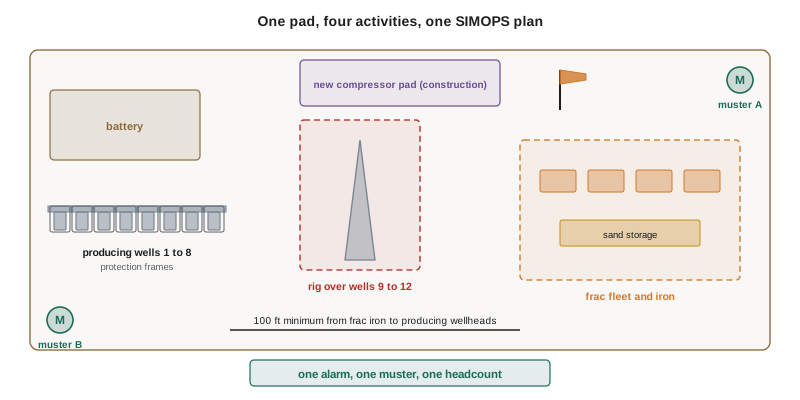
Checking the day's work against the matrix
A SIMOPS matrix is only useful if it is checked every time the plan for the day changes. The program below holds a small, invented SIMOPS matrix for the Pinecrest pad and checks the activities planned for one day, area by area. Each pair of activities in the same or an adjoining area is looked up; the program reports pairs that are not allowed and the controls required for pairs allowed with conditions.
# Check a day's activities on a pad against a small SIMOPS matrix (invented rules).
from itertools import combinations
MATRIX = {  # frozenset pair -> ("ok" | "controls" | "no", note)
    frozenset({"frac pumping", "producing well work"}): ("no", "no well work on offset wells while pumping"),
    frozenset({"frac pumping", "crane lift"}): ("controls", "lift outside frac exclusion zone; frac van agrees"),
    frozenset({"hot work", "tank truck loading"}): ("no", "suspend loading or hot work"),
    frozenset({"hot work", "line opening"}): ("controls", "upwind only, continuous gas test, kept well apart"),
    frozenset({"crane lift", "line opening"}): ("controls", "no load over the open line"),
    frozenset({"wireline", "producing well work"}): ("controls", "shared alarm, shut-in criteria agreed"),
    frozenset({"hot work", "frac pumping"}): ("no", "no hot work in frac area while pumping"),
}
ADJOINING = {("battery", "pad east"), ("pad east", "pad middle"), ("pad middle", "pad west")}

plan = [  # (activity, area, time window)
    ("frac pumping", "pad west", (7, 19)),
    ("crane lift", "pad middle", (9, 11)),
    ("producing well work", "pad middle", (13, 16)),
    ("line opening", "battery", (8, 12)),
    ("hot work", "battery", (10, 15)),
    ("tank truck loading", "battery", (14, 15)),
]

def near(a, b):
    return a == b or (a, b) in ADJOINING or (b, a) in ADJOINING

def overlap(w1, w2):
    return max(w1[0], w2[0]) < min(w1[1], w2[1])

for (a1, z1, w1), (a2, z2, w2) in combinations(plan, 2):
    if not (near(z1, z2) and overlap(w1, w2)):
        continue
    rule, note = MATRIX.get(frozenset({a1, a2}), ("ok", ""))
    if rule != "ok":
        start, end = max(w1[0], w2[0]), min(w1[1], w2[1])
print(f"{rule.upper():<8} {a1} + {a2} ({start}:00-{end}:00): {note}")CONTROLS frac pumping + crane lift (9:00-11:00): lift outside frac exclusion zone; frac van agrees NO frac pumping + producing well work (13:00-16:00): no well work on offset wells while pumping CONTROLS line opening + hot work (10:00-12:00): upwind only, continuous gas test, kept well apart NO hot work + tank truck loading (14:00-15:00): suspend loading or hot work
The check finds two pairs that cannot go ahead as planned. Producing well work in the center of the pad from 13:00 would overlap with frac pumping on the adjoining west side, which the matrix forbids, so that work must move to a day without pumping. Hot work at the battery overlaps with tank truck loading from 14:00 to 15:00, so one of them must be rescheduled. Two other pairs are allowed with controls, and those controls must appear on the permits concerned. The value of writing the matrix down is that the coordinator does not have to remember every rule under the pressure of the morning meeting.
Construction in operating facilities
Adding equipment to a live battery or plant brings construction crews, who may be used to greenfield sites, into an operating hazard area. The SIMOPS plan should set where construction ends and operations begins, which may be marked by fencing and a separate gate; require that construction crews working inside the operating area work under the operator's permit system; plan tie-ins into live systems as separate, carefully isolated jobs, often during a short outage; and control construction hazards such as excavation near buried live lines, crane lifts over live equipment and hot work near process equipment. Pre-commissioning and commissioning activities, when new equipment is first filled with hydrocarbons, are a high-risk interface and usually need their own SIMOPS review.
The control room in SIMOPS
Control rooms often see more of the site's activity than anyone in the field, and they can change conditions remotely: open a well, start a compressor, change a pipeline setpoint or reset a shutdown. In SIMOPS, the control room should attend or be briefed by the coordination meeting, show active permits and SIMOPS restrictions on its screens, agree before any remote action that affects an area with active work, and have a direct line to each activity supervisor. Pipeline control centers need the same discipline with field crews working on or near their lines, including agreed limits on pressure changes while crews are exposed.
Start-up, shutdown and abnormal conditions
Many SIMOPS incidents happen when the plant is not in its normal state: during start-up after a turnaround, during a shutdown, or during an upset. Operating crews are busy and conditions change quickly, and maintenance crews still on site may not know. Good practice is to restrict or suspend permitted work in affected areas during start-up and shutdown, to tell all crews before starting any non-routine operation, and to treat an upset as a reason to stop work and reassess, as covered in Lesson 11.
Worked problem
Planning SIMOPS for a battery expansion at Pinecrest
Larchwood will add a second separator train at the Pinecrest battery while the existing train keeps producing and while wells 9 to 12 are being completed on the same pad. What should the SIMOPS plan include?
Show solution
- Map and boundaries: mark the construction area, the operating battery, the completions area and exclusion zones, with separate gates and traffic routes for each.
- Matrix: list pairs that are not allowed, such as hot work in the battery during tank truck loading or frac pumping, and pairs allowed with controls, such as crane lifts near the battery with no load over live equipment.
- Authority: name the operator's site supervisor as the person in charge of the whole pad, with the construction and completions supervisors reporting to the daily coordination meeting.
- Tie-ins: plan the tie-ins of the new train into the live inlet and outlet headers as separate isolated jobs during a short planned outage, with positive isolation at the tie-in points.
- Emergency: one alarm, one set of muster points and one headcount for everyone on the pad, with the control center briefed every morning.
Answer: The plan must divide the pad into clear areas, write down which activities can coexist, put one person in charge, treat tie-ins as isolated jobs and give everyone one emergency system.
Common mistakes
MistakeLeaving each permit issuer to spot conflicts on the day.
InsteadPrepare a SIMOPS plan and matrix in advance and check every day's work against it.
MistakeFracturing beside producing wells without monitoring them.
InsteadShut in or isolate offset wells, confirm ratings, monitor pressures and agree stop criteria.
MistakeLetting each contractor keep its own alarm meanings and muster points.
InsteadUse one alarm system, one muster plan and one headcount for the whole site.
MistakeLetting construction crews work in an operating area under their own permits.
InsteadBring work inside the operating area under the operator's permit system.
MistakeChanging pipeline or well conditions remotely without checking active work.
InsteadShow active permits in the control room and agree before any remote action affecting them.
Summary and key terms
- SIMOPS occur when activities in the same area could affect each other, and multi-well pads, live plants and pipelines make them routine in oil and gas.
- Typical SIMOPS include drilling and fracturing beside producing wells, well intervention beside production, construction tie-ins, turnarounds of one train and pipeline repairs on live systems.
- Frac hits can overpressure offset wells, so offset wells are identified, shut in or isolated, monitored and covered by stop criteria.
- A SIMOPS plan includes a site map, a matrix of allowed pairs, one person in overall charge, bridging documents, daily coordination and one emergency plan.
- Checking each day's plan against a written matrix finds conflicts before they happen.
- Construction in operating facilities and commissioning need clear boundaries and the operator's permit system.
- The control room must know about active work, and start-up, shutdown and upsets need extra restrictions.
- Simultaneous operations
- Two or more activities close enough in place and time to affect each other.
- SIMOPS matrix
- A table showing which pairs of activities may proceed together, with controls, or not at all.
- Combined operations plan
- A plan setting out how several activities on one site will be coordinated.
- Frac hit
- Pressure or fluid communication from a well being fractured to a nearby well.
- Offset well
- A well near another well being drilled, completed or serviced.
- Person in charge
- The individual with overall authority over all activities on a site.
- Tie-in
- The connection of new equipment into an existing live system.
- Interface agreement
- A written agreement defining how two organizations' activities and systems fit together.
Practice problems
Work each problem on paper first, then reveal the answer to check.
Give three examples of SIMOPS on a multi-well pad.
Show answer
Any three of: drilling beside producing wells, fracturing beside producing wells, wireline beside production, construction tie-ins, truck loading near hot work.
What is a frac hit?
Show answer
Pressure or fluid communication from a well being fractured to a nearby well.
Name three controls for frac hits.
Show answer
Any three of: identify offset wells, shut in or isolate them, confirm ratings, monitor pressures, agree communication, set stop criteria.
List four parts of a SIMOPS plan.
Show answer
Any four of: site map, SIMOPS matrix, person in overall charge, interface and bridging documents, daily coordination meeting, one emergency plan.
In the program, which two pairs were not allowed?
Show answer
Frac pumping with producing well work, and hot work with tank truck loading.
Why did the program check adjoining areas as well as the same area?
Show answer
Hazards such as frac pressure, dropped loads and vapor can reach beyond one area.
What permit system should construction crews use inside an operating area?
Show answer
The operator's permit system.
Why is commissioning a high-risk interface?
Show answer
New equipment is first filled with hydrocarbons while other work may still be under way.
What should the control room do before a remote action affecting an area with active work?
Show answer
Check active permits and agree with the field supervisors first.
Why restrict permitted work during start-up and shutdown?
Show answer
Conditions change quickly and operating crews are busy, so maintenance crews may be exposed without warning.
Lesson quiz · 5 questions
Score 60% or more to complete this lesson.
Create a free account to save your progress, take quizzes and earn a certificate.