
HSE-333 · Lesson 6 of 12 · 26 min
Line opening, vessel entry and other high-risk work under permit
HSE-332 explained the hazards of opening process equipment: valves that pass, pressure trapped in pockets, what comes out at the first break, and the dangers of nitrogen and steam purging. HSE-211 covers confined spaces in general: atmospheric hazards, testing, ventilation, entry permits and rescue. This lesson shows how the permit system controls the two highest-risk kinds of routine oil and gas maintenance, opening lines and entering vessels and tanks, and how it handles three other high-risk activities that come up on oil and gas sites: pressure testing, industrial radiography and critical lifts near live equipment.
What a line opening permit contains
A line opening permit, sometimes called a line break or equipment opening permit, authorizes breaking containment on equipment that has held hazardous fluids or pressure. Beyond the standard permit contents described in HSE-221, it usually records:
- the equipment and the exact break points, marked on a drawing or tagged in the field;
- the previous contents and their hazards, such as sour gas, condensate, amine, methanol or produced water;
- the isolation certificate number and the isolation standard used;
- how the equipment was depressured, drained and purged, and to where;
- the gas test results at the break point and the required continuous monitoring;
- the protective equipment required for the first break and for the rest of the job, which may differ;
- the barricade or controlled zone around the break, and who may enter it;
- what the crew must do if pressure, liquid or gas appears.
Classifying line openings by contents
Many oil and gas companies use a matrix that sets the minimum protective equipment and controls for the first break according to what the line has held. A matrix makes the decision consistent and stops it being argued case by case at the worksite. The table shows the kind of matrix used; the specific entries in any company standard may differ.
| Previous contents | Illustrative first-break controls | Notes |
|---|---|---|
| Sweet gas or air, low pressure | Gas monitor, face shield, chemical gloves, barricade | Confirm the line is not tied into sour or high-pressure sources |
| Sour gas or sour water | Supplied-air breathing apparatus, personal and area H2S monitors, standby with breathing apparatus, barricade | Iron sulfide and trapped H2S may be present even after purging |
| Condensate or crude oil | Gas monitor with LEL and benzene, chemical suit or apron, catch pan, bonding | Vapor can be released for some time as liquid drains |
| Amine, glycol or caustic | Chemical suit, goggles and face shield, gloves, eyewash nearby | Rich amine may also release H2S |
| Methanol | Gas monitor, chemical gloves and face protection, no ignition sources | Methanol burns with an almost invisible flame |
| Nitrogen-purged | Oxygen monitor, no head inside openings, ventilation | Treat as oxygen deficient until tested |
The matrix applies to the first break. Once the joint is open and tests confirm there is no residual hazard, the permit may allow the crew to step down to the protective equipment needed for the rest of the job, but only on the issuer's or a competent person's confirmation, recorded on the permit.
The controlled zone
When a line is opened, the people most at risk are the ones closest to it, but a sudden release of sour gas or liquid can reach others nearby. Most companies set up a controlled zone around the break with barricade tape or barriers and signs, admit only the people needed for the first break, keep the standby and any rescue equipment just outside it, and tell nearby crews and the control room before the break starts. The zone stays until the joint is open and tests confirm it is safe, then is reduced.
Vessel and tank entry within the permit system
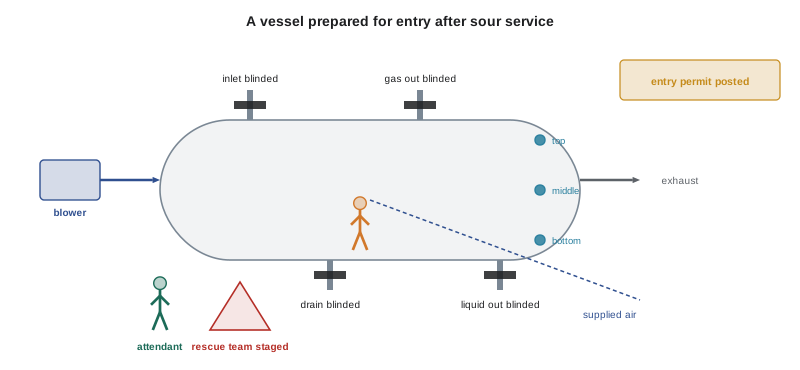
Entry into a vessel or tank that has held hydrocarbons or sour fluids combines the hazards of line opening with the hazards of confined spaces. Oil and gas companies typically add these requirements to their general confined space program:
- Positive isolation of every line into the vessel by blinds or removed spools, not valves alone, because people will be inside. Lesson 8 explains why.
- Cleaning before entry where possible, by steaming, water washing, chemical cleaning or vacuum truck, so that people enter to inspect rather than to remove large amounts of sludge.
- Gas testing at several levels inside the vessel, because some gases are heavier than air and some lighter, and continuous monitoring throughout the entry.
- A survey for naturally occurring radioactive material (NORM) before entry into vessels, tanks and filters where scale or sludge may contain it, as HSE-330 and HSE-332 described.
- Keeping iron sulfide scale wet until it is removed, to stop it heating and igniting as it dries.
- A rescue plan that works at the actual site, which on a remote battery may mean a rescue team on site for the duration of the entry rather than a phone number.
API Standard 2015 and API RP 2016 set out industry practice for tank entry and cleaning, including degassing, testing, the roles of entry supervisor, attendant and entrant, and the respiratory protection needed at each stage. Many companies in both countries adopt them for crude oil and condensate tanks.
Why continuous monitoring matters inside
A vessel that tested clear before entry can become hazardous during the job. Sludge and scale hold hydrocarbons and H2S, and when workers shovel, scrape or wash them, gas is released into the space. The program below uses a simple well-mixed model to estimate how H2S builds up inside a vessel when disturbed sludge releases gas, for two ventilation rates. The release rate and volumes are invented for teaching; real releases are uneven and can spike much higher near the work.
# H2S build-up in a ventilated vessel while sludge is disturbed (well-mixed model, invented numbers).
import math
volume_ft3 = 1060.0           # internal volume of the vessel
release_ft3_per_min = 0.0018  # H2S released from disturbed sludge, as gas
for vent_cfm in (106.0, 353.0):
    k = vent_cfm / volume_ft3                # air changes per minute
    steady_ppm = release_ft3_per_min / vent_cfm * 1e6
    print(f"Ventilation {vent_cfm:5.0f} cfm ({k * 60:4.0f} air changes per hour)")
    for minutes in (5, 10, 20, 40):
        ppm = steady_ppm * (1 - math.exp(-k * minutes))
print(f" after {minutes:>2} min of digging: about {ppm:4.1f} ppm H2S")Ventilation 106 cfm ( 6 air changes per hour) after 5 min of digging: about 6.7 ppm H2S after 10 min of digging: about 10.7 ppm H2S after 20 min of digging: about 14.7 ppm H2S after 40 min of digging: about 16.7 ppm H2S Ventilation 353 cfm ( 20 air changes per hour) after 5 min of digging: about 4.1 ppm H2S after 10 min of digging: about 4.9 ppm H2S after 20 min of digging: about 5.1 ppm H2S after 40 min of digging: about 5.1 ppm H2S
With the weaker blower, H2S climbs to about 14 ppm within 20 minutes and keeps rising toward about 17 ppm, enough to trip personal monitors and exceed most occupational limits. With the stronger blower it stays around 5 ppm. Even then, the average hides the much higher concentrations right at the shovel. Continuous monitoring on the entrant, not just at the manway, is what tells the crew to stop, and supplied-air breathing apparatus is common for sour vessel entry regardless of the readings.
Rescue on remote sites
Confined space rescue plans often assume a rescue team can arrive within minutes. On a battery 60 km (37 mi) from the nearest town, the local fire service may be an hour away and may not be trained or equipped for confined space rescue in an H2S atmosphere. Oil and gas companies therefore usually require a trained rescue team, with breathing apparatus, retrieval equipment and first aid, on site for the whole entry, and they practice the rescue before the first entry. Would-be rescuers who enter without breathing apparatus are a leading cause of multiple deaths in confined space incidents, so the plan must make that impossible: the standby does not enter until the rescue team is ready.
Pressure testing under permit
After repairs and before new piping goes into service, it is pressure tested to prove it is strong and leak-tight. HSE-332 explained why pneumatic tests store far more energy than hydrostatic tests at the same pressure. Under the permit system, a pressure test needs its own permit or a section of the line opening permit, a written test procedure, a calculated exclusion zone based on the stored energy, test blinds and fittings rated for the test pressure, a relief device on the test equipment, and a clear rule that nobody approaches the test section while it is pressured except under the procedure. Testing with gas is normally allowed only where hydrostatic testing is impractical and an engineer has approved it.
Radiography
Industrial radiography uses gamma sources or X-ray machines to examine welds. In the US it is licensed by the Nuclear Regulatory Commission or by Agreement States under equivalent rules, and radiographers must be trained and certified. The permit system coordinates radiography with other work: the radiographer sets up a controlled area with barriers, signs and warning lights at the distance where dose rates fall below the public limit, the area authority clears other crews, and the control room and nearby sites are told. Radiography is often scheduled at night or during breaks to keep other workers out of the area.
Critical lifts near live equipment
Lifting a compressor cylinder, a heat exchanger bundle or a new spool over a pipe rack in a live plant puts a suspended load over equipment full of gas. A dropped load or a swinging load striking a small-bore pipe can cause a release. Most companies treat such lifts as critical lifts needing a lift plan approved by a qualified person, and many add permit conditions: confirming that the lift path avoids live process equipment or that the equipment under the lift path is depressured, setting exclusion zones, and checking for gas before mobile cranes enter classified areas. HSE-219 covers cranes and rigging in general.
Worked problem
Permit conditions for entering the Spruce Ridge amine flash tank
The amine flash tank at Spruce Ridge must be opened and entered for internal inspection during a planned outage. It has held rich amine, which contains dissolved H2S and hydrocarbons. What should the line opening and entry permits require?
Show solution
- Isolation: positive isolation by blinds on every inlet, outlet, vent, drain, relief and instrument connection, recorded on the isolation certificate and verified before the first break.
- Preparation: drain to the closed drain system, water wash to remove amine, steam or purge as the procedure requires, and keep any iron sulfide scale wet.
- First break: sour-service controls from the first-break matrix, with supplied-air breathing apparatus, area and personal H2S monitors and a controlled zone.
- Entry: tests for oxygen, LEL and H2S at top, middle and bottom; a NORM survey; continuous ventilation and continuous personal monitoring; supplied air for entrants because of possible H2S release from sludge.
- Rescue and coordination: an on-site rescue team, a practiced rescue, an attendant at the manway, and notification of the control room and the other outage crews.
Answer: Treat the vessel as sour even after washing: blind every connection, test at several levels, monitor continuously, supply air to entrants and have rescue on site.
Common mistakes
MistakeDeciding first-break protection by debate at the worksite.
InsteadUse the company's first-break matrix based on previous contents.
MistakeEntering a vessel isolated only by closed valves.
InsteadUse positive isolation by blinds or removed spools for every vessel entry.
MistakeTesting a vessel atmosphere only at the manway.
InsteadTest at several levels inside and monitor continuously on the entrants.
MistakeRelying on the local fire department for confined space rescue at a remote site.
InsteadHave a trained rescue team and equipment on site for the duration of the entry.
MistakePressure testing with gas because water is inconvenient.
InsteadTest hydrostatically unless an engineer approves a pneumatic test with a calculated exclusion zone.
Summary and key terms
- A line opening permit records break points, previous contents, isolation, depressuring and purging, gas tests, protective equipment, the controlled zone and what to do if fluid appears.
- A first-break matrix sets minimum controls by previous contents; protective equipment may step down only after the joint is safely open and confirmed.
- Vessel and tank entry after hydrocarbon or sour service requires positive isolation, cleaning, multi-level testing, NORM surveys, wet scale and continuous monitoring.
- Disturbing sludge can raise H2S inside a ventilated vessel during the job, so monitoring must be continuous and on the entrant.
- Rescue plans at remote sites need a trained team on site for the whole entry.
- Pressure tests, radiography and critical lifts near live equipment are high-risk activities coordinated through the permit system.
- API Standard 2015 and RP 2016 give industry practice for petroleum tank entry and cleaning.
- First-break matrix
- A table setting minimum controls for opening a line according to its previous contents.
- Controlled zone
- A barricaded area around a line break or other hazard that only authorized people may enter.
- Positive isolation
- Isolation by a blind or removed spool, giving physical separation from the source.
- Supplied-air breathing apparatus
- Respiratory protection that supplies clean air from cylinders or a compressor through a hose or pack.
- Attendant
- The person outside a confined space who monitors entrants and summons rescue.
- NORM survey
- A check with a radiation meter for naturally occurring radioactive material in scale or sludge.
- Exclusion zone
- An area kept clear of people during a hazardous activity such as pressure testing.
- Critical lift
- A lift with elevated risk, such as near live equipment or near crane capacity, requiring a formal plan.
Practice problems
Work each problem on paper first, then reveal the answer to check.
Name four items a line opening permit usually records beyond the standard permit contents.
Show answer
Any four of: break points, previous contents, isolation certificate number, depressuring and purging method, gas tests, first-break protective equipment, controlled zone, actions if fluid appears.
What is the purpose of a first-break matrix?
Show answer
To set consistent minimum controls for opening lines based on what they held.
What first-break controls are typical for sour service?
Show answer
Supplied-air breathing apparatus, H2S monitors, a standby with breathing apparatus and a barricade.
When can protective equipment be stepped down after a first break?
Show answer
Only after the joint is open and a competent person confirms by test that no residual hazard remains, recorded on the permit.
Why are vessels entered after sour service positively isolated?
Show answer
Because people will be inside and valves can pass.
Why is iron sulfide scale kept wet?
Show answer
To stop it heating and igniting as it dries.
In the program, what H2S level did the weaker blower allow after 20 minutes?
Show answer
About 14 ppm.
Why must the standby not enter until the rescue team is ready?
Show answer
Untrained or unprotected rescuers are a leading cause of multiple confined space deaths.
What does a pressure test permit need besides a procedure?
Show answer
A calculated exclusion zone, rated test fittings and blinds, a relief device and a rule keeping people away while pressured.
Why is radiography often scheduled at night?
Show answer
To keep other workers out of the controlled area.
Lesson quiz · 5 questions
Score 60% or more to complete this lesson.
Create a free account to save your progress, take quizzes and earn a certificate.