
HSE-333 · Lesson 4 of 12 · 28 min
Permit types on oil and gas sites
HSE-221 explained how a site decides which work needs a permit and described the common permit types and linked certificates found in most industries. Oil and gas sites use the same basic families, but the hazards inside the equipment, the hazardous area classification of most process areas and the presence of live wells and pipelines add some permit types, change the triggers for others and make linked certificates especially important. This lesson maps the work done on batteries, compressor stations, gas plants, well pads and pipelines to the permits that control it.
Routine work and permitted work
Not every task needs a permit. Operators taking readings, adjusting a choke within limits, changing a chart, sampling from a dedicated sample point or carrying out a written operating procedure such as pigging or a routine well shut-in are normally working under operating procedures rather than permits. The permit system is for work outside normal operation: maintenance, construction, inspection, cleaning, modification and any task that breaks containment, introduces an ignition source, defeats a safety system or puts a person inside equipment. Each company's permit standard should list which tasks are routine and which need a permit, and when in doubt the default should be to issue one.
Two features of oil and gas sites push more work into the permit system than in many other industries. First, most process areas are classified as hazardous locations because flammable gas or vapor may be present, so anything that could ignite it, from a grinder to a vehicle to a non-rated phone, needs control. Second, much of the equipment is sour or pressurized, so even minor maintenance can break containment.
The main permit types
| Permit type | Typical triggers on oil and gas sites | Linked documents often required |
|---|---|---|
| Cold work or general work | Maintenance with no ignition source and no break of containment: painting, insulation, scaffolding, non-intrusive inspection | Hazard assessment; sometimes a gas test |
| Hot work: spark-producing | Grinding, drilling, needle gunning, non-rated electrical tools or vehicles in a classified area | Gas test record, fire watch assignment |
| Hot work: open flame | Welding, cutting, torch heating, preheat burners | Gas test record with continuous monitoring, fire watch, isolation of nearby openings |
| Line opening or line break | Opening a flange, removing a valve, plug or instrument, cutting into piping, opening a vessel | Isolation certificate, depressuring and purge record, gas test, breathing apparatus plan |
| Confined space entry | Entry into tanks, separators, treaters, scrubbers, well cellars, pits or excavations meeting the definition | Entry certificate, isolation certificate, gas test record, rescue plan |
| Ground disturbance | Digging, augering, hydrovac, driving stakes, near pipelines and buried services | Locate records, crossing or proximity agreements, hand exposure plan |
| Critical lift | Lifts near live equipment, over pipe racks, tandem lifts, lifts near capacity | Lift plan, rigging plan, equipment certifications |
| Energized electrical work | Work on or near live electrical parts that cannot be de-energized | Energized work justification, arc flash and shock assessment |
| Radiography | Industrial radiography of welds; other work with radioactive sources | Licensed operator, controlled area plan, notifications |
| Pressure testing | Hydrostatic or pneumatic tests of new or repaired piping | Test procedure, stored energy calculation, exclusion zone |
| Safety system override | Bypassing a shutdown, inhibiting a gas detector, defeating an interlock | Override certificate with compensating measures and time limit |
Hot work in classified areas
Oil and gas companies usually divide hot work into spark-producing and open-flame work because the controls differ. Both need a gas test and a fire watch, but open-flame work also needs continuous gas monitoring, a larger clear zone, isolation or covering of nearby drains, vents and openings, and often a higher level of issuer. Lesson 5 covers hot work and gas testing in detail.
Many oil and gas permit standards treat anything that could ignite a flammable atmosphere in a classified area as hot work, even if nobody would call it that in a workshop. Examples include vehicles and mobile equipment with ignition sources entering a classified area, portable generators and compressors, non-rated cameras, phones and radios, battery-powered tools, and test equipment. Some companies issue a separate vehicle entry permit for classified areas, with a gas test at the point of entry and a requirement for the engine to be shut down if gas is detected.
Line opening and its relationship to isolation
The line opening or line break permit is the workhorse of oil and gas maintenance. It authorizes breaking containment on equipment that has held hydrocarbons, sour gas, produced water, chemicals or pressure. It does not stand alone: it depends on an isolation certificate showing how the equipment was isolated, a record that it was depressured, drained and purged, and a gas test at the break point. Lesson 6 covers line opening and vessel entry, and Lessons 8 and 9 cover isolation planning.
Wells, pipelines and other special cases
Some work does not fit neatly into the standard families.
- Wellhead and well work. Changing a valve on a wellhead, replacing a pressure gauge on the casing, or rigging up wireline or coiled tubing involves well pressure that cannot be isolated by closing a valve at a compressor. Companies usually control this work through well servicing procedures and the bridging document with the service contractor, plus a permit from the operator for the producing site, with barriers on the well confirmed before work starts. Remember that OSHA's lockout standard does not cover well drilling and servicing, so this control comes from company procedures and API RP 54. HSE-331 covered well servicing hazards.
- Pipeline work. Work on or near a pipeline right-of-way needs ground disturbance permits, 811 tickets and crossing agreements and, for work on the line itself, isolation by valves, pigs or stopple fittings that may be miles apart. Hot taps on live lines are a specialized activity covered by their own procedures. HSE-332 covered right-of-way and pipeline hazards.
- Safety system overrides. Inhibiting a gas detector, bypassing a shutdown switch or jumpering a trip removes a layer of protection. Most companies require a separate override certificate, approved at a higher level, listing compensating measures and a time limit, and linked to the permit for the work that needs it.
- Work on a rig or frac fleet. Work on the contractor's own equipment is often under the contractor's permit system, as set out in the bridging document, while any connection to the operator's producing equipment comes back under the operator's system.
Building a permit package
Most real jobs need more than one permit or certificate. The program below takes a short list of jobs planned at the Spruce Ridge plant, described by simple yes or no features, and works out the permits and linked documents each one needs, following rules like those in the table above. It is the same logic a planner follows mentally, written down so that nothing is forgotten.
# Build permit packages for planned jobs from simple job features (teaching rules).
def package(job):
    permits, docs = [], []
    if job["opens_containment"]:
        permits.append("line opening")
        docs += ["isolation certificate", "depressure and purge record", "gas test record"]
    if job["entry"]:
        permits.append("confined space entry")
        docs += ["entry certificate", "rescue plan", "isolation certificate", "gas test record"]
    if job["flame"]:
        permits.append("hot work (open flame)")
        docs += ["gas test record", "fire watch"]
    elif job["sparks"]:
        permits.append("hot work (spark-producing)")
        docs += ["gas test record", "fire watch"]
    if job["override"]:
        docs.append("override certificate")
    if job["dig"]:
        permits.append("ground disturbance")
        docs.append("locate records")
    if not permits:
        permits.append("cold work")
    return permits, sorted(set(docs))

jobs = {
    "change amine filter element": dict(opens_containment=True, entry=False, flame=False, sparks=False, override=False, dig=False),
    "inspect inlet separator inside": dict(opens_containment=True, entry=True, flame=False, sparks=False, override=False, dig=False),
    "weld bracket on flare knockout": dict(opens_containment=False, entry=False, flame=True, sparks=False, override=True, dig=False),
    "replace gas detector head": dict(opens_containment=False, entry=False, flame=False, sparks=True, override=True, dig=False),
    "repaint pipe rack": dict(opens_containment=False, entry=False, flame=False, sparks=False, override=False, dig=False),
    "dig to expose drain line": dict(opens_containment=False, entry=False, flame=False, sparks=False, override=False, dig=True),
}
for name, features in jobs.items():
    permits, docs = package(features)
    print(f"{name}")
    print(f"   permits: {', '.join(permits)}")
    if docs:
print(f" linked: {', '.join(docs)}")change amine filter element permits: line opening linked: depressure and purge record, gas test record, isolation certificate inspect inlet separator inside permits: line opening, confined space entry linked: depressure and purge record, entry certificate, gas test record, isolation certificate, rescue plan weld bracket on flare knockout permits: hot work (open flame) linked: fire watch, gas test record, override certificate replace gas detector head permits: hot work (spark-producing) linked: fire watch, gas test record, override certificate repaint pipe rack permits: cold work dig to expose drain line permits: ground disturbance linked: locate records
The output shows how quickly the paperwork for one job grows. The internal inspection of the inlet separator needs a line opening permit and a confined space entry permit, plus an isolation certificate, a depressure and purge record, an entry certificate, a rescue plan and a gas test record. The welding job on the flare knockout drum needs an override certificate because a gas detector or flame detector nearby will have to be inhibited, or it will trip the plant when the welding starts. Replacing a gas detector head needs an override too, because the detector is out of service while it is changed, and the planner must decide what replaces it in the meantime, such as a portable area monitor.
One permit or several?
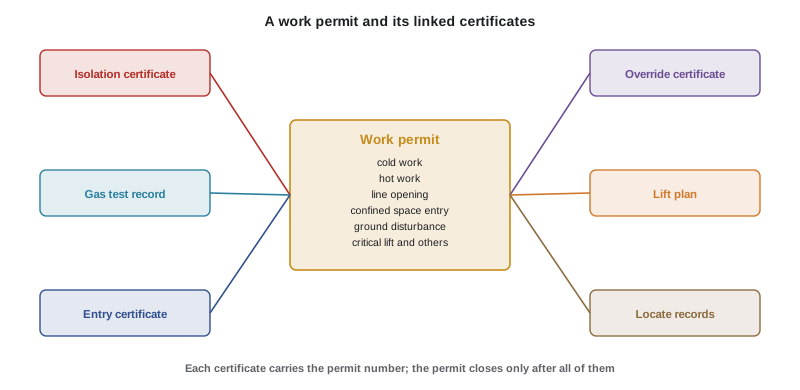
Companies differ on whether each activity gets its own permit or one permit covers a whole job with several sections. Separate permits make each hazard visible and allow different issuers to sign for different parts, but they multiply the paperwork and create more chances for permits to be filed apart, which was one of the failures at Piper Alpha. A single permit with sections is easier to manage but can hide a high-hazard step inside a long form. Either approach can work if every permit and certificate carries cross-references, the issuer reviews them together at the worksite, and the permit for the job cannot close until every linked certificate is closed.
Permit levels and issuer authority
Many oil and gas companies grade permits by risk, with higher-risk work requiring a more senior issuer, a second signature or approval from a supervisor or plant manager. Typical higher-risk categories are open-flame hot work in a process area, confined space entry, line opening in sour service, safety system overrides lasting more than one shift, and any work during start-up or shutdown. Grading keeps routine work moving while making sure that the most dangerous work gets the most attention. The grading should be written down so that issuers do not have to decide case by case under pressure.
Worked problem
Choosing permits for a tank cleaning job at Pinecrest
Larchwood plans to clean sludge from one of the Pinecrest oil tanks. A vacuum truck will remove liquids, then a crew will enter the tank to shovel out sludge, and a welder will repair a corroded nozzle once the tank is clean. The tank shares a vapor recovery header with the other tanks. Which permits and linked documents are needed?
Show solution
- Line opening permit to remove the tank's manway cover and disconnect its inlet, outlet, drain and vapor recovery connections, with an isolation certificate showing blinds on each connection, a depressure and purge record and a gas test.
- Vehicle entry or spark-producing hot work permit for the vacuum truck if it enters the classified area around the tanks, with a gas test at the truck position and a plan for grounding and bonding the hose.
- Confined space entry permit for the cleaning crew, with an entry certificate, continuous gas monitoring for LEL, oxygen, H2S and benzene, a safety watch and a rescue plan.
- Open-flame hot work permit for the nozzle repair after cleaning, with gas tests inside the tank and at nearby tank openings, isolation of the shared vapor recovery header and a fire watch.
- Cross-references between all four permits and the isolation certificate, so none can close until the others are closed and the blinds are removed.
Answer: The job needs at least four permits linked to one isolation certificate. The shared vapor recovery header is the hazard most likely to be missed, as Partridge-Raleigh showed, so it must be blinded and checked.
Common mistakes
MistakeTreating a vehicle or a phone in a classified area as harmless.
InsteadControl any ignition source in a classified area through the hot work or vehicle entry permit.
MistakeIssuing a line opening permit without an isolation certificate.
InsteadLink every line opening to an isolation certificate, depressure and purge record and gas test.
MistakeBypassing a gas detector for welding without paperwork.
InsteadUse an override certificate with compensating measures, a time limit and higher approval.
MistakeFiling related permits apart.
InsteadCross-reference all permits and certificates for a job and review them together at the worksite.
MistakeLeaving the choice of permit level to the issuer on the day.
InsteadWrite down which work needs a higher-level issuer or second signature.
Summary and key terms
- Routine operating tasks run under procedures; the permit system covers maintenance, construction, inspection and any work that breaks containment, adds ignition sources, defeats safeguards or puts people inside equipment.
- Hazardous area classification and sour, pressurized equipment push more oil and gas work into the permit system.
- The main types are cold work, spark-producing and open-flame hot work, line opening, confined space entry, ground disturbance, critical lifts, energized electrical work, radiography, pressure testing and overrides.
- Line opening permits depend on isolation certificates, depressure and purge records and gas tests.
- Well, pipeline and rig work need special arrangements through well servicing procedures, bridging documents and pipeline procedures.
- Real jobs usually need a package of permits and linked certificates that cross-reference each other.
- Grading permits by risk keeps routine work moving and puts senior attention on the most dangerous work.
- Cold work
- Permitted work with no ignition source and no break of containment.
- Spark-producing hot work
- Work such as grinding or using non-rated equipment that can ignite a flammable atmosphere without an open flame.
- Open-flame hot work
- Welding, cutting or other work using a flame or arc.
- Line opening
- Breaking containment on equipment that has held hazardous fluids or pressure.
- Classified area
- An area where flammable gas or vapor may be present, with controls on ignition sources.
- Linked certificate
- A document, such as an isolation or entry certificate, that supports and is cross-referenced to a permit.
- Override certificate
- Authorization to bypass or inhibit a safety system, with compensating measures and a time limit.
- Permit package
- All the permits and linked certificates needed for one job.
Practice problems
Work each problem on paper first, then reveal the answer to check.
Give two examples of routine operating tasks that usually do not need a permit.
Show answer
Any two of: taking readings, adjusting a choke within limits, sampling from a dedicated point, following a written pigging or shut-in procedure.
Why does hazardous area classification push more work into the permit system?
Show answer
Any potential ignition source in a classified area must be controlled.
What is the difference between spark-producing and open-flame hot work?
Show answer
Spark-producing work can ignite gas without a flame, such as grinding; open-flame work uses a flame or arc, such as welding.
Name three documents a line opening permit usually depends on.
Show answer
An isolation certificate, a depressure and purge record and a gas test record.
Why does replacing a gas detector head need an override certificate?
Show answer
The detector is out of service while it is changed, so compensating measures must be arranged.
In the program, which job needed both a line opening and a confined space entry permit?
Show answer
The internal inspection of the inlet separator.
What is one risk of using many separate permits for one job?
Show answer
They can be filed apart and their links lost, as at Piper Alpha.
What is one risk of using one long permit with many sections?
Show answer
A high-hazard step can be hidden inside a long form.
Name two kinds of work often graded as higher risk.
Show answer
Any two of: open-flame hot work in a process area, confined space entry, sour line opening, long overrides, work during start-up or shutdown.
In the tank cleaning example, which connection is most likely to be missed?
Show answer
The shared vapor recovery header.
Lesson quiz · 5 questions
Score 60% or more to complete this lesson.
Create a free account to save your progress, take quizzes and earn a certificate.