
HSE-333 · Lesson 2 of 12 · 26 min
Law and standards for permits and isolation in oil and gas
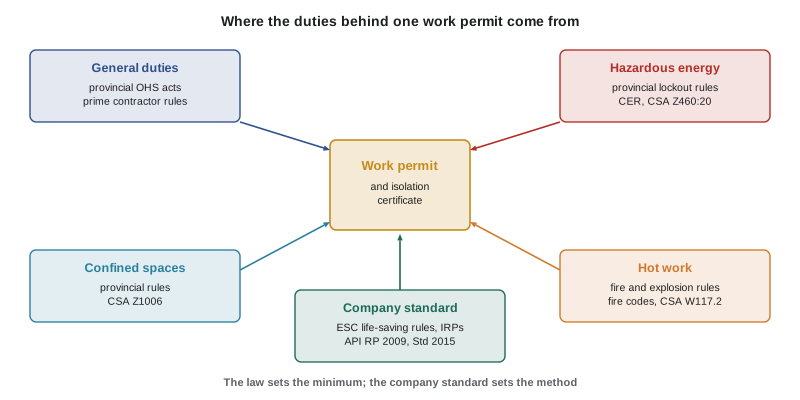
HSE-221 explained how Canadian permit duties are spread across general duties, hazard-specific rules, fire codes and CSA standards, and HSE-330 and HSE-332 mapped the regulators that oversee oil and gas sites and pipelines. This lesson narrows the focus to one question: which rules govern how work is authorized and how equipment is isolated on an oil and gas site in Canada, and where do company standards and industry guidance have to fill the gaps? The answer matters because a permit or isolation procedure that does not meet the legal minimum exposes workers and the company, and one that meets only the legal minimum may still not be safe enough for sour, high-pressure service.
General duties and who holds them
Every provincial OHS act requires employers to ensure, as far as reasonably practicable, the health and safety of their workers, and requires workers and supervisors to follow safe procedures. On oil and gas sites the prime contractor rules matter as much as the employer duties. In Alberta, a work site with two or more employers must have a prime contractor, which for an oil and gas site is normally the licensee or operator unless another party is designated in writing, and the prime contractor must coordinate the work so that every employer's activities are safe together. A permit system is one of the main ways a prime contractor meets that duty. Federally regulated pipelines fall under the Canada Labour Code and its occupational health and safety regulations rather than provincial law, alongside the Canada Energy Regulator's own requirements.
Rules for hazardous energy
Lockout rules are where most isolation requirements sit. In Alberta, the OHS Code's part on hazardous energy requires that machinery and equipment be isolated from hazardous energy before work that could expose a worker to it, using locks and procedures, and allows alternatives only in limited cases. British Columbia's OHS Regulation has a part on de-energization and lockout, and a separate part for oil and gas work. Saskatchewan and the other provinces have similar rules, and the federal occupational health and safety regulations apply on federal pipelines. CSA Z460:20, Control of hazardous energy – Lockout and other methods, is the national standard that most programs follow; it sets out lockout principles, group lockout and the risk assessment needed before any alternative to full lockout. In May 2022 the Canada Energy Regulator issued Safety Advisory SA-2022-02 on the control of hazardous energy, stating that it requires regulated pipeline companies to have energy isolation systems and pointing to CSA Z460:20.
Rules for confined spaces
Tanks, vessels, separators, treaters, well cellars and pits are confined spaces on many oil and gas sites. Alberta's OHS Code part on confined spaces requires a hazard assessment, a code of practice, an entry permit system for restricted spaces, atmospheric testing, isolation of hazardous energy and substances, a safety watch and rescue arrangements. British Columbia's regulation has an equivalent part, and CSA Z1006, Management of work in confined spaces, is the national standard. Entry into tanks used for crude oil or condensate also draws on API Standard 2015 and API RP 2016, the industry documents for safe entry and cleaning of petroleum storage tanks, which many Canadian operators adopt.
Rules for hot work
Hot work on oil and gas sites is governed by provincial OHS rules on fire and explosion hazards, which require that the atmosphere be tested and controlled before hot work where a flammable substance may be present, and by fire codes based on the National Fire Code of Canada. CSA W117.2, Safety in welding, cutting and allied processes, covers welding safety. Most operators also adopt API RP 2009, the industry's recommended practice for safe welding, cutting and hot work in the petroleum and petrochemical industries.
Process safety, change control and offshore systems
Process safety management in Canada is set mainly by standards and regulators' management system requirements rather than by a single OHS rule. CSA Z767, Process safety management, sets out the elements, including management of change, safe work practices and pre-startup review. The CER's Onshore Pipeline Regulations require companies to run a management system and a safety management program, and the AER and BC Energy Regulator expect licensees to manage the safety of their facilities through similar systems. Offshore work in Atlantic Canada falls under the offshore petroleum boards' regimes, which are outside the scope of this course.
Industry guidance that fills the gaps
Laws set the minimum; most of the detail of oil and gas permit and isolation practice comes from company standards built on industry guidance. Four sources come up again and again.
- Energy Safety Canada's 10 Life Saving Rules, which the Common Safety Orientation now covers, include rules on energy isolation, work authorization, hot work, confined space, line of fire and bypassing safety controls. The energy isolation rule says to verify isolation and zero energy before work begins: identify all energy sources, confirm they are isolated, locked and tagged, and test for residual or stored energy, and never open piping until it is verified depressurized.
- The IOGP Life-Saving Rules, used internationally, cover nine activities: bypassing safety controls, confined space, driving, energy isolation, hot work, line of fire, safe mechanical lifting, work authorization and working at height.
- The UK Health and Safety Executive's guidance on permit-to-work systems (HSG250) and on safe isolation of plant and equipment (HSG253) is the reference most often quoted for good practice, including risk-based selection of isolation methods.
- Energy Safety Canada's Industry Recommended Practices and the API documents named above give detailed practice for specific activities.
| Activity | Main legal rules (Canada) | Industry guidance often adopted |
|---|---|---|
| Energy isolation and lockout | Provincial OHS hazardous energy rules; federal regulations on CER pipelines | CSA Z460:20, HSG253, ESC life-saving rules |
| Opening process equipment | Hazardous energy rules plus general duties | Company line-break standards, CSA Z767 |
| Confined space entry | Provincial confined space rules | CSA Z1006, API Std 2015 and RP 2016 |
| Hot work | Provincial fire and explosion rules, fire codes | API RP 2009, CSA W117.2 |
| Drilling and servicing | Provincial oil and gas well rules | ESC IRPs, API RP 54 |
| Management of change and overrides | Regulator management system expectations | CSA Z767, company standards |
Using a duty map
Because the rules are scattered, many operators keep a simple duty map that lists, for each kind of permitted work, the legal rules that apply in each jurisdiction where they operate and the company standard that meets them. The program below builds a short duty map for four jobs planned at the Kettle Creek compressor station. It is a teaching sketch, not a legal opinion: the rule names are summaries and must be checked against the current text.
# A small duty map for jobs at a compressor station (teaching summary, Canada).
RULES = {
    "isolation": ["provincial hazardous energy rules", "CSA Z460:20"],
    "line break": ["provincial hazardous energy rules", "company line-break standard"],
    "entry": ["provincial confined space rules", "CSA Z1006"],
    "hot work": ["provincial fire and explosion rules", "fire code", "API RP 2009"],
    "lift": ["provincial lifting rules", "company critical lift standard"],
}
jobs = {
    "replace compressor suction valve": ["isolation", "line break"],
    "inspect inlet scrubber internally": ["isolation", "line break", "entry"],
    "weld new support on cooler skid": ["hot work"],
    "lift cylinder head with picker": ["isolation", "lift"],
}
for job, needs in jobs.items():
    rules = sorted({r for n in needs for r in RULES[n]})
    print(f"{job}:")
    for r in rules:
        print(f"   - {r}")
print("Prime contractor coordinates all four jobs on one site.")replace compressor suction valve: - CSA Z460:20 - company line-break standard - provincial hazardous energy rules inspect inlet scrubber internally: - CSA Z1006 - CSA Z460:20 - company line-break standard - provincial confined space rules - provincial hazardous energy rules weld new support on cooler skid: - API RP 2009 - fire code - provincial fire and explosion rules lift cylinder head with picker: - CSA Z460:20 - company critical lift standard - provincial hazardous energy rules - provincial lifting rules Prime contractor coordinates all four jobs on one site.
Even this small map shows why a single permit often answers to several rules at once. The internal inspection of the inlet scrubber needs isolation, a line break and a confined space entry, each with its own legal source, and the permit package has to satisfy all of them together. A duty map also shows the site's managers which rules to watch for amendments.
Inspection and enforcement
Provincial OHS officers can inspect permit records, ask how isolations were verified and issue orders or tickets, and serious incidents lead to investigations and sometimes prosecution. Energy regulators inspect facilities for compliance with their own requirements, and the CER's inspection officers can issue orders on federally regulated pipelines. Inspectors rarely accept that a form exists as proof that the system works; they ask to see permits from real jobs, compare them with what happened in the field and talk to the workers who held them.
Where the law is silent
Some of the most important oil and gas isolation decisions are not spelled out in any regulation. No rule says exactly when a sour gas line needs a spectacle blind rather than double block and bleed, how long a depressured section must be watched for pressure creep, or how a lease operator should hand over isolations to a contractor at an unstaffed battery. These are set by company standards, which should be written down, based on recognized guidance, consistent across sites and enforced for contractors and employees alike. When a regulator or court asks whether the company took every reasonable precaution, the company standard and evidence that it was followed are what it will rely on.
Worked problem
Mapping duties for a compressor overhaul at Kettle Creek
Larchwood plans a two-week overhaul of one compressor at Kettle Creek, with a mechanical contractor, an electrical contractor and a crane company on site while the other compressor keeps running. Which duties should the overhaul plan show?
Show solution
- General duties: each employer protects its own workers; Larchwood, as prime contractor, coordinates all employers' work so it is safe together.
- Hazardous energy: isolate the compressor from process gas, fuel gas, starting air, electrical supplies and stored energy under the provincial hazardous energy rules, following CSA Z460:20 for group lockout.
- Line breaking and entry: open the suction scrubber and cylinders under the company line-break standard, and treat any vessel entry as a confined space entry with permit, testing, safety watch and rescue.
- Hot work and lifting: control any welding under the fire and explosion rules and API RP 2009, and plan the cylinder lifts under the lifting rules.
- Simultaneous operations: show how the running compressor's hazards are kept away from the overhaul crew.
Answer: The overhaul plan should list each legal source next to the company procedure that meets it, so that every employer on site can see which permits and isolations apply and why.
Common mistakes
MistakeAssuming one general rule covers all permit work.
InsteadMap each activity to its own rule: hazardous energy, confined space, fire and explosion, and the prime contractor duty.
MistakeTreating industry guidance as optional decoration.
InsteadUse recognized guidance as the basis of the company standard; it is what regulators and courts compare practice against.
MistakeHolding contractors to a lower standard than employees.
InsteadApply the same permit and isolation rules to everyone on site, as Pasadena showed.
MistakeKeeping a duty map that is never updated.
InsteadReview the map when rules or standards are revised and when the company starts work in a new jurisdiction.
MistakeShowing an inspector the blank form as evidence of compliance.
InsteadShow completed permits from real jobs and evidence that the field matched the paperwork.
Summary and key terms
- General OHS duties and Alberta-style prime contractor rules make the operator responsible for coordinating permits on multi-employer sites.
- Isolation duties come from provincial hazardous energy rules and, on federal pipelines, the federal regulations and the CER, with CSA Z460:20 as the national standard.
- Confined space entry falls under provincial confined space rules and CSA Z1006, with API tank entry standards often adopted.
- Hot work falls under provincial fire and explosion rules and fire codes, with API RP 2009 widely used.
- Industry guidance such as life-saving rules, HSG250 and HSG253 fills the gaps that the law leaves.
- A duty map links each permitted activity to its legal sources and the company procedure that meets them.
- Where the law is silent, written, consistently enforced company standards are what show reasonable care.
- Prime contractor
- The party responsible for coordinating health and safety on a multi-employer work site, in Alberta usually the licensee or operator of an oil and gas site.
- Controlling employer
- Under OSHA policy, the employer with general authority over a worksite, including the power to correct hazards.
- General duty clause
- The OSH Act provision requiring employers to keep workplaces free of recognized serious hazards.
- CSA Z460
- The Canadian standard on control of hazardous energy by lockout and other methods.
- API RP 54
- The industry recommended practice for occupational safety on oil and gas well drilling and servicing operations.
- API RP 2009
- The industry recommended practice for safe welding, cutting and hot work in the petroleum and petrochemical industries.
- Life-saving rules
- A short set of mandatory rules for the activities most likely to kill, used across the industry.
- Duty map
- A table linking each permitted activity to the legal rules and company procedures that apply to it.
Practice problems
Work each problem on paper first, then reveal the answer to check.
Who is normally the prime contractor on an Alberta oil and gas site?
Show answer
The licensee or operator, unless another party is designated in writing.
Which CSA standard covers control of hazardous energy?
Show answer
CSA Z460:20, Control of hazardous energy – Lockout and other methods.
What did the CER's May 2022 advisory say it requires of pipeline companies?
Show answer
That they have energy isolation systems that identify all hazards and apply controls.
Which national standard covers management of work in confined spaces?
Show answer
CSA Z1006.
Name two API documents often adopted in Canada for tank entry and hot work.
Show answer
API Standard 2015 or RP 2016 for tank entry, and API RP 2009 for hot work.
What does the Energy Safety Canada energy isolation rule require before piping is opened?
Show answer
Verification that the line is depressurized, after isolating, locking, tagging and testing for residual energy.
Which CSA standard sets out process safety management elements?
Show answer
CSA Z767.
In the program, which job needed rules for isolation, line breaking and confined space entry?
Show answer
The internal inspection of the inlet scrubber.
Why are company standards important where the law is silent?
Show answer
They set the method for decisions the law does not specify and are the evidence of reasonable care.
What do inspectors usually ask to see instead of a blank permit form?
Show answer
Completed permits from real jobs and evidence that field conditions matched them.
Lesson quiz · 5 questions
Score 60% or more to complete this lesson.
Create a free account to save your progress, take quizzes and earn a certificate.