
HSE-242 · Lesson 3 of 12 · 25 min
Silica law and exposure limits
Every jurisdiction in North America regulates respirable crystalline silica, but the rules differ in their limits, their structure and how much they prescribe. This lesson explains how exposure limits work, which limits and rules apply where you work, and what employers must do once silica is identified. It summarizes the law as it stood in October 2026. Regulations change, so always check the current version and any guidance from your regulator.
How occupational exposure limits work
An occupational exposure limit, or OEL, is the airborne concentration that a worker may be exposed to over a defined period. For silica, limits are expressed as an 8-hour time-weighted average (TWA) concentration of the respirable fraction, in milligrams per cubic meter (mg/m³) or micrograms per cubic meter (µg/m³). One mg/m³ equals 1,000 µg/m³, so 0.025 mg/m³ is the same as 25 µg/m³ and 0.05 mg/m³ is 50 µg/m³.
Three points about OELs are easy to misunderstand:
- An OEL is not a line between safe and unsafe. For a carcinogen like silica there is no known safe level. Limits are set partly on health evidence and partly on what is technically and economically achievable, so many jurisdictions also require exposure to be kept as low as reasonably achievable.
- Limits apply to the respirable fraction. A sample of total dust cannot be compared with a respirable silica limit.
- Limits assume a standard schedule. Most are based on 8 hours a day and 40 hours a week. Longer shifts mean more exposure and less recovery time, so some jurisdictions require the limit to be adjusted.
Who sets the numbers
Two bodies influence silica limits across North America without having legal authority of their own. The American Conference of Governmental Industrial Hygienists (ACGIH) publishes threshold limit values (TLVs). Its TLV for respirable crystalline silica, both quartz and cristobalite, is 0.025 mg/m³ as an 8-hour TWA. Many Canadian jurisdictions adopt ACGIH TLVs into law. The US National Institute for Occupational Safety and Health (NIOSH) publishes recommended exposure limits (RELs); its REL for respirable crystalline silica is 0.05 mg/m³ as a TWA for up to a 10-hour day. RELs are not enforceable but are often used as good practice.
The law in the United States
In the United States, OSHA's 2016 respirable crystalline silica rule created two standards: 29 CFR 1926.1153 for construction and 29 CFR 1910.1053 for general industry and maritime. Both set a permissible exposure limit (PEL) of 50 µg/m³ and an action level of 25 µg/m³, each as an 8-hour TWA. State plans must be at least as effective as federal OSHA, and some, notably California, go further. Mining is regulated separately by MSHA.
| Rule | Limit | Key requirements |
|---|---|---|
| OSHA construction (29 CFR 1926.1153) | PEL 50 µg/m³; action level 25 µg/m³ | Either follow Table 1 task controls or assess exposure; written exposure control plan; competent person; respirators as required; medical surveillance where respirators are required 30 or more days a year; housekeeping restrictions |
| OSHA general industry and maritime (29 CFR 1910.1053) | PEL 50 µg/m³; action level 25 µg/m³ | Exposure assessment; regulated areas; engineering and work practice controls; written exposure control plan; medical surveillance at or above the action level for 30 or more days a year |
| MSHA (30 CFR, 2024 silica rule) | PEL 50 µg/m³; action level 25 µg/m³ | Applies to coal and metal and non-metal mines; compliance dates were phased and enforcement timing has shifted, so check current MSHA guidance |
| NIOSH REL | 50 µg/m³ for up to 10 hours | Not enforceable; used as good practice |
| ACGIH TLV | 25 µg/m³ | Not enforceable in the US; many employers use it as an internal limit |
| Cal/OSHA (California state plan) | PEL 50 µg/m³ with additional rules | A permanent standard adopted in early 2025 strengthened requirements for engineered stone fabrication; further rulemaking on a possible prohibition began in 2026 |
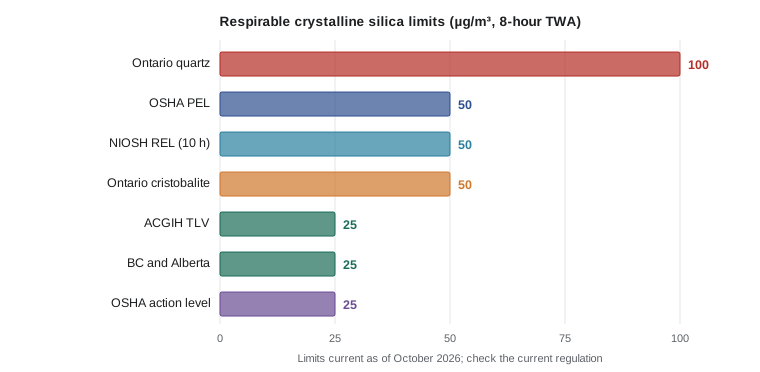
Why the limits differ
The spread between 25 and 100 µg/m³ is large. It reflects different decisions about the balance between health evidence and feasibility. OSHA's 2016 rule estimated that a 50 µg/m³ PEL would prevent hundreds of deaths and hundreds of new silicosis cases a year in the United States compared with the old limits, while recognizing that lower levels were difficult to measure and achieve reliably with the methods available then. ACGIH sets its TLVs on health grounds alone. Ontario has been urged by unions and health advocates to adopt the ACGIH value. Whatever the legal limit, good practice is to keep exposure as low as reasonably achievable, because risk continues below every current limit.
Mixtures of quartz and cristobalite
OSHA's silica PEL applies to the total of all forms of respirable crystalline silica together: quartz, cristobalite and tridymite are added and compared with 50 µg/m³. Where a jurisdiction or an internal standard sets different limits for different forms, the mixture formula is used instead: each concentration is divided by its own limit and the fractions are added, with a total over 1 meaning the combined limit is exceeded.
def mixture_index(parts):
    """parts: list of (name, concentration mg/m3, limit mg/m3)."""
    total = 0.0
    for name, conc, limit in parts:
        frac = conc / limit
        total += frac
        print(f"  {name:12s} {conc:.3f} mg/m3 against {limit:.3f}: fraction {frac:.2f}")
    return total

sample = [("quartz", 0.040, 0.10), ("cristobalite", 0.020, 0.05)]
print("Limits differ by form (as in Ontario):")
e = mixture_index(sample)
print(f"  mixture index {e:.2f} -> {'over' if e > 1 else 'within'} the combined limit")

print("Single limit for all forms (ACGIH TLV 0.025):")
total = sum(c for _, c, _ in sample)
print(f"  combined {total:.3f} mg/m3 is {total/0.025:.1f} times the limit")

print("Single limit for all forms (OSHA PEL 0.050):")
print(f" combined {total:.3f} mg/m3 is {total/0.050:.1f} times the PEL")Limits differ by form (as in Ontario): quartz 0.040 mg/m3 against 0.100: fraction 0.40 cristobalite 0.020 mg/m3 against 0.050: fraction 0.40 mixture index 0.80 -> within the combined limit Single limit for all forms (ACGIH TLV 0.025): combined 0.060 mg/m3 is 2.4 times the limit Single limit for all forms (OSHA PEL 0.050): combined 0.060 mg/m3 is 1.2 times the PEL
The same sample is within the combined limit under the Ontario approach, well over the ACGIH TLV and above the OSHA PEL. The result depends on the rule that applies, and the safest interpretation is the one most protective of the worker.
Long shifts
Exposure limits based on 8-hour days may not protect workers on 10- or 12-hour shifts, because they breathe dust for longer and have less time to clear it before the next shift. Two approaches are common.
The Brief and Scala model reduces the limit by a factor that accounts for both longer exposure and shorter recovery:
where h is the shift length in hours. The adjusted limit is the 8-hour limit multiplied by RF. For a 12-hour shift, RF = (8 ÷ 12) × (12 ÷ 16) = 0.5, so the limit is halved.
OSHA's silica standards express the PEL as an 8-hour TWA and do not prescribe an adjustment for longer shifts, although exposure must be assessed over the whole shift. Many hygienists apply the Brief and Scala model as good practice. OSHA's lead standard, by contrast, does include a formula, as Lesson 8 explains.
def brief_scala(limit, hours):
    rf = (8 / hours) * ((24 - hours) / 16)
    return rf, limit * rf

for limit, label_ in ((0.025, "ACGIH TLV"), (0.050, "OSHA PEL")):
    for h in (8, 10, 12):
        rf, adj = brief_scala(limit, h)
print(f"{label_:9s} {h:2d}-hour shift: RF {rf:.2f}, adjusted limit {adj*1000:.1f} ug/m3")ACGIH TLV 8-hour shift: RF 1.00, adjusted limit 25.0 ug/m3 ACGIH TLV 10-hour shift: RF 0.70, adjusted limit 17.5 ug/m3 ACGIH TLV 12-hour shift: RF 0.50, adjusted limit 12.5 ug/m3 OSHA PEL 8-hour shift: RF 1.00, adjusted limit 50.0 ug/m3 OSHA PEL 10-hour shift: RF 0.70, adjusted limit 35.0 ug/m3 OSHA PEL 12-hour shift: RF 0.50, adjusted limit 25.0 ug/m3
Worked problem
Comparing a long-shift result
A worker on a 12-hour shift has a full-shift respirable quartz exposure of 0.018 mg/m³. The applicable limit is the ACGIH TLV of 0.025 mg/m³. Is the exposure acceptable?
Show solution
- Compared with the unadjusted limit, 0.018 is 72 percent of 0.025 and appears acceptable.
- Brief and Scala reduction factor for 12 hours: 0.5.
- Adjusted limit: 0.025 × 0.5 = 0.0125 mg/m³.
- The exposure of 0.018 mg/m³ is about 144 percent of the adjusted limit.
Answer: Once the long shift is accounted for, the exposure exceeds the adjusted limit. Controls must be improved, and the result also shows why a 12-hour schedule should prompt a review of silica exposure.
What employers must do
Although the details vary, every jurisdiction expects employers to work through the same sequence once silica is present:
| Step | What it involves |
|---|---|
| Identify | Find the materials and tasks that can produce respirable crystalline silica |
| Assess | Estimate or measure exposure, or use a recognized task-based method where the law allows |
| Plan | Write an exposure control plan describing tasks, controls, responsibilities and procedures |
| Control | Apply the hierarchy of controls: eliminate, substitute, engineer, administer, then protect with respirators |
| Train | Explain the hazard, the controls, the plan and the worker's role |
| Monitor | Check controls are used and working; repeat assessment when conditions change |
| Health surveillance | Provide medical examinations where required, as covered in Lesson 11 |
| Record | Keep records of assessments, training and health surveillance as required |
Both OSHA standards require a written exposure control plan describing the tasks that involve silica, the engineering controls, work practices and respirators used for each, the housekeeping measures and, in construction, procedures to restrict access to areas where exposures may be high. Construction employers must designate a competent person to implement the plan. Lesson 4 explains the choice between Table 1 and exposure assessment.
Housekeeping rules
Both OSHA standards prohibit dry sweeping and dry brushing where they could contribute to exposure unless wet sweeping, HEPA vacuuming or other methods are not feasible, and prohibit compressed air for cleaning clothing or surfaces unless it is used with a ventilation system that captures the dust or no feasible alternative exists.
Common mistakes
MistakeTreating the legal limit as a safe level.
InsteadKeep exposure as low as reasonably achievable; silica is a carcinogen and risk continues below every current limit.
MistakeComparing a total dust result with a respirable silica limit.
InsteadUse respirable samples analyzed for crystalline silica.
MistakeAdding quartz and cristobalite results and comparing them with the quartz limit where the limits differ.
InsteadUse the mixture formula, dividing each concentration by its own limit.
MistakeComparing a 12-hour result with an 8-hour limit without adjustment.
InsteadApply the adjustment method your regulator accepts, or Brief and Scala as good practice.
MistakeAssuming the rules are the same everywhere.
InsteadCheck the specific regulation, limit and plan requirements for your jurisdiction and sector.
Summary and key terms
- Silica limits are 8-hour TWA concentrations of respirable crystalline silica, expressed in mg/m³ or µg/m³.
- OSHA sets a PEL of 50 µg/m³ and an action level of 25 µg/m³ in both 1926.1153 and 1910.1053; ACGIH recommends 25 µg/m³.
- No limit is a line of safety for a carcinogen, so exposure should be kept as low as reasonably achievable.
- Mixtures of quartz and cristobalite are additive; use the mixture formula where limits differ.
- Long shifts call for adjusted limits; Brief and Scala halves the limit for a 12-hour shift.
- Employers must identify, assess, plan, control, train, monitor, provide health surveillance and keep records.
- Dry sweeping and compressed air are prohibited or restricted for silica dust in favor of wet methods and HEPA vacuums.
- Occupational exposure limit (OEL)
- The maximum airborne concentration allowed over a defined period, usually an 8-hour TWA.
- Threshold limit value (TLV)
- An ACGIH guideline limit, adopted into law by many Canadian jurisdictions.
- Permissible exposure limit (PEL)
- An enforceable OSHA limit.
- Action level
- A concentration below the PEL that triggers requirements such as monitoring or medical surveillance.
- Recommended exposure limit (REL)
- A non-enforceable NIOSH recommendation.
- Designated substance
- In Ontario, a substance such as silica or lead with its own regulatory requirements.
- Exposure control plan
- A written plan setting out how exposure to a hazardous substance will be controlled.
- Mixture formula
- The sum of each concentration divided by its own limit, used for substances with additive effects.
- Brief and Scala model
- A method of reducing an 8-hour limit for longer shifts.
- As low as reasonably achievable (ALARA)
- A principle requiring exposure to carcinogens to be reduced as far as practicable, not only below the limit.
Practice problems
Work each problem on paper first, then reveal the answer to check.
Convert 0.05 mg/m³ to µg/m³.
Show answer
50 µg/m³.
What is the ACGIH TLV for respirable crystalline silica?
Show answer
0.025 mg/m³ (25 µg/m³) as an 8-hour TWA.
What are the OSHA PEL and action level for silica?
Show answer
PEL 50 µg/m³; action level 25 µg/m³.
A sample shows 0.03 mg/m³ quartz and 0.02 mg/m³ cristobalite. Using limits of 0.10 and 0.05, what is the mixture index?
Show answer
0.3 + 0.4 = 0.7, within the combined limit.
What is the Brief and Scala factor for a 10-hour shift?
Show answer
(8 ÷ 10) × (14 ÷ 16) = 0.7.
Adjust a 0.025 mg/m³ limit for a 10-hour shift with Brief and Scala.
Show answer
0.025 × 0.7 = 0.0175 mg/m³.
Why is an OEL for silica not a safe level?
Show answer
Silica is a carcinogen with no known safe threshold, and limits also reflect feasibility.
When must an OSHA construction employer have a written exposure control plan?
Show answer
Whenever employees are exposed to silica covered by the standard, whether using Table 1 or exposure assessment.
Why are dry sweeping and compressed air restricted?
Show answer
They re-suspend respirable dust into the air.
What is NIOSH's REL for respirable crystalline silica?
Show answer
50 µg/m³ as a TWA for up to a 10-hour day.
Lesson quiz · 5 questions
Score 60% or more to complete this lesson.
Create a free account to save your progress, take quizzes and earn a certificate.