
HSE-242 · Lesson 4 of 12 · 25 min
Assessing silica exposure
Before you can choose the right controls, you need to know how much silica workers are breathing, or at least whether a recognized method of control will keep exposure low enough. This lesson explains the main ways exposure is assessed: personal air sampling, objective data, task-based approaches and direct-reading monitors. It covers how a sample is collected and analyzed, how to calculate and interpret results and how to plan an assessment for a group of workers. HSE-240 introduced exposure assessment for airborne contaminants in general; this lesson focuses on what is particular to silica.
Why assessment matters
Assessment answers three questions: are workers exposed above the limit or action level, which tasks drive the exposure, and are the controls working? Without it, employers either under-protect workers or spend money on controls and respirators that are not needed. Assessment is also a legal requirement in most jurisdictions, as Lesson 3 explained, and the results determine what else must happen, from written plans to medical surveillance.
Options for assessing exposure
OSHA's construction standard gives employers a choice: follow Table 1, which specifies controls and respirators for common tasks without air monitoring, or assess exposure by the performance option or scheduled monitoring. The general industry standard requires exposure assessment and has no Table 1. The approaches below are all used in practice.
| Approach | How it works | Strengths and limits |
|---|---|---|
| Table 1 (construction only) | Fully and properly implement the engineering controls, work practices and respirators listed for the task | No air monitoring needed for listed tasks; only works if every condition in the table is met |
| Performance option | Assess the 8-hour TWA using any combination of air monitoring data or objective data sufficient to characterize exposure | Flexible; data must truly reflect current conditions |
| Scheduled monitoring option | Initial personal monitoring, then repeat monitoring on a fixed schedule depending on the results | Clear rules; needs a sampling program and accredited laboratory |
| Direct-reading monitors | Real-time dust instruments | Good for finding sources and testing controls; cannot show compliance on their own |
Personal air sampling
Personal sampling is the reference method because it measures what the worker actually breathes. A small battery-powered pump draws air through a sampler clipped to the worker's collar, within about 30 centimeters of the nose and mouth, the breathing zone. The sampler has two parts: a cyclone that spins out the larger particles, letting only the respirable fraction pass, and a filter cassette that collects the respirable dust.
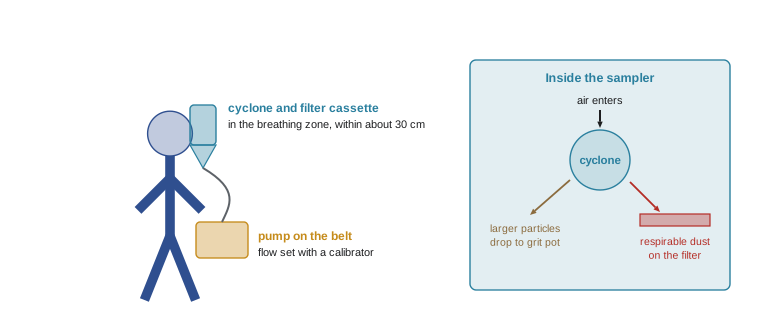
Each cyclone is designed to operate at a specific flow rate so that its cut point matches the respirable convention. The flow rate must be set and checked with a calibrator before and after sampling. Using the wrong flow rate changes the cut point and biases the result.
| Cyclone type | Typical flow rate |
|---|---|
| 10 mm nylon (Dorr-Oliver) | 1.7 L/min |
| Higgins-Dewell type | 2.2 L/min |
| Aluminum cyclone | 2.5 L/min |
| GK2.69 and similar higher-flow cyclones | About 4.2 L/min |
Higher flow rates collect more air and therefore more silica, which matters because the amount of silica on a filter from a well-controlled task can be very small. Laboratories analyze the filter by X-ray diffraction (for example NIOSH Method 7500 or OSHA Method ID-142) or by infrared spectroscopy (for example NIOSH Method 7602). Results come back as the mass of quartz and cristobalite on the filter, usually in micrograms.
Calculating the concentration
The concentration is the mass of silica collected divided by the volume of air sampled:
Here m is the mass of silica on the filter, Q is the average flow rate and t is the sampling time. With mass in micrograms and volume in cubic meters, the result is in µg/m³. Since 1 m³ is 1,000 L, a flow rate of 2.5 L/min over 480 minutes samples 1,200 L, or 1.2 m³.
def concentration(mass_ug, flow_lpm, minutes):
    volume_m3 = flow_lpm * minutes / 1000
    return mass_ug / volume_m3, volume_m3

samples = [
    ("cut-off saw, wet", 9.0, 2.5, 455),
    ("tuckpointing grinder with shroud", 31.0, 2.5, 470),
    ("floor grinder, no vacuum", 210.0, 2.5, 430),
    ("helper, general clean-up", 6.0, 2.5, 480),
]

for task, m, q, t in samples:
    c, v = concentration(m, q, t)
print(f"{task:34s} {m:6.1f} ug on {v:.2f} m3 = {c:6.1f} ug/m3")cut-off saw, wet 9.0 ug on 1.14 m3 = 7.9 ug/m3 tuckpointing grinder with shroud 31.0 ug on 1.18 m3 = 26.4 ug/m3 floor grinder, no vacuum 210.0 ug on 1.07 m3 = 195.3 ug/m3 helper, general clean-up 6.0 ug on 1.20 m3 = 5.0 ug/m3
These are concentrations over the sampled period only. To compare with an 8-hour limit, the result must be expressed as an 8-hour TWA, which depends on what happened during any unsampled time.
From sample to 8-hour TWA
Ideally, samples cover the whole shift. When a worker is sampled for only part of the shift, or several consecutive samples are taken, the 8-hour TWA is calculated by summing concentration multiplied by time and dividing by 8 hours (480 minutes):
Unsampled time must be assigned a value. If the worker was doing the same task, the sampled concentration may be assumed. If the worker was doing no silica work, zero may be reasonable. If you do not know, assume the worst case or sample longer.
Worked problem
Combining consecutive samples
A mason tender is sampled with two consecutive filters: 0 to 240 minutes at 62 µg/m³ while assisting with block cutting, and 240 to 450 minutes at 18 µg/m³ while mixing mortar. The last 30 minutes of the shift are spent on paperwork with no silica exposure. What is the 8-hour TWA?
Show solution
- First period: 62 × 240 = 14,880 µg·min/m³.
- Second period: 18 × 210 = 3,780 µg·min/m³.
- Paperwork: 0 × 30 = 0.
- TWA = (14,880 + 3,780 + 0) ÷ 480 ≈ 38.9 µg/m³.
Answer: About 39 µg/m³: above the OSHA action level of 25 µg/m³ but below the PEL of 50 µg/m³. Under scheduled monitoring this triggers repeat monitoring within six months, and the block cutting should be the first target for better controls.
Detection limits and very low results
Laboratories cannot measure arbitrarily small amounts of silica. The limit of detection for quartz by X-ray diffraction is typically a few micrograms per filter. Dividing by the air volume gives the lowest concentration the sample can detect. Short samples or low flow rates can produce detection limits close to, or even above, the action level, which makes the result useless for compliance.
lod_ug = 5.0   # illustrative limit of detection per filter, micrograms

print("minimum detectable concentration (ug/m3)")
print("flow   60 min  120 min  240 min  480 min")
for q in (1.7, 2.5, 4.2):
    row = []
    for t in (60, 120, 240, 480):
        v = q * t / 1000
        row.append(f"{lod_ug / v:7.1f}")
print(f"{q:4.1f} " + " ".join(row))minimum detectable concentration (ug/m3) flow 60 min 120 min 240 min 480 min 1.7 49.0 24.5 12.3 6.1 2.5 33.3 16.7 8.3 4.2 4.2 19.8 9.9 5.0 2.5
A 1-hour sample at 1.7 L/min cannot detect anything below about 49 µg/m³, so a result of 'not detected' says almost nothing about compliance with a 25 µg/m³ limit. Full-shift samples at higher flow rates give far more useful information. When a result is below the detection limit, report it as less than that value, not as zero.
Planning a sampling strategy
It is rarely practical to sample everyone on every shift. Hygienists group workers into similar exposure groups (SEGs): workers who do similar tasks with similar materials and controls and so are expected to have similar exposures. A few workers from each group are sampled on several days, ideally including the higher-exposure days.
Exposures vary a lot from day to day, often by a factor of two or more, because of weather, materials, production and how carefully controls are used. A single sample is a snapshot. Several results allow you to see the spread and judge how often the group might exceed the limit. A common rule of thumb is that if any result is above half the limit, the group needs closer attention.
Table 1 in practice
Table 1 in 1926.1153 lists 18 common construction tasks, such as using stationary masonry saws, hand-held power saws, walk-behind saws, jackhammers, hand-held grinders and drills. For each it specifies the engineering control and work practices, and the respirator required for 4 hours or less or more than 4 hours per shift. An employer that fully and properly implements Table 1 for a task does not need to assess exposure for that task. If any condition is not met, for example the saw lacks an integrated water system, Table 1 does not apply and exposure must be assessed.
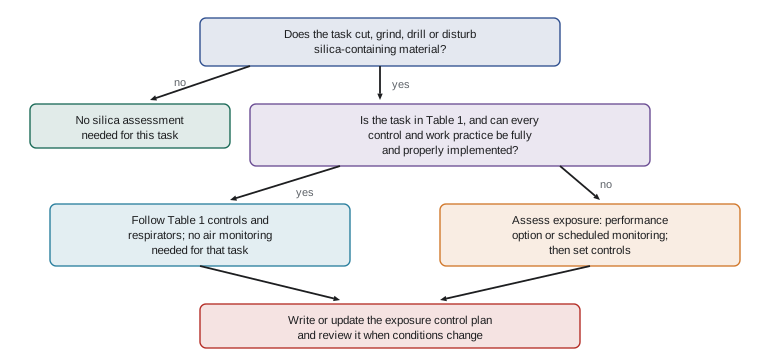
Under the scheduled monitoring option, if initial monitoring shows exposure below the action level, monitoring may stop. If it is at or above the action level, repeat within six months; if above the PEL, repeat within three months. Monitoring may stop when two consecutive results taken at least seven days apart are below the action level. Reassess whenever production, processes, controls or personnel change in ways that may affect exposure.
Direct-reading monitors
Real-time dust monitors, usually light-scattering photometers, show concentration second by second. They cannot distinguish silica from other dust and need correction factors to estimate mass, so they are not used to show compliance. But they are excellent for finding which step in a task produces the most dust, comparing tools and checking whether a vacuum shroud or water feed is working. Some newer systems combine real-time monitoring with end-of-shift silica analysis on the same filter, giving faster feedback.
Interpreting and communicating results
Results should be shared with the workers sampled and with the joint health and safety committee or representative, in plain language. Explain what was sampled, the result compared with the limit, what it means and what will change. Workers have a right to see their exposure records. Keep records for as long as your regulator requires, which for carcinogens is often decades, because they may be needed if a worker later develops disease.
Common mistakes
MistakeCollecting a total dust sample and comparing it with a respirable silica limit.
InsteadUse a respirable cyclone at its design flow rate and have the filter analyzed for crystalline silica.
MistakeTaking short samples that cannot detect concentrations near the limit.
InsteadSample for most or all of the shift at an appropriate flow rate so the detection limit is well below the action level.
MistakeReporting a result below the detection limit as zero.
InsteadReport it as less than the detection limit and judge whether that limit is low enough to be useful.
MistakeRelying on one sample to characterize a group.
InsteadSample several workers on several days and look at the spread of results.
MistakeClaiming Table 1 compliance when part of the control is missing.
InsteadImplement every control and work practice in Table 1 for the task, or assess exposure.
Summary and key terms
- OSHA construction employers can follow Table 1 or assess exposure; general industry employers must assess exposure.
- Personal sampling uses a respirable cyclone at its design flow rate and a filter analyzed by X-ray diffraction or infrared methods.
- Concentration equals mass divided by air volume; the 8-hour TWA sums concentration times time and divides by 480 minutes.
- Detection limits matter: short or low-flow samples may be unable to detect concentrations near the limit.
- Similar exposure groups and several samples per group give a fair picture of variable exposures.
- Direct-reading monitors find sources and test controls but cannot show compliance on their own.
- Results must be explained to workers and kept for as long as required.
- Breathing zone
- The area within about 30 cm of the nose and mouth where personal samples are collected.
- Cyclone
- A size-selective sampler that removes larger particles so that only the respirable fraction reaches the filter.
- X-ray diffraction (XRD)
- A laboratory method that identifies and measures crystalline silica on a filter.
- Limit of detection (LOD)
- The smallest amount a laboratory method can reliably detect.
- Time-weighted average (TWA)
- An average concentration weighted by the time spent at each level, usually over 8 hours.
- Similar exposure group (SEG)
- Workers expected to have similar exposures because they do similar tasks with similar materials and controls.
- Objective data
- Exposure information from comparable tasks and conditions used instead of new sampling.
- Table 1
- The OSHA construction silica table listing controls and respirators for common tasks.
- Direct-reading monitor
- An instrument that displays dust concentration in real time.
- Calibrator
- A device used to set and check the flow rate of a sampling pump.
Practice problems
Work each problem on paper first, then reveal the answer to check.
A filter holds 24 µg of quartz after 450 minutes at 2.5 L/min. What is the concentration?
Show answer
Volume 1.125 m³; 24 ÷ 1.125 ≈ 21.3 µg/m³.
What volume of air does a pump at 1.7 L/min sample in 8 hours?
Show answer
816 L, or 0.816 m³.
Calculate the TWA for 3 hours at 80 µg/m³ and 5 hours at 10 µg/m³.
Show answer
(240 + 50) ÷ 8 = 36.25 µg/m³.
With a 5 µg detection limit, what is the minimum detectable concentration for a 2-hour sample at 2.5 L/min?
Show answer
5 ÷ 0.3 ≈ 16.7 µg/m³.
Why must a cyclone be run at its design flow rate?
Show answer
The flow rate sets the cut point; the wrong rate changes which particles are collected.
Why can a direct-reading monitor not show compliance with a silica limit?
Show answer
It measures all dust, not silica specifically, and needs correction to estimate mass.
What is a similar exposure group?
Show answer
Workers with similar tasks, materials and controls who are expected to have similar exposures.
How should a result below the detection limit be reported?
Show answer
As less than the detection limit, not as zero.
Under scheduled monitoring, how soon must monitoring be repeated if exposure is above the PEL?
Show answer
Within three months.
Who should receive sampling results?
Show answer
The workers sampled and the joint health and safety committee or representative, explained in plain language.
Lesson quiz · 5 questions
Score 60% or more to complete this lesson.
Create a free account to save your progress, take quizzes and earn a certificate.