
HSE-242 · Lesson 10 of 12 · 26 min
Lead controls and hygiene
Controlling lead has two jobs: keeping lead out of the air workers breathe, and keeping lead off hands, food, clothing and vehicles so that it is not swallowed or carried home. Air controls follow the familiar hierarchy. Hygiene controls are what make lead different from many other hazards: without washing facilities, change rooms and strict rules about eating, drinking and smoking, workers can absorb dangerous amounts of lead even when air exposure is well controlled. This lesson covers both, with a focus on renovation, structural steel and firing range work. Respirator selection and fit testing are covered in HSE-240.
The hierarchy of controls applied to lead
| Level | Examples for lead |
|---|---|
| Elimination | Leave intact lead paint undisturbed where it is in good condition; replace painted components such as doors and windows rather than stripping them in place; design out lead products |
| Substitution | Use lead-free solder, ammunition, flashing and shielding where possible; strip with lower-hazard chemical strippers or low-temperature methods instead of torches; cut painted steel with shears, saws or cold methods instead of torches |
| Engineering controls | Containment and negative-pressure enclosures; HEPA-shrouded power tools; vacuum blasting; wet methods; local exhaust ventilation on fixed processes; ventilation at firing ranges |
| Administrative controls | Regulated work areas with signs and restricted access; no eating, drinking, smoking or phone use in work areas; work scheduling; training and supervision |
| Hygiene controls | Hand and face washing, change rooms with separate clean and dirty sides, showers, employer-laundered clothing, clean eating areas |
| Respirators | Selected for the expected or measured exposure, from half-facepiece respirators to supplied-air blasting helmets, under a full program |
Leaving lead paint in place
The simplest way to avoid lead exposure is not to disturb lead paint. Intact paint in good condition is not a hazard by itself. Options that avoid removal include encapsulation, applying a special coating that seals the lead paint, and enclosure, covering it with drywall, wall panels or cladding. Both need to be documented so that future workers know the lead is there. Where components must be renovated, removing and replacing them whole, or sending them to a facility for stripping, usually creates far less exposure than stripping them on site.
Safer removal methods
When lead paint must be removed, the method has a huge effect on exposure, as Lesson 9 showed. In general, wet hand methods and chemical stripping produce the least airborne lead; dry hand scraping and heat guns produce more; and dry power sanding, open abrasive blasting and torch cutting produce the most.
- Wet scraping and sanding. Misting the surface with water before and during hand scraping or sanding keeps dust down. Do not mist near electrical circuits.
- Chemical strippers. These soften paint so that it can be scraped off wet. They avoid dust and fume but have their own chemical hazards; read the safety data sheet and avoid strippers containing methylene chloride, which many jurisdictions now restrict because it has caused deaths.
- Heat guns at low temperature. Heat guns soften paint without burning it. Keep temperatures low; above about 500 °C lead fumes. Many rules prohibit open-flame torches for paint removal.
- HEPA-shrouded power tools. Sanders, grinders and needle guns fitted with shrouds connected to HEPA vacuums capture dust at the source, as described for silica in Lesson 5.
- Vacuum blasting. Blasting heads with an integrated vacuum recover abrasive and paint at the surface.
- Cold cutting. Shears, nibblers, saws and hydraulic cutters avoid creating lead fume when dismantling painted steel. Where torch cutting is unavoidable, strip the paint back from the cut line first.
Containment
Containment keeps lead dust inside the work area and away from other workers, the public and the environment. For interior renovation, it usually means plastic sheeting on floors and over doorways, sealing ventilation openings, and covering or removing furniture. For larger jobs, such as blasting a bridge or water tank, the work is fully enclosed with rigid or flexible walls and tarpaulins, and air is drawn out through a dust collector so that the enclosure is under negative pressure: air leaks in, not out. Industry guidance from SSPC and others classifies containment systems for industrial structures by how airtight and well ventilated they are.
A simple way to size the air movers for an enclosure is by air changes per hour (ACH): the volume of air extracted each hour divided by the enclosure volume.
Here Q is the airflow in m³/min (or ft³/min) and V is the enclosure volume in m³ (or ft³). Guidance for negative-pressure enclosures commonly calls for at least four air changes per hour, and blasting enclosures often need far more to keep visibility and exposure acceptable.
import math

def air_movers_needed(volume_m3, target_ach, unit_flow_m3min, filter_loading=0.8):
    """unit_flow_m3min: rated flow of one HEPA air mover; filter_loading derates it."""
    effective = unit_flow_m3min * filter_loading
    needed_flow = target_ach * volume_m3 / 60
    return needed_flow, math.ceil(needed_flow / effective)

rooms = [("apartment kitchen", 4.0 * 3.5 * 2.6), ("school classroom", 9 * 8 * 3.0)]
for name, vol in rooms:
    q, n = air_movers_needed(vol, target_ach=4, unit_flow_m3min=17)   # 17 m3/min is about 600 cfm
    print(f"{name:18s} {vol:6.1f} m3: need {q:5.1f} m3/min for 4 ACH -> {n} air mover(s)")

# A blasting enclosure on a steel tank, much higher air change rate
vol = 30 * 12 * 10
q, n = air_movers_needed(vol, target_ach=60, unit_flow_m3min=280)        # large dust collector units
print(f"tank enclosure {vol:6.0f} m3: need {q:7.0f} m3/min for 60 ACH -> {n} collector unit(s)")apartment kitchen 36.4 m3: need 2.4 m3/min for 4 ACH -> 1 air mover(s) school classroom 216.0 m3: need 14.4 m3/min for 4 ACH -> 2 air mover(s) tank enclosure 3600 m3: need 3600 m3/min for 60 ACH -> 17 collector unit(s)
The numbers in the script are illustrative; ventilation for large enclosures must be designed by a competent person, considering airflow patterns, make-up air and the dust collector's filter performance. The point for supervisors is that negative pressure only works if enough air is extracted and the enclosure is reasonably sealed: flapping tarps and open gaps defeat it.
Regulated areas and signs
Areas where lead exposure may exceed the limit should be marked with signs and barriers, and entry limited to trained, authorized workers wearing the required protection. Signs typically warn of lead hazards and prohibit eating, drinking and smoking. Keeping the work area small and clearly defined makes hygiene easier to manage.
Hygiene: the heart of lead control
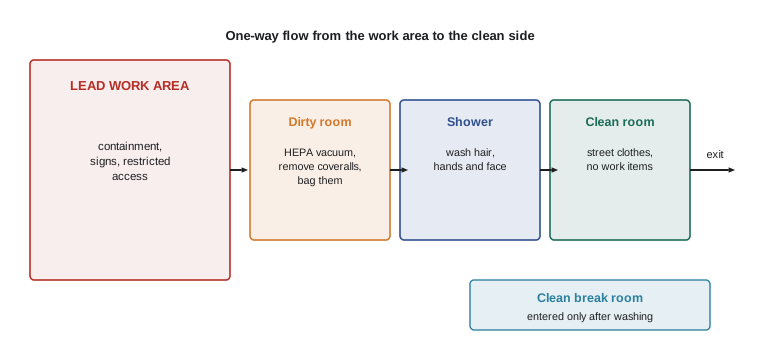
Hygiene controls break the chain from lead dust to the worker's mouth and to their home. They work only if facilities are provided, kept clean and used every time.
| Hygiene control | What good practice looks like |
|---|---|
| Hand and face washing | Wash hands and face with soap and water, not just wipes, before eating, drinking, smoking, using the toilet, touching a phone and leaving work; scrub under the nails |
| No eating, drinking or smoking in work areas | Food, drinks, tobacco, gum and cosmetics kept out of work areas entirely; phones kept in sealed bags or left in the clean area |
| Protective clothing | Coveralls and dedicated work boots or boot covers provided by the employer; HEPA vacuumed, not blown or shaken, before removal; disposable or laundered by a service that knows they contain lead |
| Change areas | Separate clean and dirty sides so that street clothes never contact work clothes |
| Showers | Provided and used where exposure is high, such as abrasive blasting and torch cutting, and wherever required by the applicable rules |
| Clean eating areas | Separate from the work area, cleaned regularly and entered only after removing protective clothing and washing |
| Vehicles | Work clothes and boots never worn into personal vehicles; tools and equipment cleaned or bagged before transport |
Supervisors set the standard. If a supervisor eats lunch in the work area or drives home in dusty coveralls, workers will follow. Hygiene rules should be explained in terms of what they protect, including workers' own children, rather than presented as arbitrary.
Housekeeping and clean-up
Lead dust must be cleaned up regularly during the job, not only at the end. Use HEPA vacuums and wet wiping or mopping. Never dry sweep or use compressed air or leaf blowers on lead dust. A common clean-up sequence for interior work is: mist and remove large debris and sheeting carefully by folding inward, HEPA vacuum all surfaces from top to bottom, wet wipe with a detergent solution and fresh rinse water, then HEPA vacuum again. Clearance wipe sampling, described in Lesson 9, confirms the work is complete before the area is reoccupied.
Waste
Paint chips, debris, used plastic sheeting, filters, disposable clothing, spent abrasive and wash water can all contain lead. Collect waste in sealed, labeled bags or containers and dispose of it according to environmental rules, which may classify it as hazardous waste depending on how much lead leaches out in a standard test. Do not wash lead-contaminated water down storm drains.
Respirators for lead work
Respirators for lead work are selected by the expected or measured exposure and the assigned protection factor, under a respirator program meeting 29 CFR 1910.134, as described in HSE-240. In construction, OSHA's trigger task categories specify minimum respirators for interim protection: for example, half-facepiece respirators for tasks presumed to exceed the PEL, and supplied-air respirators for abrasive blasting and other tasks presumed to produce the highest exposures. Workers may request a powered air-purifying respirator.
Special settings: firing ranges
Indoor firing ranges can expose instructors, police officers and range staff to lead from bullets and primers. Controls include ventilation that moves air from behind the firing line toward the targets at a steady speed, lead-free ammunition and primers, HEPA vacuuming instead of sweeping, careful cleaning of bullet traps with full protection, and washing facilities and rules for shooters, who can also carry lead home.
Worked problem
Setting up hygiene for an interior renovation
A four-person crew will spend three weeks removing lead-painted trim and doors from an occupied office building, using wet scraping and HEPA-shrouded sanders. What hygiene arrangements should be in place?
Show solution
- Containment: plastic sheeting on floors and doorways, sealed ventilation openings, and a defined work area with signs.
- Change area: a clean side for street clothes and a dirty side at the work area exit for coveralls and boot covers; HEPA vacuum to clean clothing before removal.
- Washing: a hand-wash station with soap, warm water and paper towels at the work area exit; showers are less likely to be required for this lower-exposure work but should be considered if exposures prove higher.
- Clean break area: a separate room for meals, away from the work area and entered only after washing.
- Clothing and vehicles: disposable coveralls bagged as waste, or laundered by a service; no work clothes in personal vehicles.
- Daily clean-up with HEPA vacuums and wet wiping, and clearance wipe sampling before handover.
Answer: Containment, a change area with clean and dirty sides, washing facilities, a clean break area, clothing controls and daily HEPA clean-up together prevent ingestion and take-home lead.
Common mistakes
MistakeStripping all old paint as a matter of routine.
InsteadConsider leaving intact paint, encapsulating, enclosing or replacing components before choosing removal.
MistakeUsing a torch or high-temperature heat gun to strip lead paint.
InsteadUse wet hand methods, chemical strippers, low-temperature heat guns or HEPA-shrouded tools.
MistakeProviding hand wipes instead of soap and water.
InsteadProvide proper washing facilities with soap and water, and showers where exposure is high.
MistakeBlowing dust off coveralls with compressed air.
InsteadHEPA vacuum clothing before removal and handle it as contaminated.
MistakeLeaving gaps in a negative-pressure enclosure.
InsteadSeal the enclosure and extract enough air to keep it under negative pressure.
Summary and key terms
- Lead control must keep lead out of the air and off hands, food, clothing and vehicles.
- Leaving intact paint in place, encapsulation, enclosure and component replacement can avoid removal altogether.
- Removal methods differ hugely: wet hand methods and chemical strippers are lowest, torches and dry power sanding highest.
- Containment, often under negative pressure, keeps lead in the work area; air changes per hour help size air movers.
- Hygiene controls are central: washing, no eating or smoking in work areas, protective clothing, change areas, showers and clean eating areas.
- Clean up with HEPA vacuums and wet methods, never dry sweeping or compressed air, and manage lead waste under environmental rules.
- Respirators are selected by exposure under a program, and special settings such as firing ranges need their own controls.
- Encapsulation
- Sealing lead paint with a special coating so that it cannot be released.
- Enclosure
- Covering lead paint with a solid barrier such as drywall or cladding.
- Containment
- Barriers that keep lead dust inside the work area.
- Negative pressure
- A condition in which air is extracted from an enclosure so that leaks draw air in, not out.
- Air changes per hour (ACH)
- The volume of air removed from a space each hour divided by the space's volume.
- Vacuum blasting
- Abrasive blasting with an integrated vacuum that recovers abrasive and debris at the surface.
- Decontamination unit
- A facility with dirty, shower and clean rooms used to remove contamination before leaving the work area.
- Regulated area
- A marked area where lead exposure may exceed the limit and access is restricted.
- Cold cutting
- Cutting metal by mechanical means without heat, avoiding lead fume.
- Clearance
- Testing after clean-up to confirm surfaces meet agreed criteria before reoccupation.
Practice problems
Work each problem on paper first, then reveal the answer to check.
Give two ways to avoid disturbing lead paint.
Show answer
Leave intact paint in place, encapsulate it, enclose it, or replace whole components.
Why are open-flame torches prohibited for paint removal in many rules?
Show answer
They heat lead above the temperature at which it forms fume, causing very high exposures.
What is a hazard of some chemical strippers?
Show answer
Some contain methylene chloride, which has caused deaths and is restricted in many jurisdictions.
An enclosure is 300 m³. What airflow gives 4 air changes per hour?
Show answer
4 × 300 ÷ 60 = 20 m³/min.
Why is negative pressure used in enclosures?
Show answer
So that air leaks into the enclosure rather than carrying lead dust out.
Why are hand wipes not a substitute for soap and water?
Show answer
They remove lead less effectively, especially from creases and under nails.
How should coveralls be cleaned before removal?
Show answer
With a HEPA vacuum, never by blowing or shaking.
Why should work clothes never be worn in personal vehicles?
Show answer
Lead dust contaminates the vehicle and can be carried to the home and children.
What clean-up sequence is commonly used after interior lead work?
Show answer
Remove debris and sheeting carefully, HEPA vacuum, wet wipe, HEPA vacuum again, then clearance testing.
Name two controls for indoor firing ranges.
Show answer
Ventilation moving air from the firing line toward targets, lead-free ammunition, HEPA cleaning and washing facilities.
Lesson quiz · 5 questions
Score 60% or more to complete this lesson.
Create a free account to save your progress, take quizzes and earn a certificate.