
HSE-242 · Lesson 7 of 12 · 25 min
Lead: sources and health effects
Lead is a soft, dense, gray metal that is easy to melt, shape and alloy. These properties made it useful for thousands of years, and its toxicity has been recognized for almost as long. Today most new uses of lead in consumer products have been phased out, but lead remains common at work: in old paint, solder, batteries, ammunition, scrap and many industrial processes. This lesson explains where workers meet lead, how it gets into the body, where it goes once it is there and what it does. Lesson 8 covers the law and Lessons 9 and 10 cover assessment and control.
Where workers meet lead
Exposure happens in two broad situations: industries that make, use or recycle lead products, and work that disturbs lead already in place, especially old paint.
| Setting | Typical lead sources and tasks |
|---|---|
| Renovation and repainting of older buildings | Sanding, scraping, heat-gun stripping and demolition of lead-based paint; cutting or removing old plumbing with lead solder |
| Bridges, tanks and industrial structures | Abrasive blasting, power tool cleaning and torch cutting of steel coated with lead-based paint |
| Welding, burning and cutting | Torch cutting or welding painted or lead-containing metal produces lead fume |
| Battery manufacturing and recycling | Handling lead oxide, casting grids, breaking and smelting used batteries |
| Smelting and secondary lead refining | Melting, refining and casting lead and lead alloys |
| Firing ranges | Lead from bullets and primers released as fume and dust, especially at indoor ranges; cleaning ranges and bullet traps |
| Scrap and recycling | Cutting and sorting scrap metal, cables, radiators and electronic waste |
| Other | Radiator repair, stained glass, ceramic glazes, some brass and bronze foundry work, lead shielding installation, demolition |
Lead-based paint deserves special attention. Paint with high lead content was used widely on homes in Canada and the United States until the 1950s and 1960s, with use declining through the 1970s. Lead paint continued to be used much longer on bridges, ships, tanks, industrial equipment and other steel structures because of its corrosion protection. Any building or structure painted before about 1980 should be assumed to contain lead paint until testing shows otherwise. Lesson 9 explains how paint is tested.
How lead enters the body
Workers absorb lead in two main ways.
Inhalation. Breathing lead fume or fine dust is the main route in most workplaces. Fume, produced when lead is heated above about 500 °C by torch cutting, welding or burning, consists of very fine particles that reach deep into the lungs and are absorbed efficiently. Dust from sanding, scraping and blasting is coarser, but much of it is still inhaled and either absorbed in the lungs or cleared up the airways and swallowed.
Ingestion. Swallowing lead dust that gets onto hands, food, drinks, cigarettes, gum or phones is a major and often overlooked route. Adults absorb roughly 10 to 15 percent of ingested lead, more on an empty stomach or with poor nutrition; young children absorb much more, often around 40 to 50 percent. Eating, drinking or smoking in the work area, or before washing, can contribute as much lead as breathing it.
Skin absorption of inorganic lead is very low, though organic lead compounds such as those once used in leaded gasoline are absorbed through the skin. Lead on the skin matters mainly because it is transferred to the mouth and carried home.
Where lead goes
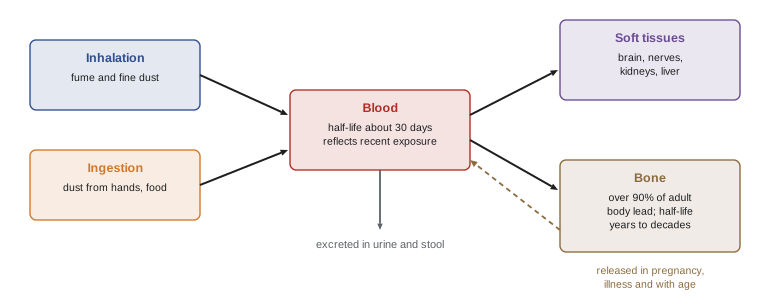
Absorbed lead enters the blood, where most of it binds to red blood cells. From the blood it moves to soft tissues, including the brain, kidneys, liver and nerves, and to bone, where it replaces calcium. In adults, more than 90 percent of the body's lead is stored in bone.
Lead leaves the blood with a half-life of about a month, so blood lead reflects mainly the last few weeks of exposure. Lead in bone has a half-life of years to decades. Bone lead is released back into the blood during pregnancy and breastfeeding, during illness or immobilization and with aging and osteoporosis. A worker who had high exposure years ago may therefore have elevated blood lead long after exposure ends, and a pregnant worker can pass stored lead to the fetus.
Modeling blood lead
A simple one-compartment model shows how blood lead rises during exposure and falls after it stops. Real lead kinetics are more complex because of the bone store, but the model captures the key point: blood lead responds within weeks to changes in exposure.
import math

half_life_days = 30
k = math.log(2) / half_life_days        # elimination rate per day
baseline = 1.0                           # ug/dL background
steady_extra = 34.0                      # ug/dL added at steady state by the job (illustrative)

def blood_lead(day, start=0, stop=120):
    if day < start:
        return baseline
    if day <= stop:
        return baseline + steady_extra * (1 - math.exp(-k * (day - start)))
    peak = baseline + steady_extra * (1 - math.exp(-k * (stop - start)))
    return baseline + (peak - baseline) * math.exp(-k * (day - stop))

for d in (0, 15, 30, 60, 90, 120, 150, 180, 240):
    phase = "exposed" if d <= 120 else "removed"
print(f"day {d:3d} ({phase:7s}): about {blood_lead(d):5.1f} ug/dL")day 0 (exposed): about 1.0 ug/dL day 15 (exposed): about 11.0 ug/dL day 30 (exposed): about 18.0 ug/dL day 60 (exposed): about 26.5 ug/dL day 90 (exposed): about 30.8 ug/dL day 120 (exposed): about 32.9 ug/dL day 150 (removed): about 16.9 ug/dL day 180 (removed): about 9.0 ug/dL day 240 (removed): about 3.0 ug/dL
In this illustration, blood lead approaches its steady level after about three to four months of exposure and halves roughly every month after exposure stops. In practice, workers with long exposure histories fall more slowly because lead keeps moving out of bone.
Units: µg/dL
US laboratories report blood lead in micrograms per deciliter (µg/dL). Some international and Canadian sources use micromoles per liter (µmol/L); 1 µmol/L equals about 20.7 µg/dL, so 0.48 µmol/L is about 10 µg/dL. Always check which unit a report uses before comparing it with a guideline.
Health effects in adults
Lead affects almost every organ system. The effects depend on how much lead is absorbed and for how long. Effects once thought to need high blood lead levels are now known to occur at much lower levels.
| System | Effects |
|---|---|
| Nervous system | Fatigue, headache, irritability, poor concentration and memory, mood changes; peripheral neuropathy with weakness in the hands and feet at higher levels; encephalopathy with confusion, seizures and coma at very high levels |
| Blood | Interference with hemoglobin production, leading to anemia |
| Cardiovascular | Raised blood pressure and increased risk of cardiovascular disease, even at relatively low blood lead levels |
| Kidneys | Chronic kidney damage, which may be permanent |
| Digestive | Abdominal pain (lead colic), constipation, nausea and loss of appetite |
| Reproductive | Reduced sperm count and quality in men; increased risk of miscarriage, premature birth and low birth weight; lead crosses the placenta and affects the developing brain |
| Joints and muscles | Joint and muscle pain |
| Cancer | Inorganic lead compounds are classified by IARC as probably carcinogenic to humans (Group 2A) |
Many early symptoms of lead poisoning are vague and easily mistaken for stress, flu or overwork. Workers and doctors may not make the connection unless they know about the exposure. That is why blood lead testing for exposed workers, covered in Lesson 11, is important: it detects absorption before symptoms appear.
Health effects in children and the developing fetus
Children are much more vulnerable than adults. They absorb more of the lead they swallow, their brains are developing rapidly, and they put hands and objects in their mouths. There is no known safe blood lead level in children; even low levels are associated with reduced IQ, attention problems and behavioral difficulties that may be permanent. The developing fetus is similarly vulnerable, which is why lead exposure of pregnant workers, and of workers who may become pregnant, must be kept very low.
Public health agencies use reference values to identify children with blood lead levels higher than most of the population. The CDC's blood lead reference value for children has been 3.5 µg/dL since 2021, and the same figure is used as a reference value for adults by the Council of State and Territorial Epidemiologists. There is no known safe level for children.
Take-home lead
Lead dust on clothes, boots, skin, hair, tools and in vehicles can be carried home, where it settles in cars, laundry areas, carpets and furniture. Children of lead workers have been found with elevated blood lead from this route. Lesson 10 explains how change rooms, showers, work clothing and vehicle practices prevent take-home exposure. This is one of the most important reasons lead hygiene rules exist.
Worked problem
Explaining a blood lead result
A worker who has been stripping lead paint for two months receives a blood lead result of 23 µg/dL and asks what it means. How would you explain it?
Show solution
- No conversion is needed; the result is in µg/dL.
- Compare with background: typical adult levels today are around 1 µg/dL, so the result shows significant absorption from work.
- Compare with guidelines: it is above the ACGIH biological exposure index of 20 µg/dL and well above public health reference values, though below the levels at which most regulations require medical removal.
- Explain the trend: blood lead reflects the last few weeks, so improving controls and hygiene now should bring it down within a few months.
- Next steps: review the controls, respirator use and hygiene practices, and follow up with repeat testing and the physician's advice.
Answer: The result shows the worker is absorbing lead at work and controls need to improve, even though it does not yet trigger removal. Explaining the comparison and the trend helps the worker understand why hygiene and controls matter.
Recognizing lead poisoning early
Because early lead poisoning looks like many common complaints, supervisors and workers should know the pattern. Signs that should prompt a blood lead test in an exposed worker include unusual tiredness, headaches, irritability or difficulty concentrating; stomach pain, constipation or loss of appetite; aching joints or muscles; and, at higher levels, weakness in the wrists or ankles. A metallic taste or a blue-gray line on the gums is sometimes described but is unreliable. No symptom is specific enough to diagnose lead poisoning: the blood test is the only way to know. A worker who reports any of these symptoms after lead work should be referred to the program physician promptly, and the controls on their tasks should be checked at the same time.
Common mistakes
MistakeAssuming lead paint is only a problem in homes.
InsteadExpect lead paint on bridges, tanks, ships and industrial steel, often well after it was phased out of homes.
MistakeFocusing only on inhalation.
InsteadControl ingestion by banning eating, drinking and smoking in work areas and requiring hand and face washing.
MistakeComparing a µmol/L result directly with a µg/dL guideline.
InsteadConvert units first: 1 µmol/L is about 20.7 µg/dL.
MistakeAssuming blood lead will drop to normal within days of stopping exposure.
InsteadExpect blood lead to fall over months, and more slowly for workers with long exposure histories because of bone stores.
MistakeTreating vague symptoms such as fatigue and headache as unrelated to work.
InsteadConsider lead exposure and arrange blood lead testing for exposed workers with these symptoms.
Summary and key terms
- Workers meet lead in industries that make or recycle lead products and in work that disturbs old lead paint, solder and coatings.
- Structures painted before about 1980, and steel structures painted much later, should be assumed to have lead paint until tested.
- Inhalation of fume and dust and ingestion of dust from hands, food and cigarettes are the main routes; skin absorption of inorganic lead is low.
- Blood lead has a half-life of about a month; bone stores more than 90 percent of adult body lead and releases it for years.
- US labs report blood lead in µg/dL; some sources use µmol/L, where 1 µmol/L is about 20.7 µg/dL.
- Lead harms the nervous system, blood, blood pressure, kidneys, digestion and reproduction, and is a probable carcinogen.
- Children and the fetus are especially vulnerable, with no known safe level, so take-home lead must be prevented.
- Lead fume
- Very fine particles formed when lead is heated above about 500 °C, efficiently absorbed when inhaled.
- Lead-based paint
- Paint containing significant amounts of lead, widely used before about 1980 and longer on steel structures.
- Ingestion
- Swallowing a substance, for example lead dust from hands or food.
- Body burden
- The total amount of a substance stored in the body.
- Half-life
- The time taken for the amount of a substance in a compartment to fall by half.
- Blood lead level (BLL)
- The concentration of lead in blood, reflecting mainly recent exposure.
- Peripheral neuropathy
- Damage to the nerves of the arms and legs, causing weakness or numbness.
- Anemia
- A shortage of hemoglobin or red blood cells, reducing oxygen delivery.
- Biological exposure index (BEI)
- An ACGIH guidance value for a biological measurement such as blood lead.
- Take-home exposure
- Lead carried home on clothing, skin, tools or vehicles.
Practice problems
Work each problem on paper first, then reveal the answer to check.
Name four occupations or tasks with lead exposure.
Show answer
Renovation painters, bridge blasters, welders cutting painted steel, battery recyclers, firing range staff, plumbers working on old solder.
Why does torch cutting painted steel create a high lead hazard?
Show answer
Heating lead above about 500 °C produces fine fume that is efficiently absorbed in the lungs.
Roughly what share of swallowed lead do adults and young children absorb?
Show answer
Adults about 10 to 15 percent; young children often around 40 to 50 percent.
Where is most lead stored in an adult body?
Show answer
In bone, which holds more than 90 percent.
Convert 0.72 µmol/L to µg/dL.
Show answer
About 14.9 µg/dL.
Why can blood lead rise during pregnancy even without new exposure?
Show answer
Lead stored in bone is released into the blood.
List three health effects of lead in adults.
Show answer
Anemia, high blood pressure, kidney damage, nerve damage, reproductive effects, abdominal pain.
What is the CDC blood lead reference value for children?
Show answer
3.5 µg/dL.
If exposure stops, about how long does it take for the job-related part of blood lead to halve?
Show answer
About a month, longer for workers with large bone stores.
Why must take-home lead be prevented?
Show answer
Dust carried home can poison children, who are much more vulnerable than adults.
Lesson quiz · 5 questions
Score 60% or more to complete this lesson.
Create a free account to save your progress, take quizzes and earn a certificate.