
HSE-242 · Lesson 2 of 12 · 26 min
Respirable crystalline silica: sources and health effects
Silica is everywhere, yet only some silica is dangerous and only in some forms. This lesson explains the difference between crystalline and amorphous silica, which particle sizes matter, where silica dust comes from at work and what it does to the lungs and other organs. The goal is to be able to look at a task and say whether it is likely to produce respirable crystalline silica, and to explain to workers why it matters.
Crystalline and amorphous silica
Silicon dioxide exists in two broad families. In crystalline silica the atoms form a repeating three-dimensional lattice. In amorphous silica they are arranged randomly, like glass. The difference matters because the crystalline forms are far more toxic to the lungs.
| Form | Where it is found | Hazard |
|---|---|---|
| Quartz | Sand, sandstone, granite, shale, concrete, mortar, brick, many soils and rocks | The most common form at work; causes silicosis and lung cancer |
| Cristobalite | Formed when quartz or amorphous silica is heated above about 1,000 °C; calcined diatomaceous earth, refractory brick, some foundry sands | At least as toxic as quartz; some jurisdictions set a lower limit |
| Tridymite | Formed at high temperatures; rare in most workplaces | Treated like cristobalite |
| Amorphous silica | Uncalcined diatomaceous earth, silica fume, glass, fused silica | Much less fibrogenic, but heating can convert it to cristobalite |
In practice, when workers and regulations talk about silica they mean respirable crystalline silica, often abbreviated RCS. Most occupational exposure is to quartz. Cristobalite matters in foundries, refractory work, kiln and furnace maintenance and some filtration media.
How much silica is in common materials
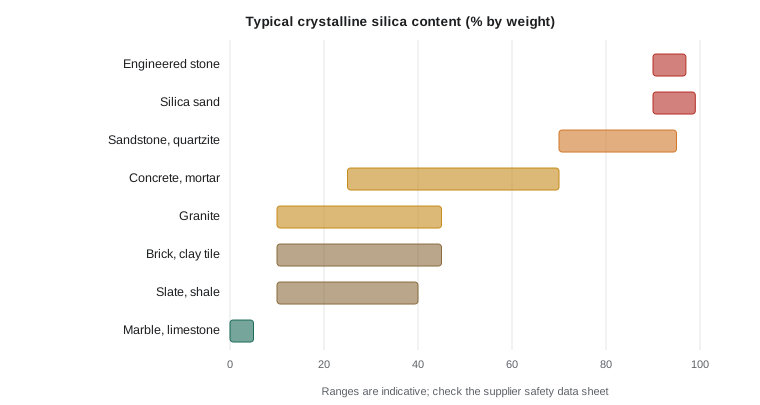
The amount of crystalline silica in a material strongly affects how much reaches the air when it is cut or ground. The ranges below are typical; individual products vary, and the safety data sheet or supplier should be checked.
| Material | Typical crystalline silica content |
|---|---|
| Engineered stone (quartz surfacing) | Often above 90 percent |
| Sandstone and quartzite | 70 to over 90 percent |
| Silica sand, including frac sand and some blasting sands | Over 90 percent |
| Concrete and mortar | Commonly 25 to 70 percent, depending on the aggregate |
| Granite | Commonly 10 to 45 percent |
| Brick and clay tile | Varies widely, often 10 to 45 percent |
| Slate and shale | Varies, often 10 to 40 percent |
| Marble and limestone | Usually low, often under 5 percent |
Particle size: why respirable dust matters
The lungs have defenses against dust. Large particles are trapped in the nose and throat. Smaller particles that reach the airways are caught in mucus and moved upward by tiny hair-like cilia, then swallowed or coughed out. Only the finest particles reach the alveoli, the small air sacs where oxygen passes into the blood. There, particles are attacked by immune cells called macrophages, and this is where silica does its damage.
Occupational hygienists divide airborne dust into fractions by where it deposits:
| Fraction | Approximate particle size | Where it deposits |
|---|---|---|
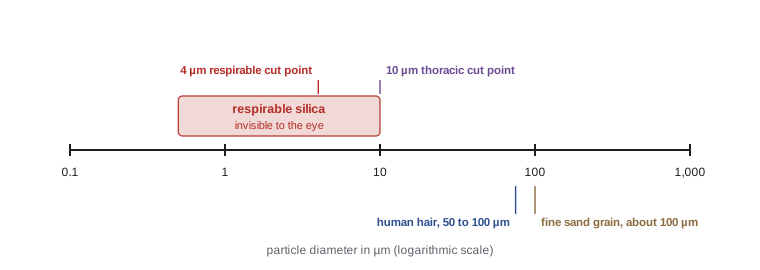
| Inhalable | Up to about 100 µm | Anywhere in the respiratory tract, including the nose and mouth |
| Thoracic | Up to about 25 µm, 50 percent cut point at 10 µm | Below the larynx, in the airways and lungs |
| Respirable | Up to about 10 µm, 50 percent cut point at 4 µm | The gas-exchange region of the lungs |
For comparison, a human hair is roughly 50 to 100 µm across and a fine grain of sand is around 100 µm. Respirable particles are invisible to the naked eye except as a haze when present in large numbers. Exposure limits for crystalline silica apply to the respirable fraction, and air samples are collected with a size-selective device that mimics the lung's filtering.
How long does fine dust stay in the air?
Fine particles settle very slowly. Their settling speed in still air follows Stokes' law, which says that settling velocity rises with the square of particle diameter. A particle ten times smaller settles a hundred times more slowly. That is why respirable dust from a cutting task can linger in an enclosed space for hours and drift to workers who are not doing the cutting.
In the formula, v is the settling velocity, ρ is the particle density (about 2,650 kg/m³ for quartz), g is gravitational acceleration, d is the particle diameter and μ is the viscosity of air (about 1.8 × 10⁻⁵ Pa·s at room temperature). The short script below estimates how long particles of different sizes take to fall 2 meters in still air.
rho = 2650        # density of quartz, kg/m^3
g = 9.81          # m/s^2
mu = 1.8e-5       # viscosity of air, Pa.s
height = 2.0      # m, roughly breathing height to floor

for d_um in (50, 20, 10, 4, 2, 1):
    d = d_um * 1e-6
    v = rho * g * d**2 / (18 * mu)          # Stokes settling velocity, m/s
    t = height / v                           # seconds to fall 2 m
    if t < 120:
        when = f"{t:6.0f} seconds"
    elif t < 7200:
        when = f"{t/60:6.1f} minutes"
    else:
        when = f"{t/3600:6.1f} hours"
print(f"{d_um:3d} um particle: settles at {v*1000:8.3f} mm/s, falls 2 m in {when}")50 um particle: settles at 200.590 mm/s, falls 2 m in 10 seconds 20 um particle: settles at 32.094 mm/s, falls 2 m in 62 seconds 10 um particle: settles at 8.024 mm/s, falls 2 m in 4.2 minutes 4 um particle: settles at 1.284 mm/s, falls 2 m in 26.0 minutes 2 um particle: settles at 0.321 mm/s, falls 2 m in 103.9 minutes 1 um particle: settles at 0.080 mm/s, falls 2 m in 6.9 hours
Real workplaces have air currents that keep fine particles suspended even longer and spread them around. The practical lessons are that dust must be captured at the source, that people nearby are exposed too and that dry sweeping or blowing with compressed air puts settled dust back into the air.
Where silica dust comes from at work
Any process that breaks, abrades or disturbs silica-containing material can generate respirable dust. Common sources include:
- Construction: cutting, grinding, drilling and chipping concrete, brick, block and stone; tuckpointing and mortar removal; jackhammering; concrete floor grinding and polishing; dry sweeping and demolition.
- Stone and countertop fabrication: cutting, edging, polishing and installing natural and engineered stone.
- Mining, quarrying and tunneling: drilling, blasting, crushing and conveying rock.
- Foundries: sand molding, shake-out, fettling and cleaning castings.
- Manufacturing: glass, ceramics, pottery, brick and tile making; cement and concrete products.
- Abrasive blasting: especially where silica sand is still used.
- Oil and gas: handling frac sand at well sites.
- Agriculture and landscaping: tilling dry soils and cutting pavers and stone.
What silica does inside the lungs
When respirable crystalline silica reaches the alveoli, macrophages engulf the particles. The sharp, chemically reactive surfaces of the silica damage and kill these cells, which release chemical signals that attract more immune cells and stimulate the growth of scar tissue. The silica is released again when the macrophage dies, and the cycle repeats. Over time, small nodules of scar tissue form and can merge into larger masses. Freshly fractured silica, produced by cutting and grinding, is especially reactive.
Silicosis
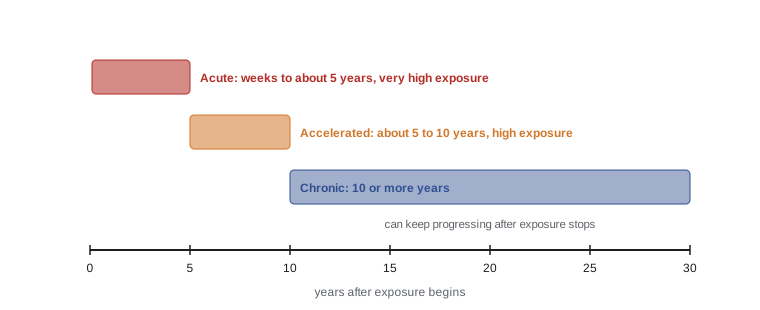
Silicosis is the scarring of the lungs caused by crystalline silica. It is incurable and often progresses even after exposure stops. There are three recognized forms, defined by how quickly they develop:
| Form | Typical latency | Exposure | Course |
|---|---|---|---|
| Chronic silicosis | 10 or more years | Lower, long-term exposure | Most common form; may be found on X-ray before symptoms; can progress to progressive massive fibrosis |
| Accelerated silicosis | 5 to 10 years | Higher exposure | Faster progression and greater disability; seen in engineered stone fabricators and sandblasters |
| Acute silicosis (silicoproteinosis) | Weeks to about 5 years | Very high exposure, such as sandblasting in confined spaces | Rapid breathlessness and often death; the alveoli fill with protein-rich fluid |
Early silicosis may cause no symptoms. As it advances, people develop shortness of breath on exertion, a persistent cough, fatigue and reduced exercise capacity. In advanced disease, breathlessness occurs at rest, and the strain on the heart can lead to right-sided heart failure. Some people with severe silicosis need a lung transplant, and many die of respiratory failure.
Other diseases linked to silica
Silicosis is not the only risk. Respirable crystalline silica is classified by the International Agency for Research on Cancer as a Group 1 carcinogen, meaning it is known to cause cancer in humans.
| Disease | Link to silica |
|---|---|
| Lung cancer | Silica is a known human carcinogen; risk rises with cumulative exposure and is higher in people with silicosis and in smokers |
| Chronic obstructive pulmonary disease (COPD) | Silica exposure causes chronic bronchitis and emphysema even without silicosis |
| Tuberculosis | Silicosis greatly increases the risk of tuberculosis because silica impairs the macrophages that fight the infection |
| Kidney disease | Silica exposure is associated with chronic kidney disease |
| Autoimmune diseases | Associated with rheumatoid arthritis, systemic sclerosis (scleroderma) and lupus |
Smoking and silica together are much worse than either alone for lung cancer and COPD. Workers exposed to silica who smoke should be offered help to quit, and health monitoring programs often include smoking cessation support.
Recognizing a silica task
A useful question for supervisors and workers is: does this task break, abrade or disturb a material that contains crystalline silica? If the answer is yes, assume respirable dust will be produced unless effective controls are in place. Lesson 4 explains how exposure is measured or estimated, and Lesson 5 covers controls.
Worked problem
Spotting the silica tasks on a renovation
A crew is renovating a 1950s commercial building. Tasks include removing drywall, chasing grooves in brick walls for new wiring, cutting a doorway in a concrete block wall, grinding a concrete floor smooth, and sweeping up at the end of each day. Which tasks are likely to produce respirable crystalline silica?
Show solution
- Drywall removal: gypsum drywall contains little or no crystalline silica, although some joint compounds contain small amounts. Low concern for silica, but check for asbestos in older joint compounds, as covered in HSE-246.
- Chasing grooves in brick: brick and mortar contain silica, and wall chasers produce large amounts of fine dust. High concern.
- Cutting the block wall: concrete block contains silica. High concern.
- Grinding the concrete floor: high concern; floor grinding is one of the dustiest construction tasks.
- Dry sweeping: re-suspends settled silica dust from the other tasks. Moderate to high concern; use wet methods or HEPA vacuums instead.
Answer: Four of the five tasks involve silica. Each needs a control plan before work starts, and the clean-up method must change from dry sweeping.
Common mistakes
MistakeTreating all silica as equally hazardous.
InsteadFocus on respirable crystalline silica, mainly quartz and cristobalite; amorphous silica is much less harmful unless heated.
MistakeAssuming dust that has settled is no longer a hazard.
InsteadSettled dust can be re-suspended by sweeping, compressed air or traffic; clean it up wet or with HEPA vacuums.
MistakeBelieving silicosis stops progressing once exposure ends.
InsteadSilicosis often continues to progress after exposure stops, which is why prevention is essential.
MistakeThinking only silicosis matters.
InsteadSilica also causes lung cancer, COPD and kidney disease, and increases the risk of tuberculosis and autoimmune disease.
MistakeAssuming natural granite and engineered stone carry the same risk.
InsteadEngineered stone often contains more than twice as much silica as granite and needs stricter controls.
Summary and key terms
- Crystalline silica, mainly quartz and cristobalite, is far more harmful than amorphous silica.
- Silica content varies widely, from over 90 percent in engineered stone and silica sand to under 5 percent in marble.
- Respirable particles, with a 50 percent cut point of 4 µm, reach the gas-exchange region of the lungs and are invisible.
- Fine particles settle very slowly, so dust must be captured at the source and never swept dry or blown with compressed air.
- Silica damages macrophages and causes scarring; silicosis has chronic, accelerated and acute forms and is incurable.
- Silica also causes lung cancer, COPD and kidney disease and raises the risk of tuberculosis and autoimmune disease.
- Any task that breaks, abrades or disturbs silica-containing material should be assumed to produce respirable dust until controlled.
- Quartz
- The most common form of crystalline silica, found in sand, rock, concrete and many building materials.
- Cristobalite
- A form of crystalline silica created at high temperatures, at least as toxic as quartz.
- Amorphous silica
- Non-crystalline silicon dioxide, much less harmful to the lungs.
- Respirable fraction
- The portion of airborne dust that reaches the gas-exchange region of the lungs, with a 50 percent cut point of 4 µm.
- Alveoli
- The tiny air sacs in the lungs where oxygen enters the blood.
- Macrophage
- An immune cell that engulfs foreign particles in the lungs.
- Silicosis
- Incurable scarring of the lungs caused by inhaling crystalline silica.
- Progressive massive fibrosis
- An advanced stage of silicosis in which scar nodules merge into large masses.
- Stokes' law
- A formula showing that the settling speed of a small particle rises with the square of its diameter.
- Group 1 carcinogen
- An IARC classification for agents known to cause cancer in humans, which includes crystalline silica.
Practice problems
Work each problem on paper first, then reveal the answer to check.
Why is cristobalite a concern in foundries and refractory work?
Show answer
It forms when silica is heated above about 1,000 °C and is at least as toxic as quartz.
What is the 50 percent cut point for respirable dust?
Show answer
4 µm.
A particle settles at 1 mm/s. How long does it take to fall 2 meters in still air?
Show answer
2,000 seconds, about 33 minutes.
If one particle is a third of the diameter of another, how does its settling speed compare?
Show answer
It settles about nine times more slowly, because speed depends on diameter squared.
Name the three forms of silicosis.
Show answer
Chronic, accelerated and acute.
Why does silicosis increase the risk of tuberculosis?
Show answer
Silica impairs the macrophages that normally fight the tuberculosis bacteria.
Why is freshly fractured silica especially hazardous?
Show answer
Its newly broken surfaces are more chemically reactive and more damaging to lung cells.
Give two non-lung diseases linked to silica.
Show answer
Chronic kidney disease and autoimmune diseases such as rheumatoid arthritis or scleroderma.
Why should dry sweeping be avoided on silica jobs?
Show answer
It re-suspends settled respirable dust into the breathing zone.
Which is more hazardous to fabricate, marble or engineered stone, and why?
Show answer
Engineered stone, because it often contains over 90 percent silica against under 5 percent in marble.
Lesson quiz · 5 questions
Score 60% or more to complete this lesson.
Create a free account to save your progress, take quizzes and earn a certificate.