
HSE-230 · Lesson 6 of 12 · 21 min
Line of fire, overhead work, ground disturbance and simultaneous operations
In December, Coldwater won a three-week contract to replace a section of distribution main along a residential street in Tulsa. It was the biggest job of Dani's season: a crew of six, an excavator, the hydrovac truck, a picker truck, traffic control and, for one week, a second contractor installing new fiber-optic cable on the same street. On the first morning, Owen Brady, the field superintendent, came out for the pre-task plan himself.
'There are four things that kill people on jobs like this,' Owen said, holding up four fingers. 'Being in the line of fire. Overhead lines. What's in the ground. And other people's work you didn't know about.' This lesson covers each of those four. They are not the only serious hazards on field jobs, but they show up on almost every one, and they are behind a large share of the serious injuries and fatalities in construction, utilities, and oil and gas.
The line of fire
The line of fire is the path that energy will take if it is released: the direction a load will fall, a hose will whip, a truck will roll, a fitting will fly or a pipe will spring. Being in the line of fire means having part of your body in that path. Many serious incidents are not caused by a hazard nobody saw. They happen because someone was standing in the wrong place when a known hazard released its energy.
Line of fire is one of the life-saving rules that many oil and gas and utility companies use. The International Association of Oil and Gas Producers includes it in its set of Life-Saving Rules, and Energy Safety Canada includes it in the life-saving rules it publishes for the Canadian energy industry. The basic idea is the same everywhere: keep yourself and others out of the line of fire, position yourself to avoid moving objects, vehicles, pressure releases and dropped objects, and set up and obey barriers and exclusion zones.
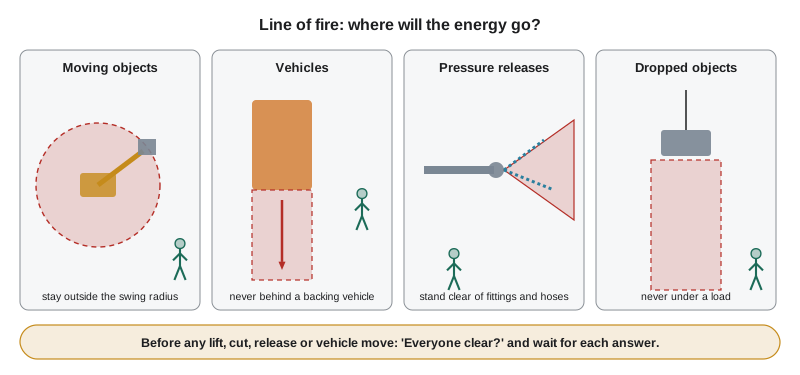
On the pre-task plan, line of fire is not one hazard; it is a question to ask at every step: if the energy in this step is released, where will it go, and is anyone there?
- Moving objects. Swinging booms and buckets, loads on a crane or picker, rolling pipe, a pipe section springing when a clamp is released. Stay out of the swing radius and away from the ends of pipe under tension.
- Vehicles. Backing trucks, equipment tracking along the trench, traffic on the road. Never stand between a vehicle and a fixed object, and never walk behind a vehicle that is backing.
- Pressure releases. Gas or air escaping from a fitting, a hose coming off its coupling, trapped pressure behind a valve. Do not stand in front of fittings, caps or plugs that are being loosened, and use whip checks on air hoses.
- Dropped objects. Tools and materials falling from above, a load dropping from rigging, spoil falling into the excavation. Secure tools at height, keep out from under loads, and keep spoil back from the edge.
The direct controls for line of fire are usually physical: barricades around the swing radius, exclusion zones with a single controlled entry point, blocked or cribbed loads, whip checks, tethered tools and keeping people out of an excavation while loads are moving overhead. Indirect controls such as spotters and rules about where to stand are useful too, but they depend on everyone paying attention all the time.
Positioning
Dani's crew has a simple habit for line of fire. Before any lift, cut, release or vehicle move, the person doing it says out loud, 'Everyone clear?' and waits for each person to answer from a position they have chosen. It takes five seconds. It forces everyone to think about where they are standing, and it gives the operator a chance to see if someone is out of sight.
Dropped objects at ground level
People often think of dropped objects as something that happens only on towers and pipe racks. On excavation jobs, the most common dropped objects are much closer to the ground: a shovel left on the edge of the excavation, a chunk of asphalt from the spoil pile, a fitting knocked off a pipe stand, or a tool that slides off the step of the truck. Anything left within 3 ft (about 1 m) of the edge can end up on the head or back of someone in the hole. Dani's rule is that the edge of an open excavation is kept clear, spoil is piled back from the edge, and tools are passed down by hand or lowered on a line, never dropped or thrown.
Overhead hazards
Overhead hazards include anything above the work area: power lines, tree limbs, pipe racks, structures, loads being lifted and the edges of anything stored high. Of these, overhead power lines are the deadliest. Contact between a boom, a dump box, a ladder or a long pipe and an energized line can kill the person touching the equipment and anyone nearby on the ground.
OSHA's general rules keep unqualified workers and the equipment they use at least 10 ft (3 m) away from overhead lines up to 50 kV, and farther for higher voltages. For cranes and derricks, the construction standard sets a minimum of 20 ft (6 m) for lines up to 350 kV, unless the voltage is confirmed and a table permits a smaller distance. Before any equipment that could come within those limits is used, the line owner must be contacted, and the work must follow the owner's instructions, which may include covering, de-energizing or relocating the line, or using a dedicated observer.
On the pre-task plan, an overhead line should be described with its location, its height if known, and which steps could bring equipment near it. The control should be specific: the boom limit, the physical barrier or goal posts on the travel route, the observer's name and the line owner's reference number if the line has been covered.
Owen also reminded the crew about two less obvious overhead hazards. Service drops, the lines from the pole to each house, hang lower than the main lines and are easy to forget. And dump trucks, picker booms and excavator arms are often raised to a height the operator cannot see from the cab. 'If it can go up,' Owen said, 'ask where the wire is.'
Ground disturbance and buried facilities
Any work that disturbs the ground can hit a buried facility: gas lines, water and sewer, electrical cables, telecommunications and fiber-optic cable, and pipelines. In Oklahoma, every excavation must start with a notice to OKIE811, the state's one-call center, which passes it to its member facility operators so they can mark their lines. Oklahoma law requires the notice at least 48 hours before digging, not counting the day of the call, weekends and legal holidays, and no more than 14 days before. The marks are good for a limited time, so long jobs need the ticket renewed. Not every buried facility owner is a member, so the crew must also look for private lines, such as a landowner's water line or a farm power cable.
Pipelines have extra rules. Transmission pipeline operators publish their own requirements for work near their lines, and many require their representative on site before any excavation within a set distance, often 25 to 50 ft (about 8 to 15 m) of the pipeline. Operators of gas distribution systems, like Southplains Gas, have similar rules for their own mains and services.
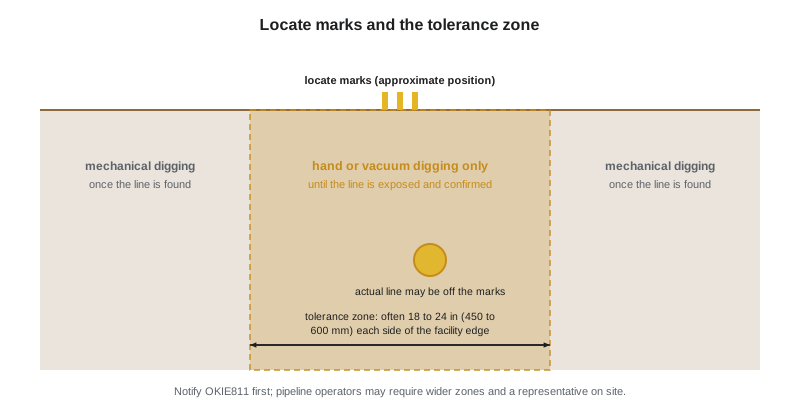
Locate marks show an approximate position, not an exact one. Lines can be deeper or shallower than expected, can bend between marks, and can be off the mark by a surprising amount. That is why state laws set a tolerance zone on each side of the marks, often 18 to 24 in (about 450 to 600 mm) from the edge of the facility depending on the state, and why many facility owners set a wider zone for high-pressure lines. Inside that zone, only hand digging or vacuum excavation may be used until the line is exposed and its exact position is confirmed.
On the pre-task plan, the ground disturbance section should record:
- The 811 ticket number and its valid dates.
- Every marked facility, by type and color, and whether it has been exposed.
- Any facilities found that were not marked, and what was done about them.
- The tolerance zone and the digging method inside it.
- The depth of the excavation and the protective system, such as sloping, benching or a trench box, required when the excavation is 5 ft (1.5 m) deep or more and workers will enter, unless it is in stable rock.
- Who the competent person is for the excavation, and when it was last inspected.
If the crew hits a line, or finds one that was not marked, they stop. For a gas line, the response is set out in the emergency box: shut down equipment, move everyone upwind to the muster point, keep ignition sources away, call 911 and the gas utility, and do not try to stop the leak or move the equipment. Dani's crews rehearse this at least once a season.
Simultaneous operations
Simultaneous operations, often shortened to SIMOPS, means two or more activities happening at the same time in the same area, where one could create a hazard for the other. On Owen's street job, the fiber-optic contractor would be boring under the road while Coldwater was replacing the gas main. Neither crew's pre-task plan alone would show the hazard that each created for the other: the boring head could hit the new main, and Coldwater's excavation could undermine the fiber crew's equipment.
Common SIMOPS on Coldwater's jobs include:
- Another contractor working on the same site or street.
- The client's operators working on the system at the same time, for example opening a valve, running a pig through a pipeline, venting gas or doing a pressure test.
- Two of Coldwater's own crews on the same site, such as welders and an excavation crew.
- Public activity: school drop-off, garbage trucks, residents moving cars.
- Emergency or maintenance work by other utilities.
SIMOPS hazards are controlled mainly by coordination: a joint meeting before the work starts, a shared site map that shows each crew's area and route, a single permit or authorization system run by the client or controlling contractor, an agreed communication method such as a shared radio channel, and clear rules about who has priority in shared spaces. On the pre-task plan, the SIMOPS section should name the other activities, the person coordinating them and how the crew will be told about changes.
Owen set up a ten-minute meeting with the fiber contractor's supervisor every morning of the overlap week. They compared plans, marked each crew's area on the drawing and agreed that the fiber crew would not bore within 10 ft (3 m) of Coldwater's excavation without Dani's sign-off. Both crews wrote the arrangement on their forms.
Worked problem
One step, four hazards
Show solution
- Step: excavator removes asphalt and digs a 6 ft (1.8 m) deep excavation to expose the old main, with the hydrovac first daylighting crossing lines.
- Line of fire: excavator swing radius over the sidewalk; workers on the ground near the bucket. Control: barricade with a single entry point; nobody inside the swing radius when the machine is working; operator stops and grounds the bucket when anyone needs to enter.
- Overhead: a service drop to a house crosses the excavation at 16 ft (about 5 m). Control: boom height limit set; spotter while digging under the line; the utility contacted about raising or covering it.
- Ground disturbance: locate marks for water, telecom, the old main and the new fiber conduit. Control: locate ticket checked and valid; hand expose within the zone at every crossing; protective system for the excavation chosen by the competent person.
- SIMOPS: fiber crew boring 50 ft (15 m) away. Control: morning coordination meeting; no boring within 10 ft (3 m) of the excavation without Dani's sign-off; shared radio channel.
Answer: Asking Owen's four questions for one step found four separate high-energy hazards, each with a specific control.
Common mistakes
MistakeWriting 'line of fire' as a single hazard for the whole job.
InsteadAsk at every step where released energy would go and who could be there.
MistakeForgetting service drops and raised dump boxes near overhead lines.
InsteadAsk 'if it can go up, where is the wire?' for every piece of equipment.
MistakeDigging with a machine right up to the locate marks.
InsteadHand or hydrovac expose inside the zone until the line is found and confirmed.
MistakeAssuming all buried lines are marked.
InsteadLook for private lines and unmarked facilities, and stop if one is found.
MistakePlanning only your own crew's work on a shared site.
InsteadFind out what else is happening and coordinate before starting.
Summary and key terms
- The line of fire is the path released energy will take; keep people out of it for moving objects, vehicles, pressure releases and dropped objects.
- Physical barriers and exclusion zones are stronger than rules about where to stand.
- Overhead power lines have minimum safe distances; contact the line owner before equipment could come within them.
- Excavation starts with an 811 notice to OKIE811; marks are approximate and must be hand or vacuum exposed inside the tolerance zone.
- Pipelines have extra rules, and excavations deep enough for entry need a protective system chosen by a competent person.
- Simultaneous operations are controlled by coordination: joint meetings, shared maps, a common permit system and agreed communication.
- Line of fire
- The path that released energy will take, such as the fall line of a load or the swing of a boom.
- Exclusion zone
- An area people may not enter while a hazard is active, usually marked by a barrier.
- Minimum approach distance
- The minimum distance people and equipment must keep from an energized power line.
- Tolerance zone
- The area on each side of a marked facility where only hand or vacuum digging is allowed until it is exposed.
- SIMOPS
- Simultaneous operations: two or more activities in the same area at the same time that could affect each other.
Practice problems
Work each problem on paper first, then reveal the answer to check.
Name the four main line-of-fire hazards.
Show answer
Moving objects, vehicles, pressure releases and dropped objects.
Why does Dani's crew say 'Everyone clear?' before a lift?
Show answer
It makes everyone think about where they are standing and gives the operator a chance to spot someone out of sight.
Why are locate marks not enough on their own?
Show answer
They show only an approximate position; the line may be deeper, shallower or off the mark.
What should the crew do if they find a buried line that was not marked?
Show answer
Stop, protect the line, and contact the owner or the supervisor before continuing.
Give two ways to control a SIMOPS hazard.
Show answer
Any two: joint planning meeting, shared site map, common permit system, agreed communication channel, rules about priority in shared areas.
Lesson quiz · 5 questions
Score 60% or more to complete this lesson.
Create a free account to save your progress, take quizzes and earn a certificate.