
HSE-230 · Lesson 1 of 12 · 23 min
What a pre-task plan is and why it matters
At 6:40 on a cold October morning, a crew from Coldwater Field Services Inc. pulled up to a natural gas valve site on the edge of Tulsa. The job looked simple: dig down to a buried service line, expose 10 ft (about 3 m) of pipe, cut out a corroded section and weld in a new one. Foreman Dani Whitehorse had done the same job dozens of times. Sam Oduya, a laborer in his second month with the company, had never done it at all.
Before anyone touched a shovel, Dani handed Sam a clipboard and a pen. 'Read the work order out loud,' she said. 'Then we walk the site, and then we fill this in together.' The form at the top of the clipboard said pre-task plan (PTP), which some companies call a field-level hazard assessment or a job hazard analysis. Sam had signed a dozen of them already, mostly by putting his name at the bottom where someone pointed. Today Dani wanted him to understand what the form was for.
The walk took eight minutes. In that time the crew found a second gas line that was not on the work order drawing, a gopher hole near where the hydrovac truck would park, a power line crossing the back corner of the lot, and frost on the ladder rungs. None of those hazards were unusual. All of them could have hurt someone if nobody had looked. That, Dani told Sam, is what a pre-task plan is for: to make the crew stop, look at the actual work in the actual place on the actual day, and decide together how to do it without anyone getting hurt.
This course is about doing that well. It is written for field workers and the foremen who run small crews in construction, utilities, oil and gas, and maintenance. You will follow Dani's crew through a season of real jobs in and around Tulsa, and you will learn how to fill in a pre-task plan that actually catches hazards, how to think about energy and the line of fire, how to choose controls that work, when to stop the job, and how to lead a pre-job talk that people listen to.
What a pre-task plan is
A pre-task plan, or PTP, is a short, written hazard assessment done by the people doing the work, at the work location, right before the work starts. Companies use many names for the same idea: pre-task plan, job hazard analysis (JHA), job safety analysis (JSA), field-level hazard assessment, tailboard or tailgate meeting form. In this course we use 'pre-task plan' for the version filled in on site each day, and 'job hazard analysis' for the longer, office-written study of a type of job.
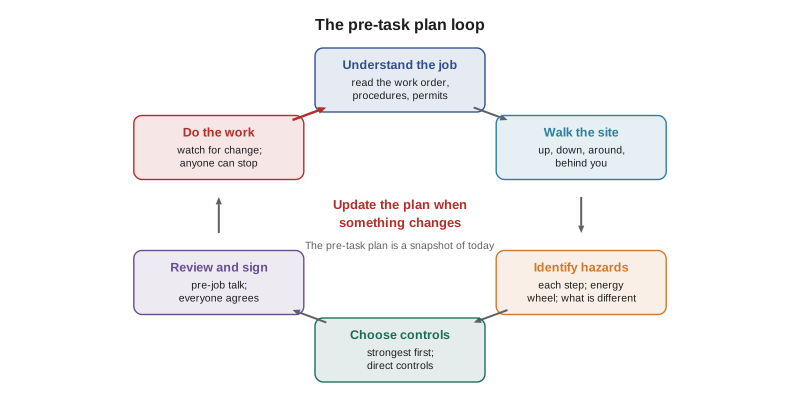
Whatever the name, the core is always the same. The crew lists the steps of the job, looks for the hazards in each step and in the surroundings, decides how each hazard will be controlled, and writes it down. Everyone who will do the work reviews it and signs it. If conditions change during the day, the crew stops and updates it.
A pre-task plan has three features that make it different from other safety paperwork:
- It is done by the people doing the work. The crew knows things that a manager in an office cannot know: that the ground is soft from last night's rain, that the new laborer has never used a cut-off saw, that a customer's dog is loose in the yard.
- It is done at the work location. Hazards are found by looking, not by remembering. A form filled in at the shop the night before misses whatever is different about today.
- It is done right before the work starts, and again when things change. It is a snapshot of today's conditions, not a permanent document.
How a pre-task plan fits with other hazard assessments
Most companies assess hazards at more than one level. It helps to know where a pre-task plan fits, because it is not meant to do everything on its own.
- Job hazard analysis (JHA). Done by the employer, usually by supervisors, safety staff and experienced workers, for each type of job. It is written ahead of time, looks at every step of a routine job, and sets out the standard controls and procedures. OSHA publishes a guide to doing a JHA. For Coldwater, there is a JHA for 'excavation and repair of a steel service line.'
- Safe work procedures. Written steps for specific tasks, such as hydrovac excavation, cold cutting a pipe or entering a valve vault. These come from the JHA.
- Site-specific safety plan. For a larger project, the controlling contractor or client often prepares a plan for the whole site, covering things like traffic, other contractors and emergency access.
- Pre-task plan. Done by the crew on the day, at the spot, for the task in front of them. It picks up what the earlier levels could not know: today's weather, today's ground, today's crew, today's surprises.
The levels support each other. A good pre-task plan does not try to rewrite the whole procedure. It points to the procedure, then asks: what is different here, today? If the crew finds that the procedure does not fit the job, that is a signal to stop and call the supervisor, not to improvise.
Why it matters
The best reason to take pre-task plans seriously is simple. Most people hurt at work are hurt doing ordinary tasks, on ordinary days, by hazards that someone could have seen. In field work, the hazards change from site to site and hour to hour. A trench that was stable at 8 a.m. may not be stable after a rain shower. A line that was locked out may be put back in service by someone who did not know the crew was there. A pump that was quiet may start without warning.
Research on hazard recognition in construction has found the same uncomfortable result again and again: even experienced workers, asked to list the hazards in a work scene, often miss a large share of them. In some studies crews missed close to half. People are not careless. Our brains simply get used to familiar hazards and stop noticing them. A structured walk and a written list are tools for fighting that habit.
Pre-task plans also matter because serious injuries and fatalities follow a different pattern from minor injuries. A crew can go years without a cut finger and still be one dropped load or one gas release away from a fatality. Safety researchers now focus on the high-energy hazards that cause serious injuries and fatalities, and on making sure each one has a control that works even when someone makes a mistake. Lesson 5 covers this idea in detail. A good pre-task plan is where a crew first asks those questions about each job.
What a good pre-task plan does for the crew
- It shares what each person knows. The operator knows where the truck's blind spots are. The welder knows how far sparks fly. The new laborer may notice something everyone else has stopped seeing.
- It makes the plan visible. When the plan is on paper, people can question it. 'Who is watching the excavator while we are in the hole?' is easier to ask when the answer is supposed to be written down.
- It gives everyone permission to speak up. Signing a pre-task plan means agreeing to the plan, and that includes agreeing that anyone can stop the job if the plan stops working.
- It prepares the crew for an emergency. The form names the muster point, the nearest hospital, who has the first aid kit, and how the crew will call for help.
- It creates a record. If something goes wrong, the form shows what the crew knew and planned. That record helps the company learn, not just assign blame.
What a pre-task plan is not
Dani had seen many bad pre-task plans over the years. Some were filled in at the shop before the crew even saw the site. Some were copied from yesterday's form with the date changed. Some listed 'slips, trips and falls' and 'pinch points' for every job, from welding to paperwork. Some were signed by people who arrived after the work started and never read them.
Those forms all look like hazard assessments, but they do nothing to protect people. Safety professionals call this 'pencil-whipping': filling in a form to satisfy a rule rather than to think about the work. Lesson 11 looks at why it happens and how supervisors can spot it. For now, it is enough to know what a pre-task plan is not:
- It is not a permit. Permits for hot work, confined space entry or ground disturbance give formal authority to do high-risk work under specific conditions. A pre-task plan works alongside permits but does not replace them.
- It is not a procedure. It does not tell you how to do the job step by step. It tells you what is different about today and how you will deal with it.
- It is not a shield against blame. A signed form does not make a job safe, and it does not move responsibility from the employer to the worker.
- It is not a one-time event. Once the job changes, the old form is out of date.
Worked problem
Sam's first real pre-task plan
Show solution
- Dani asked Sam to read the work order. It said: excavate and expose the steel service line at the Hillcrest valve site, cut out and replace 4 ft (1.2 m) of corroded pipe, wrap, backfill and restore. Sam read it out loud.
- The crew walked the site together. Rick Tanaka, the hydrovac operator, pointed out a soft spot and a gopher hole where he had planned to park. Grace Mbeki, the welder, noticed the power line over the back corner and dry grass along the fence. Sam spotted frost on the ladder.
- Back at the truck, the crew wrote the job steps on the form: set up and traffic control, locate and daylight, hydrovac excavation, shore or slope the excavation, purge and isolate the line, cut and weld, coat and wrap, backfill and restore.
- For each step they listed hazards and controls. The second gas line went next to the excavation step, with the control 'hand expose and mark before hydrovac work within 3 ft (1 m).' The soft spot moved the truck to firmer ground. The power line went next to the excavation step with 'no booms or long tools near the line; spotter when moving the truck.' The dry grass went next to welding with 'wet down and keep a charged fire extinguisher at the hole.'
- Everyone read the form, asked questions and signed it. Dani added the muster point, the nearest hospital and the emergency number, and named Rick as the spotter for truck moves.
Answer: The form now described the real job on the real site. Each control was something a person could do, check or point to.
The four questions
When Sam asked how to remember all of this, Dani gave him four questions that sit under every pre-task plan, whatever the form looks like:
- What are we doing? Name the job and break it into steps.
- What could hurt us? Look at each step and at the surroundings for the hazards, especially the ones that could kill or seriously injure someone.
- What will we do about it? Choose controls for each hazard, starting with the strongest available.
- What will make us stop? Agree on the changes or warning signs that mean the crew stops and re-assesses.
The fourth question is the one most often forgotten. A plan is only good until conditions change. If the crew agrees ahead of time that rain, a new person on site, a smell of gas or an unexpected line means 'stop and talk,' they are much more likely to actually stop when it happens.
Who does what
Everyone on the crew has a part in a pre-task plan:
- The foreman or crew lead runs the process, makes sure the walk happens, guides the discussion, checks that the controls are realistic, and makes sure everyone signs only after they understand. In most companies, the foreman also signs as the person responsible for the plan.
- Each worker takes part in the walk, names hazards they see, asks questions about anything they do not understand, and signs only when they agree.
- The supervisor or superintendent reviews pre-task plans regularly, visits crews, asks questions about the plan, and gives feedback. Supervisors also make sure crews have the time, equipment and help they need to follow the plan.
- Visitors and late arrivals must be briefed on the pre-task plan and sign it before they enter the work area.
On Dani's crew, the newest person reads the work order out loud and is asked first for hazards during the walk. It is a deliberate choice. New workers often see things that experienced workers have stopped noticing, and if they speak first, they are not just agreeing with what the foreman has already said.
How long it should take
A common complaint is that pre-task plans slow the job down. For a routine job on a familiar site, a good pre-task plan usually takes 10 to 20 minutes including the walk. For a complex job, it may take longer, and that time is well spent. Most of the time is in the walk and the discussion, not the writing. A crew that spends two minutes on the form and goes straight to work has not saved time; it has skipped the part that finds the hazards.
Dani tells new workers that the pre-task plan is the cheapest part of the job. Fifteen minutes spent at the start costs much less than a damaged gas line, a cave-in or a trip to the hospital. It also tends to save time later, because the crew has agreed on the plan, has the right equipment ready and is not stopping to argue in the middle of the job.
Common mistakes
MistakeFilling in the form at the shop before seeing the site.
InsteadWalk the actual work location first, then write the hazards you actually found.
MistakeCopying yesterday's form and changing the date.
InsteadStart fresh each day and look for what is different today.
MistakeListing only generic hazards such as 'slips, trips and falls' for every job.
InsteadName the specific hazard and where it is, such as 'frost on ladder rungs into the excavation.'
MistakeSigning the form without reading it because the foreman says it is fine.
InsteadRead it, ask about anything unclear, and sign only when you understand and agree.
MistakeTreating the form as finished once it is signed.
InsteadStop and update it whenever the job, the crew or the conditions change.
Summary and key terms
- A pre-task plan is a short written hazard assessment done by the crew, at the work location, right before the work starts, and updated when conditions change.
- It sits alongside the employer's formal hazard assessments, procedures and site plans, and adds what only the crew on site can see on the day.
- Good pre-task plans share what each crew member knows, make the plan visible, give everyone permission to speak up, prepare for emergencies and create a useful record.
- A pre-task plan is not a permit, a procedure, a shield against blame or a one-time event.
- Four questions sit under every pre-task plan: what are we doing, what could hurt us, what will we do about it, and what will make us stop.
- Filling in the form without walking the site, copying old forms and listing generic hazards are signs of pencil-whipping.
- Pre-task plan (PTP)
- A short, written hazard assessment done by the crew at the work location right before the work starts.
- Job hazard analysis (JHA)
- The employer's written, in-depth study of a type of job, prepared ahead of time.
- Hazard
- Anything that could cause harm to people, property or the environment.
- Control
- Something that removes a hazard or reduces the chance or severity of harm.
- Pencil-whipping
- Filling in a safety form to satisfy a rule without actually thinking about the work.
Practice problems
Work each problem on paper first, then reveal the answer to check.
Name the three features that make a pre-task plan different from other safety paperwork.
Show answer
It is done by the people doing the work, at the work location, right before the work starts and again when things change.
What are the four questions that sit under every pre-task plan?
Show answer
What are we doing? What could hurt us? What will we do about it? What will make us stop?
Why does Dani ask the newest worker to name hazards first?
Show answer
New workers often see hazards others have stopped noticing, and speaking first means they are not just agreeing with the foreman.
Give two things a pre-task plan is not.
Show answer
Any two: not a permit, not a procedure, not a shield against blame, not a one-time event.
What did the crew's walk find that was not on the work order?
Show answer
A second gas line, a soft spot and gopher hole where the truck would park, a power line over the back corner, dry grass and frost on the ladder.
Lesson quiz · 5 questions
Score 60% or more to complete this lesson.
Create a free account to save your progress, take quizzes and earn a certificate.