
HSE-230 · Lesson 9 of 12 · 21 min
Stop-work authority and changing conditions
In early April, Dani's crew was replacing a section of main in a back lane. The morning pre-task plan was thorough, the locates were fresh, and the excavation was shored with a trench box. By 1 p.m., the sky to the west had turned dark. A light rain started. Then the wind swung around from the south to the northwest and picked up. Sam, standing at the edge of the excavation, noticed that the muster point they had chosen that morning, by the truck on the east side, was now downwind of the open pipe. He also noticed that water was starting to run along the lane toward the excavation.
Sam had been with Coldwater for seven months. He looked at Rick in the excavator, at Grace preparing to weld, and at Dani on the phone with the client. Nobody else seemed to have noticed. He hesitated. Then he raised his arm, crossed it over his chest in the crew's stop signal, and called out: 'Can we stop a minute? The wind's changed.'
Everyone stopped. Dani hung up and walked over. Ten minutes later, the crew had a new muster point, a sandbag berm to keep water out of the excavation, a new note on the pre-task plan, and a decision to pause welding until the wind dropped. The rain passed within an hour. Nobody was hurt, and nothing dramatic happened. That is what a successful stop usually looks like.
What stop-work authority means
Stop-work authority, often shortened to SWA, means that every person on a work site has the authority, and the responsibility, to stop work when they believe it is unsafe or when conditions have changed so that the plan no longer fits. It does not matter who they are: a new laborer, a visitor, a client inspector, a truck driver delivering material. Most utility, pipeline and construction companies, including Coldwater and Southplains Gas, write stop-work authority into their safety programs, and many put it on the pre-task plan itself.
Stop-work authority has three parts that make it work:
- Anyone can stop. You do not need permission, a title or proof. A reasonable concern is enough.
- No punishment for stopping in good faith. Even if the concern turns out to be unfounded, the person who stopped is thanked, not blamed.
- The stop is resolved before work restarts. The concern is discussed, the hazard is fixed or explained, and the plan is updated if needed. Work restarts only when everyone involved agrees it is safe.
Stop-work authority is a company policy, but it rests on legal protections. Section 11(c) of the OSH Act protects workers from retaliation for raising safety concerns, and OSHA recognizes a narrow right to refuse work that poses an imminent danger of death or serious injury. A formal refusal has its own conditions, covered below. Stop-work authority is broader and faster: it lets anyone pause the job for any safety concern, even one that would not meet the legal test for a refusal.
How to stop the job
Stopping well is a skill. Done badly, a stop can create new hazards, such as someone shouting at an operator who then turns suddenly, or a crew abandoning a load in mid-air. Coldwater teaches a simple sequence.
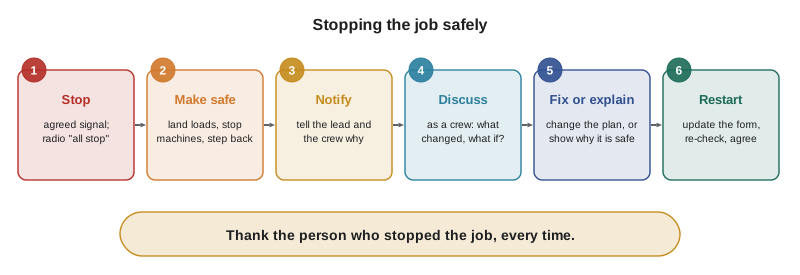
- Stop. Use the agreed signal. Many crews use a raised arm or crossed arms, and a radio call such as 'all stop.' Make sure operators can see or hear you before moving close.
- Make safe. Bring the work to a safe pause: land the load, stop the machine and ground the bucket, close the valve, step out of the line of fire. Do not leave things half-done in a dangerous state.
- Notify. Tell the foreman and the crew what you are concerned about, in plain words.
- Discuss. Talk it through as a crew. Is the concern real? What has changed? What could happen?
- Fix or explain. Change the plan, add or repair a control, or, if the concern turns out to be unfounded, explain why the job is safe so the person understands.
- Restart. Update the pre-task plan, re-check the critical controls, make sure everyone agrees and knows what changed, and then restart.
The last step that is not on the chart may be the most important: thank the person who stopped the job. Dani always says 'good catch' out loud, in front of the crew, whatever the outcome. 'If I make people feel stupid for stopping,' she says, 'the next person won't stop, and that might be the time it really matters.'
Why people don't stop
Almost every investigation of a serious incident finds that someone on the site felt uneasy before it happened, and did not say anything. That is not because people do not care. Several pressures make stopping hard, especially for new workers:
- Production pressure. The job is behind, the client is waiting, the crew wants to finish before the weekend.
- Hierarchy. The person with the concern is junior, and the person doing the work is senior or a supervisor.
- Fear of being wrong. 'What if I stop the job and there's nothing wrong?'
- Assuming someone else will. 'Rick must have seen it; he's been doing this for twenty years.'
- Normalization. 'We always do it this way and nothing has happened.'
- Not knowing how. The person is unsure of the signal, the words or who to tell.
The pre-task plan helps with each of these. It names stop-work authority at the start of the day. It sets out, in the fourth of Dani's four questions, what will make the crew stop. And during the pre-job talk, the foreman can say directly: 'If anyone sees something that worries them, stop us. I would rather stop ten times for nothing than miss once.' A foreman who says that, and then thanks people who stop, builds a crew that stops when it matters.
What supervisors must do
Owen, the superintendent, is clear with his foremen about their part. When someone stops the job, the supervisor's response decides whether the next person will stop. Supervisors must respond calmly, listen first, take the concern seriously even when they think it is wrong, fix what needs fixing, and never criticize, joke about or punish someone for a good-faith stop. They should also report stops as positive events, so the company can learn from them. At Coldwater, every stop-work event is logged, and the foremen with the most stops on their crews are recognized, not questioned.
Refusing imminently dangerous work
Sometimes a concern cannot be resolved on the spot. OSHA's rules protect a worker who refuses to do a task when all of these conditions are met: the worker has, where possible, asked the employer to eliminate the danger and the employer failed to do so; the refusal is in good faith; a reasonable person would agree there is a real danger of death or serious injury; and there is not enough time, because of the urgency, to get the hazard corrected through an OSHA inspection. A worker in that situation should stay at the site unless told to leave, tell the supervisor clearly that they will not do the task until the hazard is fixed, and ask for other work. A worker who believes they have been punished for a refusal or for raising a concern can file a retaliation complaint with OSHA, generally within 30 days.
Formal refusals are rare on crews that use stop-work authority well, because most concerns are dealt with long before they reach that point. But every worker should know the formal right exists, and every foreman should know how to respond if it is used.
Changing conditions
Sam's stop in the back lane was about a change in conditions. Lesson 4 introduced the idea that change is behind many serious incidents. The pre-task plan is a snapshot of conditions when it was written, and when those conditions change, the plan may no longer fit. The crew needs to notice the change, stop, and re-assess.
Common changes that should trigger a stop and re-assessment:
- Weather. Wind shifts or strengthens, rain or snow starts, lightning is seen or thunder is heard, temperature rises or falls sharply, visibility drops.
- Ground. Water enters an excavation, walls show cracks or sloughing, the ground near the edge softens, spoil slides.
- People. Someone new arrives, someone leaves, someone is unwell or tired, a crew member is replaced.
- Equipment. A different machine or tool is brought in, equipment breaks down, a control such as a barricade or a detector is moved or stops working.
- Scope or method. The job changes, a step is added, the sequence changes, a different method is needed because the planned one does not work.
- Unexpected findings. An unmarked line, contaminated soil, a strange smell, an old foundation, a pipe in worse condition than expected.
- Other activity. A new crew or contractor starts nearby, the client begins an operation, traffic patterns change.
- An incident or near miss. Anything that goes wrong, even without injury, is a sign that the plan missed something.
- Alarms. A gas detector alarms, a backup alarm fails, a pressure gauge reads something unexpected.
Lightning deserves a special note because it is so often underestimated. A common rule in outdoor work is that if you can hear thunder, you are close enough to be struck. When thunder is heard, crews should stop work, get off equipment and out of excavations, and shelter in vehicles or buildings, waiting until about 30 minutes have passed without thunder before returning.
How to re-assess
Re-assessing does not mean starting the whole pre-task plan again. It means focusing on what changed. Dani's crew uses the re-assessment log on the back of the form:
| Time | What changed | New or changed hazards | Controls | Initials |
|---|---|---|---|---|
| 13:05 | Wind swung to the northwest, rain starting | Muster point now downwind; gas could drift to the truck; water entering the excavation | New muster point at the lane entrance, upwind; sandbag berm at the edge; pause welding until wind drops | DW, SO, RT, GM |
| 13:40 | Rain stopped; wind easing | Wet walls; slippery ladder | Competent person re-inspects excavation; sand on ladder rungs | DW, SO, RT, GM |
| 14:10 | Client operator arrives to open valve upstream | Pressure change in the section | Confirm the valve is outside our isolation; operator signs onto the form | DW, client |
Each entry records the time, the change, the hazard it created, the control and the initials of everyone affected. If a change affects a critical control, such as an isolation or the protective system in an excavation, the critical control is re-verified before work restarts. If a change is big enough that the original plan no longer makes sense, the crew starts a new form.
Worked problem
A stop that changed the job
Show solution
- Later in April, Rick was hydrovac digging to expose a crossing line when the nozzle exposed an old, rusted steel pipe that was not on any locate.
- He stopped the hydrovac, lifted the wand clear and called 'all stop' on the radio. Everyone stepped back from the excavation.
- Dani came over. The pipe was not marked, its contents were unknown, and it could be an abandoned line, a live private gas line or an old oil line.
- The crew discussed it. They could not tell what it was, and the planned method assumed only the marked lines were present. They agreed the job could not continue as planned.
- Dani called Owen and Southplains Gas. The utility sent a locator, who found that it was an abandoned line but could not confirm it was empty. The crew was told to work around it with hand tools, keep the detector at the excavation, and not cut or move it.
- The crew updated the form with the new hazard and controls, everyone initialed, and work restarted an hour later.
Answer: The stop took an hour. Cutting an unknown line with a power saw could have taken someone's life.
Common mistakes
MistakeWaiting for a supervisor to notice a problem instead of stopping the job yourself.
InsteadUse your stop-work authority; anyone can stop for a reasonable concern.
MistakeStopping by shouting at an operator from inside the line of fire.
InsteadUse the agreed signal from a safe position, then make safe before discussing.
MistakeRestarting as soon as the concern seems to go away.
InsteadFix or explain, update the form, re-check critical controls and agree as a crew before restarting.
MistakeTreating weather changes as background rather than hazards.
InsteadStop and re-assess when wind, rain, lightning or temperature change.
MistakeMaking a joke about someone's stop that turned out to be unnecessary.
InsteadThank every good-faith stop so people keep stopping.
Summary and key terms
- Stop-work authority lets anyone on site stop the job for a reasonable safety concern, without punishment, with the concern resolved before restarting.
- Stop well: stop, make safe, notify, discuss, fix or explain, restart; and thank the person who stopped.
- Production pressure, hierarchy, fear of being wrong and normalization keep people from stopping; foremen counter them by inviting and thanking stops.
- OSHA protects refusals of imminently dangerous work under narrow conditions, and section 11(c) protects workers from retaliation.
- Changes in weather, ground, people, equipment, scope, findings, nearby activity, incidents and alarms should trigger a stop and re-assessment.
- Re-assess by recording the time, change, hazards, controls and initials, re-verifying critical controls, and starting a new form if the plan no longer fits.
- Stop-work authority (SWA)
- The authority and responsibility of every person on site to stop work they believe is unsafe.
- Make safe
- Bringing work to a safe pause before discussing a concern, such as landing a load or stopping a machine.
- Normalization
- Coming to accept an unsafe practice as normal because nothing bad has happened yet.
- Re-assessment
- Updating the hazard assessment when conditions change, focusing on what changed.
- Good-faith stop
- A stop made because of an honest safety concern, whether or not the concern proves correct.
Practice problems
Work each problem on paper first, then reveal the answer to check.
List the six steps of stopping the job safely.
Show answer
Stop, make safe, notify, discuss, fix or explain, restart.
Why does Dani always say 'good catch' when someone stops the job?
Show answer
So that people keep stopping; if they feel stupid, the next person may not stop when it really matters.
Name four kinds of change that should trigger a re-assessment.
Show answer
Any four: weather, ground, people, equipment, scope or method, unexpected findings, other activity, incidents or near misses, alarms.
What should crews do when they hear thunder?
Show answer
Stop work, get off equipment and out of excavations, and shelter in vehicles or buildings, waiting about 30 minutes after the last thunder.
When should the crew start a new form instead of adding to the re-assessment log?
Show answer
When the change is big enough that the original plan no longer makes sense.
Lesson quiz · 5 questions
Score 60% or more to complete this lesson.
Create a free account to save your progress, take quizzes and earn a certificate.