
HSE-230 · Lesson 3 of 12 · 22 min
Walking through the pre-task plan form
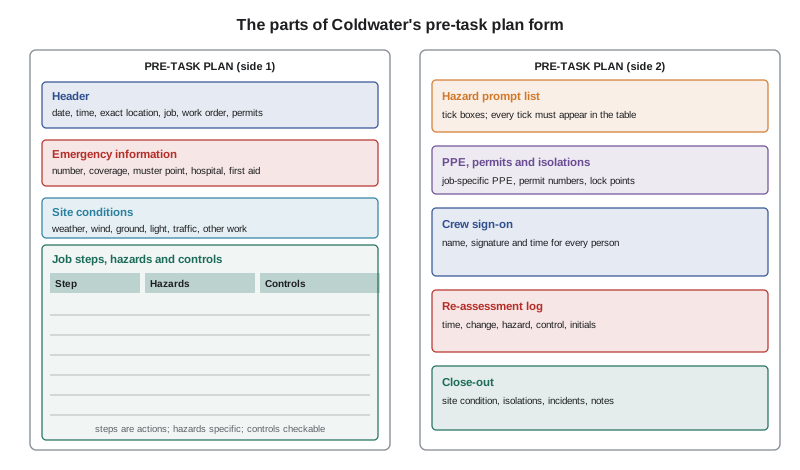
Every company's pre-task plan form looks a little different. Some are a single printed card that fits in a shirt pocket. Some are three pages long. More and more are on a tablet or phone, with drop-down lists and photo uploads. Coldwater Field Services Inc. uses a two-sided paper form for most jobs, with an app version for crews who work on Southplains Gas's larger projects. The layout changes, but the parts are almost always the same.
On a slow Monday, with rain keeping the crew in the shop, Dani sat down with Sam and a blank form and went through it box by box. 'Nobody ever explains the form,' she said. 'They hand it to you and point to where you sign. Then they wonder why people fill it in badly.' This lesson follows that conversation.
The header
The header seems like the boring part, but it does important work. It ties the form to one job, in one place, at one time, with one crew. A form without a clear header could belong to any job, which means it does not really belong to any.
- Date and start time. Write the actual time the pre-task plan was done, not the time the shift started. If the crew moves to a second site, that site needs its own plan with its own time.
- Location. Be precise enough that an ambulance could find you. Coldwater uses the street address, the client's site name and a GPS position. On rural pipeline and lease sites, crews also write the lease name, the county road and the gate number, because that is how many rural sites are found.
- Job description. One or two lines in plain words: 'Expose and replace 4 ft (1.2 m) of corroded steel service line at Hillcrest valve site.' Include the work order number.
- Company and client. On shared sites, also name the controlling contractor.
- Permit and procedure numbers. List any permits that cover the job, such as an 811 ticket number, a hot work permit or a confined space entry permit, and the safe work procedures that apply.
Sam asked why the location had to be so exact when the crew knew where they were. Dani told him about a crew she had worked with years earlier. One of them had a heart attack at a remote valve site. The person who called for help knew the site's company name but not the road, and the ambulance spent twenty minutes looking for the gate. 'Now we write it so a stranger could find us,' she said.
Emergency information
The emergency box is completed before work starts, not after something goes wrong. It answers the questions that people struggle with in a panic:
- Emergency number and how to call it. Is there cell coverage at this site? If not, where is the nearest spot with coverage, or who has the satellite device?
- Site address for emergency services. Copied from the header in a form a 911 operator can use.
- Muster point. A specific, upwind spot that everyone can reach. For gas work, Dani always picks a muster point upwind and away from the excavation, and changes it if the wind changes.
- Nearest hospital or emergency department and the travel time.
- First aid. Who is the trained first aider on this crew, and where are the first aid kit, the eyewash and the fire extinguisher?
- Specific emergencies for this job. For example, what the crew will do if they smell gas, hit a line, or if someone is injured in the excavation.
Dani's rule is that every person on the crew should be able to answer three questions without looking at the form: where do we muster, who calls for help, and what do we do if we hit the line. During the pre-job talk she asks those questions, often to the newest person.
Site conditions
This box records the things that change from day to day and can turn an ordinary job into a dangerous one:
- Weather. Temperature, wind direction and strength, rain, snow, lightning risk, heat or cold. Wind direction matters for gas work, welding fumes and dust. Temperature matters for cold stress, heat stress and frozen ground.
- Ground conditions. Wet, frozen, soft, uneven, sloped. Ground affects excavation walls, where trucks can park and whether people will slip.
- Lighting. Daylight hours, shade, darkness in vaults or under equipment.
- Traffic and public. Roads, driveways, pedestrians, school zones, livestock.
- Other work nearby. Other crews, other contractors, the client's operators, equipment moving on site.
These conditions are also the main reasons the form will need updating later. If the crew writes 'wind from the west, light' in the morning, they have a baseline. When the wind swings to the east in the afternoon, someone should notice that the muster point and the welding screen may now be in the wrong place.
Steps, hazards and controls
The middle of the form is the heart of the pre-task plan. It is usually a table with three columns: job steps, hazards for each step, and controls for each hazard. Some forms add a fourth column for a risk rating, which Lesson 7 covers, or for the person responsible for each control.
| Job step | Hazards | Controls |
|---|---|---|
| Set up site and traffic control | Traffic on lane; backing truck; uneven ground | Cones and signs per traffic plan; spotter for all backing; walk the parking area first |
| Locate and daylight lines | Second gas line not on drawing; power cable near fence | Locates checked against marks; hand expose within 3 ft (1 m) of marks; mark exposed lines with flags |
| Hydrovac excavation | High-pressure water wand; boom swing; soft ground | Trained operator only; exclusion zone 10 ft (3 m) around boom; truck on firm ground |
| Enter excavation | Cave-in; ladder frost; spoil falling in | Slope or shore per competent person; sand on ladder rungs; spoil 3 ft (1 m) back |
| Cut and weld | Gas release; fire in dry grass; fumes | Line isolated and purged per procedure; gas test before cutting; wet grass, extinguisher at hole |
Dani taught Sam three rules for this part of the form.
Rule 1: Steps are actions, not equipment
Write each step as something the crew does: 'lift pipe into excavation with the picker truck,' not 'picker truck.' When the step is written as an action, it is easier to see who is doing it, where they are standing and what could go wrong. Most jobs break into five to ten steps. If you have more than fifteen, you may be listing tiny details. If you have only two, you are probably skipping steps.
Rule 2: Hazards are specific
A hazard should say what the hazard is and where it is. 'Overhead power line' is a start; 'overhead power line 26 ft (8 m) up, crossing the northwest corner of the lot, over where the truck parks' is a hazard the crew can actually control. Generic words like 'pinch points' or 'slips, trips and falls' are not wrong, but on their own they do not tell anyone what to watch for.
Rule 3: Controls are actions someone will take
A control is something a person will do, use or check. 'Be careful' and 'stay alert' are not controls. 'Spotter watches boom when within 20 ft (6 m) of the line' is a control. So is 'gas detector on at the edge of the excavation, alarm at 10 percent of the lower explosive limit.' Lesson 8 covers how to choose strong controls. For now, the test is simple: could someone walk up to the site and see whether the control is in place?
The hazard prompt list
Most forms include a list of common hazards with tick boxes, such as overhead lines, buried lines, mobile equipment, working at height, confined spaces, hazardous energy, hot work, chemicals, noise, weather, wildlife and working alone. The list is a memory aid. It reminds the crew of hazards they may have forgotten to think about.
Prompt lists have a risk, though. When people are rushed, they tick boxes instead of thinking. A crew can tick 'overhead lines' without ever writing down where the line is or what they will do about it. Dani's rule is that every ticked box must show up somewhere in the steps, hazards and controls table. If it is ticked but not in the table, the form is not finished.
PPE, permits and isolations
This section lists the personal protective equipment needed for the job and any special equipment, such as gas detectors, fall arrest gear or a fire extinguisher. It also lists permits and isolations: which valves are closed and locked, which electrical sources are locked out, who holds the permit and its number. Lesson 12 looks at how pre-task plans and permits work together.
The PPE list should not be a copy of the company's standard list. Standard PPE, such as hard hat, safety boots, safety glasses, high-visibility clothing and flame-resistant clothing for gas work, is usually printed on the form. The pre-task plan adds what this job needs beyond that: hearing protection for the hydrovac, a face shield for grinding, a respirator for coating removal, cold-weather gear for a winter job.
Crew sign-on
Each person who will work in the area writes their name, signs, and writes the time they signed. Signing means three things:
- I took part in, or was briefed on, this hazard assessment.
- I understand the hazards and the controls.
- I agree to follow the plan and to stop the work if it stops working.
Anyone who arrives later, such as a client inspector, a delivery driver who will be in the work area, or a crew member who joins after lunch, must be briefed and sign before they enter the work area. The time column shows that they signed after arriving, not in the morning before they were there.
Sam asked what he should do if he did not agree with something on the form. 'Then you don't sign yet,' Dani said. 'You say what's bothering you. Either we fix the plan, or you explain it to me and I learn something. Either way, we talk about it before anyone signs.'
The re-assessment log
Many forms have a small table on the back for changes during the day: the time, what changed, the new hazard, the new control and the initials of the crew. This section is often blank on forms that come back to the office, even on jobs that clearly changed. Lesson 9 covers when and how to re-assess. For now, know that a blank re-assessment log on a long, complex job is often a sign that nobody stopped to update the plan.
Job completion
At the end of the job, the crew fills in a short close-out: Is the site left in a safe condition? Are all isolations removed or handed over? Were there any incidents, injuries or near misses? Are there hazards that the next crew needs to know about? The foreman signs off, and the form goes back to the office.
The close-out is also a chance to learn. Dani often adds a line at the bottom: 'What surprised us today?' Over a season, those lines tell the company where its formal hazard assessments and procedures need updating.
Worked problem
Reviewing Sam's first solo draft
Show solution
- A month later, Dani let Sam draft the form for a simple job: replacing a meter set at a farm property. She would review it before the crew signed.
- Sam's header was complete, with the address, GPS position and work order. His emergency box named the muster point as 'by the truck.' Dani asked which truck, and where it would be parked relative to the meter. They changed it to 'at the gate, 130 ft (40 m) west of the meter, upwind.'
- His steps were good, but one hazard just said 'dog.' Dani asked what kind, where, and what they would do. The owner's dog was friendly but loose; the control became 'ask owner to keep dog inside while crew is working.'
- He had ticked 'working alone' but nothing in the table mentioned it. Dani asked why. Sam explained that he would be checking the regulator station alone for 20 minutes. They added a check-in by radio every 10 minutes.
- He listed the control for the gas release as 'be careful.' Dani asked him what he would actually do. Sam rewrote it as 'close and lock the service valve, bleed down at the meter, test with the gas detector before opening the fitting.'
Answer: The draft was good enough to start from, and the review turned vague items into specific hazards and controls the crew could check.
Common mistakes
MistakeWriting the location as just the client's site name.
InsteadWrite it so a stranger or an ambulance crew could find you.
MistakeTicking hazards on the prompt list without listing them in the table.
InsteadMake sure every ticked hazard has a specific entry with controls.
MistakeWriting 'be careful' or 'stay alert' as a control.
InsteadWrite a control that someone will do, use or check.
MistakeSigning in the morning for a job you will not join until the afternoon.
InsteadSign when you arrive, after being briefed, and write the actual time.
MistakeLeaving the close-out blank.
InsteadRecord the site condition, isolations, incidents and anything the next crew needs to know.
Summary and key terms
- Most forms have the same parts: header, emergency information, site conditions, steps-hazards-controls table, prompt list, PPE and permits, crew sign-on, re-assessment log and close-out.
- The header ties the form to one job, place, time and crew; the location should be exact enough for an ambulance to find.
- The emergency box is filled in before work starts so every person knows where to muster, who calls and what to do if the line is hit.
- Steps should be actions, hazards should be specific, and controls should be actions someone will take and that anyone could check.
- Prompt lists are memory aids; every ticked item must appear in the table.
- Signing means you took part, understand and agree to follow the plan and stop work if it stops working; late arrivals sign when they arrive.
- Job step
- One action in the sequence of a job, such as lifting the pipe into the excavation.
- Hazard prompt list
- A list of common hazards with tick boxes, used as a memory aid.
- Muster point
- The agreed place where everyone gathers in an emergency.
- Re-assessment log
- The part of the form where changes during the job and new controls are recorded.
- Close-out
- The end-of-job section that records site condition, isolations, incidents and handover notes.
Practice problems
Work each problem on paper first, then reveal the answer to check.
Rewrite this control so it can be checked: 'be careful of the excavator.'
Show answer
For example: 'Nobody within the swing radius while the excavator is working; operator stops when anyone approaches; spotter in radio contact.'
Why should the time of signing be written next to each name?
Show answer
It shows when each person was briefed, and that late arrivals signed after they arrived.
What is wrong with a muster point written as 'by the truck'?
Show answer
It is not specific: which truck, where it is parked, and whether it is upwind and away from the hazard.
Name three things the emergency box should answer.
Show answer
Any three: emergency number and coverage, site address for responders, muster point, nearest hospital and travel time, first aider and kit locations, specific emergencies for the job.
What does a blank re-assessment log on a long, complex job suggest?
Show answer
That nobody stopped to update the plan when the job changed.
Lesson quiz · 5 questions
Score 60% or more to complete this lesson.
Create a free account to save your progress, take quizzes and earn a certificate.