
HSE-230 · Lesson 7 of 12 · 20 min
Rating risk and the limits of the risk matrix
By January, Sam was writing good pre-task plans. His steps were clear, his hazards were specific, and he went around the energy wheel without being reminded. Then Southplains Gas changed its form. The new version had a column for rating each hazard on a five-by-five risk matrix, before and after controls. Sam stared at it. 'How am I supposed to know if a cave-in is a 3 or a 4?' he asked.
It was a fair question, and the honest answer is that nobody knows exactly. Risk matrices are useful tools, but they are also easy to misuse. This lesson explains how a risk matrix works, how to use one well on a pre-task plan, and where its limits are, so that you can use it to start conversations rather than to end them.
Risk is likelihood and severity
In safety, risk combines two things: how likely it is that a hazard will cause harm, and how bad the harm could be. A hazard that is very likely to cause a minor cut is a different kind of problem from a hazard that is unlikely to happen but would kill someone if it did. Both need attention, but in different ways.
A risk matrix puts those two things on a grid. Most matrices use five levels for each:
| Level | Likelihood | Severity |
|---|---|---|
| 1 | Rare: could happen, but almost never does | Minor: first aid only |
| 2 | Unlikely: has happened in the industry | Moderate: medical treatment, no lost time |
| 3 | Possible: has happened in the company | Serious: lost-time injury |
| 4 | Likely: has happened to this crew or on similar jobs | Major: permanent injury or disability |
| 5 | Almost certain: expected to happen on this job without controls | Death: one or more people killed |
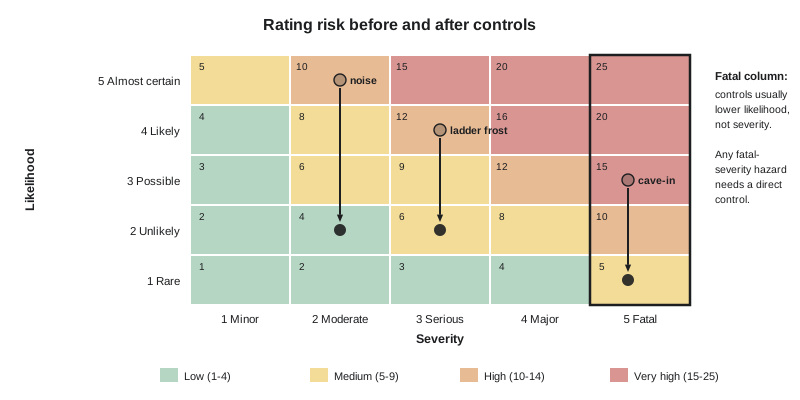
The risk score is usually likelihood multiplied by severity, giving a number from 1 to 25. The score is placed in a band, often shown with colors: low (green), medium (yellow), high (orange) and very high (red). Each band has a required response. For example, Southplains Gas's form says that very high risk must not proceed, high risk needs supervisor approval and additional controls, medium risk needs controls and monitoring, and low risk can proceed with normal controls.
Rating before and after controls
Most forms ask for two ratings. The first, often called the initial or inherent risk, is the risk if the hazard were left uncontrolled. The second, the residual risk, is the risk with the planned controls in place. The gap between them shows how much work the controls are doing.
There is an important pattern in that gap. Most controls reduce likelihood, not severity. A trench box makes a cave-in much less likely to injure anyone, but if the box failed or someone was outside it when the wall collapsed, the result could still be fatal. So the severity stays at 5, and the likelihood drops from, say, 3 to 1. Only a few controls reduce severity, such as reducing the depth of the excavation, lowering the pressure in a line, or replacing a heavy component with a lighter one.
That is why many companies add a rule to the matrix: any hazard with a severity of 5, meaning it could kill, needs a direct control, whatever its likelihood. A low residual score is not enough on its own. The question for a fatal-severity hazard is not 'is the score green?' but 'what is the control that works even if someone makes a mistake?'
Dani showed Sam a short program that scores hazards from a recent job before and after controls, and flags any fatal-severity hazard without a direct control.
# Score hazards before and after controls on a 5 x 5 risk matrix,
# with a rule that any hazard that could kill needs a direct control.

def band(score):
    if score >= 15: return "very high"
    if score >= 10: return "high"
    if score >= 5:  return "medium"
    return "low"

# (hazard, likelihood before, severity, likelihood after, direct control in place?)
hazards = [
    ("Cave-in, excavation 6 ft deep",        3, 5, 1, True),
    ("Backing hydrovac truck near crew",      3, 5, 2, False),
    ("Frost on ladder rungs",                 4, 3, 2, False),
    ("Hand cut from pipe edge",               4, 2, 2, False),
    ("Gas release when cutting the line",     2, 5, 1, True),
    ("Noise from hydrovac",                   5, 2, 2, False),
]

print(f"{'Hazard':38} {'before':>12} {'after':>12}  note")
for name, lb, sev, la, direct in hazards:
    before, after = lb * sev, la * sev
    note = ""
    if sev == 5 and not direct:
        note = "STOP: could kill and has no direct control"
print(f"{name:38} {before:>3} {band(before):>8} {after:>3} {band(after):>8} {note}")Hazard before after note Cave-in, excavation 6 ft deep 15 very high 5 medium Backing hydrovac truck near crew 15 very high 10 high STOP: could kill and has no direct control Frost on ladder rungs 12 high 6 medium Hand cut from pipe edge 8 medium 4 low Gas release when cutting the line 10 high 5 medium Noise from hydrovac 10 high 4 low
The program flagged the backing truck. Its residual score was 10, in the high band, and its only controls were a spotter and a backup alarm. Those are indirect controls. The crew discussed it and changed the plan: the hydrovac truck would be positioned before anyone entered the area, with a barricade between the truck and the work zone, and any later move would happen only after everyone was out of the zone and accounted for. That is a direct control, and the residual score dropped to 5.
How to rate well
Rating risk is a judgment, and different people will often give the same hazard different scores. A few habits make the ratings more consistent and more useful.
- Rate as a crew, not alone. When three people rate a hazard and disagree, the discussion about why is often more valuable than the number.
- Use the descriptions, not your gut. Read the likelihood and severity definitions on the form. 'Has this happened to our crew or on similar jobs?' is easier to answer honestly than 'is this likely?'
- Rate the realistic worst case for severity. Ask what could reasonably happen, not what usually happens. A dropped wrench usually misses; the realistic worst case is a head injury.
- Rate the hazard, not the person. Do not lower a likelihood because 'Rick is careful.' Careful people still have bad days.
- Be honest about residual risk. If the controls are weak, the residual score should stay high. The point is not a green form; it is an accurate picture.
The limits of the matrix
Leila, who had used risk matrices for twenty years, was blunt with Sam. 'The matrix is a conversation tool,' she said. 'It is not a calculator, and it can fool you.' She gave him five reasons to be careful.
1. The numbers are not real measurements
A likelihood of 3 is not three times a likelihood of 1. The levels are labels in order, not quantities. Multiplying them gives a number that looks precise but is not. A score of 10 is not twice as dangerous as a score of 5. The score is useful for sorting hazards into bands, but you should not do arithmetic with it, such as adding up scores for a whole job.
2. Rare, deadly events get scored down
Serious injuries and fatalities are rare for any single crew on any single day. That is exactly why they are hard to rate. A crew that has never seen a cave-in may honestly rate the likelihood as 1 or 2. But across thousands of excavations, cave-ins do happen, and when they do, people die. A matrix that lets a fatal-severity hazard score green because it is 'rare' can lull people into accepting weak controls. That is why the direct control rule matters.
3. Different people, different scores
Studies of risk ratings have found that people given the same scenario often give quite different scores. Experience, recent events, mood and pressure all affect the number. Two crews doing the same job on the same day can produce very different forms. That does not make the ratings useless, but it means a score should never be the only reason to proceed.
4. Scores can be bent
When a high score means extra paperwork, a supervisor's approval or a delay, there is pressure to score lower. A crew in a hurry can talk itself down from a 4 to a 3 on likelihood without changing anything about the job. Leila's advice is to watch for residual scores that are always low and always the same. A form where every hazard is rated 'low' after controls usually means the matrix is being filled in, not used.
5. The matrix does not show combinations
A matrix rates hazards one at a time. Real incidents often involve combinations: a soft spot in the ground plus a heavy truck plus a crew member behind it. Each might score medium on its own, but together they create a high-energy pinning hazard. The energy wheel and the line-of-fire questions are better at catching combinations than the matrix is.
Using the matrix wisely
None of this means the matrix should be thrown away. Used well, it helps crews do three useful things:
- Sort hazards so the most serious ones get the most attention in the discussion and the controls.
- Show the effect of controls and reveal when a control is not doing much.
- Trigger the right response, such as calling the supervisor or stopping, when a hazard falls in a high band.
Dani's crew uses it this way. They rate each hazard together. They mark every severity-5 hazard with a star and write its direct control next to it. If the residual score stays high or very high, they call Owen before starting. And they never argue about whether something is a 3 or a 4 for more than a minute; if they cannot agree, they take the higher score and move on.
Worked problem
Rating three hazards together
Show solution
- Hazard A: frost on the ladder rungs into a 6 ft (1.8 m) excavation. Before controls, the crew agreed on likelihood 4 (it has happened to people on this crew) and severity 3 (a fall could cause a lost-time injury), for a score of 12, high.
- Controls for A: knock the frost off and sand the rungs, maintain three-point contact, and hand tools down on a line. After controls, likelihood 2, severity 3, score 6, medium. Residual medium is acceptable with monitoring.
- Hazard B: cave-in. Before controls, likelihood 3, severity 5, score 15, very high. Controls: trench box placed before entry, inspected by the competent person, spoil 3 ft (1 m) back. After controls, likelihood 1, severity 5, score 5, medium, with a direct control in place.
- Hazard C: wasp nest in a nearby fence post. Sam rated severity 1. Grace pointed out that she is allergic. The crew changed severity to 4 for her and agreed on a control: remove the nest before starting, and Grace keeps her auto-injector on her belt.
- The ratings started a useful discussion each time. The matrix did not decide anything on its own.
Answer: Rating as a crew turned up an allergy the matrix alone would have missed, and confirmed that the fatal-severity hazard had a direct control.
Common mistakes
MistakeLowering a severity because a control is in place.
InsteadRemember that most controls reduce likelihood; severity usually stays the same.
MistakeAccepting a fatal-severity hazard because its residual score is green.
InsteadRequire a direct control for any hazard that could kill.
MistakeAdding up scores to get a 'job risk score.'
InsteadUse scores to sort hazards into bands, not for arithmetic.
MistakeRating every residual risk as low.
InsteadBe honest; a high residual score is a signal to improve the controls or call the supervisor.
MistakeRating alone and rushing through the column.
InsteadRate as a crew and use the discussion to find what the matrix misses.
Summary and key terms
- Risk combines likelihood and severity; a 5 by 5 matrix multiplies them and places the score in a band with a required response.
- Rate risk before and after controls; most controls reduce likelihood, not severity.
- Any hazard that could kill needs a direct control whatever its residual score.
- Rate as a crew, use the written definitions, rate the realistic worst case, and be honest about residual risk.
- The matrix has limits: its numbers are labels, rare deadly events get scored down, people disagree, scores can be bent, and it misses combinations.
- Use the matrix to sort hazards, show what controls do and trigger the right response, not to end the conversation.
- Risk
- The combination of how likely a hazard is to cause harm and how serious the harm could be.
- Risk matrix
- A grid that combines likelihood and severity levels to place a hazard in a risk band.
- Initial risk
- The risk of a hazard before any controls are applied.
- Residual risk
- The risk that remains after the planned controls are in place.
- Risk band
- A range of scores, such as low, medium, high or very high, with a required response.
Practice problems
Work each problem on paper first, then reveal the answer to check.
A hazard has likelihood 2 and severity 5. What is its score and band on the matrix in this lesson?
Show answer
10, high.
Why does a trench box usually reduce likelihood but not severity?
Show answer
It makes a cave-in much less likely to hurt anyone, but if it fails or someone is outside it, the result could still be fatal.
Give two reasons the matrix can mislead.
Show answer
Any two: the numbers are labels, not measurements; rare deadly events get scored down; people give different scores; scores can be bent under pressure; it rates hazards one at a time and misses combinations.
In the program, why was the backing truck flagged?
Show answer
Its severity was 5 and its only controls were indirect, so it had no direct control.
What should the crew do if they cannot agree whether a likelihood is 3 or 4?
Show answer
Take the higher score and move on.
Lesson quiz · 5 questions
Score 60% or more to complete this lesson.
Create a free account to save your progress, take quizzes and earn a certificate.