
HSE-230 · Lesson 4 of 12 · 21 min
Breaking the job into steps and scanning the work area
In late October, Coldwater sent Dani's crew to a small above-ground valve station on a gravel road east of Tulsa. The job was a coating repair: remove flaking paint from 20 ft (about 6 m) of exposed pipe and two valve bodies, clean the steel, and apply a new coating system. It was not an excavation, there was no welding, and the line would stay in service. Sam thought it sounded like the easiest job of the season.
Dani asked him to break it into steps before they left the yard. He wrote three: prep, paint, clean up. Dani laughed, not unkindly. 'That's a job with three steps the way a hockey game has three periods,' she said. 'True, but it doesn't tell you where you'll get hit.' They sat down and broke it down properly. Then, on site, they scanned the area before finalizing the pre-task plan. This lesson teaches both skills.
Why steps matter
Hazards live in the steps. A coating repair has different hazards when you are unloading the compressor, when you are blasting or grinding, when you are mixing the coating and when you are cleaning brushes with solvent. If the pre-task plan treats the whole job as one block, it tends to list only the most obvious hazards and miss the ones that show up in the transitions: the moment someone climbs onto the valve to reach the top, or the moment a full drum of waste is lifted into the truck.
Breaking a job into steps also makes it easier to share the work of finding hazards. Each crew member can look at the steps they will do and think through what could go wrong. The operator thinks about moving and parking the truck. The person blasting thinks about pressure, dust and noise. The person mixing thinks about chemicals and fire.
How to break a job into steps
A good set of steps follows the job from arrival to departure. Dani's checklist for building it:
- Start with arrival and set-up. Driving onto the site, parking, unloading, setting up barriers and signs. Many incidents happen before the main work even starts.
- Follow the order of the work. Write each step as an action with a verb: 'lift,' 'cut,' 'open,' 'climb,' 'mix,' 'test.' If two people do different things at the same time, write both.
- Include the in-between steps. Moving equipment from one spot to another, changing tools, refueling, breaks, handovers.
- Include the non-routine steps you might need. Clearing a blocked nozzle, fixing a stuck valve, dealing with a leak. These are where people take shortcuts.
- End with clean-up, demobilization and leaving the site. Loading waste, removing isolations, restoring the site and driving out.
- Aim for five to fifteen steps. Fewer usually means steps are being skipped; more usually means the crew is listing tiny details instead of meaningful actions.
For the coating repair, Sam and Dani ended up with eleven steps:
| # | Step | Who |
|---|---|---|
| 1 | Drive in, park the truck and compressor trailer on firm gravel, set up signs on the road | Dani, Rick |
| 2 | Check in with the client operator; confirm which valves must not be touched | Dani |
| 3 | Inspect the station; check gas detector readings around the valves | Dani, Sam |
| 4 | Unload and set up the compressor, hoses and abrasive blasting equipment | Rick, Sam |
| 5 | Set up containment tarps and a barrier around the blast area | Sam |
| 6 | Remove loose coating by power tool and abrasive blasting | Rick |
| 7 | Climb onto the valve supports to reach the top of the valve bodies | Rick |
| 8 | Mix the two-part coating; apply by brush and roller | Sam, Dani |
| 9 | Clean tools with solvent; handle waste abrasive and coating | Sam |
| 10 | Pack up equipment and load waste drums into the truck | Rick, Sam |
| 11 | Final check with the operator; remove signs; drive out | Dani |
Already, the hazards were easier to see. Step 7 was a working-at-height step that the three-step version had hidden completely. Step 10 involved lifting drums weighing 200 lb (about 90 kg). Step 2 was where the crew would learn whether any valves at the station were automated and might move on their own.
Scanning the work area
A list of steps tells you what you will do. A scan of the work area tells you where you will do it, and what is already there. Both are needed. A crew can have a perfect list of steps and still miss the overhead line, the wasp nest in the valve housing or the fact that the client's operator is about to start a pressure test next door.
Dani teaches a scan she calls 'up, down, all around, and behind you.' It is simple enough to remember on a cold morning and thorough enough to catch most hazards.
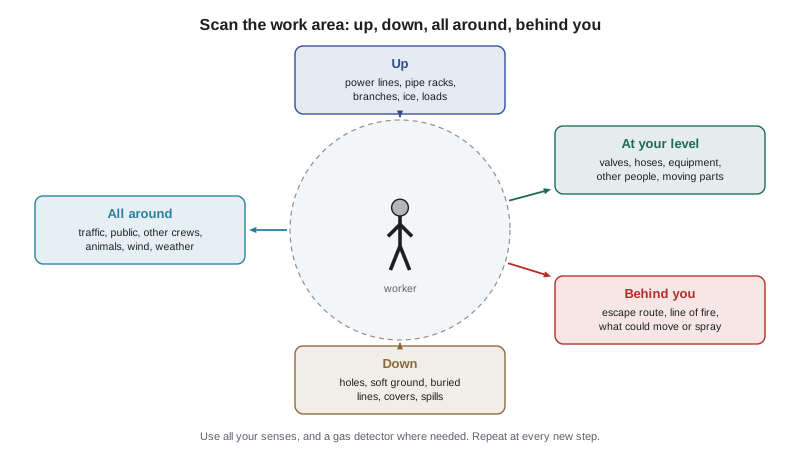
- Up. Look above the work area and above any route a truck or boom will travel. Power lines, pipe racks, tree branches, overhead valves, anything stacked or stored above head height, anything that could fall. In winter, look for ice or snow that could slide off a roof or structure.
- Down. Look at the ground and below it. Holes, soft spots, slopes, frozen patches, gopher and badger holes, buried lines and the locate marks for them, drains, valve boxes and covers that could give way. On gravel sites, look for spills and stains that could mean a leak.
- All around. Turn a full circle. Look at the station, the equipment, other people, the road, the neighbors, livestock or wildlife, and the weather coming in. Note where the wind is coming from. Note anything that is running, under pressure or could start on its own.
- Behind you. Think about your escape route and the line of fire. If something moves, sprays, falls or rolls, where will it go, and is anyone standing there? Where will you go if the gas detector alarms?
On the coating job, the scan turned up several things the steps alone did not: a wasp nest under the lid of a valve actuator, a gravel shoulder too soft for the compressor trailer, an automated valve that the client used for remote shut-in, a buried cathodic protection cable running from a test post along the line of the containment tarps, and a cattle fence with a gate the crew would need to keep closed.
Use all your senses
Scanning is mostly looking, but not only looking. Listen for hissing, running engines, alarms and the sound of other equipment. Smell for gas, solvent, smoke or hydrogen sulfide, though never rely on smell for gas or hydrogen sulfide, which can deaden the sense of smell at high levels; use the gas detector. Feel for vibration in the ground, heat from equipment and the strength of the wind. A good scan uses all of them, and the gas detector extends what your senses can do.
Look at the site from other people's positions
Each crew member sees the site from where they will stand. The truck operator sees it from the cab, with blind spots behind and to the right. The person blasting sees it from inside a hood with limited vision and hearing. A member of the public sees it from the road, maybe not noticing a hose across the shoulder. Dani asks each crew member, during the walk, to stand where they will work and describe what they can and cannot see.
What's different today?
The single most useful question during a scan is: what is different today? Most serious incidents involve some kind of change: a new person, a new tool, a different location, a change in the weather, a change in the schedule, a job that runs late. When something is different, the routine plan may not fit anymore.
Dani's crew asks about five kinds of change during every scan:
- People. Is anyone new to the crew, the task or the site? Is anyone tired, unwell or distracted? Is there a visitor?
- Equipment. Is anything new, borrowed, repaired or different from usual? Is any equipment showing signs of wear?
- Place. Is the site layout different from the drawing? Have other crews, the client or the public changed anything since the last visit?
- Conditions. Weather, light, ground, temperature, traffic.
- Plan. Has the scope, the sequence or the schedule changed? Is there pressure to finish fast?
The human side of scanning
Even a good scan can miss hazards, because people are people. A few states of mind make hazards much harder to see. Safety trainers often describe four of them: rushing, frustration, fatigue and complacency. Each one narrows attention. Someone who is rushing looks only at the task, not the surroundings. Someone frustrated by a stuck bolt stops thinking about where the wrench will go when it slips. Someone tired misses small details. Someone who has done the job a hundred times sees what they expect to see, not what is there.
The pre-task plan cannot fix these states, but it can name them. Dani asks during every pre-job talk: 'Is anyone rushed, tired or not feeling right today?' and she answers first. On days when the crew is behind schedule, she says so out loud and makes it a hazard on the form, with a control: 'If we fall behind, we call Owen and move the finish, we don't skip steps.'
Worked problem
Finding the hazards the steps missed
Show solution
- On the coating job, Sam had listed step 5 as 'set up containment tarps and barrier.' Hazards he had written: tripping on tarps, wind lifting tarps.
- During the scan, Sam stood where the tarp would go and looked down. He found an orange-capped test post and a shallow trench line in the gravel. Dani explained that it was a cathodic protection test lead, part of the system that protects the pipe from corrosion.
- That changed the step. Stakes for the barrier could damage the cable. The crew changed the control to weights on the barrier legs instead of stakes, and no ground penetration within 3 ft (1 m) of the test post or the cable route.
- Looking up from the same spot, Rick noticed the wasp nest under the actuator lid, right where he would be climbing in step 7. They added it to the hazards for step 7, with the control 'spray and remove the nest before climbing; Rick is not allergic but keeps the first aid kit at the trailer; Sam carries his own auto-injector.'
- Turning around, Dani noticed the wind was from the north, toward the road. Blast dust would drift over the shoulder. They moved the containment so the open side faced south and added a sign telling drivers to slow down.
Answer: The scan turned two generic tarp hazards into four specific hazards with controls, and caught a buried cable, a wasp nest and a dust problem that the steps alone missed.
Making the scan a habit
The scan is not just for the morning. Dani teaches her crew to do a quick version whenever they move to a new spot, start a new step, or come back from a break. It takes less than a minute: stop, look up, look down, look around, look behind. Many companies call this a 'last-minute risk assessment' or a 'take five.' Whatever the name, the habit is the point.
When Sam asked how he would know he had found everything, Dani was honest. 'You won't,' she said. 'Nobody does. That's why we all walk it, and that's why we keep looking all day. The form is our best guess at 7 a.m. The job is what actually happens.'
Common mistakes
MistakeWriting a job as two or three broad steps such as 'prep, paint, clean up.'
InsteadBreak it into five to fifteen actions from arrival to departure, including in-between steps.
MistakeLeaving out arrival, set-up and demobilization.
InsteadInclude driving in, parking, unloading, loading and leaving, where many incidents happen.
MistakeScanning only at eye level.
InsteadLook up, down, all around and behind you, and use your other senses and the gas detector.
MistakeAssuming today is the same as last time.
InsteadAsk what is different about people, equipment, place, conditions and plan.
MistakeIgnoring rushing, fatigue or frustration because they are not 'real' hazards.
InsteadName them on the form and agree on what the crew will do about them.
Summary and key terms
- Hazards live in the steps, so break each job into five to fifteen actions from arrival to departure, including in-between and non-routine steps.
- Scan the work area up, down, all around and behind you, using all your senses and a gas detector where needed.
- Look at the site from each person's position, including the truck operator, the person in PPE and the public.
- Ask what is different today about people, equipment, place, conditions and plan, because change is behind many serious incidents.
- Rushing, frustration, fatigue and complacency narrow attention; name them and plan for them.
- Repeat a quick scan whenever you move, start a new step or come back from a break.
- Job step breakdown
- A list of the actions in a job, in order, from arrival to departure.
- Work area scan
- A deliberate look above, below, around and behind the work area to find hazards.
- Cathodic protection
- A system that uses a small electric current to protect buried steel pipe from corrosion.
- Complacency
- Overconfidence from familiarity that makes people stop noticing hazards.
- Last-minute risk assessment
- A quick personal scan done right before starting a step or after a change.
Practice problems
Work each problem on paper first, then reveal the answer to check.
Break 'unload a pallet of pipe with the picker truck' into at least four steps.
Show answer
For example: position truck and set outriggers on firm ground; check the load and rigging; lift and swing the pallet; land and secure it; stow the boom and remove outriggers.
What does the scan 'up, down, all around and behind you' look for behind you?
Show answer
Your escape route and the line of fire of anything that could move, spray, fall or roll.
Name the five kinds of change Dani's crew asks about.
Show answer
People, equipment, place, conditions and plan.
Why should you not rely on smell to detect hydrogen sulfide?
Show answer
Because at high levels it can deaden the sense of smell; use a gas detector.
What two hazards did the coating job's three-step version hide?
Show answer
Any two: climbing onto the valve supports (working at height), lifting heavy waste drums, the automated valve, the buried cathodic protection cable.
Lesson quiz · 5 questions
Score 60% or more to complete this lesson.
Create a free account to save your progress, take quizzes and earn a certificate.