
HSE-224 · Lesson 6 of 12 · 30 min
Energized electrical work permits
When energized work is justified, it must be authorized in writing. The energized electrical work permit is the document that captures the justification, the risk assessments, the controls and the approvals, and puts them in front of the people doing the work. This lesson walks through the contents of a permit, the tasks that are exempt from needing one, the approval process and the common ways permits fail in practice.
When a permit is required
NFPA 70E 130.2(B) requires an energized electrical work permit whenever work is performed within the restricted approach boundary, or when the employee interacts with equipment where conductors or circuit parts are not exposed but an increased likelihood of injury from an exposure to an arc flash hazard exists. OSHA does not prescribe a permit form, but 1910.333(a)(1) requires the employer to be able to demonstrate why energized work is necessary, and a documented permit is the practical way to do that. Citations for energized work without a demonstrated justification are common after incidents.
In plain terms: if a qualified worker is going to put hands, tools or probes inside the restricted approach boundary of exposed energized parts, or do a task likely to initiate an arc flash, a permit is needed unless the task falls within one of the specific exemptions described below.
What the permit contains
NFPA 70E 130.2(B)(2) lists the minimum contents of the permit, and Annex J provides an example form. The employer may add items but should not remove any. The minimum contents are:
- A description of the circuit and equipment to be worked on and their location.
- A description of the work to be performed.
- Justification for why the work must be performed in an energized condition.
- A description of the safe work practices to be employed.
- Results of the shock risk assessment: the voltage to which personnel will be exposed, the limited and restricted approach boundaries, and the PPE and other safety equipment needed.
- Results of the arc flash risk assessment: the available incident energy at the working distance or the arc flash PPE category, the PPE needed and the arc flash boundary.
- The means employed to restrict the access of unqualified persons to the work area.
- Evidence of completion of a job briefing, including a discussion of any job-specific hazards.
- Energized work approval signatures from the authorizing or responsible management, safety officer or owner.
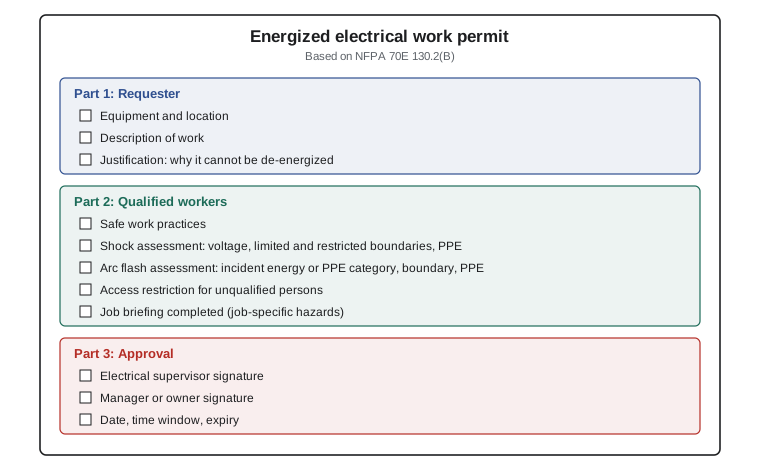
A useful way to think about the permit is as three conversations. In the first, the person requesting the work explains why it must be done energized. In the second, the qualified workers who will do the task assess the hazards and plan the controls. In the third, management with real authority reads both and either approves or refuses. Each conversation is a chance to stop.
Worked problem
Writing a justification that will survive scrutiny
A hospital facilities team asks for a breaker to be added to an energized emergency branch panel serving critical care areas. Draft the justification section and decide whether it is adequate.
Show solution
- State the facts: the panel serves life support receptacles in the intensive care unit; there is no alternate feed; de-energizing would interrupt equipment keeping patients alive.
- Check alternatives: can patients be moved, can a temporary supply be connected through a transfer switch, can the work be done during a planned generator test with clinical staff prepared? If any of these is feasible, the justification fails.
- If no alternative is reasonable, record why each was rejected. This is a greater-hazard justification.
- Note that the same hospital adding a breaker to a non-critical lighting panel would have no valid justification.
Answer: A justification is adequate only if it shows that de-energizing creates a greater hazard or is infeasible and that reasonable alternatives were considered and rejected. Convenience never qualifies.
Tasks that do not need a permit
NFPA 70E 130.2(B)(3) allows certain tasks to be performed without an energized work permit, provided that a qualified person uses appropriate safe work practices and PPE. The exemptions are:
- Testing, troubleshooting and voltage measuring.
- Thermography, ultrasound and visual inspections, if the restricted approach boundary is not crossed.
- Access to and egress from an area with energized electrical equipment, if no electrical work is performed and the restricted approach boundary is not crossed.
- General housekeeping and miscellaneous non-electrical tasks, if the restricted approach boundary is not crossed.
The exemptions remove the paperwork, not the hazard. A shock and arc flash risk assessment is still required, PPE is still required, approach boundaries still apply and a job briefing is still needed. Many incidents occur during troubleshooting, precisely the exempt category, which is why some employers require a permit or a simplified task authorization even for exempt work above a certain incident energy.
| Task | Permit required? | Notes |
|---|---|---|
| Measuring voltage at MCC bucket terminals | No (exempt) | Risk assessment, PPE and job briefing still required |
| Infrared scan of a switchboard through open doors, from outside the restricted boundary | No (exempt) | Arc flash PPE needed inside the arc flash boundary |
| Replacing a breaker in an energized panel | Yes | Only if justified at all; usually de-energize |
| Tightening a hot lug found by thermography | Yes | Almost never justified; schedule an outage |
| Cleaning the floor of an electrical room with doors closed | No | Not inside the restricted boundary; normal operating condition |
| Removing bolted covers on energized switchgear | Depends on the employer's procedure | Likely to cause an arc flash; many employers require a permit |
| Landing a new conductor on an energized terminal | Yes | Requires strong justification; usually not acceptable |
Worked problem
Exempt or not?
An electrician is troubleshooting a 600 V (or 480 V) conveyor drive. Taking voltage readings shows a loose control wire on a terminal. The electrician wants to tighten the screw while the drive is energized to see if the fault clears. Is a permit required?
Show solution
- Taking voltage readings is testing and troubleshooting, so it is exempt from the permit requirement, though not from PPE and risk assessment.
- Tightening the terminal is a repair, not a test. It is no longer within the exemption.
- It also involves manipulating a conductor inside the restricted approach boundary with a tool.
- Unless there is a valid justification to do the repair energized, which there rarely is for a loose terminal, the drive must be de-energized and locked out first.
Answer: Yes. Once the work moves from diagnosis to repair, the exemption no longer applies. The correct course is to de-energize, tighten the terminal and then re-test.
Approvals and authority
The approval signatures are the most important line on the permit. The person who signs must have the authority to refuse, must understand what they are approving and must not be the same person who would benefit from the work being done live. Common good practices include the following:
- Two levels of approval: the electrical supervisor or a designated electrical safety authority for the technical content, and a facility or operations manager for the justification.
- An expiry: the permit covers a defined task, time window and crew. If the task changes, the crew changes or the shift changes, it must be reviewed or reissued.
- A field verification: before work starts, the crew walks down the permit against the actual equipment and conditions. Any mismatch stops the job.
- Retention: completed permits are kept and reviewed periodically, as a source of information on how often energized work is happening and why.
Worked problem
Reviewing permit records
An electrical safety committee reviews six months of permits and finds 42 energized work permits, 30 of them for adding breakers or circuits to occupied office panels during business hours, with the justification "tenant cannot lose power". What should the committee conclude?
Show solution
- The justification is inconvenience, not a greater hazard or infeasibility.
- 30 of 42 permits, about 71 %, were therefore probably not justified.
- The pattern points to a systemic problem: outages are not being planned, and approvers are signing permits they should refuse.
- Corrective actions: retrain approvers, set up a process for scheduling short outages after hours, and require the facility manager to sign any justification based on tenant needs.
Answer: Most of these permits should have been refused. Permit records are a powerful audit tool for showing whether the de-energize-first policy is really working.
The job briefing
Every permit requires evidence of a job briefing, and so does every task, exempt or not. A good briefing covers the hazards associated with the job, the work procedures involved, special precautions, energy source controls, PPE requirements and the information on the energized work permit. It identifies who will do what, who will act as the attendant or safety watch, how to raise the alarm and where the nearest means of disconnect is. The briefing is repeated if the work or conditions change significantly during the job.
OSHA 1910.269 requires a second person trained in first aid and CPR at many utility energized tasks, and many employers apply a similar rule to energized work under 70E. Even where it is not required, a trained safety watch with the authority to stop the job and the means to de-energize and summon help is good practice for any energized work.
How permits fail
A permit can be signed and filed and still fail to protect anyone. The common failure modes are:
- The justification is copied from a previous permit and never questioned.
- The arc flash information is taken from an out-of-date label, or from the wrong equipment.
- The task grows: the permit was for measurement, but the crew also replaces a component.
- The approver signs remotely without understanding the task.
- Access restriction exists on paper only; there is no barricade or attendant.
- The crew believes the permit makes the work safe, rather than recognizing it as a record of hazards that are still present.
Remember that the permit does not make energized work safe. It documents why the risk is being accepted and how it is being controlled.
A worked permit in brief
To see how the pieces fit, consider a permit for taking thermal and electrical readings on an energized switchboard during a commissioning test, where the test procedure requires the equipment to carry load. The requester, the commissioning lead, writes that the test cannot be performed de-energized because its purpose is to verify connections under load, which is an infeasibility based on the nature of the task. The qualified electricians record the nominal voltage, the shock boundaries from the label, the incident energy at the working distance and the arc flash boundary, the PPE they will wear, the meter and tools they will use and how the test points will be accessed. They describe the barricade at the arc flash boundary and the attendant who will keep others out. They record that a job briefing took place, who attended and the job-specific hazards discussed, such as a cramped room and an adjacent energized section. Finally, the electrical supervisor and the facility manager sign, each after reading the justification and the risk assessment.
Several things are worth noting. The justification is specific to this task and could not be copied to a different one. The permit limits the scope to readings; if the readings show a hot connection, the permit does not authorize tightening it. And the permit has a defined window, the commissioning shift, after which it expires.
Permits are often kept with a copy of the arc flash label for the equipment, a marked-up drawing showing the barricade and the attendant's position, and the briefing sign-in sheet. Together, these make a record that an auditor or investigator can follow, and a source of examples for training new approvers.
Organizations that use permits well tend to find that the number of permits falls over time, because each request for energized work prompts a conversation about why it is needed and leads to better outage planning, test points, remote monitoring and other controls that remove the need for it.
Common mistakes
MistakeTreating troubleshooting exemptions as permission to repair while energized.
InsteadExemptions cover testing; repairs need a permit or, preferably, de-energizing.
MistakeCopying the justification from an old permit.
InsteadWrite and challenge a specific justification for every task.
MistakeApproving a permit by phone without reviewing the task.
InsteadApprovers must understand the work and have authority to refuse it.
MistakeSkipping the job briefing for exempt tasks.
InsteadEvery task needs a briefing, with or without a permit.
MistakeContinuing under a permit after the scope or crew changes.
InsteadReview or reissue the permit whenever the task or conditions change.
Summary and key terms
- A permit is required for work inside the restricted approach boundary or tasks with increased arc flash likelihood.
- It records the justification, both risk assessments, safe work practices, access control, briefing and approvals.
- Testing, troubleshooting, voltage measurement, thermography and access are exempt from the permit, not from PPE.
- Moving from diagnosis to repair ends the exemption.
- Approvers must have authority, understanding and independence.
- Permit records show whether the de-energize-first policy is working.
- A permit documents accepted risk; it does not remove the hazard.
- Energized electrical work permit
- A written authorization documenting justification, risk assessments, controls and approvals for energized work.
- Justification
- The documented reason why de-energizing creates a greater hazard or is infeasible.
- Exempt task
- A task, such as testing or thermography, that may be done without a permit by a qualified person using PPE.
- Job briefing
- A discussion before work of hazards, procedures, controls and roles.
- Safety watch
- A trained person who observes energized work and can raise the alarm or de-energize.
- Access restriction
- Barriers, signs or attendants that keep unqualified persons out of the work area.
- Approver
- The manager or designated person with authority to authorize or refuse energized work.
- Field verification
- Checking the permit against actual equipment and conditions before starting.
Practice problems
Work each problem on paper first, then reveal the answer to check.
Name four required contents of a permit.
Show answer
Equipment and location, description of work, justification, safe work practices, shock and arc flash results, access restriction, job briefing and approvals.
Is a permit required for voltage measurement?
Show answer
No, it is exempt, but PPE, risk assessment and a briefing are still required.
What ends the troubleshooting exemption?
Show answer
Moving from testing to repair or manipulation of conductors.
Is thermography inside the restricted approach boundary exempt?
Show answer
No; the exemption applies only if the restricted boundary is not crossed.
What should happen to a permit if the crew changes at shift change?
Show answer
It should be reviewed or reissued.
Why should the approver be independent of the requester?
Show answer
So that the person who benefits from live work is not the person accepting the risk.
What does a pattern of convenience-based justifications indicate?
Show answer
A systemic failure to plan outages and to refuse unjustified permits.
Give two ways to restrict access of unqualified persons.
Show answer
Barricades, danger tape, signs or an attendant.
Does a signed permit make energized work safe?
Show answer
No; it documents accepted risk and the controls in place.
What should a job briefing identify besides hazards?
Show answer
Roles, the safety watch, emergency procedures and the location of the disconnecting means.
Lesson quiz · 5 questions
Score 60% or more to complete this lesson.
Create a free account to save your progress, take quizzes and earn a certificate.