
HSE-224 · Lesson 5 of 12 · 32 min
Arc flash risk assessment and labels
Before anyone works on or near exposed energized parts, the employer must assess the arc flash risk. The assessment answers three questions: is there an arc flash hazard, how likely is it to occur and how severe would it be, and what controls, including PPE, are needed. This lesson compares the two methods the standards allow for selecting arc flash PPE, shows how incident energy falls with distance and how the arc flash boundary is set, and explains how to read and check an arc flash label.
The arc flash risk assessment
NFPA 70E 130.5 requires an arc flash risk assessment to identify arc flash hazards, estimate the likelihood of occurrence of injury or damage to health and its potential severity, and determine whether additional protective measures, including PPE, are required. It must consider the design of the equipment and its overcurrent protective devices and their operating times, and the condition of maintenance. The assessment must be reviewed periodically, at intervals not exceeding five years, and updated whenever a major modification or renovation takes place, to account for changes in the distribution system that could affect the results. The 2024 edition added a note in 130.5(G) that system changes can affect the accuracy of an incident energy analysis.
The assessment produces, for each piece of equipment and task, the arc flash boundary, the PPE needed inside it and the other controls required. Those results are recorded on the arc flash label, in the energized work permit and in the job briefing.
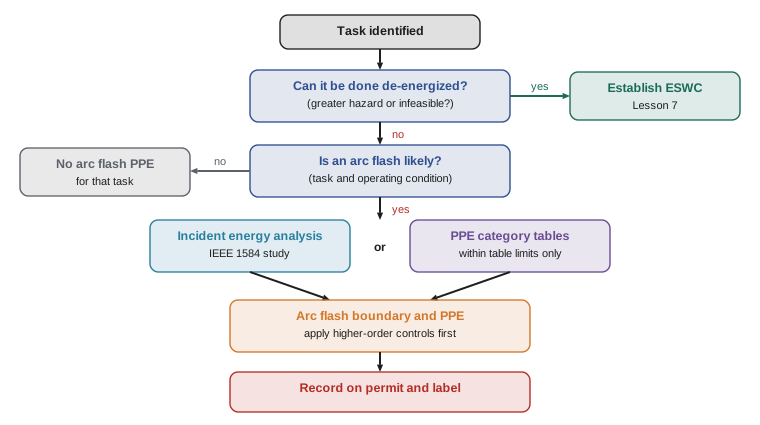
Two methods for selecting arc flash PPE
The standards allow either of two methods, but not a mixture of them on the same piece of equipment:
- The incident energy analysis method calculates the incident energy at the working distance for each piece of equipment, usually using IEEE 1584-2018 for AC systems from 208 V to 15 kV. PPE is then selected with an arc rating at least equal to the calculated incident energy. This is the more precise method and is the preferred approach for most facilities.
- The arc flash PPE category method uses tables in the standard. For listed equipment types, provided that the available fault current and the clearing time of the upstream device are within the limits in the table, the table gives a PPE category (1 to 4) and an arc flash boundary. If the equipment falls outside the table's limits, the table cannot be used and an incident energy analysis is required.
The PPE category method is useful for small facilities without an engineering study, but its limits are strict. NFPA 70E prohibits showing both the incident energy and a PPE category on the same label, because the two methods must not be mixed.
| Equipment | PPE category | Arc flash boundary | Maximum fault current and clearing time | Working distance |
|---|---|---|---|---|
| Panelboards and other equipment rated 240 V and below | 1 | 19 in | 25 kA, 2 cycles (0.03 s) | 18 in |
| Panelboards and other equipment rated over 240 V up to 600 V | 2 | 3 ft | 25 kA, 2 cycles (0.03 s) | 18 in |
| 600 V class motor control centers, fast clearing | 2 | 5 ft | 65 kA, 2 cycles (0.03 s) | 18 in |
| 600 V class motor control centers, slower clearing | 4 | 43 ft | 42 kA, 20 cycles (0.33 s) | 18 in |
| 600 V class switchgear | 4 | 20 ft | 35 kA, 30 cycles (0.5 s) | 18 in |
| Metal-clad switchgear, 1 kV to 15 kV | 4 | 40 ft | 35 kA, 15 cycles (0.24 s) | 36 in |
The PPE categories correspond to minimum arc ratings of clothing: category 1 requires at least 4 cal/cm², category 2 at least 8 cal/cm², category 3 at least 25 cal/cm² and category 4 at least 40 cal/cm². Lesson 8 describes the full clothing and equipment for each category.
Worked problem
Using the PPE category table for a 480 V panel
An electrician must take voltage readings inside a 277/480 V panelboard. The available fault current is 22 kA and the upstream fuse clears faults of that size in less than 2 cycles. Can the PPE category method be used, and what does it give? What if the fault current were 35 kA?
Show solution
- Identify the row: panelboards rated over 240 V up to 600 V.
- Check the limits: 22 kA is below 25 kA and the clearing time is under 2 cycles, so the table applies.
- Read the result: PPE category 2, arc flash boundary 3 ft, working distance 18 in.
- At 35 kA the fault current exceeds the 25 kA limit, so the table cannot be used. An incident energy analysis is required.
Answer: At 22 kA: PPE category 2 (at least 8 cal/cm²) with a 3 ft arc flash boundary. At 35 kA the table does not apply.
How incident energy falls with distance
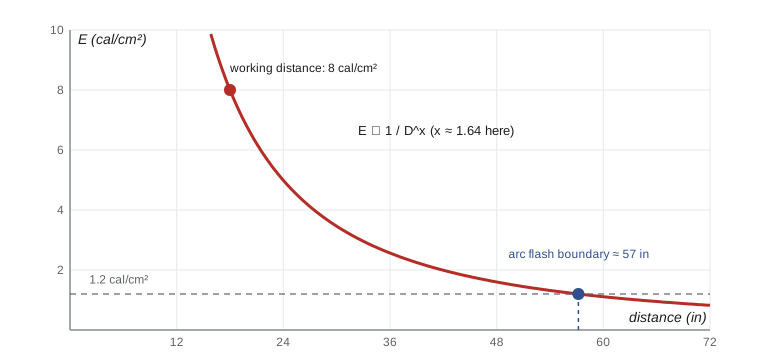
Incident energy decreases rapidly as distance from the arc increases. At awareness level, the relationship can be described by \( E \propto 1/D^{x} \), where \( E \) is incident energy, \( D \) is distance and \( x \) is a distance exponent that depends on the equipment configuration. In open air, energy spreads in all directions and \( x \) is about 2, the familiar inverse square law. In an enclosure, the box focuses energy out of the opening and \( x \) is lower, typically between about 1.4 and 1.7 for low voltage equipment in the older IEEE 1584-2002 model. The 2018 model is more complex and does not use a single exponent, but the same principle holds.
Worked problem
Incident energy at a greater working distance
A label shows 8.0 cal/cm² at a working distance of 18 in for an MCC. A worker can perform a task with an extended tool from 24 in. Estimate the incident energy using a distance exponent of 1.641.
Show solution
- Use \( E_2 = E_1 (D_1/D_2)^{x} \).
- Distance ratio: \( 18/24 = 0.75 \).
- Raise to the exponent: \( 0.75^{1.641} \approx 0.624 \).
- Multiply: \( 8.0 \times 0.624 \approx 5.0 \) cal/cm².
Answer: About 5 cal/cm². Increasing the working distance by a third cuts the exposure by nearly 40 %. Only the engineer who did the study should formally recalculate, but the example shows why remote tools and longer hot sticks help.
Worked problem
Finding the arc flash boundary
For the same MCC (8.0 cal/cm² at 18 in, exponent 1.641), estimate the arc flash boundary, the distance at which incident energy falls to 1.2 cal/cm².
Show solution
- Rearrange: \( D_B = D_W (E_W / 1.2)^{1/x} \).
- Energy ratio: \( 8.0 / 1.2 = 6.67 \).
- Raise to \( 1/1.641 = 0.609 \): \( 6.67^{0.609} \approx 3.18 \).
- Multiply: \( 18 \times 3.18 \approx 57 \) in, or about 4 ft 9 in.
Answer: About 57 in (4 ft 9 in). Anyone inside that distance from the open MCC needs arc flash protection appropriate to the energy at their position.
Arc flash labels
NEC 110.16(A) requires switchboards, switchgear, panelboards, industrial control panels, meter socket enclosures and motor control centers in other than dwelling units, which are likely to require examination, adjustment, servicing or maintenance while energized, to be field or factory marked to warn qualified persons of potential arc flash hazards. NEC 110.16(B) adds a more detailed label for service equipment and feeder supply equipment rated 1,200 A or more, showing the nominal voltage, the available fault current, the clearing time of the service overcurrent device and the date, or alternatively a label meeting industry practice. The NEC sets the requirement to mark; NFPA 70E 130.5(H) sets out what the arc flash label must contain: the nominal system voltage, the arc flash boundary and at least one of the following: the available incident energy and the corresponding working distance, or the arc flash PPE category (but not both); the minimum arc rating of clothing; or a site-specific level of PPE. The 2024 edition added that labels must be durable for the environment in which they are installed. Most labels also show the shock boundaries, the date of the assessment and the source of the study.
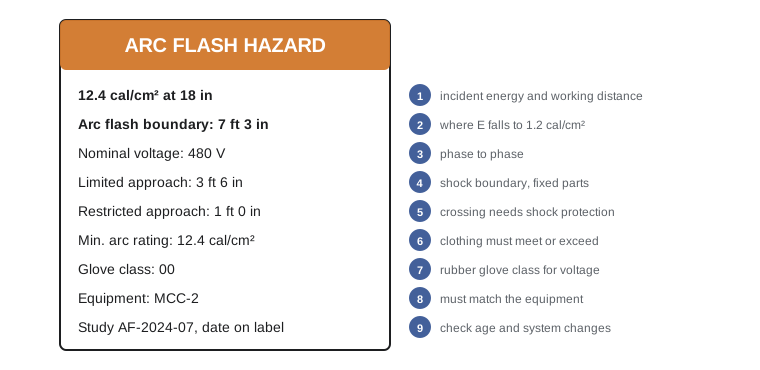
When you read a label, check it rather than simply obeying it:
- Does the equipment name on the label match the equipment in front of you?
- Is the date within the last five years, and have there been changes since, such as a new transformer, a utility upgrade, a new generator or changed breaker settings?
- Does it show either incident energy or a PPE category, but not both?
- Does the working distance on the label match the way you will actually do the task? If you must lean in closer, the exposure will be higher.
- Is the equipment in normal operating condition and properly maintained, as the study assumed?
If the answer to any of these is no, stop and ask for the label to be verified. A label is only as good as the study and the maintenance behind it.
Worked problem
A label after a system change
A plant replaced its 1,500 kVA service transformer with a 2,500 kVA unit with lower impedance last year. The arc flash labels, dated three years ago, show 6.2 cal/cm² at the main switchboard. Should workers rely on the labels?
Show solution
- A larger, lower-impedance transformer increases the available fault current at the switchboard.
- Higher fault current can either increase incident energy, if clearing time stays similar, or decrease it, if devices now trip faster. The direction cannot be assumed.
- The change is a major modification, which requires the arc flash risk assessment to be updated regardless of the five-year interval.
- Until the study is updated, the labels must be treated as unverified.
Answer: No. The transformer change requires an updated study and new labels. Until then, energized work at the switchboard should not proceed on the basis of the old labels.
Shock risk assessment
The arc flash assessment is half of the picture. A shock risk assessment determines the voltage to which workers will be exposed, the boundary requirements and the PPE needed to minimize the possibility of shock. It also considers the likelihood of contact, which depends on the task and the equipment condition, just as for arc flash. Lessons 3 and 8 cover the boundaries and the shock protective equipment. Both assessments feed into the energized work permit described in the next lesson.
Who performs the study, and what the worker should ask
An incident energy analysis is an engineering task. It is normally performed or supervised by a professional engineer, using a current one-line diagram, utility fault data, cable lengths and sizes, transformer data and protective device settings collected in the field. The quality of the study depends entirely on the quality of that data. A study built on an outdated one-line diagram, or on assumed breaker settings rather than the ones actually dialed into the trip units, can produce labels that look precise and are wrong.
A qualified worker does not need to repeat the calculation, but can ask useful questions. Which operating scenarios were studied, including generator operation and tie breakers closed? Were the protective device settings verified in the field? Has anything changed since the study date? Does the working distance on the label reflect how the task is really done? A worker who asks these questions helps keep the labels honest, and an employer who welcomes them has a stronger program.
Some facilities supplement labels with a site-specific PPE matrix, which lists tasks and equipment together with the required PPE. Where such a matrix exists, it must be derived from the same study and kept consistent with the labels.
Common mistakes
MistakeUsing the PPE category table without checking fault current and clearing time limits.
InsteadThe table applies only within its stated limits; otherwise do an incident energy analysis.
MistakeShowing both incident energy and PPE category on one label.
InsteadUse one method per piece of equipment and show only its result.
MistakeTrusting a label that predates a transformer or utility change.
InsteadMajor modifications require the assessment to be updated.
MistakeLeaning closer than the label's working distance.
InsteadExposure rises steeply as distance shrinks; plan to keep at least the working distance.
MistakeAssuming arc flash labels never expire.
InsteadReview the assessment at least every five years.
Summary and key terms
- The arc flash risk assessment identifies hazards, estimates likelihood and severity, and selects controls.
- Use either incident energy analysis or the PPE category tables, never both on one piece of equipment.
- The PPE category tables apply only within their fault current and clearing time limits.
- Incident energy falls roughly as 1/D^x, with x near 2 in open air and lower in enclosures.
- The arc flash boundary is where incident energy reaches 1.2 cal/cm².
- Labels must show voltage, arc flash boundary and either incident energy or PPE category.
- Assessments are reviewed at least every five years and after major modifications.
- Incident energy analysis
- A calculation of incident energy at the working distance, typically using IEEE 1584.
- Arc flash PPE category method
- Selecting PPE from standard tables for listed equipment within stated limits.
- PPE category
- A level from 1 to 4 corresponding to minimum clothing arc ratings of 4, 8, 25 and 40 cal/cm².
- Distance exponent
- The power x in E ∝ 1/D^x describing how incident energy falls with distance.
- Arc flash label
- A field-applied marking showing voltage, boundaries and PPE information.
- Major modification
- A change to the distribution system that could affect fault current or clearing times.
- Shock risk assessment
- An assessment of shock hazards, boundaries and shock PPE for a task.
- Site-specific level of PPE
- An employer-defined PPE set referenced on labels.
- Arc flash study
- An engineering analysis of fault currents, protective device times and incident energy.
Practice problems
Work each problem on paper first, then reveal the answer to check.
What is the maximum review interval for an arc flash risk assessment?
Show answer
Five years.
What minimum arc rating corresponds to PPE category 3?
Show answer
25 cal/cm².
Can the PPE category table be used at 30 kA for a panelboard row limited to 25 kA?
Show answer
No; an incident energy analysis is required.
Estimate E at double the working distance in open air if E is 10 cal/cm² at the working distance.
Show answer
About 2.5 cal/cm², using the inverse square law.
Name two things a label must show in addition to voltage.
Show answer
The arc flash boundary and either incident energy with working distance, PPE category, minimum arc rating or site-specific PPE.
Why is a single distance exponent only an approximation for IEEE 1584-2018?
Show answer
The 2018 model uses more complex equations that depend on configuration and enclosure.
What should a worker do if a label's equipment name does not match the equipment?
Show answer
Stop and have the label verified.
What minimum arc rating corresponds to PPE category 1?
Show answer
4 cal/cm².
Does a larger transformer always increase incident energy?
Show answer
No; higher fault current may speed up device operation. The study must be redone.
Why might the distance exponent be lower in an enclosure than in open air?
Show answer
The enclosure focuses energy out of the opening toward the worker.
Lesson quiz · 5 questions
Score 60% or more to complete this lesson.
Create a free account to save your progress, take quizzes and earn a certificate.