
HSE-224 · Lesson 4 of 12 · 30 min
Arc flash and arc blast
An arc flash is one of the most violent events in industry. In a fraction of a second, an electrical fault through air releases heat, light, pressure, sound and molten metal. This lesson explains what an arc is, what happens physically during an arc flash, what the injuries are, and which factors make one arc far more dangerous than another. It deliberately stays at an awareness level: the engineering calculation of incident energy is the job of a qualified engineer using IEEE 1584, but every qualified worker needs to understand the inputs well enough to know when a label may be wrong.
What an arc is
An electric arc is a sustained flow of current through ionized gas, called plasma, between two conductors or between a conductor and ground. Air is normally an excellent insulator, but once something bridges the gap, even briefly, the current heats the air and vaporizes metal. The vapor and plasma are conductive, so the arc sustains itself as long as the voltage can drive current across the gap and no protective device interrupts it.
Arcs are usually started by one of a small number of events:
- A tool, probe, wire, screw or washer dropped or slipped across phases or between a phase and ground.
- A worker's movement bringing a conductor too close to another during tightening, removal of a cover or pulling of a cable.
- Insulation failure from age, heat, moisture, contamination or mechanical damage.
- Loose connections that overheat, char and eventually arc.
- Racking or operating equipment that fails mechanically, such as a breaker stab misaligning with the bus.
- Animals, such as rodents, snakes and birds, bridging conductors.
- Testing errors: a meter set to amps across a voltage source, test leads with damaged insulation, or an instrument with too low a category rating.
The common thread is that most of these involve someone working on or near the equipment. Equipment that is closed and in a normal operating condition rarely fails catastrophically on its own; equipment that is open and being worked on is far more likely to.
What happens in an arc flash
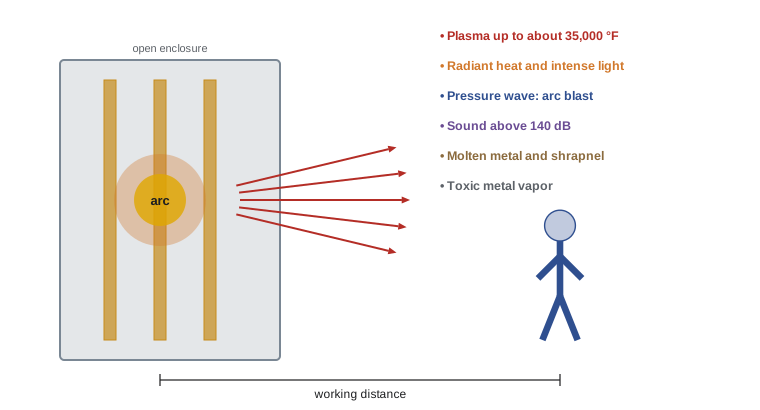
Arc temperatures can reach about 35,000 °F (about 20,000 °C). Copper vaporizing in the arc expands to roughly 67,000 times its solid volume, producing a pressure wave that can knock a worker off a ladder, rupture eardrums, collapse lungs and throw enclosure doors and covers across a room. The arc emits intense ultraviolet and infrared light that can damage eyes, and sound levels can exceed 140 dB. Molten metal droplets and fragments are thrown outward at high speed, and the arc products include toxic vapors of copper, aluminum and insulation materials.
Most of the energy reaches the worker as radiant and convective heat. The quantity used to measure it is incident energy, the amount of thermal energy per unit area on a surface at a given distance from the arc. It is expressed in calories per square centimeter (cal/cm²) or joules per square centimeter (J/cm²), where 1 cal/cm² equals about 4.184 J/cm².
| Incident energy | Approximate effect on unprotected skin |
|---|---|
| About 1.2 cal/cm² (5 J/cm²) | Onset of a second-degree burn; the basis of the arc flash boundary |
| 4 cal/cm² | Everyday cotton shirt may ignite and continue burning |
| 8 cal/cm² | Severe second- and third-degree burns over exposed areas |
| 25 cal/cm² | Deep third-degree burns; synthetic clothing melts into skin |
| 40 cal/cm² | Often fatal without protection; blast effects increasingly significant |
Burns from arc flash are often far worse than their area suggests, because ordinary clothing ignites and continues burning after the arc is over. Synthetic fibers such as polyester and nylon melt and stick to the skin, deepening the burn. That is why arc-rated clothing must not be worn over meltable underlayers and why everyday clothing under arc-rated PPE must be made of non-melting fibers.
Worked problem
Converting between units of incident energy
A label lists incident energy as 33.5 J/cm². What is this in cal/cm², and is clothing rated 8 cal/cm² adequate?
Show solution
- Divide by 4.184: \( 33.5 / 4.184 \approx 8.0 \) cal/cm².
- The clothing rating of 8 cal/cm² equals the incident energy, so it is just adequate at the labeled working distance.
- Any reduction in working distance, such as leaning in, would raise exposure above the rating, so most employers choose a margin above the calculated value.
Answer: About 8.0 cal/cm². 8 cal/cm² clothing is the minimum and leaves no margin, so the worker must maintain at least the labeled working distance.
Arc blast
The arc blast is the mechanical side of the event. A pressure wave expands from the arc in milliseconds, and in an enclosure it is directed out of any opening, which is exactly where the worker stands. Doors and covers that are not latched, or that are held by only a few screws, can be torn off. Workers have been thrown several meters, and the sudden pressure can cause concussion, lung injury and ruptured eardrums. The blast also launches molten metal and fragments of bus, insulators and components.
Arc-rated clothing is tested for its thermal performance, not for blast protection. NFPA 70E and CSA Z462 both note that at high incident energies the blast pressure can be a serious hazard even when the thermal energy is within the rating of the PPE. Many employers therefore prohibit energized work where incident energy exceeds 40 cal/cm², even though the standard no longer states a fixed upper limit, and require the equipment to be de-energized instead.
Hearing protection is required whenever a person is inside the arc flash boundary, whether or not they are actively working, because the sound pressure alone can cause permanent hearing loss.
The factors that determine incident energy
IEEE 1584-2018, IEEE Guide for Performing Arc-Flash Hazard Calculations, is the method used in North America to calculate arcing current and incident energy for three-phase AC systems from 208 V to 15 kV. A qualified engineer performs the calculation, usually with software, as part of an arc flash study. The worker does not need to perform it, but should understand what drives the result:
- Available bolted fault current at the equipment: the higher the fault current, the higher the arcing current and the faster the energy is released. IEEE 1584 is valid for bolted fault currents from about 500 A to 106 kA at low voltage.
- Arcing current and clearing time: the time it takes the upstream protective device to detect the arcing current and interrupt it. Incident energy is roughly proportional to arc duration, so clearing time is often the most important factor.
- System voltage: higher voltage sustains longer arcs across wider gaps.
- Gap between conductors: wider gaps at higher voltages; IEEE 1584 provides typical values by equipment class.
- Electrode configuration: the 2018 edition models five configurations, such as vertical conductors in a box (VCB), vertical conductors terminated in an insulating barrier (VCBB) and horizontal conductors in a box (HCB). Horizontal conductors in a box direct energy straight out of the enclosure and can produce much higher incident energy.
- Enclosure size: a smaller enclosure concentrates energy toward the opening.
- Working distance: the distance from the arc source to the worker's face and chest. Incident energy falls rapidly with distance.
| Equipment class | Typical working distance | Typical gap |
|---|---|---|
| Low voltage panelboards and MCCs | 18 in (455 mm) | 1 in (25 mm) |
| Low voltage switchgear | 24 in (610 mm) | 1.25 in (32 mm) |
| 5 kV switchgear | 36 in (910 mm) | 4.1 in (104 mm) |
| 15 kV switchgear | 36 in (910 mm) | 6 in (152 mm) |
| Cable junction boxes, low voltage | 18 in (455 mm) | 0.5 in (13 mm) |
Worked problem
Why lower fault current can mean higher incident energy
A study finds that at a downstream panel the bolted fault current falls from 30 kA under normal conditions to 8 kA when the facility runs on its standby generator. The upstream breaker trips instantaneously at 30 kA (0.05 s), but at the lower arcing current it operates on its time-delay curve and takes 0.5 s. Which case is worse?
Show solution
- At 30 kA, the arcing current is high but the arc lasts only 0.05 s.
- At 8 kA, the arcing current is lower, perhaps a third of the normal-case value, but the arc lasts 0.5 s, ten times longer.
- Incident energy depends on both current and time; a roughly three-fold drop in current combined with a ten-fold increase in time gives a much larger result.
- This is why IEEE 1584 studies examine several operating scenarios, including minimum fault current, and report the worst case.
Answer: The generator case is much worse. Lower fault current can push a protective device out of its instantaneous region, dramatically increasing arcing time and incident energy.
Likelihood: when does an arc actually happen?
Not every task near energized equipment carries the same likelihood of initiating an arc. NFPA 70E Table 130.5(C) lists tasks and equipment conditions and indicates whether an arc flash is likely. Operating a properly installed, maintained and closed circuit breaker in normal operating condition is generally not considered likely to cause an arc flash. Removing bolted covers, racking breakers in or out, working on exposed energized parts or performing tasks on equipment showing signs of impending failure are considered likely. The 2024 edition renamed the equipment condition column operating condition and added a note in 130.5(B) that closed doors do not necessarily provide protection unless the equipment is arc-resistant.
Normal operating condition has a specific meaning. All of the following must be true: the equipment is properly installed, it is properly maintained, it is used according to instructions included in its listing and labeling and by the manufacturer, the doors are closed and secured, all covers are in place and secured, and there is no evidence of impending failure. A missing screw, a door held shut with tape, a burning smell or a buzzing sound means the equipment is not in normal operating condition.
Worked problem
Is the breaker in normal operating condition?
An operator is asked to reset a tripped 600 A feeder breaker in a switchboard. When they arrive, they notice a smell of burnt insulation, a discolored section of the switchboard door and one of the door bolts missing. Should they reset the breaker?
Show solution
- Check the conditions: there is evidence of impending failure (smell and discoloration) and the door is not fully secured.
- The equipment is therefore not in normal operating condition, so operating it is likely to cause an arc flash.
- The trip itself may have been caused by a fault, and re-energizing into a fault is a classic arc flash trigger.
- The correct action is to leave it open, keep people away and call a qualified person to investigate.
Answer: No. Resetting it would be operating equipment that is not in normal operating condition, and a qualified person must determine it is safe before it is re-energized.
Arc flash in DC systems
DC arcs behave differently from AC arcs. An AC arc passes through current zero 120 times a second, which helps extinguish it; a DC arc has no current zero and can be harder to extinguish once established. Battery systems can supply very high fault currents, and protective devices on DC circuits may not clear as quickly as their AC equivalents. IEEE 1584 does not cover DC, so DC incident energy is estimated using other methods, such as those in the informative annexes of CSA Z462 and NFPA 70E, which are deliberately conservative. Lesson 10 returns to batteries, UPS and photovoltaic systems.
Common mistakes
MistakeAssuming lower fault current always means a smaller arc flash hazard.
InsteadLower current can lengthen clearing time and increase incident energy.
MistakeBelieving arc-rated PPE protects against blast pressure.
InsteadArc ratings are thermal; blast and shrapnel remain hazards at high energies.
MistakeWearing a polyester shirt under arc-rated coveralls.
InsteadWear non-melting natural fiber or arc-rated underlayers.
MistakeTreating a closed switchboard door as full protection.
InsteadOnly arc-resistant equipment is designed to contain an arc with doors closed.
MistakeResetting a breaker on equipment that smells burnt or has missing bolts.
InsteadEquipment showing impending failure is not in normal operating condition.
Summary and key terms
- An arc is current through ionized gas; most arcs are triggered by work on or near equipment.
- Arc flash releases heat, light, pressure, sound, molten metal and toxic vapor.
- Incident energy is measured in cal/cm² or J/cm²; 1.2 cal/cm² is the onset of a second-degree burn.
- IEEE 1584-2018 calculates incident energy from fault current, clearing time, voltage, gap, configuration, enclosure and distance.
- Clearing time is often the dominant factor, and minimum fault current scenarios can be the worst case.
- Normal operating condition requires proper installation, maintenance, closed and secured doors and no sign of failure.
- DC arcs lack a current zero and are estimated with conservative methods outside IEEE 1584.
- Electric arc
- A sustained current through ionized gas between conductors.
- Incident energy
- Thermal energy per unit area at a given distance from an arc, in cal/cm² or J/cm².
- Arcing current
- The current that flows through the arc, lower than the bolted fault current.
- Bolted fault current
- The current that would flow through a zero-impedance short circuit.
- Clearing time
- The time for a protective device to detect and interrupt a fault.
- Working distance
- The distance from the arc source to the worker's face and chest.
- Electrode configuration
- The arrangement of conductors used in IEEE 1584-2018, such as VCB or HCB.
- Normal operating condition
- Equipment properly installed and maintained, doors and covers secured, with no sign of impending failure.
- Arc-resistant equipment
- Switchgear designed and tested to direct arc products away from personnel.
Practice problems
Work each problem on paper first, then reveal the answer to check.
Convert 20 J/cm² to cal/cm².
Show answer
About 4.8 cal/cm².
What is the typical working distance for an LV MCC in IEEE 1584?
Show answer
18 in (455 mm).
Name four inputs to an IEEE 1584 calculation.
Show answer
Bolted fault current, clearing time, voltage, gap, electrode configuration, enclosure size or working distance.
What voltage range does IEEE 1584-2018 cover?
Show answer
Three-phase AC from 208 V to 15 kV.
Why can a DC arc be harder to extinguish?
Show answer
It has no natural current zero.
What does a missing door bolt mean for normal operating condition?
Show answer
The equipment is not in normal operating condition.
Why must hearing protection be worn inside the arc flash boundary?
Show answer
Arc blast sound can exceed 140 dB and cause permanent hearing loss.
If clearing time doubles and everything else stays the same, what happens to incident energy?
Show answer
It roughly doubles.
Give three common arc initiators.
Show answer
Dropped tools, slipped probes, insulation failure, loose connections, animals or failed racking.
Why are synthetic fibers dangerous in an arc flash?
Show answer
They melt and stick to skin, deepening burns.
Lesson quiz · 5 questions
Score 60% or more to complete this lesson.
Create a free account to save your progress, take quizzes and earn a certificate.