
HSE-224 · Lesson 1 of 12 · 32 min
Why energized work is the last resort
This course is written for electricians, electrical technicians, instrumentation and controls workers, maintenance electricians, apprentices working under supervision, and the supervisors and engineers who plan their work. It assumes you already understand the electrical hazards covered in HSE-214 and the hazardous energy control principles covered in HSE-210. It works at the level of a practitioner who needs to understand why the rules exist, how the numbers on an arc flash label are produced, and how to challenge a request to work live. It does not qualify anyone to do anything.
Being qualified for a particular task is a determination your employer makes, based on your training, your demonstrated skills, your knowledge of the specific equipment and its hazards, and any license your state or city requires. Nothing in an online course replaces that determination, the employer's electrical safety program, or the hands-on training required by OSHA 1910.332 and NFPA 70E. Treat what follows as the background that makes your employer's procedures make sense.
The basic rule: de-energize first
Every modern electrical safety standard starts from the same position: the safest way to work on electrical equipment is to remove the energy, verify that it is gone and keep it gone. OSHA 29 CFR 1910.333(a)(1) requires live parts to which an employee may be exposed to be de-energized before the employee works on or near them, unless the employer can demonstrate that de-energizing introduces additional or increased hazards or is infeasible because of equipment design or operational limitations. NFPA 70E-2024, Standard for Electrical Safety in the Workplace, makes the same point in Article 110, which requires the employer to establish an electrically safe work condition policy, and in Article 130, which sets out the narrow justifications for energized work.
The rule is simple to state and hard to live by. Production pressure, a customer who does not want an outage, a hospital that cannot lose power, a data center with contractual uptime targets, or simply the habit of always having done it that way all push work toward being done live. The purpose of this lesson is to give you the reasons and the vocabulary to push back, and to recognize the small number of cases in which energized work really is justified.
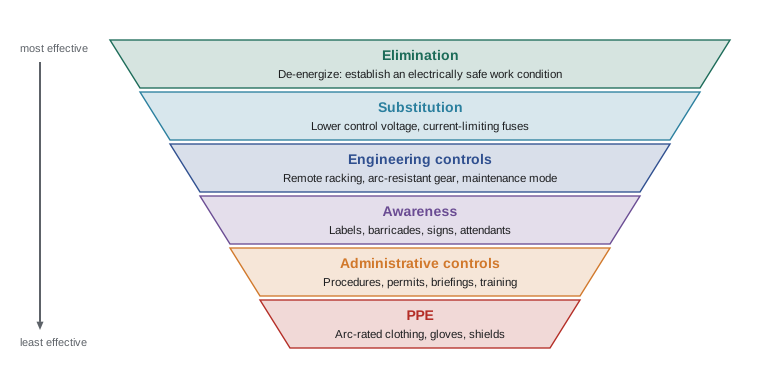
The hierarchy of risk controls
NFPA 70E requires the employer's risk assessment procedure to apply the hierarchy of risk controls, and lists the levels in order of effectiveness: elimination, substitution, engineering controls, awareness, administrative controls and personal protective equipment. The same hierarchy appears in ANSI/ASSP Z10 and ISO 45001. The order matters. A control higher up the list works whether or not anyone remembers to use it; a control lower down depends on people doing the right thing every time.
- Elimination: put the equipment in an electrically safe work condition, so there is no shock or arc flash hazard at all. Designing equipment so that routine tasks never require opening it also counts.
- Substitution: use a lower voltage for control circuits (24 V instead of 120 V), replace fuses that require exposure with fused disconnects that can be operated with the door closed, or choose current-limiting fuses that reduce incident energy.
- Engineering controls: remote racking and remote switching, arc-resistant switchgear, infrared viewing windows, finger-safe terminals, barriers inside enclosures, arc flash relays, and maintenance mode switches that speed up protective devices while someone is working.
- Awareness: arc flash and shock labels, barricades, signs, attendants and flagging that warn people about a hazard.
- Administrative controls: written procedures, energized work permits, job briefings, training, qualification and audits.
- Personal protective equipment: arc-rated clothing, rubber insulating gloves with leather protectors, face shields and hoods, hearing protection and insulated tools.
Arc-rated clothing is designed to limit burn injury to a level from which a worker can recover. It does not prevent the arc, does not stop the blast pressure, does not protect against shrapnel at high energies and does not prevent shock. A worker in a category 4 arc flash suit standing in front of a failing switchboard may still be killed by the blast or seriously injured by flying parts. That is why PPE sits at the bottom of the hierarchy.
Worked problem
Ranking the controls for a panel task
A maintenance crew must replace a failed breaker in a 347/600 V (or 277/480 V) lighting panel in an occupied office. The facility manager suggests doing it live to avoid turning off the lights. List possible controls from most to least effective.
Show solution
- Elimination: schedule the change outside working hours or provide temporary lighting, then open the feeder, lock it out and verify absence of voltage. This removes the hazard entirely.
- Substitution: if the panel is replaced in a future renovation, specify a design in which breakers can be changed with the bus de-energized section by section, or one fed through a disconnect located in the same room.
- Engineering: install a lockable feeder disconnect near the panel, so that de-energizing is quick and convenient.
- Awareness and administrative: if the work proceeds live, it needs a justification that meets the standard, an energized work permit, a job briefing and barricades.
- PPE: arc-rated clothing and insulating gloves chosen from the risk assessment, as the last line of defense.
Answer: The inconvenience of lights being off does not justify live work. Elimination by de-energizing outside working hours is both possible and the most effective control, so it is the required choice.
What counts as a valid reason to work live
NFPA 70E 130.2(A) allows energized work only where the employer can show that de-energizing introduces additional hazards or increased risk, or that it is infeasible because of equipment design or operational limitations. Normal operation of properly installed and maintained equipment, and work where the worker is not exposed to an electrical hazard, are treated separately and are covered in Lesson 6. The standard's informational notes give examples of additional hazards, including the interruption of life support equipment, the deactivation of emergency alarm systems and the shutdown of ventilation in a hazardous location. Examples of infeasibility include diagnostics and testing, such as start-up or troubleshooting of circuits that can only be tested while energized, and work on circuits that form an integral part of a continuous process that would otherwise need to be completely shut down.
Look at what is missing from the list. Cost, inconvenience, lost production, overtime, a customer's preference, the effort of coordinating an outage and the time it takes to apply locks are not on it. Both standards say so explicitly: the employer must justify energized work, and economic convenience is not a justification. If an outage can be scheduled, even if it means working at night, at a weekend or during a planned shutdown, then the work can be done de-energized and must be.
| Request | Valid reason to work live? | Why |
|---|---|---|
| Measure voltage to find a fault in a control circuit | Usually yes | Diagnostic work needs the circuit energized; still requires risk assessment and PPE |
| Add a breaker to a panel during business hours to avoid an outage | No | Inconvenience and lost production are not valid reasons |
| Replace a component on a hospital life support circuit with no alternate feed | Possibly | De-energizing may create a greater hazard; the better answer is often a temporary alternate supply |
| Tighten lugs on a main switchboard found hot during thermography | No, in almost all cases | Schedule an outage; a hot joint is already a likely failure point |
| Take readings at a continuous process drive that would shut down a kiln | Possibly | Operational limitation, but planning and engineering controls should come first |
| Remove a panel cover to look for a label | Exposure begins when the cover comes off | Removing covers is itself a task that needs a risk assessment |
Why live work is so dangerous
Two very different hazards are present whenever conductors are exposed. Shock occurs when current passes through the body. Arc flash occurs when current passes through the air between conductors, or between a conductor and ground, producing an intense burst of heat and light, followed immediately by the pressure wave, sound and flying material of the arc blast. Lessons 3 and 4 treat each in detail. For now, three facts frame everything else in the course:
- The current that can stop a heart is tiny compared with the current a circuit breaker allows. A few tens of milliamperes through the chest can cause ventricular fibrillation; a 15 A breaker allows hundreds of times more.
- Arc temperatures can reach about 20,000 °C, several times hotter than the surface of the sun, and an arc lasting a fraction of a second can cause third-degree burns several meters away.
- Most arc flash incidents are triggered by the worker: a dropped tool, a slipped probe, a loose wire swinging into a bus, a meter on the wrong setting, or a racking operation on a breaker that fails. The person who starts the arc is almost always the person closest to it.
These facts explain why both standards move work away from exposed live parts wherever they can, and why the decision to work live must be made deliberately, in writing and by someone with the authority to say no.
Worked problem
Comparing breaker current with lethal current
A 120 V receptacle circuit is protected by a 15 A breaker. A worker with wet hands, whose hand-to-hand resistance is about 1,000 Ω, contacts the live and grounded conductors. Estimate the body current and compare it with the breaker rating.
Show solution
- Use Ohm's law: \( I = V/R = 120/1{,}000 = 0.12 \) A, or 120 mA.
- Ventricular fibrillation is possible at currents of roughly 50 to 100 mA or more lasting about a second, and at lower currents for longer durations.
- Compare with the breaker: 15 A is 15,000 mA, about 125 times the body current.
- The breaker will not trip, because 120 mA is far below its rating and is not an overload.
Answer: About 120 mA, which is in the range that can cause fibrillation. The breaker protects the wiring, not the worker, so it will not open.
The cost of getting it wrong
Electrical incidents are among the most severe events in industrial safety. HSE-214 covers the national statistics from the Bureau of Labor Statistics and the Electrical Safety Foundation (ESFI); for this course the key point is that qualified workers, not bystanders, are injured most often in arc flash events, and that a large share of the fatalities among electrical workers involve contact with or exposure to energized equipment the worker believed was safe or chose to work on live. OSHA electrical citations under 1910.333 and 1910.335, and under the General Duty Clause when arc flash hazards are not addressed, appear every year among the most serious and costly.
Beyond the human cost, an arc flash event typically destroys the equipment involved, causes an unplanned outage much longer than the planned one that was avoided, and can bring regulatory charges, civil claims and insurance consequences. The outage that was too inconvenient to schedule becomes a multi-week rebuild.
When live work is justified: the questions to ask
Before accepting any request to work on or near exposed energized parts, a qualified worker and supervisor should be able to answer each of these questions in writing:
- What exactly is the task, and which parts will be exposed?
- Why can the equipment not be de-energized? Is the reason a greater hazard, an infeasibility, or simply inconvenience?
- Could the task be split so that only the part that truly needs energy (for example, the measurement) is done live, and the rest (for example, the repair) is done de-energized?
- What are the shock and arc flash risks, and what is the incident energy at the working distance?
- What engineering controls can reduce the risk before PPE is considered, such as a maintenance switch, remote operation, barriers or insulating covers?
- Who is qualified for this specific task on this specific equipment, and who will stand by to respond if something goes wrong?
- Who has the authority to approve the work, and have they signed the permit?
Lesson 6 turns these questions into the energized electrical work permit, and Lesson 12 works through them for a full task.
Worked problem
Splitting a task to minimize live exposure
A conveyor motor starter is tripping intermittently. The electrician needs to find the cause and replace a suspect overload relay. Plan the work to minimize energized exposure.
Show solution
- Diagnosis: measuring voltage and current with the starter energized is a diagnostic task that may be justified. Do it with the correct meter, PPE and approach discipline, and avoid any contact with live parts beyond the probes.
- Repair: replacing the overload relay requires removing conductors from terminals. There is no need to do this live. Open the bucket disconnect, apply locks, verify absence of voltage and then make the change.
- Re-test: re-energize under the employer's procedure and confirm correct operation, again using appropriate PPE if covers are open.
Answer: Only the measurement is done energized. The repair is done in an electrically safe work condition, which removes most of the exposure time and all of the manual handling of live conductors.
Your right to refuse and your duty to stop
US workers are protected by OSHA regulations at 29 CFR 1977.12, which allow a worker to refuse work in good faith where there is a real danger of death or serious injury and no time to correct it through normal channels, and by Section 11(c) of the OSH Act, which prohibits retaliation. Qualified electrical workers are also expected by NFPA 70E to make their own judgment: a permit signed by a manager does not oblige a worker to proceed if the conditions in the field do not match the permit, if the equipment shows signs of damage or impending failure, or if they do not feel qualified for the task. Stopping the job is part of the procedure, not a failure of it.
A good electrical safety culture makes stopping easy. Supervisors thank workers who stop a job, outages are scheduled routinely rather than as a special favor, and the first question asked about any energized work is why it cannot be done dead.
Common mistakes
MistakeTreating arc-rated PPE as permission to work live.
InsteadPPE is the last line of defense; elimination by de-energizing comes first.
MistakeAccepting lost production or customer inconvenience as a reason to work energized.
InsteadOnly a greater hazard or genuine infeasibility can justify energized work.
MistakeDoing the whole task live because part of it requires energy.
InsteadSplit the task so only the diagnostic part is done energized.
MistakeAssuming a course or a trade certificate makes you qualified for every task.
InsteadThe employer determines qualification for each task and piece of equipment.
MistakeProceeding because a permit has been signed even though field conditions differ.
InsteadStop and reassess whenever conditions do not match the permit.
Summary and key terms
- De-energizing and verifying absence of voltage is the default for all electrical work.
- Energized work is allowed only where de-energizing creates a greater hazard or is infeasible.
- Cost, inconvenience and lost production are never valid reasons to work live.
- The hierarchy of risk controls puts elimination first and PPE last.
- Arc-rated PPE limits burn injury but does not prevent arcs, blast or shock.
- Split tasks so that only the work that truly needs energy is done energized.
- This course provides background only; the employer determines who is qualified.
- Electrically safe work condition
- A state in which conductors have been disconnected, locked out, tested for absence of voltage and, where needed, grounded.
- Energized work
- Work on or near exposed conductors or circuit parts that are or might be energized.
- Hierarchy of risk controls
- The ordered list of controls from elimination to PPE.
- Infeasibility
- A situation in which de-energizing is not possible because of equipment design or operational limits.
- Greater hazard
- A situation in which de-energizing would create more risk than working energized.
- Qualified person
- Someone with the skills, knowledge and safety training to identify and avoid the hazards of specific electrical equipment, as determined by the employer.
- Arc flash
- The release of heat and light from an electric arc through air.
- Arc blast
- The pressure wave, sound and flying material produced by an arc.
- Diagnostic work
- Testing, troubleshooting and measuring that requires circuits to be energized.
Practice problems
Work each problem on paper first, then reveal the answer to check.
What are the two accepted reasons for energized work?
Show answer
De-energizing introduces a greater hazard, or it is infeasible because of equipment design or operational limits.
Name the six levels of the hierarchy of risk controls in order.
Show answer
Elimination, substitution, engineering controls, awareness, administrative controls, PPE.
Is a planned weekend outage too inconvenient to count as feasible?
Show answer
No. If an outage can be scheduled, the work can be done de-energized.
What body current flows at 240 V through 1,200 Ω?
Show answer
200 mA, from 240/1,200.
Why does a 15 A breaker not protect a worker from shock?
Show answer
Dangerous body currents are milliamperes, far below the breaker trip level.
Give an example of an engineering control for arc flash.
Show answer
Remote racking, arc-resistant switchgear, an arc flash relay or a maintenance mode switch.
Who determines whether a worker is qualified for a task?
Show answer
The employer, based on training, demonstrated skills and knowledge of the equipment.
What should a worker do if field conditions do not match the permit?
Show answer
Stop the job and reassess with the supervisor.
Give an example of a task that is usually justified as energized.
Show answer
Measuring voltage to troubleshoot a control circuit.
What does arc-rated clothing not protect against?
Show answer
Blast pressure, shrapnel at high energies and electric shock.
Lesson quiz · 5 questions
Score 60% or more to complete this lesson.
Create a free account to save your progress, take quizzes and earn a certificate.