
HSE-224 · Lesson 2 of 12 · 31 min
Electrical safety programs and qualified persons
Safe energized work does not start at the panel. It starts with a written electrical safety program that sets the rules for the whole organization: when equipment must be de-energized, how risk is assessed, who is allowed to do what, how people are trained and how the program is checked. This lesson describes what a program contains, how qualification is determined and documented, and the review cycles that keep the program current.
What an electrical safety program is
NFPA 70E Article 110 requires the employer to implement and document an overall electrical safety program that directs activity appropriate to the risk associated with electrical hazards. The program sits inside the employer's broader safety and health management system, ideally one aligned with ANSI/ASSP Z10 or ISO 45001. OSHA does not use the words electrical safety program, but 1910.331 to 1910.335 impose the underlying duties: safety-related work practices, training under 1910.332, de-energizing under 1910.333 and protective equipment under 1910.335. OSHA regularly points to NFPA 70E as the recognized industry practice for meeting those duties, and has used the General Duty Clause, Section 5(a)(1) of the OSH Act, to cite employers who ignored arc flash hazards.
A program that exists only in a binder does nothing. The test is whether the people doing the work know it, use it and can explain how it applies to the task in front of them.
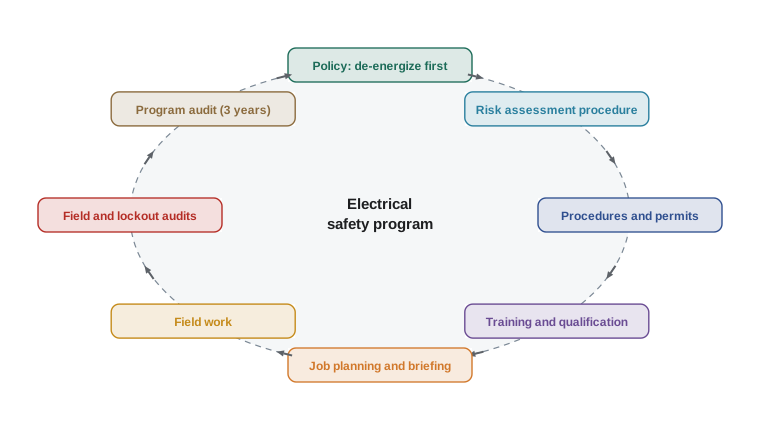
Core elements of a program
Although every organization will write its own, a typical program includes the following elements:
- A policy statement from senior management, including a policy that electrical equipment will be placed in an electrically safe work condition before work, unless energized work is justified.
- Principles, controls and procedures, including the electrically safe work condition procedure, lockout procedures and the energized work permit process.
- A risk assessment procedure covering both shock and arc flash, applied before any work on or near exposed energized parts. It must address the potential for human error and apply the hierarchy of risk controls.
- A job safety planning and job briefing requirement, so that each task is planned, the hazards and controls are discussed and the briefing is repeated when the work changes.
- An incident investigation procedure for electrical incidents and near misses.
- Requirements for the condition of maintenance of electrical equipment, since a risk assessment assumes equipment that will operate as designed.
- Training and qualification requirements, records and retraining intervals.
- Requirements for contractors and host employers, so both sides know whose program applies.
- Audit requirements for the program itself, for field work and for lockout procedures.
- A process for reviewing and updating arc flash risk assessments and labels when the system changes.
| Element | Purpose | Typical evidence |
|---|---|---|
| Policy and electrically safe work condition policy | Sets de-energizing as the default | Signed policy; posted statement |
| Risk assessment procedure | Identifies shock and arc flash hazards and controls | Procedure; completed assessments; labels |
| Energized work permit process | Controls justified energized work | Permit form; approved permits on file |
| Job planning and briefing | Makes sure every worker understands the plan | Briefing forms; tailboard records |
| Training and qualification | Confirms who may do which tasks | Training records; qualification lists |
| Maintenance | Keeps protective devices working as the study assumes | NFPA 70B based maintenance records |
| Contractor coordination | Aligns host and contractor programs | Written exchange of hazards and procedures |
| Audits | Tests whether the program works in the field | Audit reports and corrective actions |
Condition of maintenance
An arc flash study calculates incident energy on the assumption that the upstream protective device will open in the time the manufacturer's curve shows. A breaker that has not been exercised for fifteen years, a relay with drifted settings or a fuse replaced with the wrong type may take much longer, and incident energy rises in proportion to arcing time. NFPA 70E therefore requires the employer to consider the condition of maintenance of equipment in the risk assessment, and the 2024 edition added Annex S on assessing it. NFPA 70B, Standard for Electrical Equipment Maintenance, became an enforceable standard in its 2023 edition and sets out what maintenance to do and how often. An inspection that finds signs of impending failure, such as arcing damage, overheating, loose or bound components, or missing covers, means the equipment is not in a normal operating condition and must be treated as a much greater hazard.
Worked problem
How a slow breaker changes incident energy
An arc flash study shows 6 cal/cm² at an MCC, assuming the upstream breaker clears an arcing fault in 0.10 s. A maintenance test finds the breaker's trip unit is sluggish and it would actually clear in 0.30 s. Estimate the effect, assuming incident energy is roughly proportional to arcing time.
Show solution
- Ratio of clearing times: \( 0.30 / 0.10 = 3 \).
- New incident energy: \( 6 \times 3 = 18 \) cal/cm².
- Compare with PPE: clothing rated 8 cal/cm², chosen from the label, would now be well below the actual exposure.
- The label is therefore wrong until the breaker is repaired or the study is redone.
Answer: About 18 cal/cm², three times the labeled value. Poor maintenance silently makes arc flash labels unsafe, which is why maintenance is part of the program.
Qualified and unqualified persons
NFPA 70E defines a qualified person as one who has demonstrated skills and knowledge related to the construction and operation of electrical equipment and installations and has received safety training to identify the hazards and reduce the associated risk. OSHA 1910.399 uses a similar definition: one who has received training in and has demonstrated skills and knowledge in the construction and operation of electric equipment and installations and the hazards involved. Being qualified is task-specific: a person can be qualified to test and troubleshoot 120 V control circuits but unqualified to rack a 4.16 kV breaker. Separately, state and local law decides who may legally perform electrical work: most states and many cities license journeyman and master electricians and electrical contractors. A license is necessary for most electrical work, but it is not by itself proof that someone is qualified for a particular energized task.
To be considered qualified for a task, a worker must be trained and knowledgeable in at least the following:
- The construction and operation of the specific equipment, and the specific work method.
- How to distinguish exposed energized conductors and circuit parts from other parts of the equipment.
- How to determine the nominal voltage of exposed energized parts.
- The approach distances for shock protection and the arc flash boundary, and how to apply them.
- The decision-making process needed to perform a job safety plan, identify hazards, assess risk and select controls, including PPE.
- The skills and techniques needed to select an appropriate test instrument, verify its operation and use it to verify absence of voltage.
- How to release a victim from contact with exposed energized parts, and first aid and CPR, where the worker's duties require it.
An unqualified person is anyone who does not meet these requirements for the task. Unqualified people may still work near electrical equipment, but they must be trained in the hazards they could meet, must stay outside the limited approach boundary unless escorted and continuously advised by a qualified person, and must never cross the restricted approach boundary. Lesson 3 explains these boundaries.
Worked problem
Is this apprentice qualified for the task?
A second-year apprentice has completed in-class training on approach boundaries and has worked on de-energized panels for a year. The foreman asks the apprentice to measure voltage in an energized 600 V (or 480 V) switchboard alone while the foreman is on another floor. Can the apprentice be considered qualified?
Show solution
- Training alone is not enough; the apprentice must also have demonstrated skill on this type of equipment and task.
- Both standards allow a person in training to perform tasks under the direct supervision of a qualified person while they build that skill.
- Direct supervision means a qualified person is present and able to intervene, not on another floor.
- The employer's records should show what tasks the apprentice has been evaluated on.
Answer: No. Unless the apprentice has been evaluated and documented as qualified for this task, the measurement must be done by a qualified worker or under the direct supervision of one.
Training and retraining
NFPA 70E requires training to be classroom, on-the-job or a combination, with the type and extent determined by the risk to the worker. It must be documented, and the employer must verify that each worker can apply what they learned. Training is required in emergency response, including methods of release from contact and first aid and CPR, with refresher training at least annually for the release methods and as required by the certifying body for first aid and CPR. Retraining in safety-related work practices is required at intervals not exceeding three years, and sooner when supervision or annual inspections show the worker is not following practices, when new technology or equipment is introduced, or when the worker must use practices they do not normally use. OSHA 1910.332 separately requires training for employees who face a risk of electric shock, and 1910.269 requires training for utility workers.
Training records should contain the content of the training, the name of each worker and the date. A useful qualification record goes further and lists, for each worker, the specific tasks and equipment for which they have been evaluated and found qualified, who did the evaluation and when it expires.
| Activity | Maximum interval | Notes |
|---|---|---|
| Retraining in safety-related work practices | 3 years | Sooner if practices are not followed or equipment changes |
| Release of victims from contact | 1 year | Refresher at least annually |
| First aid, CPR and AED | Per certifying body | Commonly every 2 to 3 years |
| Field work audit | 1 year | Observe work to verify the program is followed |
| Lockout procedure audit | 1 year | Review of the procedure and its use |
| Electrical safety program audit | 3 years | Full review of the program |
| Arc flash risk assessment review | 5 years | Sooner after any major modification |
Audits
A program needs three kinds of audit. A program audit looks at the whole document at least every three years and asks whether it still reflects the standard, the law and the organization's equipment. Field work audits, done at least annually, involve a competent person observing actual tasks to see whether the procedures are followed, and whether the procedures themselves are workable. Lockout procedure audits, also at least annually, check that each lockout procedure is correct and used properly. Each audit must be documented, and anything it finds must lead to changes in the program, training or procedures.
A good field audit is not a hunt for someone to blame. When an auditor finds an electrician working inside the restricted approach boundary without gloves, the useful questions are why: was the glove size wrong, was the job briefing skipped because of time pressure, did the procedure require something that could not be done? The answers usually point at the program rather than the individual.
Worked problem
Turning an audit finding into improvement
A field audit finds that three of five electricians observed did not test their voltage tester on a known source before and after verifying absence of voltage. What should the program response be?
Show solution
- Find out why: the auditor learns that the proving units issued to crews were lost, and the nearest known live source is often far from the work.
- Fix the system: issue a proving unit with every tester and add it to the tool check list.
- Fix the knowledge: hold a short refresher on the live-dead-live test during the next safety meeting.
- Follow up: repeat the observation within three months to confirm the change worked.
Answer: Treat the finding as a program weakness. Provide the equipment, refresh the training and re-audit, rather than only disciplining the individuals.
Host employers and contractors
When an outside contractor works at a facility, the host employer and the contractor each have duties. NFPA 70E requires the host employer to tell the contractor about known hazards related to the contractor's work, information about the installation the contractor needs to assess risk, and any safety-related work practices that apply. The contractor must make sure its workers follow the host's practices where they apply, tell the host about any unique hazards its work creates, and report any violations of the host's practices it discovers. OSHA's multi-employer citation policy means that a host, a controlling contractor and an exposing employer can each be cited for the same hazard.
These duties should be documented in writing before work begins, typically through a pre-job meeting and a signed coordination form. Questions to settle include whose lockout procedure applies, whose energized work permit form is used, who approves permits and how arc flash labels are to be read if the host and contractor use different methods.
Common mistakes
MistakeEquating a trade certificate or license with being qualified for every task.
InsteadQualification is task-specific and determined and documented by the employer.
MistakeLetting an apprentice work alone on energized equipment to build experience.
InsteadPersons in training work under direct supervision of a qualified person.
MistakeAssuming labels stay valid regardless of maintenance.
InsteadPoorly maintained protective devices can clear slowly and raise incident energy.
MistakeTreating audits as a search for someone to discipline.
InsteadUse audit findings to fix equipment, procedures and training.
MistakeStarting contractor work without agreeing whose procedures apply.
InsteadDocument host and contractor responsibilities before work begins.
Summary and key terms
- An electrical safety program documents policy, procedures, risk assessment, training, maintenance and audits.
- De-energizing is the program's default policy.
- Qualified persons have demonstrated skills and safety training for specific tasks and equipment.
- Legal authorization to do electrical work and task qualification are separate questions.
- Retraining is required at least every three years, and release-of-victim training annually.
- Programs are audited every three years, field work and lockout procedures annually.
- Maintenance affects protective device clearing times and so the accuracy of arc flash labels.
- Electrical safety program
- The documented system that directs activity appropriate to the risk of electrical hazards.
- Qualified person
- A person with demonstrated skills and knowledge and safety training for specific electrical equipment and tasks.
- Unqualified person
- Anyone who is not qualified for the task in question.
- Direct supervision
- Supervision by a qualified person who is present and able to intervene.
- Field work audit
- Observation of actual work to check that procedures are followed.
- Condition of maintenance
- The state of equipment and protective devices relative to manufacturer's instructions and standards.
- Host employer
- The employer that owns or controls the facility where contractors work.
- Job briefing
- A discussion before work of hazards, procedures, controls and responsibilities.
- Retraining
- Repeated training to maintain knowledge and skills, at most every three years.
Practice problems
Work each problem on paper first, then reveal the answer to check.
What is the maximum interval for retraining in safety-related work practices?
Show answer
Three years.
How often must release-from-contact training be refreshed?
Show answer
At least annually.
How often must the electrical safety program be audited?
Show answer
At intervals not exceeding three years.
How often must field work be audited?
Show answer
At least annually.
Is a person qualified for 120 V troubleshooting automatically qualified for medium voltage switching?
Show answer
No; qualification is task- and equipment-specific.
If a breaker's clearing time doubles, what happens to incident energy, roughly?
Show answer
It roughly doubles.
Name three things a qualified person must know.
Show answer
How to identify exposed live parts, determine voltage, apply approach boundaries, select PPE or verify absence of voltage.
What must a host employer tell a contractor?
Show answer
Known hazards, installation information needed for risk assessment and applicable safe work practices.
What should a qualification record contain?
Show answer
The tasks and equipment the worker is qualified for, the evaluator and the date.
What does an unqualified person need to cross the limited approach boundary?
Show answer
A qualified person as escort who continuously advises them; they never cross the restricted approach boundary.
Lesson quiz · 5 questions
Score 60% or more to complete this lesson.
Create a free account to save your progress, take quizzes and earn a certificate.