
HSE-224 · Lesson 12 of 12 · 30 min
Capstone: planning a justified energized task
This capstone brings the course together by working through one realistic task from request to close-out. The scenario is a food processing plant with a 277/480 V distribution system. A packaging line conveyor has started tripping intermittently, and the line supervisor wants it fixed without stopping the neighboring lines, which share the same motor control center (MCC). The plant has an NFPA 70E based electrical safety program, a current arc flash study and an energized work permit procedure. Read each stage, decide what you would do, then compare with the discussion.
As throughout the course, the scenario illustrates reasoning. Your employer's procedures, your own qualification and the actual conditions in the field always govern what you do.
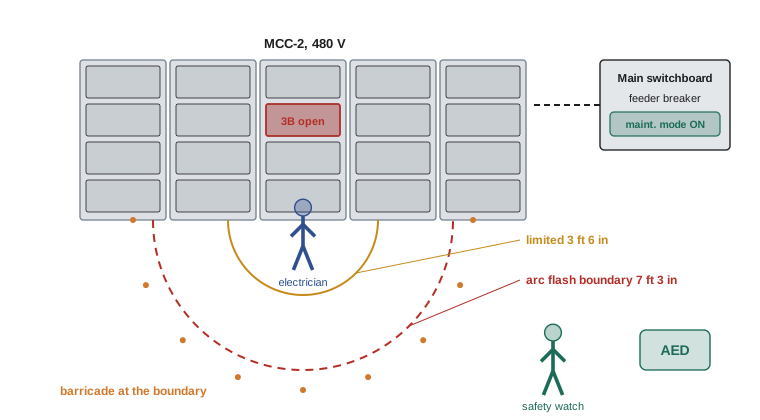
Stage 1: Challenge the request
The supervisor's request is "fix the conveyor without shutting down the MCC". The first job of the qualified electrician and the electrical supervisor is to break that request into tasks and ask, for each one, whether energy is really needed.
- Diagnosing the trip: measuring supply voltage, control voltage and motor current while the starter is energized and running is diagnostic work. It needs the circuit energized and is a task the standards recognize as justified, though it still needs a risk assessment and PPE.
- Repairing the fault: whatever is found, such as a worn contactor, a failing overload relay or a loose terminal, the repair does not need the circuit energized. Bucket 3B has its own disconnect, which can be opened, locked and verified without affecting the other buckets.
- Avoiding shutdown of the whole MCC: this is not a reason to do anything live. The MCC bus stays energized, but the work inside bucket 3B can be done with the bucket in an electrically safe work condition, as long as the bucket design allows it and the bus stabs and line-side parts are not exposed.
The outcome of stage 1 is a plan in which only the diagnosis is done with exposed energized parts, and only inside bucket 3B.
Stage 2: Gather the information
Before planning the controls, the electrician collects the facts:
- Arc flash label on the MCC (dated 2 years ago, study reference AF-2024-07): 480 V, incident energy 12.4 cal/cm² at 18 in, arc flash boundary 7 ft 3 in, limited approach boundary 3 ft 6 in, restricted approach boundary 1 ft 0 in.
- Maintenance records: the upstream feeder breaker was tested within the last year, and its trip unit has a maintenance mode switch that reduces the instantaneous pickup while it is on.
- The study's alternative label value with maintenance mode on: 1.6 cal/cm² at the same working distance.
- Equipment condition: doors latch, covers are in place, no signs of overheating or damage on a walk-down. The trip history suggests an intermittent component fault, not a failing bus.
- Drawings: bucket 3B is fed only from the MCC bus; its 120 V control power comes from an internal control power transformer, not an external panel.
Worked problem
Checking the arc flash boundary on the label
Using the awareness-level relationship \( E \propto 1/D^{x} \) with \( x = 1.641 \), check that the label's arc flash boundary of 7 ft 3 in is consistent with 12.4 cal/cm² at 18 in.
Show solution
- Energy ratio: \( 12.4 / 1.2 = 10.33 \).
- Raise to \( 1/1.641 = 0.609 \): \( 10.33^{0.609} \approx 4.15 \).
- Multiply by the working distance: \( 18 \times 4.15 \approx 75 \) in, or about 6 ft 3 in.
- The label shows 7 ft 3 in. The study's IEEE 1584-2018 model gives a somewhat larger value than the simple exponent, which is reasonable: the 2018 equations are not a single power law.
Answer: The label is broadly consistent. The check is a sanity test, not a recalculation; use the label's value, which is the more conservative, for barricade placement.
Stage 3: Apply the hierarchy of controls
With the task reduced to diagnosis inside one bucket, the next step is to reduce the risk of that task before choosing PPE.
- Engineering control: switch the upstream feeder breaker's maintenance mode on before opening bucket 3B. This shortens the clearing time for an arcing fault and reduces the incident energy at the MCC.
- Engineering control: use the bucket's test points or a voltage portal where provided, and fit insulating covers over line-side terminals inside the bucket that will not be measured.
- Substitution: use a clamp meter on conductors rather than inserting a meter in series to measure current.
- Awareness: barricade the arc flash boundary and post signs; assign a safety watch who is not otherwise occupied.
- Administrative: complete the permit or task authorization, hold a job briefing and confirm the emergency plan.
Worked problem
Effect of the maintenance mode switch
With maintenance mode off, the feeder breaker clears an arcing fault at the MCC in about 0.32 s. With it on, it clears in about 0.04 s. If incident energy is roughly proportional to clearing time, estimate the reduced incident energy and compare with the study's value of 1.6 cal/cm².
Show solution
- Ratio of clearing times: \( 0.04 / 0.32 = 0.125 \).
- Estimated energy: \( 12.4 \times 0.125 = 1.55 \) cal/cm².
- This agrees closely with the study's 1.6 cal/cm².
- The arc flash boundary also shrinks dramatically, to well under the original value.
Answer: About 1.6 cal/cm², an 87 % reduction. The maintenance mode switch is the single most effective control available for this task, short of de-energizing.
The plant's procedure requires that maintenance mode be switched on by a qualified person, that its status be confirmed by the indicator light on the trip unit, and that it be switched off again when the task is complete. A maintenance mode that is forgotten in the on position reduces selective coordination for the rest of the plant, so it is part of the close-out checklist.
Stage 4: Select PPE
Even with maintenance mode on, the plant's procedure requires PPE to be selected for at least 1.6 cal/cm², with a minimum of category 1 clothing (4 cal/cm²) for any task inside the arc flash boundary of a 480 V MCC. Many plants choose an 8 cal/cm² everyday arc-rated uniform for electricians, which gives a comfortable margin. The shock assessment calls for rubber insulating gloves with leather protectors because the electrician's hands will cross the 1 ft restricted approach boundary; class 00 is rated for 480 V, but the plant standardizes on class 0 for margin.
| Item | Selection | Reason |
|---|---|---|
| Arc-rated shirt and pants | 8 cal/cm² daily uniform | Exceeds 1.6 cal/cm² with margin |
| Face and head | Arc-rated face shield and balaclava rated at least 8 cal/cm², hard hat | Face is closest to the arc |
| Eyes and ears | Safety glasses, ear canal inserts | Required inside the arc flash boundary |
| Hands | Class 0 rubber insulating gloves with leather protectors, in test date | Shock and arc protection inside 1 ft |
| Feet | Leather work boots | Protection from molten metal |
| Meter | CAT III 1000 V, certified, with tip covers and high-energy fuses | MCC is a CAT III location at 480 V |
| Tools | Insulated screwdriver to ASTM F1505 for opening terminal covers | Live work tools near exposed parts |
Stage 5: The permit and the briefing
Voltage measurement and troubleshooting are exempt from the energized work permit requirement in the standards, but this plant's procedure requires a simplified task authorization for any troubleshooting where incident energy without maintenance mode would exceed 8 cal/cm². The electrician completes it with the following content: the equipment and location; the task, limited to measurements; the reason the measurements must be energized; the shock and arc flash assessment results, with and without maintenance mode; the PPE; the barricade and safety watch arrangements; and the supervisor's signature.
The job briefing, held at the MCC with the electrician, the safety watch and the line supervisor, covers:
- The scope: measurements only. Any repair will be done with bucket 3B locked out.
- Who does what: the electrician measures; the safety watch stays outside the arc flash boundary, keeps others out and is ready to open the feeder breaker and call for help.
- The emergency plan: the feeder breaker location, the AED (brought to the work area), the emergency number and the plant address for the ambulance.
- The stop rules: any unexpected reading, any sign of damage inside the bucket, or anyone entering the barricade stops the job.
Worked problem
What would make the job stop?
When the electrician opens bucket 3B, they see a blackened area on the line-side terminal of the contactor and smell burnt insulation. What should happen?
Show solution
- The equipment now shows evidence of impending failure, so it is not in a normal operating condition.
- The arc flash likelihood is higher than assumed in the plan, and the incident energy at the line side depends on the bucket's own protection and the MCC bus, which may be higher than the bucket's load-side value.
- The electrician closes the door without further probing, and the team reports the condition to the supervisor.
- The plan changes: bucket 3B, and possibly the MCC section, must be de-energized for inspection and repair. The line supervisor's preference no longer matters; the equipment condition decides.
Answer: Stop. Evidence of failure changes the risk assessment, and the task must be re-planned with the equipment de-energized.
Stage 6: Do the work and close out
In the planned scenario with no damage found, the electrician measures supply voltage, control voltage and motor current, and finds the overload relay tripping below its setting. The diagnosis complete, they close the bucket door, switch the bucket disconnect off, apply their lock and tag, verify absence of voltage at the overload relay using live-dead-live, replace the relay with the bucket in an electrically safe work condition, and then restore it under the plant's procedure. They switch the maintenance mode off and confirm the indicator, remove the barricades and return the authorization to the supervisor with notes.
The close-out is also a chance to improve. The team notes that the conveyor's starter has no test points, so future diagnosis will again require opening the bucket. They recommend installing a voltage portal and current monitoring on the MCC as a future engineering control.
Reflecting on the capstone
Look back at what the plan achieved. The original request would have exposed a worker to 12.4 cal/cm² and to energized 600 V or 480 V parts for the whole repair. The final plan limited energized exposure to a few minutes of measurement, at about 1.6 cal/cm², with appropriate shock protection, a safety watch and an emergency plan, and did the repair in an electrically safe work condition. Every element of the course played a part: questioning the justification, understanding the boundaries, reading and checking the label, using an engineering control before PPE, selecting rated equipment, writing down the plan and being ready to stop.
Applying the capstone to your own workplace
The same six stages can be applied to almost any request for energized work: challenge the request, gather the information, apply the hierarchy of controls, select PPE, document and brief, and do the work and close out. A useful exercise is to take a task you or your crew perform regularly, such as resetting a tripped breaker, taking readings at a switchboard or troubleshooting a drive, and write down the answers for each stage. Where you cannot find the answer, such as a missing label, an unknown fault level, or no procedure for the task, you have found a gap in the program that is worth raising with your supervisor or electrical safety committee.
It is also worth noticing how much of the capstone was decided before anyone opened the bucket. Most of the risk reduction came from planning: splitting the task, using the maintenance mode switch and preparing for an emergency. The PPE mattered, but it was the last item considered, which is exactly where the hierarchy of controls places it.
Common mistakes
MistakeAccepting "don't shut down the MCC" as a reason to repair live.
InsteadIsolate the individual bucket and repair it in an electrically safe work condition.
MistakeChoosing PPE before considering engineering controls such as maintenance mode.
InsteadApply higher-order controls first, then select PPE for the reduced exposure.
MistakeLeaving the maintenance mode switch on after the job.
InsteadInclude switching it off and confirming the indicator in the close-out.
MistakeContinuing to probe after finding signs of damage.
InsteadStop; evidence of impending failure changes the risk assessment.
MistakeUsing a meter rated CAT II in an MCC.
InsteadUse a certified CAT III meter rated for the system voltage or higher.
Summary and key terms
- Break requests into tasks and question whether each needs energy.
- Limit energized work to diagnosis, and repair in an electrically safe work condition.
- Gather label, study, maintenance and drawing information before planning.
- Use engineering controls such as maintenance mode switches to reduce incident energy first.
- Select arc-rated PPE, glove class, meter and tools from the assessment.
- Document the task, brief the team, barricade the boundary and assign a safety watch.
- Stop when conditions differ from the plan, and close out by restoring settings and recording lessons.
- Maintenance mode switch
- A trip unit setting that speeds up protective device operation while work is performed.
- Task authorization
- A simplified written approval for exempt tasks above a threshold set by the employer.
- Bucket
- A removable or fixed compartment in an MCC containing a starter or feeder.
- Selective coordination
- Arrangement of protective devices so the one nearest a fault opens first.
- Voltage portal
- A door-mounted test point that allows voltage measurement without opening equipment.
- Close-out
- The steps that finish a job, including restoring settings and documenting results.
- Stop rule
- A predefined condition under which work must stop immediately.
- Walk-down
- A visual inspection of equipment and the work area before work.
Practice problems
Work each problem on paper first, then reveal the answer to check.
Which part of the conveyor task justifies energized work?
Show answer
The diagnostic measurements only.
What does the maintenance mode switch change?
Show answer
It shortens the clearing time and so reduces incident energy.
Estimate incident energy if clearing time falls from 0.4 s to 0.05 s at 16 cal/cm².
Show answer
About 2 cal/cm².
Where should the safety watch stand?
Show answer
Outside the arc flash boundary, able to see the worker and reach the disconnect.
What should happen if burn marks are found inside the bucket?
Show answer
Stop, close up and re-plan the work de-energized.
What glove class does the plant use at 480 V?
Show answer
Class 0.
Why must maintenance mode be switched off at close-out?
Show answer
Leaving it on can defeat selective coordination for the plant.
What meter rating suits the MCC?
Show answer
A certified CAT III meter rated at or above the system voltage.
What future engineering control did the team recommend?
Show answer
Voltage portals and current monitoring on the MCC.
Name three items in the job briefing.
Show answer
Scope, roles, emergency plan and stop rules.
Lesson quiz · 5 questions
Score 60% or more to complete this lesson.
Create a free account to save your progress, take quizzes and earn a certificate.