
HSE-218 · Lesson 9 of 12 · 31 min
Loading docks, trailers and rail cars
The loading dock is where lift trucks meet road trailers, rail cars, dock levelers, open edges and people from other companies. It concentrates many of the hazards in this course into a small space: trucks driving onto a surface that can move, falls from the dock edge, pedestrians who do not work at the site, poor lighting inside trailers and time pressure from shipping schedules. This lesson covers the hazards at docks, the controls for trailers and rail cars, dock equipment, and the communication systems that keep drivers and operators working together.
How dock incidents happen
| Hazard | What happens |
|---|---|
| Early departure | The road driver pulls the trailer away while a lift truck is inside or on the dock leveler, and the truck falls into the gap |
| Trailer creep | Each time a loaded truck brakes or accelerates inside the trailer, it pushes the trailer slightly away from the dock until the leveler lip slips off |
| Landing gear collapse or upending | An uncoupled trailer tips forward or its landing gear fails when a heavy truck drives into the front |
| Trailer floor failure | A truck breaks through a weak, rotted or damaged trailer floor |
| Dock edge fall | A truck or person goes off an open dock edge where no trailer is present |
| Leveler failure | A leveler lip is not fully extended onto the trailer bed, or the leveler is overloaded |
| Struck pedestrians | Drivers, shippers and visitors on the dock are hit by trucks working in and out of trailers |
Several of these happen without any obvious warning to the operator. A trailer that creeps away does so a little at a time. A driver in the cab may be unable to see whether a truck is inside the trailer. That is why dock safety relies on positive controls that physically hold the trailer, and on communication systems that do not depend on people shouting.
Securing road trailers
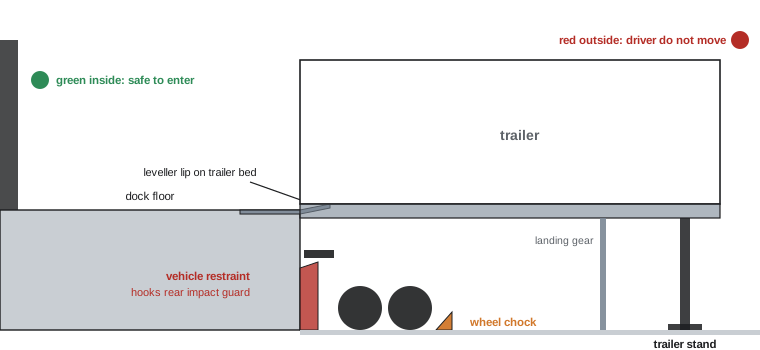
Under 1910.178(k)(1), the brakes of highway trucks must be set and wheel chocks placed under the rear wheels to prevent the trucks from rolling while they are boarded with powered industrial trucks. Under (k)(3), fixed jacks may be necessary to support a semitrailer and prevent upending during loading or unloading when the trailer is not coupled to a tractor. Many sites go further than the minimum. The main options, from strongest to weakest, are:
- Vehicle restraints mounted at the dock that hook the trailer's rear impact guard (the underride bar) or lock a rear wheel, interlocked with the dock door and leveler and with a light system for the driver and the operator.
- Wheel-based restraints that position a steel barrier in front of a rear tire.
- Wheel chocks placed in front of the rear wheels on both sides, ideally linked to a sensor or a chock holder that shows when they are in place.
- Keys or glad-hand locks that prevent the driver from leaving: the driver hands the keys to the shipper, or a lock is placed on the trailer's air line connector so the brakes cannot release.
Most well-run sites combine a physical restraint with a procedure: the restraint engages, the light outside turns red for the driver, the light inside turns green for the operator, and only then does the door open and the leveler go out. When loading is finished, the sequence runs in reverse.
Uncoupled trailers
A trailer dropped at the dock without its tractor stands on its landing gear at the front. When a heavy lift truck drives to the front of the trailer, the load on the landing gear rises sharply. Worn or partly raised landing gear can collapse, and a trailer with its load concentrated at the rear can tip up at the front. Trailer stands or jacks placed under the front of the trailer prevent both failures. Many sites require stands under every uncoupled trailer before anyone enters it.
Inspecting the trailer
Before the first truck enters, someone should look inside the trailer and check:
- the floor for holes, rot, broken boards, soft spots and loose plates;
- that the trailer is level enough and the leveler lip rests fully on the bed;
- lighting, adding a dock light if the trailer is dark;
- that the load is stable and not leaning against the doors;
- the trailer's rated floor capacity against the truck's axle load.
Worked problem
Will the trailer floor take the truck?
A sit-down forklift weighs 9,000 lb and carries a 3,300 lb pallet. With the load on, about 90 percent of the combined weight sits on the front axle. The trailer floor is rated for a forklift front-axle load of 16,000 lb. Is the floor adequate?
Show solution
- Combined weight: \( 9000 + 3300 = 12{,}300 \) lb.
- Front-axle load: \( 0.9 \times 12{,}300 = 11{,}070 \) lb.
- The floor rating of 16,000 lb leaves a margin of about 4,900 lb.
- The rating assumes a sound floor. Damage, rot or a heavier truck would change the answer, so the visual check still matters.
Answer: Yes, the floor rating exceeds the expected front-axle load, provided the floor is in good condition. Check the rating when using heavier trucks or loads.
Dock levelers and dock boards
Dock levelers bridge the gap and height difference between the dock and the trailer bed. Hydraulic, air-powered and mechanical types all have a deck and a hinged lip that extends onto the trailer. Portable dockboards and plates do the same job at docks without levelers. Under 29 CFR 1910.26, dockboards must be capable of supporting the maximum intended load, portable dockboards must be secured by anchors or other devices to prevent displacement, and dockboards put into service after January 17, 2017 must have run-off protection such as curbs where there is a risk of equipment going off the side. Under 1910.178(j) and (k), dockboards and bridge plates must be properly secured before they are driven over.
Worked problem
Sizing a dock leveler (illustrative)
The heaviest forklift that uses a dock weighs 9,000 lb and carries loads up to 3,300 lb. The dock handles many trailers a day. Leveler manufacturers often suggest multiplying the gross truck weight by a factor of 1.5 to 2 for frequent, fast use. What leveler rating should be considered?
Show solution
- Gross weight: \( 9000 + 3300 = 12{,}300 \) lb.
- With a factor of 2 for heavy use: \( 2 \times 12{,}300 = 24{,}600 \) lb.
- A 25,000 lb or higher rated leveler fits this duty; a lighter unit would be overstressed by repeated impact loading.
Answer: Choose the rating from the gross weight multiplied by the manufacturer's duty factor, not from the load alone. Check the manufacturer's method for the actual product.
The slope across a leveler also matters. When the trailer bed is much higher or lower than the dock, the leveler becomes a steep ramp. Low-clearance trucks such as pallet trucks can ground out, and loads can shift. The grade is the height difference divided by the leveler length.
Worked problem
Leveler grade
A dock is 48 in high. A trailer bed sits at 54 in. The leveler is 8 ft long. What is the grade, and is it suitable for a powered pallet jack whose manufacturer limits it to about 3 percent on loaded transitions?
Show solution
- Height difference: \( 54 - 48 = 6 \) in.
- Grade: \( \tfrac{6}{96} \times 100 = 6.25 \) percent.
- That exceeds the pallet jack's 3 percent limit, so it may ground out or lose traction.
- Options: a longer leveler, a different truck for that trailer, or adjusting the trailer height if the trailer has air suspension.
Answer: About 6 percent, too steep for that pallet jack. Check truck limits when specifying levelers and choosing which truck works which door.
Dock edges
An open dock door with no trailer is a serious fall hazard for both trucks and people. Doors should be closed when no trailer is present, and many sites add a barrier across the opening, such as a dock barrier arm, a vertical-storing leveler with a barrier, or a net. Dock edges should be marked with high-visibility striping, and operators should never use a dock door as a turning area. Stand-up truck operators are trained that if a truck goes off a dock, they step off the back rather than staying with it, because the stand-up compartment offers little protection in a fall.
Rail cars
Under 1910.178(k)(2), wheel stops or other recognized positive protection must be provided to prevent railroad cars from moving during loading or unloading. The site must coordinate with the railroad so that no locomotive couples to or moves cars while work is underway, and many sites use blue flag or blue light protection, a railroad practice where a blue signal means workers are present and the equipment must not be moved. Under (n)(5), trucks must cross railroad tracks diagonally where possible and must not be parked within 8 ft of the center of a track. Bridge plates between the dock and the car must be secured and rated for the loaded truck.
Communication and procedures
Dock incidents often come down to two people who each assumed the other knew what was happening. A written dock procedure should set out:
- how trailers are checked in, positioned and secured, and who confirms the restraint is engaged;
- the light or signal system that tells the driver not to move and the operator that it is safe to enter;
- who controls the trailer's release: for example, the shipper removes the restraint and returns the driver's keys only after the last truck has left the trailer and the leveler is stored;
- where drivers wait, and that they may not enter the dock floor or trailer during loading;
- what to do when equipment fails: no loading on manual chocks alone if the procedure requires a restraint, unless an alternative is approved.
Worked problem
Reviewing a near miss
A driver received paperwork at the shipping window and began to pull away while an operator was still inside the trailer. The operator felt the trailer move and stopped. The dock had wheel chocks, but they had not been placed. What failed, and what should change?
Show solution
- Physical control failed: the chocks were not used, and there was no restraint or interlock to prove the trailer was held.
- Communication failed: the driver received paperwork and assumed loading was complete.
- Procedure failed: nothing linked the release of paperwork or keys to the end of loading.
- Changes: install vehicle restraints interlocked with the door and lights; release paperwork only after the restraint is disengaged by the shipper; keep drivers in a waiting area; audit chock and restraint use.
Answer: This was a serious near miss with several layers missing. A restraint with lights, plus tying paperwork release to the end of loading, would address the root causes.
Common mistakes
MistakeEntering a trailer that is not restrained or chocked.
InsteadConfirm the restraint or chocks are in place and the inside light is green before entering.
MistakeDriving into the front of an uncoupled trailer without stands.
InsteadPlace trailer stands under the front of every uncoupled trailer.
MistakeUsing a dock board that is not secured or rated for the truck.
InsteadUse rated, secured dock boards and levelers with the lip fully on the trailer bed.
MistakeLeaving dock doors open with no trailer.
InsteadClose doors or place barriers across open dock positions.
MistakeGiving the driver paperwork before loading is finished.
InsteadRelease paperwork and keys only after the last truck is out and the restraint is released.
Summary and key terms
- Dock hazards include early departure, trailer creep, landing gear collapse, floor failure, dock edge falls and struck pedestrians.
- Secure trailers with vehicle restraints, chocks or wheel-based restraints, backed by key or glad-hand control and a light system.
- Support uncoupled trailers with stands and inspect trailer floors before entering.
- Levelers and dock boards must be rated, secured and inspected; check the grade for low-clearance trucks.
- Rail cars need wheel stops or derails, coordination with the railway and secured bridge plates.
- Written dock procedures tie trailer release to the end of loading and keep drivers out of the work area.
- Trailer creep
- Gradual movement of a trailer away from the dock caused by lift trucks braking and accelerating inside it.
- Early departure
- A driver pulling a trailer away from the dock before loading is complete.
- Vehicle restraint
- A dock-mounted device that hooks a trailer's rear impact guard or wheel to hold it at the dock.
- Rear impact guard
- The underride bar at the rear of a trailer, used by many restraints.
- Trailer stand
- A jack placed under the front of an uncoupled trailer to prevent upending or landing gear collapse.
- Dock leveler
- A hinged platform that bridges the gap and height difference between the dock and a trailer.
- Derail
- A device that guides a rolling rail car off the track to stop it.
- Blue flag protection
- A railway signal showing that workers are on or around equipment that must not be moved.
Practice problems
Work each problem on paper first, then reveal the answer to check.
What is trailer creep?
Show answer
A trailer gradually moving away from the dock as trucks brake and accelerate inside it.
Name three ways to secure a trailer at a dock.
Show answer
Vehicle restraints, wheel-based restraints, wheel chocks, and key or glad-hand control.
Why use trailer stands?
Show answer
To prevent an uncoupled trailer upending or its landing gear collapsing when a truck drives to the front.
What should be checked inside a trailer before entry?
Show answer
Floor condition, leveler lip position, lighting, load stability and floor capacity.
A dock is 44 in high and a trailer bed is 52 in. With a 10 ft leveler, what is the grade?
Show answer
8/120 = 6.7 percent.
How should leveler capacity be chosen?
Show answer
From the gross weight of the truck and load multiplied by the manufacturer's duty factor.
What protects workers when loading rail cars?
Show answer
Wheel stops or derails, coordination with the railway, blue flag protection and secured bridge plates.
What should happen to dock doors with no trailer?
Show answer
Close them or place a barrier across the opening.
When should a driver get paperwork and keys back?
Show answer
Only after the last truck has left the trailer and the restraint is released.
What should a stand-up operator do if the truck goes off a dock?
Show answer
Step off the back, as trained for that truck type.
Lesson quiz · 5 questions
Score 60% or more to complete this lesson.
Create a free account to save your progress, take quizzes and earn a certificate.