
HSE-218 · Lesson 7 of 12 · 27 min
Pedestrians and traffic management
The most common way a lift truck kills is by striking a person on foot. Operators can reduce the risk by driving well, but the larger gains come from the way a workplace is laid out and run: where people walk, where trucks travel, how the two cross, and what rules and technology support them. This lesson covers the principles of traffic management, the hierarchy of separation, crossings and intersections, warning technology, and the rules that both operators and pedestrians must follow.
Why separation comes first
1910.178 contains only scattered pedestrian rules, such as slowing and sounding the horn at cross aisles and keeping people out from under elevated loads, so OSHA relies on the general duty clause and industry practice for traffic management. ANSI/ITSDF B56.1 and OSHA's own guidance call for separating pedestrians and trucks where possible, marking aisles and walkways, and controlling intersections. Inspectors and courts expect separation by design, not just signs.
The hierarchy of separation
| Approach | Examples | Strength |
|---|---|---|
| Separate in space | Physical barriers or guardrails between walkways and truck aisles; separate pedestrian doors; pedestrian-free zones | Strongest: people and trucks cannot meet |
| Separate in time | Pick faces restocked by trucks only when pickers are absent; dock areas closed to visitors during loading | Strong if enforced |
| Control the crossing points | Gated crossings, zebra crossings, interlocked doors, stop lines and mirrors at intersections | Reduces conflict to known points |
| Warn | Blue or red projected lights, proximity detection, flashing beacons, audible alarms | Helps but relies on people responding |
| Rules and behavior | Speed limits, right-of-way rules, eye contact, no phones while walking, high-visibility clothing | Weakest on its own |
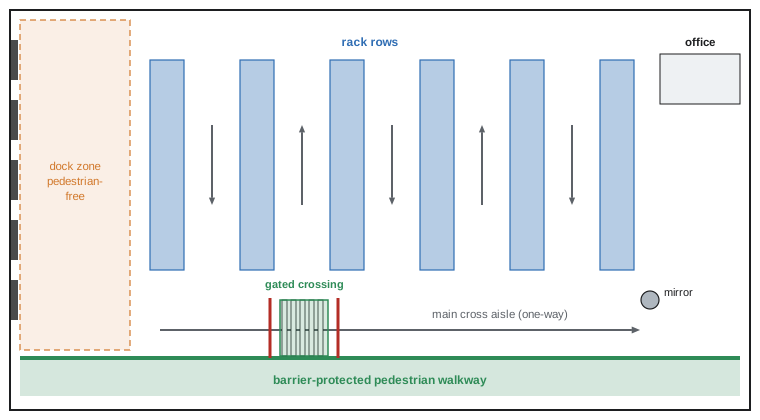
Most workplaces use a combination. A well-run distribution center might have barrier-protected walkways along the main aisles, pedestrian-free narrow aisles, gated crossings at the few places walkways cross truck routes, blue lights on every truck, a 4 or 5 mph speed limit and strict rules on phone use. Each layer catches some of what the others miss.
Designing routes
A traffic management plan starts with a drawing of the site showing where trucks travel, where people walk, and where they meet. The aim is to reduce the number of meeting points and make each one safe. Useful principles include:
- Keep pedestrian routes short and direct, or people will take shortcuts through truck areas.
- Put pedestrian routes along walls or behind barriers, not down the middle of truck aisles.
- Use one-way systems for trucks to reduce head-on meetings and reversing.
- Avoid blind corners; where they cannot be removed, add mirrors, cut-back corners, warning lights or presence detection.
- Separate entrances: people should not have to walk through a truck door to enter a building.
- Locate offices, washrooms, lunchrooms and time clocks so that reaching them does not require crossing truck routes.
- Mark aisles, walkways, crossings and stop lines clearly and keep the markings maintained.
- Provide enough aisle width for the trucks used, with clearance for turning and rear swing.
Intersections and crossings
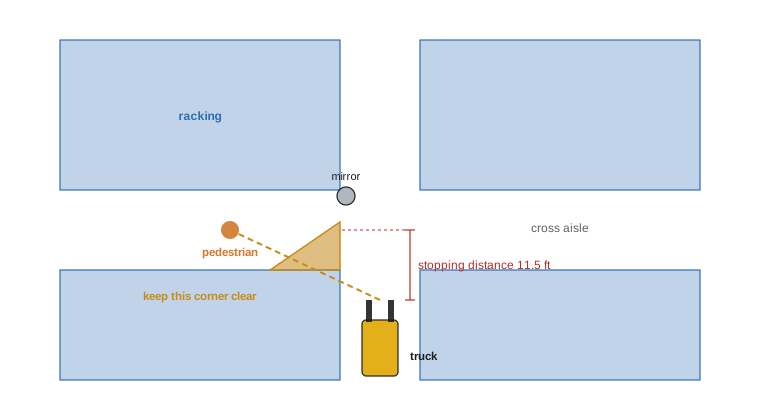
Intersections are where most strikes happen. An operator approaching a cross aisle needs to see far enough along it to stop for a person stepping out, and a pedestrian needs the same view of approaching trucks. The sight distance required depends on the truck's speed and stopping distance.
Worked problem
Sight distance at a cross aisle
Trucks approach a cross aisle at 5 mph. Using a reaction time of 1.0 s and a wet-floor friction coefficient of 0.2 (illustrative), how far must the operator be able to see to stop for someone stepping out?
Show solution
- 5 mph is 7.3 ft/s. Reaction distance: 7.3 ft.
- Braking distance: \( \tfrac{7.3^{2}}{2 \times 0.2 \times 32.2} = 4.2 \) ft.
- Stopping distance: about 11.5 ft.
- The operator must be able to see a pedestrian at least 11.5 ft before reaching the crossing point, so racking, stacked product or walls must not block that view. If they do, a mirror, a lower speed limit at the intersection or a stop line is needed.
Answer: About 11.5 ft of clear sight before the crossing. Where the layout cannot give that, require trucks to stop at the line before entering.
Pedestrian crossings over truck routes should be few, clearly marked and placed where visibility is good. Gates or barriers that make pedestrians stop and look before crossing are more effective than paint alone. At busy crossings, light-controlled or interlocked systems can stop trucks or warn them when a gate opens.
Alert and warning devices
A wide range of devices helps operators and pedestrians notice each other. None replaces separation, but each can catch some of the conflicts that remain.
| Device | How it works | Limits |
|---|---|---|
| Blue spot light | Projects a blue spot several meters ahead of or behind the truck to warn people before it appears | Hard to see in bright areas; people stop noticing it over time |
| Red zone or halo lights | Projects a red line or ring on the floor around the truck to mark a keep-out zone | Shows the zone but does not stop anyone entering it |
| Travel and reversing alarms | Audible beeps or broadband sound when the truck moves | Can be lost in noise; many alarms together cause alarm fatigue |
| Mirrors and cameras | Show areas hidden by the load, mast or rear of the truck | Need cleaning, correct adjustment and the operator's attention |
| Proximity detection | Tags worn by pedestrians, radar or camera systems detect people near the truck and warn or slow it | Cost, false alarms, and people may rely on it too much |
| Speed and zone control | Telematics or floor markers limit speed automatically in set zones | Must be configured and maintained |
| Intersection warning systems | Sensors at blind corners flash lights when a truck or person approaches | Only cover the points where installed |
When adding technology, involve operators and pedestrians, test it in real conditions, and watch for unintended effects. A proximity system that alarms constantly will be ignored or disabled. A blue light that becomes part of the background no longer warns anyone.
Speed limits
Speed limits should be set for each area based on visibility, congestion and floor conditions, posted clearly, and enforced. Many sites use about 5 to 6 mph in open warehouse areas and walking pace, around 3 mph, in congested areas, near pedestrians and in buildings with poor visibility. Speed limiters built into modern trucks, or zone-based telematics, make limits reliable instead of aspirational.
Worked problem
Counting conflicts
A crossing between the break room and the production floor is used by 40 people an hour during shift changes. Trucks pass through it 120 times an hour. A gated crossing is proposed. How should the risk be thought about?
Show solution
- Each pedestrian crossing and each truck pass is an opportunity for conflict. A simple exposure measure multiplies them: \( 40 \times 120 = 4800 \) potential pairings an hour at shift change.
- Even if only a tiny fraction of pairings produce a near miss, the number is large. Over a year of shift changes, conflicts become close to certain without control.
- Options in order: move the break room door or reroute trucks so the crossing disappears; schedule trucks away from the crossing at shift change; gate the crossing so pedestrians stop and trucks see them; add warning lights.
- Measure afterward: count near misses and observe behavior at the crossing.
Answer: The exposure is high enough that relying on attention alone is not reasonable. Removing the crossing or separating it in time is better than paint and signs; a gate is a minimum.
Rules for operators and pedestrians
Rules cannot replace design, but they set expectations and give supervisors something clear to enforce. A typical set includes:
- Pedestrians use marked walkways and crossings and never walk in narrow aisles while a truck is working.
- Pedestrians stop at crossings, look, and make eye contact with operators before stepping out.
- No phone use while walking in operating areas, for operators or pedestrians.
- Operators slow down and sound the horn at intersections and doorways, and stop for pedestrians.
- Nobody stands in the swing zone of a turning truck or near a truck that is placing a load.
- Visitors and drivers are escorted or confined to designated safe areas such as driver waiting rooms.
- High-visibility clothing is worn by everyone in operating areas.
Right-of-way rules vary. Some sites give pedestrians the right of way everywhere; others give trucks the right of way in aisles and pedestrians the right of way on walkways and crossings. Either can work if the rule is clear, consistent and taught, but both operator and pedestrian must still act as if the other has not seen them.
Visitors, contractors and truck drivers
People who do not work at the site are at particular risk because they do not know its routes and rules. Delivery drivers waiting at the dock, contractors working near aisles and visitors on tours should receive a short orientation, be given high-visibility clothing, and be kept to safe zones. Many sites have a driver waiting area with a window onto the dock so drivers can watch their trailer being loaded without standing in the truck path. Contractors working in truck areas need the work area barricaded and a plan agreed with the site supervisor.
Writing the traffic management plan
A traffic management plan is a living document, not a one-time drawing. A useful plan contains a scaled site drawing showing routes, walkways, crossings, one-way systems, speed zones, pedestrian-free zones, parking and charging areas; the rules for operators, pedestrians, visitors and drivers; the controls at each crossing and blind spot; the equipment fleet and who may operate it; and how the plan is communicated, inspected and reviewed. It should be posted where people can see it and included in orientation for every new worker, temporary worker and contractor.
The plan should be reviewed whenever something changes: new racking, a new product line that brings more trucks into an area, a seasonal peak with extra temporary staff, construction work that closes a route, or an incident or near miss that shows a weakness. Seasonal peaks deserve special attention, because they bring more trucks, more new workers and more time pressure at the same moment.
Involve the people who use the routes. Operators know where the near misses happen, pickers know the shortcuts people take, and drivers know where they are left waiting. A short walk-through with a few of each, plan in hand, often finds problems that no drawing shows.
Common mistakes
MistakePainting a walkway down the middle of a truck aisle and calling it separation.
InsteadProtect walkways with barriers and route them along walls or away from truck traffic.
MistakeStoring product at the ends of rack rows where it blocks the view at intersections.
InsteadKeep sight triangles clear or add mirrors, stop lines and warning systems.
MistakeAdding blue lights and assuming the problem is solved.
InsteadUse warning devices as a layer on top of separation and speed control.
MistakeLetting delivery drivers stand on the dock while their trailer is loaded.
InsteadProvide a safe waiting area and orientation for drivers and visitors.
MistakeSetting speed limits but never checking them.
InsteadEnforce limits through supervision, telematics or built-in speed limiting.
Summary and key terms
- Pedestrian strikes are the leading cause of lift truck deaths; separation by design is the main control.
- The hierarchy runs from separation in space and time to controlled crossings, warning devices and rules.
- Traffic plans reduce meeting points: protected walkways, one-way aisles, few crossings and no blind corners.
- Sight distance at intersections must exceed the truck's stopping distance.
- Alert devices help but can be ignored; involve users and test them.
- Clear rules for operators, pedestrians, visitors and drivers support the design.
- Traffic management plan
- A documented plan showing how trucks and pedestrians move around a site and how conflicts are controlled.
- Separation in space
- Keeping pedestrians and trucks in physically separate areas.
- Separation in time
- Scheduling work so pedestrians and trucks are not in the same area at the same time.
- Sight triangle
- The area at an intersection that must be kept clear so operators and pedestrians can see each other.
- Blue spot light
- A light that projects a blue spot on the floor to warn of an approaching truck.
- Proximity detection
- A system that senses people near a truck and warns or slows the truck.
- Pedestrian-free zone
- An area where pedestrians are not permitted while trucks operate.
Practice problems
Work each problem on paper first, then reveal the answer to check.
What is the strongest way to protect pedestrians from lift trucks?
Show answer
Separate them in space with barriers and separate routes.
Give an example of separation in time.
Show answer
Restocking pick faces with trucks only when pickers are not present.
Forklifts approach an intersection at 5 mph with a stopping distance of 11.5 ft. What sight distance is needed?
Show answer
At least 11.5 ft along the cross aisle.
Why can blue lights lose their effect?
Show answer
People get used to them and stop noticing them.
Name three principles for designing pedestrian routes.
Show answer
Short and direct, along walls behind barriers, few crossings, no blind corners, separate entrances.
What should a pedestrian do before crossing a truck route?
Show answer
Stop, look and make eye contact with the operator.
Why are delivery drivers at particular risk?
Show answer
They do not know the site's routes and rules and often wait on the dock.
How can speed limits be made reliable?
Show answer
Built-in speed limiters or zone-based telematics, plus supervision.
What is a sight triangle?
Show answer
The area at an intersection that must be kept clear so people can see each other in time.
Why is a gate at a crossing better than paint alone?
Show answer
It makes pedestrians stop and look before entering the truck route.
Lesson quiz · 5 questions
Score 60% or more to complete this lesson.
Create a free account to save your progress, take quizzes and earn a certificate.