
HSE-218 · Lesson 6 of 12 · 29 min
Safe operation and load handling
Safe operation is where training meets daily habits. This lesson covers the rules and techniques that keep a truck, its load and the people around it safe: starting and parking, travel speed and stopping distance, visibility, ramps and slopes, picking up and stacking loads, working with racking, and the practices that are never acceptable. Supervisors need to know these well enough to recognize good and bad operation at a glance.
Before moving
A safe trip starts before the truck moves. The operator should have completed the pre-use inspection, adjusted the seat and mirrors, fastened the seatbelt, checked that the path is clear, and confirmed the load weight and center are within the truck's capacity. Mounting and dismounting should use three points of contact and the steps and grab handles provided. Jumping down from a truck is a common cause of ankle and knee injuries.
Travel
Travel rules exist to give the operator time to react and to keep the truck stable. Paragraph (n) of 1910.178 sets out the main federal rules, and the site's traffic rules add specific speed limits and routes. Good practice includes:
- Observe all traffic regulations, including the plant's speed limits, and operate at a speed that permits a safe stop under all conditions ((n)(1) and (n)(8)).
- Keep a safe distance of approximately three truck lengths from the truck ahead ((n)(1)).
- Slow down and sound the horn at cross aisles and other places where vision is obstructed ((n)(4)).
- Look in the direction of travel and keep a clear view of the path ((n)(6)); if the load obstructs the forward view, travel with the load trailing.
- Travel with the forks or load low, just high enough to clear the floor, and tilted back.
- Keep arms, legs and head inside the operator's compartment.
- Never pass another truck at intersections, blind spots or other dangerous locations.
- Cross railway tracks diagonally where possible, and do not park close to tracks.
Stopping distance
A lift truck cannot stop instantly. The total stopping distance is the distance traveled during the operator's reaction time plus the braking distance. Braking distance grows with the square of speed and depends on the friction between the tires and the floor. Lift trucks also cannot brake as hard as a car without shifting or dropping the load, so the usable deceleration is modest.
Worked problem
Stopping distance on dry and wet floors
Using illustrative values, a reaction time of 1.0 s and friction coefficients of 0.4 on a dry floor and 0.2 on a wet one, estimate the stopping distance at 6 mph and at 9 mph.
Show solution
- 6 mph is 8.8 ft/s. Reaction distance: 8.8 ft.
- Dry braking: \( \tfrac{8.8^{2}}{2 \times 0.4 \times 32.2} = 3.0 \) ft. Total: about 11.8 ft.
- Wet braking: \( \tfrac{8.8^{2}}{2 \times 0.2 \times 32.2} = 6.0 \) ft. Total: about 14.8 ft.
- 9 mph is 13.2 ft/s. Dry: \( 13.2 + 6.8 = 20.0 \) ft. Wet: \( 13.2 + 13.5 = 26.7 \) ft.
Answer: Going from 6 to 9 mph raises the wet stopping distance from about 15 ft to 27 ft. Most of the extra distance comes from braking, which grows with the square of speed.
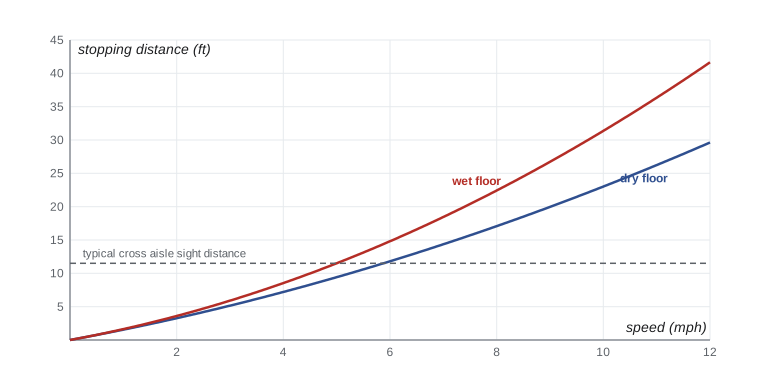
The practical lesson is simple: at a blind corner, the operator must be going slowly enough to stop within the distance they can see. If an operator can see only 10 ft around a rack end, the truck must be able to stop in less than 10 ft, which in the example above means walking pace on a wet floor.
Visibility
Blind spots are built into a lift truck. The mast and its channels block parts of the forward view, the load can block it entirely, and the overhead guard posts and counterweight block views to the sides and rear. Mirrors, cameras and lights help, but the main tools are technique and layout: traveling in reverse with bulky loads, looking over the shoulder before reversing, stopping before entering a doorway, and designing routes without blind corners.
When an operator must travel forward with an obstructed view, for example up a ramp with a tall load, a trained spotter should guide them using agreed hand signals, staying in view of the operator and out of the truck's path.
Ramps and slopes
Slopes change the stability of a truck. On a slope, the load must always be on the uphill side so that gravity holds it against the backrest and the truck's weight stays over the drive wheels. This leads to a rule that looks odd at first: a loaded truck goes up a ramp forward and comes down in reverse, while an empty truck goes up in reverse and comes down forward, so the forks always point downhill when empty.
| Situation | Direction of travel |
|---|---|
| Loaded, going up | Forward, load leading uphill |
| Loaded, going down | Reverse, load trailing uphill |
| Empty, going up | Reverse, forks trailing downhill |
| Empty, going down | Forward, forks leading downhill |
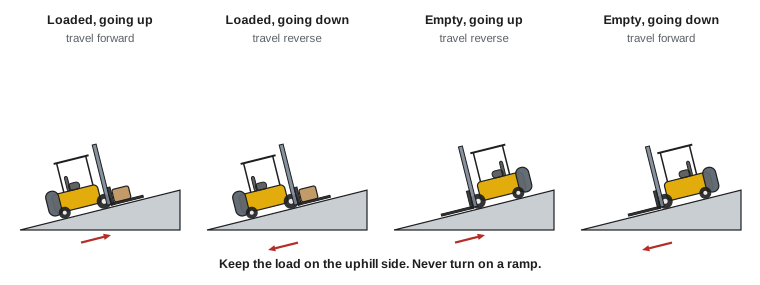
On slopes the operator should also tilt the load back, raise it only enough to clear the surface, travel slowly, never turn or travel across the slope, and never park on a slope unless the wheels are blocked. Before allowing trucks on any ramp, check the manufacturer's maximum gradeability and the ramp's surface condition.
Worked problem
Grade of a dock ramp
A yard ramp rises 4 ft over a horizontal run of 26 ft. What is the grade, and how must a loaded truck travel on it?
Show solution
- Grade: \( \tfrac{4}{26} \times 100 = 15.4 \) percent.
- The angle is \( \arctan(0.154) \approx 8.8^{\circ} \).
- The grade exceeds 10 percent, so (n)(7)(i) requires loaded trucks to travel with the load upgrade: forward going up, reverse coming down.
- Check that 15 percent is within the truck's rated gradeability, especially with a full load and on a wet or icy surface.
Answer: About 15 percent. Keep the load upgrade and confirm the truck can handle the grade.
Picking up and placing loads
Load handling is where most dropped loads and rack strikes happen. A standard sequence helps:
- Approach squarely and stop before the load with the forks level and at the right height.
- Set the fork spread for the pallet, as wide as practical for stability.
- Drive forward slowly until the load is against the backrest or fork face, never spearing the pallet at speed.
- Lift just enough to clear the surface, tilt back slightly, check behind and reverse out slowly.
- Lower the load to travel height before turning or traveling.
- To place, stop square to the location, raise the load with the mast vertical, move forward slowly, level the forks, lower the load, and back out with the forks clear before lowering them.
Loads should be stable and secure. Damaged pallets, leaning stacks, loose items and off-center loads should be fixed before lifting. Long loads may need fork extensions approved by the manufacturer, and the extension changes the load center and capacity. Never use the forks to push or pull loads unless the truck and attachment are designed for it.
Racking and stacking
Lift trucks and racking are closely linked. A truck that strikes an upright can weaken a rack that holds tons of product above people's heads. Storage racks should carry load capacity plaques, be designed and installed to ANSI MH16.1 from the Rack Manufacturers Institute or the manufacturer's specifications, and be inspected regularly for damage. Operators and supervisors should report every rack strike, and damaged uprights should be unloaded and repaired or replaced according to the rack manufacturer's or an engineer's instructions.
Worked problem
Checking a rack beam load
A pair of rack beams is posted for 4,000 lb per level, evenly distributed. A supervisor wants to store two pallets of 2,200 lb each on that level. Is it acceptable?
Show solution
- Total load: \( 2 \times 2200 = 4400 \) lb.
- That exceeds the 4,000 lb rating by 10 percent.
- Overloaded beams deflect and can drop loads or overload the uprights below.
Answer: No. Store the pallets elsewhere or have the rack re-rated by its manufacturer or an engineer. The truck's capacity and the rack's capacity are both limits.
Block stacking on the floor also needs rules: maximum stack heights based on product strength and stability, clear aisles between stacks, and inspection for leaning stacks.
Parking and leaving the truck
Under (m)(5)(i), when a truck is left unattended the load-engaging means must be fully lowered, the controls neutralized, the power shut off and the brakes set, with wheels blocked if the truck is parked on an incline. Under (m)(5)(ii), a truck is unattended when the operator is 25 ft or more away or the truck is out of the operator's view. When the operator dismounts within 25 ft and stays in view, the forks must still be fully lowered, controls neutralized and brakes set. Parking must not block exits, fire equipment, electrical panels or walkways.
Never acceptable
Some practices are prohibited everywhere and should lead to immediate correction:
- Allowing anyone to stand or walk under raised forks or a raised load.
- Carrying passengers, unless the truck has a seat designed for one and the rider is authorized.
- Lifting people on the forks or on a pallet; only an approved work platform may be used, as described in Lesson 10.
- Traveling with a raised load or with the mast tilted forward.
- Turning on a ramp or slope.
- Exceeding the truck's capacity or using unapproved counterweights.
- Horseplay, racing or stunt driving.
- Operating a truck while impaired by alcohol, cannabis, drugs or fatigue.
Floors, surfaces and lighting
The floor is part of the truck's braking and stability system. Wet or oily patches, ice near dock doors, dust on smooth concrete, potholes, expansion joints, drains and floor plates can all cause skids, lost loads or tip-overs. Small wheels on narrow aisle trucks and pallet trucks are especially sensitive to bumps and cracks. Supervisors should include floor condition in workplace inspections, clean spills promptly, mark and repair damage, and check that floors and mezzanines are rated for the truck's weight plus its load.
Lighting matters too. Operators need enough light to see loads, rack beams, floor markings and pedestrians, and dark trailers and the far ends of rack rows are common problem spots. Lights on the truck help, but area lighting that removes deep shadows and glare is the stronger control. Where trucks move between bright outdoor yards and darker buildings, operators need a moment to adjust, and a slower speed at the doorway allows for it.
Noise affects safety in both directions. Horns and alarms must be audible over background noise, but operators wearing hearing protection, headphones or earbuds may not hear a warning or a shouted instruction. Sites should set rules on personal audio devices in operating areas.
Common mistakes
MistakeDriving forward with a load that blocks the view.
InsteadTravel in reverse, looking in the direction of travel, or use a trained spotter.
MistakeComing down a ramp forward with a load.
InsteadCome down in reverse so the load stays on the uphill side.
MistakeRounding a blind rack end at normal speed.
InsteadSlow to a speed that lets you stop within the distance you can see, and sound the horn.
MistakeIgnoring a minor rack strike.
InsteadReport every strike so the rack can be inspected before it fails.
MistakeLeaving the forks raised when stepping off the truck.
InsteadLower the forks, neutralize controls, set the brake and turn off the power.
Summary and key terms
- Speed must allow a safe stop within the distance the operator can see.
- Stopping distance grows with the square of speed and is longer on wet floors.
- Travel with the load low and tilted back; travel in reverse if the load blocks the view.
- On ramps keep the load uphill when loaded and the forks downhill when empty; never turn on a slope.
- Approach and place loads squarely and slowly; respect both truck and rack capacity.
- Secure the truck when leaving it, and never allow riders, people under loads or people on forks.
- Stopping distance
- Reaction distance plus braking distance.
- Reaction time
- The time between seeing a hazard and applying the brakes.
- Grade
- The rise of a slope divided by its horizontal run, usually expressed as a percentage.
- Spotter
- A trained person who guides an operator whose view is obstructed.
- Backrest
- The load backrest extension that keeps loads from falling back toward the operator.
- Upright
- A vertical frame member of a storage rack.
- Unattended truck
- A truck the operator has left, defined in US rules as 25 ft or more away or out of view.
Practice problems
Work each problem on paper first, then reveal the answer to check.
What two parts make up stopping distance?
Show answer
Reaction distance and braking distance.
How does doubling speed affect braking distance?
Show answer
It roughly quadruples it, because braking distance grows with the square of speed.
How should a loaded truck descend a ramp?
Show answer
In reverse, with the load on the uphill side, tilted back and low.
How should an empty truck go up a ramp?
Show answer
In reverse, so the forks point downhill.
A ramp rises 3 ft over 20 ft. What is its grade?
Show answer
15 percent.
What should an operator do if the load blocks the forward view?
Show answer
Travel in reverse or use a trained spotter.
Why report every rack strike?
Show answer
A damaged upright can collapse and drop heavy loads.
What must be done when leaving a truck?
Show answer
Lower the forks fully, neutralize the controls, set the brake and turn off the power; remove the key if out of sight.
Name four practices that are never acceptable.
Show answer
People under raised loads, riders, lifting people on forks, traveling with a raised load, turning on ramps, overloading, horseplay, impaired operation.
How should a pallet be picked up?
Show answer
Approach squarely and slowly, forks level and spread, drive in fully, lift slightly, tilt back, check behind and reverse out.
Lesson quiz · 5 questions
Score 60% or more to complete this lesson.
Create a free account to save your progress, take quizzes and earn a certificate.