
HSE-218 · Lesson 3 of 12 · 27 min
Types and classes of lift trucks
Lift trucks come in many shapes because warehouses, factories, lumber yards and construction sites ask very different things of them. Each design has its own stability characteristics, controls, blind spots and failure modes, which is why an operator needs separate training for each type. This lesson sets out the seven-class system used across North America, explains the main truck designs within each class, and covers power sources and the special ratings needed for hazardous locations.
The seven classes
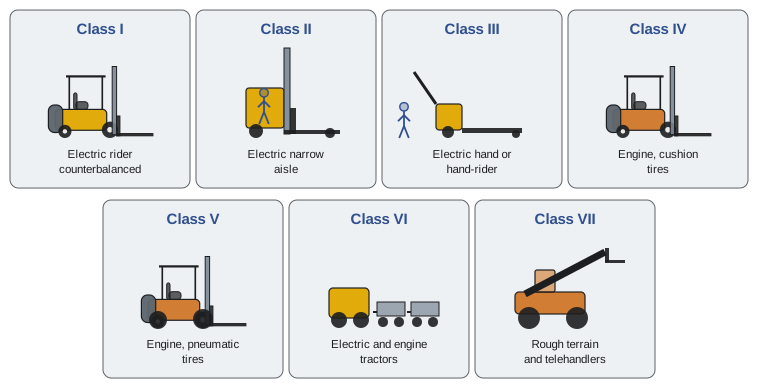
Manufacturers and trainers group powered industrial trucks into seven classes developed by the Industrial Truck Association, and OSHA uses the same classes in its training materials. The classes are based mainly on power source, tire type and how the operator rides. The same system is used in Canada under CSA B335, so equipment and training materials from both countries line up.
| Class | Description | Typical examples and uses |
|---|---|---|
| I | Electric motor rider trucks | Sit-down and stand-up counterbalanced trucks with cushion or pneumatic tires; general warehouse and manufacturing work indoors |
| II | Electric motor narrow aisle trucks | Reach trucks, order pickers, turret and swing-mast trucks; high-density racking |
| III | Electric motor hand or hand-rider trucks | Powered pallet jacks and stackers, walkie or rider; retail backrooms, docks, short moves |
| IV | Internal combustion engine trucks with cushion (solid) tires | Propane or gasoline counterbalanced trucks on smooth floors; docks and indoor work with adequate ventilation |
| V | Internal combustion engine trucks with pneumatic tires | Propane, gasoline or diesel trucks for yards and rougher surfaces, indoors and out |
| VI | Electric and internal combustion engine tractors | Tow tractors and tuggers pulling carts or baggage trains |
| VII | Rough terrain forklift trucks | Straight-mast rough terrain forklifts and variable-reach telehandlers on construction sites, farms and lumber yards |
Counterbalanced trucks
The counterbalanced truck, found in Classes 1, 4 and 5, is the most common design. The load rides on forks in front of the front wheels, and a heavy counterweight at the rear balances it. Sit-down models are the norm for longer travel; stand-up models, where the operator stands sideways at the rear, are common on docks where the operator gets on and off often. Three-wheel electric models turn very tightly but are less stable laterally than four-wheel models, a point Lesson 4 returns to.
Counterbalanced trucks need wide aisles because the whole truck must turn to face the rack. They carry the load ahead of the front axle, so the load moment matters greatly: the further the load sits from the front wheels, the less the truck can safely lift. They are usually fitted with an overhead guard to protect the operator from falling objects and an operator restraint such as a seatbelt.
Narrow aisle trucks
Class 2 trucks are built to work in narrow aisles and high racking. The main types are:
- Reach trucks, where the mast or forks extend forward on a pantograph or moving mast to pick a pallet, then retract so the load sits within the wheelbase during travel. Outrigger legs at the front carry the load. The operator usually stands sideways and drives with a tiller or joystick.
- Order pickers, where the operator rides up with the forks on a platform to pick individual items from high shelves. The operator must wear a fall protection harness attached to the designated anchor, because the platform may rise far above the floor.
- Turret and swing-mast trucks, which rotate the forks to pick from either side of a very narrow aisle without turning the truck. They are often guided by rails or wires in the floor.
Narrow aisle trucks bring their own hazards: the operator can be crushed between the truck and racking, falls from order picker platforms, loads falling from height, and pedestrians trapped in an aisle with nowhere to step aside. Many sites ban pedestrians from narrow aisles while a truck is working and use aisle-entry sensors to warn of conflicts.
Hand and hand-rider trucks
Class 3 trucks are the powered pallet trucks and stackers found in grocery stores, retail backrooms and on docks. Walkie models are controlled by an operator walking beside or behind the tiller; rider models have a small platform. They look simple, which leads employers to skip training, but they cause many foot injuries, crush injuries against walls and docks, and falls from dock edges. A walkie truck pulling an operator backward into a wall or rack is a common pattern, which is why the tiller handle has a belly button or reversing switch that stops or reverses the truck if it presses against the operator.
Powered pallet jacks are powered industrial trucks under 1910.178, and an employee who uses one needs training and evaluation on that type of truck just as a counterbalanced operator does. Manual pallet jacks are not powered industrial trucks, but they still cause strains and crush injuries and belong in the site's material handling procedures, with a pointer to the manual handling principles in HSE-107.
Internal combustion trucks
Class 4 trucks use internal combustion engines on cushion tires, which are solid rubber bands pressed onto the wheel. They suit smooth, dry floors such as docks and warehouses. Class 5 trucks use pneumatic or solid pneumatic tires and handle rougher surfaces, gravel yards and outdoor work. Engines run on propane (LPG), gasoline, diesel or compressed natural gas. Propane is common indoors because it burns relatively cleanly and cylinders are easy to change, but every engine produces carbon monoxide. Lesson 8 covers fuels and exhaust.
Tractors and tuggers
Class 6 tow tractors pull trains of carts or trailers. They are common in manufacturing plants that deliver parts to assembly lines and at airports. Their hazards are different from those of a forklift: a long train swings wide on corners and can cut across a pedestrian path, carts can derail or uncouple, and coupling and uncoupling carts puts workers between moving units. Lesson 10 covers tuggers in more detail.
Rough terrain trucks and telehandlers
Class 7 covers rough terrain trucks built for unpaved sites. Straight-mast rough terrain forklifts look like large counterbalanced trucks with big pneumatic tires. Variable-reach rough terrain trucks, usually called telehandlers, carry the forks on a telescoping boom. Telehandlers can place loads on upper floors or far from the machine, but their capacity changes dramatically with boom angle and extension, so the operator must use the load chart for every lift. Some can be fitted with work platforms, buckets or winches, each of which changes the rating. Lesson 10 covers telehandler load charts.
Worked problem
Matching the truck to the task
A distribution center has 33 ft high selective racking with 9 ft aisles, a dock with 12 doors and an outdoor yard with gravel areas where steel is stored. Suggest the class of truck for each area.
Show solution
- Racking: a 9 ft aisle is too narrow for most counterbalanced trucks, which typically need 11 to 12 ft or more. A Class II reach truck fits, and its mast can reach 33 ft.
- Dock: frequent short trips in and out of trailers suit a Class I stand-up electric counterbalanced truck or Class III powered pallet jacks for loading floor-stacked pallets.
- Yard: gravel needs pneumatic tires, so a Class V engine truck or, for long steel, a Class VII rough terrain truck with long forks or a spreader attachment.
- Each class needs its own training and evaluation, so the site needs a training plan that matches its fleet.
Answer: Reach trucks (Class II) in the racking, stand-up electrics (Class I) or pallet jacks (Class III) at the dock, and pneumatic-tire engine or rough terrain trucks (Class V or VII) in the yard.
Power sources compared
| Power source | Advantages | Main hazards |
|---|---|---|
| Lead-acid battery | No exhaust, quiet, low running cost | Hydrogen during charging, sulfuric acid electrolyte, heavy battery handling, watering |
| Lithium-ion battery | Fast and opportunity charging, no watering, no gassing in normal use | Thermal runaway and fire if damaged or poorly managed, high-energy electrical system |
| Hydrogen fuel cell | Quick refueling, no tailpipe exhaust except water | Flammable hydrogen gas under high pressure; leak detection needed |
| Propane (LPG) | Easy cylinder exchange, indoor and outdoor use | Carbon monoxide, fire, cold burns from liquid, cylinder handling injuries |
| Gasoline | Widely available | Carbon monoxide, flammable liquid; rarely suitable indoors |
| Diesel | High torque for heavy outdoor work | Diesel exhaust particulate and carbon monoxide; unsuitable in enclosed areas |
Electric trucks have taken a growing share of new forklift sales in North America. Lithium-ion batteries in particular change maintenance and charging practices; Lesson 8 compares them and points to HSE-322 for battery room hazards.
Hazardous locations
Paragraphs (b) to (f) of 1910.178 set out designations for trucks approved for hazardous locations, such as D, DS, DY, E, ES, EE, EX, G, GS, LP and LPS, and tables that match designations to the class and division of each location under the National Electrical Code. A truck with no designation must not enter a classified area. Never take an ordinary truck into a spray booth, a solvent store, a grain elevator gallery or another classified area without confirming the truck's designation matches the location.
| Question | Why it matters |
|---|---|
| Is the area classified for flammable gases, vapors or combustible dust? | An unrated truck is an ignition source |
| What designation or rating does the truck carry? | The rating must match the hazard and the zone or division |
| Has the truck been modified or repaired with non-approved parts? | Modifications can void the rating |
| Are battery changing and fueling kept out of the classified area? | These activities can release vapors or create sparks |
Attachments
Attachments let a truck handle loads that forks cannot: side shifters, fork positioners, clamps for cartons, paper rolls or bales, rotators, push-pulls for slip sheets, booms, carpet poles and drum handlers. Every attachment adds weight and usually moves the load center forward, which reduces the truck's capacity. The truck must carry a capacity plate that reflects the attachment, and the operator must be trained on it. Some attachments, such as clamps, also add a hazard of crushing or dropping the load if hydraulic pressure is lost.
Worked problem
Reading a fleet list for training needs
A site's fleet list shows: four Class I sit-down electric trucks, two Class II order pickers, six Class III walkie pallet jacks, one Class V propane truck with a carton clamp and one Class VII telehandler. How many distinct training and evaluation programs does the site need?
Show solution
- Sit-down counterbalanced electric: one program.
- Order pickers: one program, including fall protection.
- Walkie pallet trucks: one program.
- Propane counterbalanced with clamp: the counterbalanced principles overlap with the electric program, but propane handling and the clamp attachment need additional modules and a separate evaluation.
- Telehandler: one program with load charts and boom operation.
Answer: At least five evaluated programs, plus add-on modules for propane and the clamp. Operators are authorized only for the trucks and attachments they have been evaluated on.
Common mistakes
MistakeTreating powered pallet trucks as too simple to need training.
InsteadPowered pallet trucks are lift trucks; train and evaluate their operators.
MistakeAssuming a counterbalanced evaluation covers reach trucks and order pickers.
InsteadEach type has different controls, stability and hazards and needs its own evaluation.
MistakeUsing a propane or diesel truck in a poorly ventilated room.
InsteadChoose electric trucks indoors or provide ventilation and carbon monoxide monitoring.
MistakeTaking an ordinary truck into a classified hazardous location.
InsteadUse only trucks rated for the hazard and the area.
MistakeFitting an attachment and keeping the original capacity plate.
InsteadGet a revised capacity rating that accounts for the attachment.
Summary and key terms
- Lift trucks fall into seven classes based on power source, tire type and operator position.
- Counterbalanced trucks carry the load ahead of the front wheels; narrow aisle trucks carry it within the wheelbase or lift the operator.
- Powered pallet trucks, tow tractors and telehandlers are all covered by lift truck training rules.
- Each power source has characteristic hazards: hydrogen and acid, thermal runaway, carbon monoxide, diesel exhaust or flammable gas.
- Trucks in hazardous locations must carry a rating that matches the hazard.
- Attachments add weight, move the load center and require a revised capacity rating and training.
- Reach truck
- A narrow aisle truck whose forks extend to pick a load and retract so it rides within the wheelbase.
- Order picker
- A truck on which the operator rides up with the forks to pick items from shelving.
- Cushion tire
- A solid rubber tire pressed onto the wheel, used on smooth floors.
- Pneumatic tire
- An air-filled or solid pneumatic tire for rough surfaces.
- Telehandler
- A variable-reach rough terrain truck with forks on a telescoping boom.
- Tow tractor
- A Class 6 vehicle that pulls carts or trailers.
- Attachment
- A device fitted to the carriage, such as a clamp or side shifter, that changes how the truck handles loads.
- Hazardous location
- An area where flammable gases, vapors, dusts or fibers may be present in ignitable amounts.
Practice problems
Work each problem on paper first, then reveal the answer to check.
Which class covers reach trucks and order pickers?
Show answer
Class II, electric motor narrow aisle trucks.
What is the difference between Classes 4 and 5?
Show answer
Both are internal combustion trucks; Class 4 has cushion tires for smooth floors and Class 5 has pneumatic tires for rough surfaces.
Why must order picker operators wear fall protection?
Show answer
They ride up on the platform and could fall from height.
What is the belly button switch on a walkie pallet truck for?
Show answer
It stops or reverses the truck if the tiller presses against the operator, preventing them being pinned.
Name two hazards of tow tractors pulling carts.
Show answer
Wide swing of the train on corners and crush hazards when coupling or uncoupling carts.
Why does a telehandler need a load chart?
Show answer
Its capacity changes with boom angle and extension.
What is the main hazard of propane trucks indoors?
Show answer
Carbon monoxide from the exhaust.
What must be checked before a truck enters a hazardous location?
Show answer
That the truck is rated for the specific hazard and area.
How do attachments affect capacity?
Show answer
They add weight and usually move the load center forward, reducing capacity.
Why does a fleet list matter for training?
Show answer
Each truck type and attachment needs its own training and evaluation.
Lesson quiz · 5 questions
Score 60% or more to complete this lesson.
Create a free account to save your progress, take quizzes and earn a certificate.